8th Grade Decimals Worksheets
All worksheets are created by the team of experienced teachers at Cazoom Math.
Why Do 8th Graders Need Practice With Decimals and Measurement Conversions?
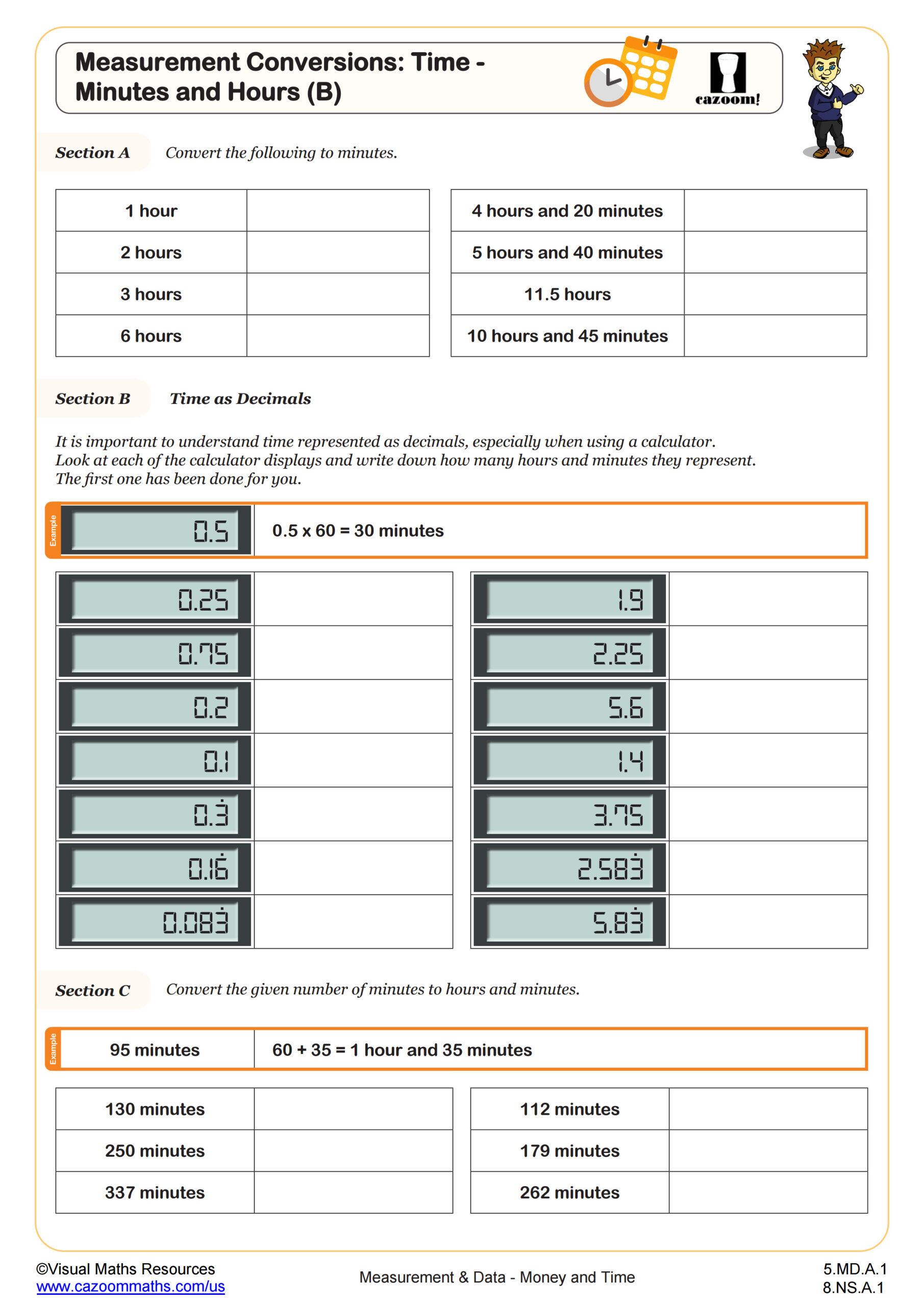
By 8th grade, students are expected to fluently apply decimal operations within real-world contexts, and measurement conversions provide an ideal application. Converting between minutes and hours requires students to divide or multiply by 60, which produces decimals that must be interpreted correctly. This skill directly supports work in science labs, where timing experiments often requires converting between units, and prepares students for high school algebra where unit conversions appear regularly in word problems and formula applications.
A common error teachers notice is when students correctly calculate 90 minutes ÷ 60 = 1.5 hours but then mistakenly interpret 1.5 as 1 hour 50 minutes instead of 1 hour 30 minutes. This confusion stems from misunderstanding that the decimal portion represents a fraction of an hour, not leftover minutes. Addressing this misconception early prevents similar errors with other measurement conversions and helps students develop stronger proportional reasoning skills needed throughout high school mathematics.
What Should 8th Grade Students Already Know About Decimals?
Students entering 8th grade should confidently perform all four operations with decimals, understand place value through thousandths, and compare decimal values. They should recognize that decimals represent fractions with denominators of 10, 100, 1,000, and so on, and be comfortable moving between decimal and fraction representations. According to Common Core State Standards, 8th graders extend their decimal work by applying these operations to increasingly complex problems, including multi-step conversions and scientific contexts where precision matters.
This measurement conversion work builds directly on 7th grade proportional relationships and prepares students for high school algebra and geometry, where unit conversions appear in distance-rate-time problems, scale factors, and trigonometry applications. Students who master decimal conversions in 8th grade find physics and chemistry calculations significantly more manageable, as they've already developed the foundational skills for dimensional analysis. The time spent solidifying these skills pays dividends across STEM coursework throughout high school.
How Do You Convert Minutes to Hours Using Decimals?
Converting minutes to hours requires dividing the number of minutes by 60, since there are 60 minutes in one hour. For example, 45 minutes becomes 45 ÷ 60 = 0.75 hours. Converting hours to minutes requires multiplying by 60, so 2.25 hours equals 2.25 × 60 = 135 minutes. Students need to recognize that the decimal answer represents a portion of the whole unit—0.75 hours means three-quarters of an hour, or 45 minutes. Understanding this relationship helps students verify whether their answers make sense, a critical skill for state assessments where answer reasonableness is often tested.
These conversions appear constantly in real-world applications, from calculating wages when employees track time in decimal hours (2.5 hours) to interpreting GPS travel times (1.75 hours to destination) to analyzing athletic performance where race times combine minutes and decimal fractions. In STEM fields, scientists record experimental durations in decimal hours for easier statistical analysis, and engineers use decimal time notation when programming automated systems. Students who recognize these practical applications develop stronger number sense and appreciate why precision with decimals matters beyond the classroom.
How Can Teachers Use These Decimal Worksheets Most Effectively?
These worksheets provide targeted practice with measurement conversions that reinforce decimal operations while building practical numeracy skills. The structured format allows students to develop fluency through repetition while the answer keys enable immediate feedback, which research shows significantly improves learning outcomes. Teachers can use the worked examples to model the conversion process, emphasizing how to set up division or multiplication correctly and how to interpret decimal results as fractional parts of the larger unit. This scaffolded approach helps students build confidence before attempting problems independently.
Many teachers assign these worksheets as warm-up activities to maintain decimal fluency throughout the year, even after the main decimals unit concludes. They work well for differentiated instruction, allowing students who need extra practice to work through problems at their own pace while others move to extension activities. The worksheets are equally effective for homework assignments, intervention sessions for students preparing for state assessments, or partner work where students can discuss their problem-solving strategies. Having answer keys available lets students self-check during independent work, promoting mathematical autonomy and helping them identify specific areas where they need additional support.