8th Grade Describe and Compare Shapes Worksheets
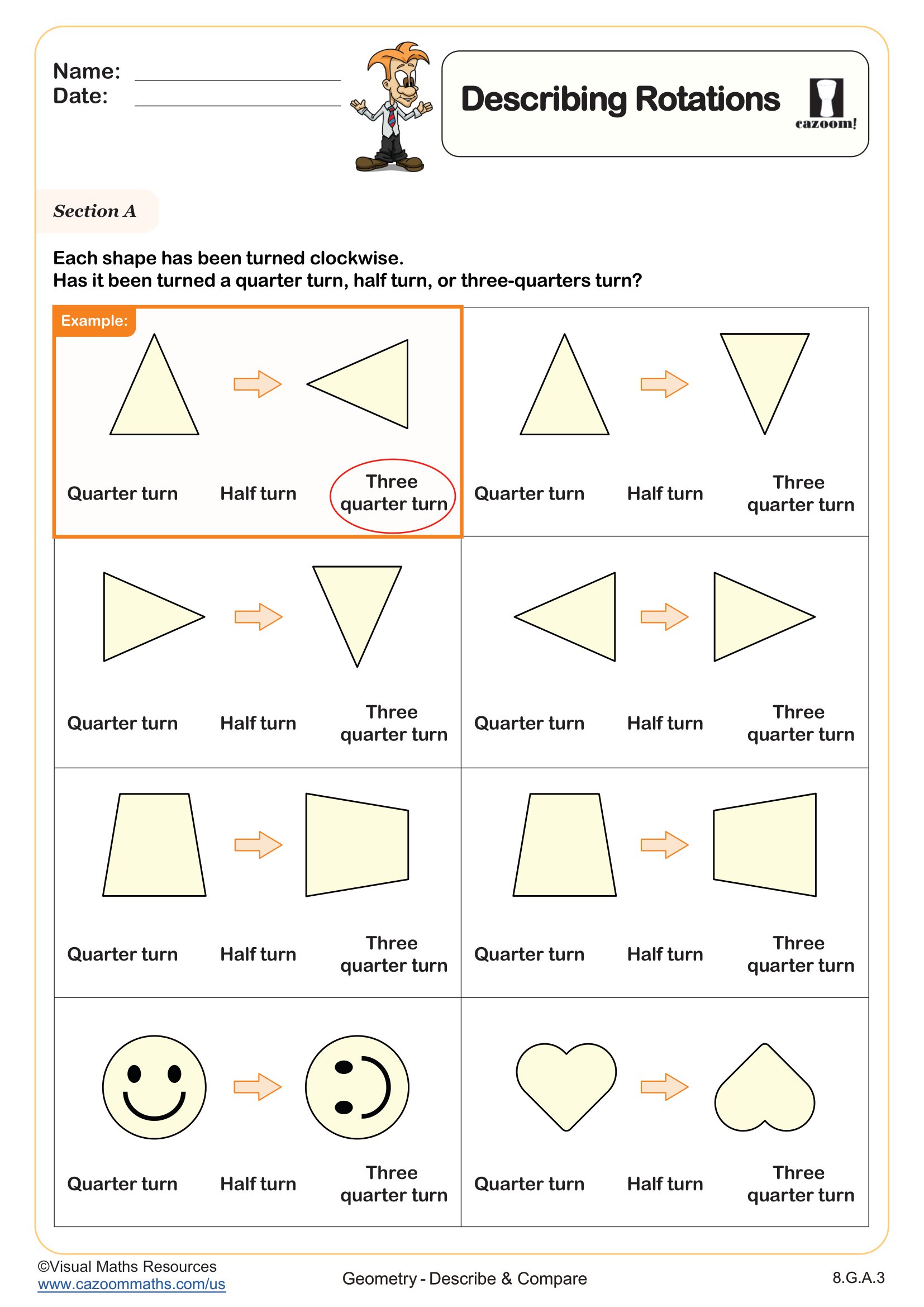
All worksheets are created by the team of experienced teachers at Cazoom Math.
What Skills Do Students Practice When Describing Rotations?
Students learn to identify and describe the three components of any rotation: the center of rotation (the fixed point around which the figure turns), the angle of rotation (measured in degrees), and the direction (clockwise or counterclockwise). They compare pre-image and image positions to determine these characteristics and verify whether two figures are related by rotation. The worksheets strengthen understanding of how coordinates change during rotations and help students recognize rotation as a rigid transformation that preserves size and shape.
A common error occurs when students confuse the angle of rotation with the position of the rotated figure. Many students initially believe a shape rotated 90 degrees will always end up in a specific quadrant, not recognizing that the center of rotation determines final placement. Teachers find that having students physically rotate graph paper or tracing paper around a marked center point helps them visualize why the same rotation angle can produce different results depending on where the center is located.
What Should 8th Graders Know About Describing Geometric Transformations?
By 8th grade, students should confidently describe transformations using precise mathematical language and notation. This includes stating rotation angles, identifying centers of rotation, and explaining how to verify that a rotation occurred rather than a different transformation like reflection or translation. According to Common Core Standard 8.G.A.1, students must describe the effect of transformations and understand that rotations preserve congruence, meaning the original and rotated figures remain identical in size and shape.
This work builds directly on 7th grade understanding of angle relationships and extends into high school geometry, where students prove congruence using sequences of transformations. Students who master describing rotations in 8th grade find it significantly easier to work with composition of transformations and geometric proofs in Geometry class. The vocabulary and notation established now become the foundation for more abstract work with transformation rules and algebraic representations in later grades.
How Do Students Identify Centers of Rotation on the Coordinate Plane?
Finding the center of rotation requires students to recognize that this point remains fixed while all other points rotate around it at the same angle. On coordinate grids, students can connect corresponding points from the pre-image and image, then construct perpendicular bisectors of these segments. The intersection of these perpendicular bisectors reveals the center of rotation. Alternatively, students can measure equal distances from a suspected center point to corresponding vertices, verifying that all points rotated through the same angle from that center.
This skill connects directly to robotics and computer graphics, where programmers must specify exact rotation parameters to animate objects or control robotic arms. Video game developers use rotation centers and angles to create smooth character movements and camera rotations. Engineering applications include designing rotating machinery, where understanding the center of rotation helps predict stress points and motion paths. Students often engage more deeply with rotation concepts when they see how game designers and engineers use these exact mathematical descriptions in professional software.
How Can Teachers Use These Worksheets to Build Transformation Skills?
These worksheets provide structured practice moving from identifying basic rotation characteristics to comparing multiple transformations and explaining reasoning. The problems progress from straightforward rotations around the origin to more complex scenarios involving rotation centers at other coordinate points. Answer keys allow students to self-check their descriptions and verify their understanding of transformation vocabulary, while teachers can quickly identify students who need reteaching on specific aspects like determining rotation direction or measuring angles accurately.
Many teachers use these worksheets during small group instruction to target students who struggle with spatial visualization, pairing stronger students with those who need support to discuss their reasoning aloud. The worksheets work well as warm-up activities before lessons on composition of transformations or as review before unit assessments on geometric transformations. Some teachers assign specific problems as homework after introducing rotation concepts, then use student work to guide the next day's discussion about common misconceptions and effective strategies for describing transformations precisely.