8th Grade Factors and Multiples Worksheets
All worksheets are created by the team of experienced teachers at Cazoom Math.
What Are Factors and Multiples in 8th Grade Math?
In 8th grade, factors and multiples extend beyond basic divisibility to include prime factorization analysis and its applications to perfect powers. Students use prime factor decomposition to identify perfect squares (where all prime factors appear an even number of times) and perfect cubes (where all factors appear in multiples of three). This builds directly on the Number System domain in Common Core State Standards, particularly standard 8.NS.A.2, which requires understanding rational and irrational numbers.
A common misconception occurs when students assume that a number with many factors must be a perfect square. For example, 72 has twelve factors but isn't a perfect square because its prime factorization (2³ × 3²) includes an odd exponent. Teachers frequently address this by having students write out prime factorizations systematically and examine exponent patterns before drawing conclusions about perfect powers.
What Should 8th Graders Know About Factors and Multiples?
By 8th grade, students should confidently find prime factorizations of numbers up to several hundred and apply this skill to determine if a number is a perfect square or perfect cube. They should recognize that square roots of non-perfect squares are irrational and understand why this matters when working with radicals. State assessments often include questions where students must simplify radicals by identifying perfect square factors, which requires strong prime factorization skills.
This work builds directly on 6th and 7th grade factor work (greatest common factor and least common multiple) but shifts toward algebraic reasoning. The connection between prime factorization and perfect squares becomes foundational for simplifying radicals in Algebra 1 and understanding quadratic functions in high school. Students who master these patterns find rational exponent notation (a^(1/2) = √a) much more intuitive in later courses.
How Do You Use Prime Factors to Identify Square and Cube Roots?
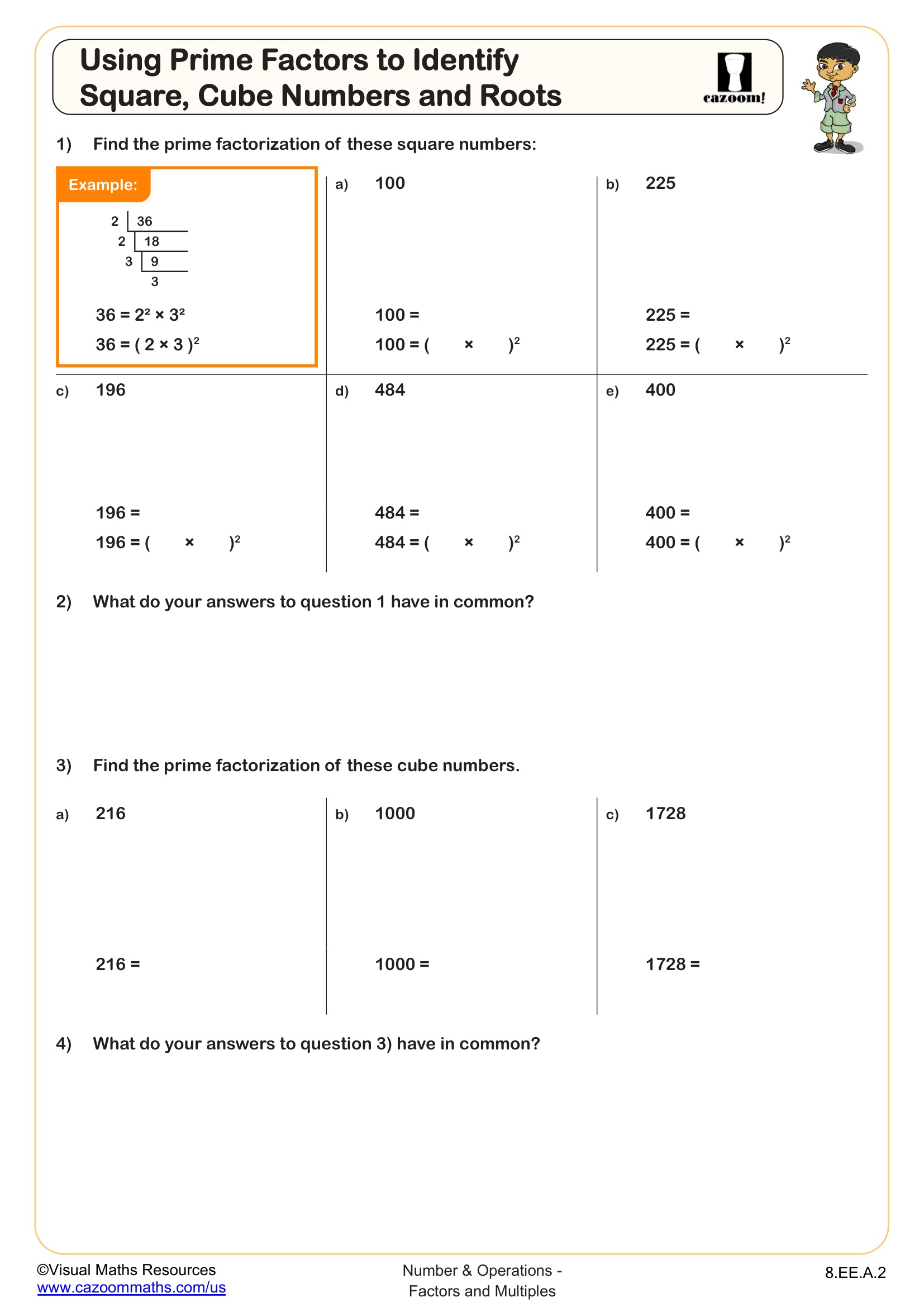
To identify if a number is a perfect square using prime factors, students write the complete prime factorization and check whether all exponents are even. For example, 144 = 2⁴ × 3² has all even exponents, confirming it's a perfect square with √144 = 2² × 3 = 12. For perfect cubes, all exponents must be divisible by 3. Students lose points on assessments when they forget to fully reduce prime factorizations or miscalculate exponents when extracting roots.
This skill connects directly to cryptography and computer science, where prime factorization forms the basis of encryption algorithms like RSA. Engineers and programmers regularly work with perfect squares when calculating areas, volumes, and optimizing data structures. Understanding how prime factors determine root values helps students grasp why factoring large numbers is computationally difficult, which protects digital security systems used in online banking and secure communications.
How Can Teachers Use These Factors and Multiples Worksheets?
These worksheets provide structured practice moving from prime factorization to identifying perfect powers, helping students recognize patterns in exponents that signal perfect squares or cubes. The answer keys allow students to self-check their prime factorizations before proceeding to root calculations, which builds independence and helps identify where errors occur. Teachers find that students benefit most when they verbalize the exponent patterns they're looking for rather than just computing answers.
These worksheets work well as warm-up activities before introducing radical simplification or as targeted intervention for students who struggle with irrational number concepts. Many teachers use them during test review since standardized assessments frequently include perfect square recognition problems. They're also effective for paired work, where one student finds the prime factorization while their partner checks exponent patterns and calculates roots, encouraging mathematical discourse about why certain numbers are or aren't perfect powers.