Algebra I Proportion Worksheets
All worksheets are created by the team of experienced teachers at Cazoom Math.
What Do Students Learn in Algebra I Proportions Worksheets?
Algebra I proportion worksheets focus on solving equations where two ratios are set equal to each other, typically written as a/b = c/d. Students learn to apply cross-multiplication (ad = bc) and then use inverse operations to isolate the variable. This topic reinforces foundational skills with fractions, variables, and equation solving while introducing students to the structure of rational equations they'll encounter later in the course.
A common error occurs when students cross-multiply correctly but then lose track of which operation to perform next, especially when the variable appears in a denominator or is multiplied by a coefficient. Teachers often address this by having students explicitly write out the cross-multiplication step before solving, rather than trying to do multiple steps mentally. This deliberate approach reduces careless mistakes and helps students recognize the logical sequence of algebraic steps.
How Are Proportions Tested on the SAT and ACT?
Standardized tests like the SAT and ACT frequently embed proportion problems within word problems involving rates, scale drawings, unit conversions, and mixture scenarios. Students must first recognize that a proportion applies to the situation, set up the equation correctly with corresponding values aligned, and then solve algebraically. The SAT calculator section often includes multi-step problems where proportion solving is combined with other algebraic skills or data interpretation.
Students lose points when they set up proportions incorrectly by mismatching units or placing values in the wrong positions within the ratios. For example, when converting miles to kilometers using a given rate, students might write the proportion with miles in both numerators instead of maintaining consistent unit alignment. Teachers notice that students who label their ratios with units before cross-multiplying catch these setup errors more consistently during test situations.
What Is Cross-Multiplication and Why Does It Work?
Cross-multiplication is the technique where students multiply the numerator of each fraction by the denominator of the other fraction to create an equivalent equation without fractions. If a/b = c/d, then ad = bc. This method works because multiplying both sides of an equation by the same non-zero value (in this case, bd) maintains equality while eliminating the denominators. Students confidently tackle more complex rational equations once they recognize that cross-multiplication is simply an application of the multiplication property of equality.
This skill appears throughout STEM fields, particularly in chemistry when working with molarity calculations, physics when analyzing gear ratios or lever systems, and engineering when scaling blueprints or models. Nurses use proportions to calculate medication dosages based on patient weight, and architects rely on proportional reasoning when creating scale drawings. Understanding why cross-multiplication works algebraically, rather than memorizing it as a trick, helps college-bound students grasp more advanced rational equation techniques in Algebra II and Precalculus.
How Can Teachers Use These Proportion Worksheets in Algebra I Classes?
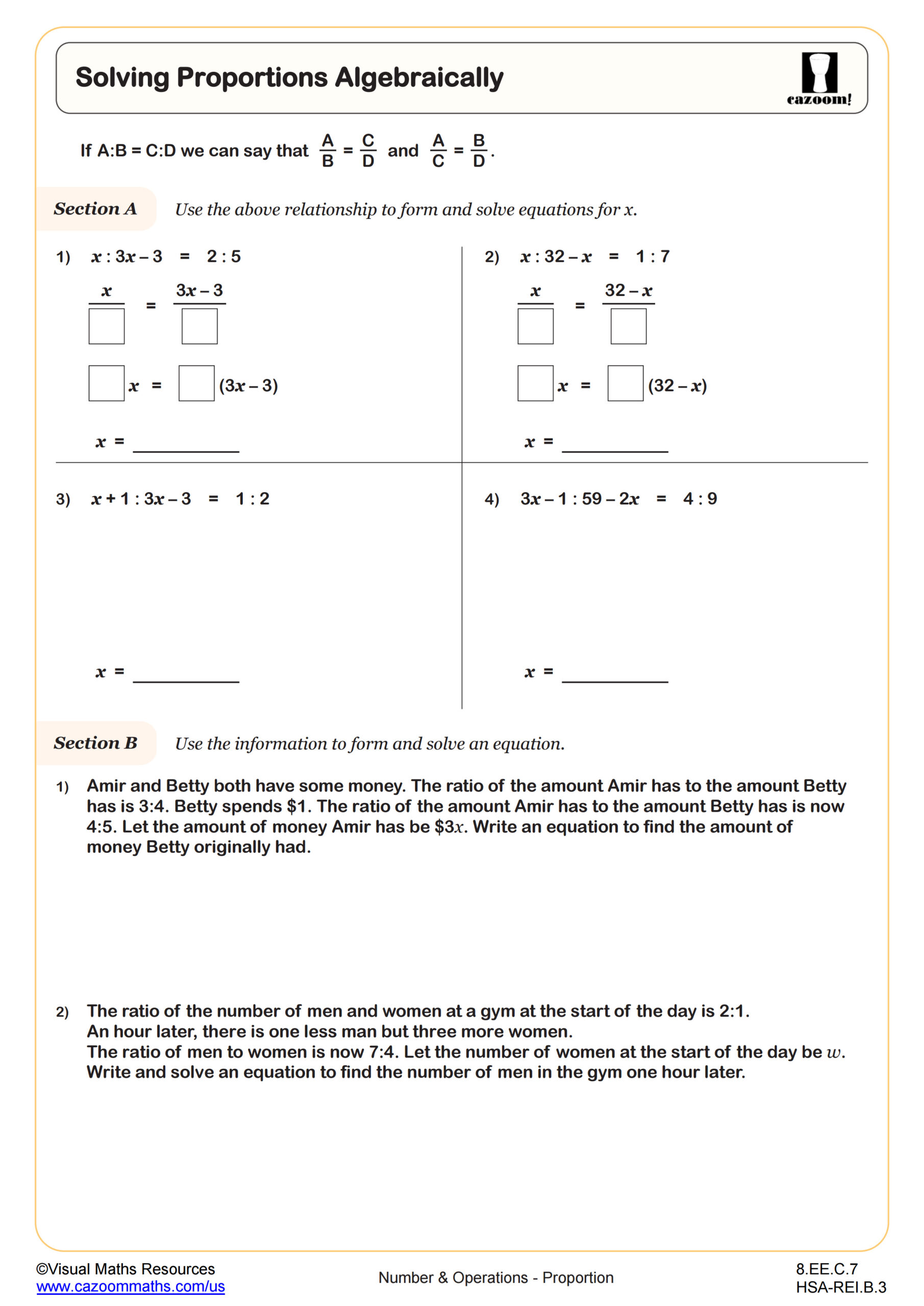
The worksheet provides structured practice with solving proportions algebraically, allowing students to build procedural fluency through repeated application of cross-multiplication and equation-solving steps. The answer key enables students to check their work independently, making these materials effective for differentiated instruction where some students need additional practice while others move ahead. Teachers can use the worksheet to identify which students still need support with fraction operations or isolating variables before introducing more complex rational expressions.
Many teachers find these worksheets valuable for warm-up activities when reviewing before assessments, targeted intervention for students who struggled with proportion word problems, or homework assignments that reinforce classroom instruction. The materials work well in paired activities where students solve problems independently and then compare their cross-multiplication steps with a partner to catch errors. Because proportions connect to so many other Algebra I topics, including percent problems, direct variation, and similar figures in the geometry unit, this practice sheet serves as a foundation-building tool throughout the course.