Algebra I Ratio Worksheets
All worksheets are created by the team of experienced teachers at Cazoom Math.
What ratio concepts do Algebra I students need to master?
Algebra I students work with ratios as equations rather than just numerical comparisons. This includes forming equations from ratio statements like "the ratio of x to y is 3:5," solving proportion problems algebraically, and applying ratio reasoning to real-world scenarios involving rates, mixtures, and proportional relationships. Students learn to translate ratio language into algebraic expressions and equations they can solve systematically.
A common error occurs when students see "the ratio of boys to girls is 2:3" and incorrectly assume there are exactly 2 boys and 3 girls, rather than recognizing that 2x and 3x represent the quantities. Teachers find that using a multiplier variable consistently helps students grasp that ratios describe relationships, not absolute values. This understanding becomes critical when ratios appear in more complex contexts like similar figures in geometry or concentration problems in chemistry.
How do standardized tests assess ratio skills?
The SAT and ACT include ratio problems in both multiple-choice and grid-in formats, often embedded within word problems about recipes, maps, model scales, or data analysis. State assessments aligned with Common Core State Standards expect students to work fluently with ratios and proportional relationships, recognizing equivalent ratios and solving multi-step problems. Tests frequently present scenarios where students must first translate verbal descriptions into mathematical relationships before solving.
Students lose points when they set up proportions incorrectly by mixing units or mismatching corresponding quantities. For example, given "5 workers complete 3 jobs in 2 hours," students sometimes create proportions that compare workers to hours rather than maintaining consistent relationships. Another testing pitfall appears when students solve for an intermediate variable but forget to answer the actual question asked, such as finding the number of items per person when the problem requests total items.
What does it mean to form equations from ratios?
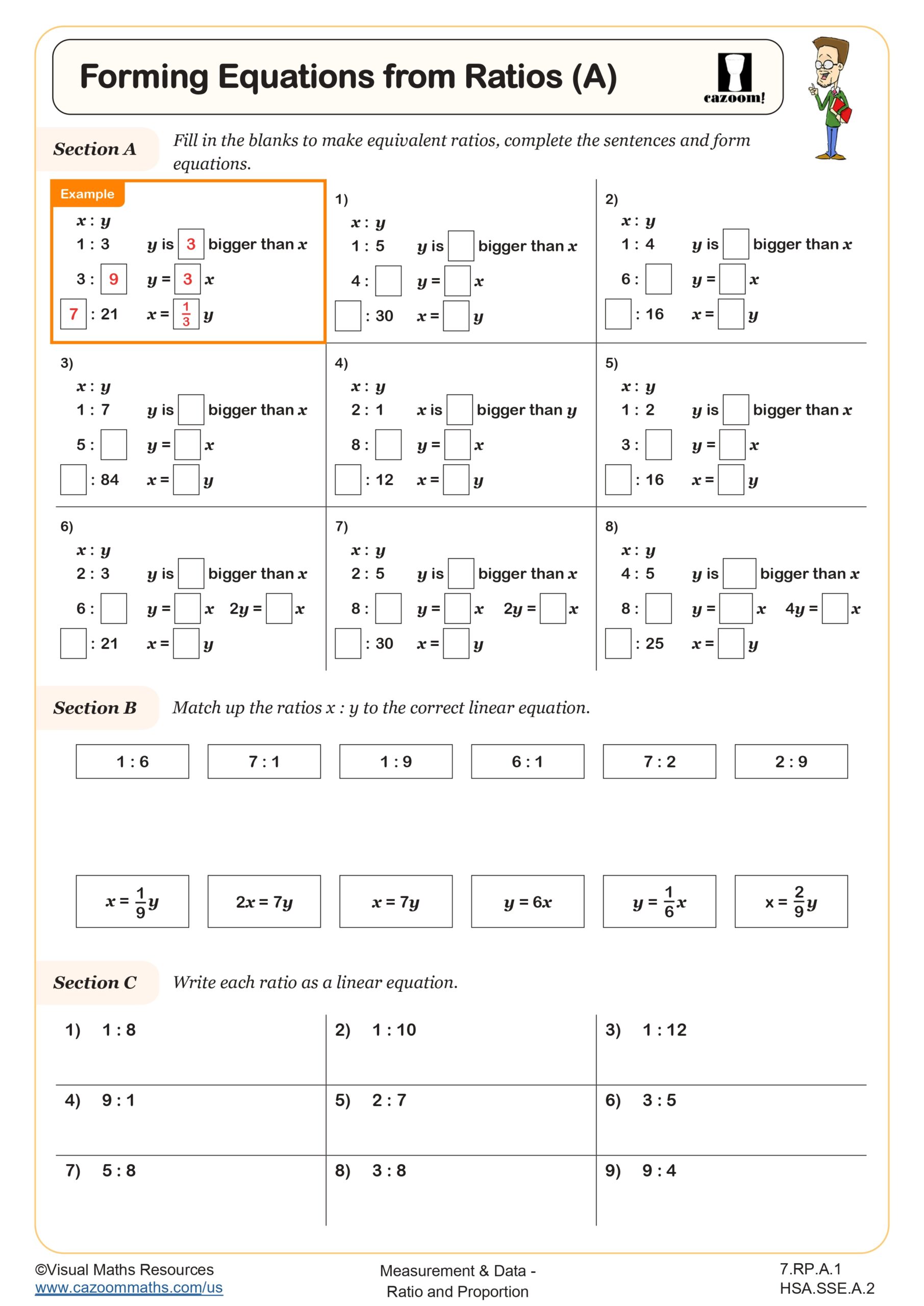
Forming equations from ratios means converting ratio statements into algebraic equations that can be solved using standard techniques. When a problem states "the ratio of length to width is 5:2," students express this as l/w = 5/2 or as l = 5x and w = 2x, then use additional information to find the multiplier. This skill requires understanding that ratios establish relationships between quantities, and those relationships become equations when combined with other constraints like perimeter, total amount, or specific values.
This skill connects directly to STEM applications in engineering and chemistry. Architects use ratio equations to maintain proportional dimensions when scaling blueprints. Chemical engineers rely on ratio equations to calculate reactant quantities needed to produce specific amounts of products while maintaining stoichiometric relationships. Students preparing for AP Chemistry or Physics encounter these same ratio-to-equation conversions when working with molar ratios, gear ratios in mechanical systems, and voltage-current relationships in circuits.
How do these worksheets support Algebra I ratio instruction?
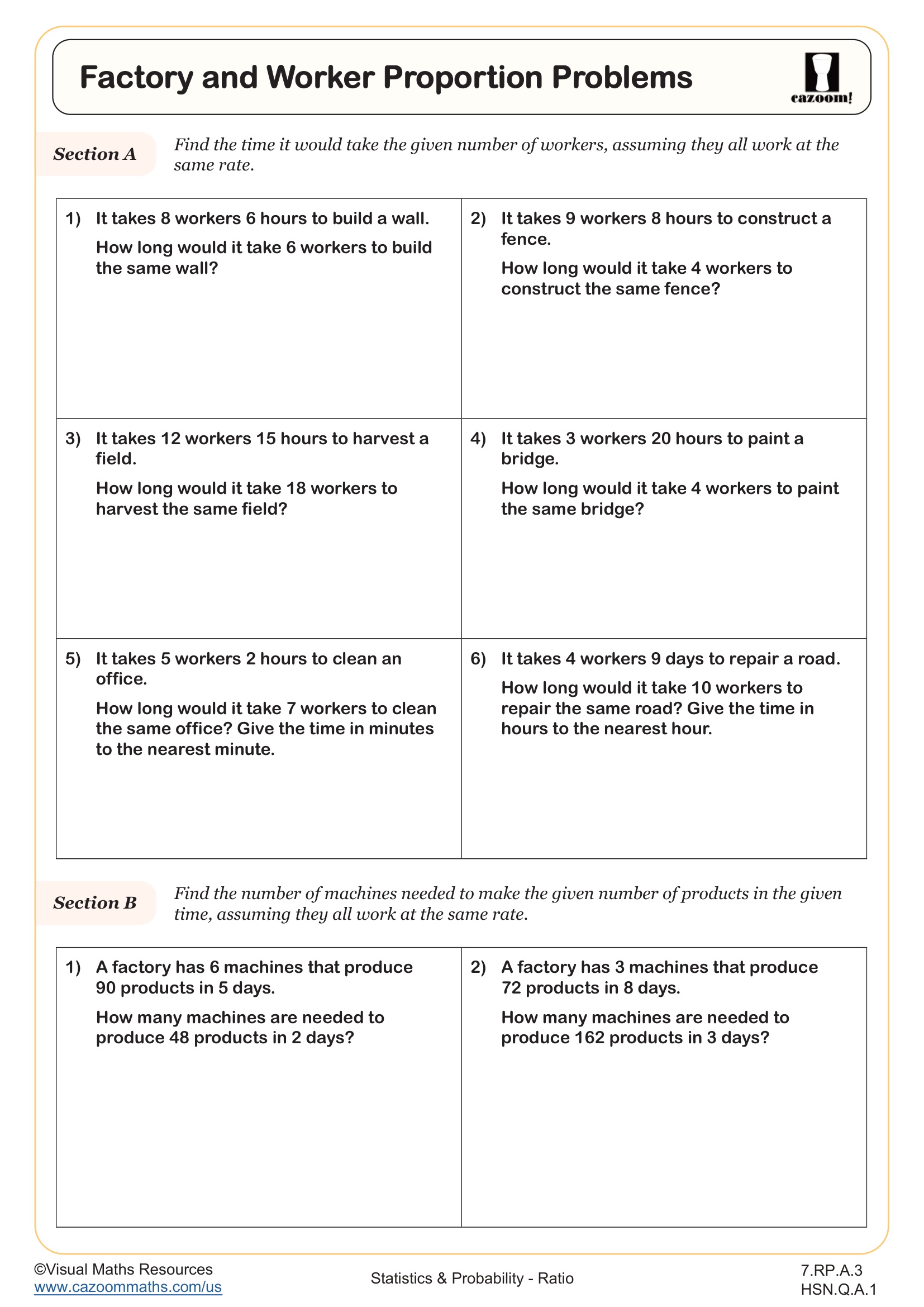
The worksheets provide structured practice in translating ratio contexts into solvable equations, with problems ranging from straightforward proportion setups to multi-step scenarios requiring equation formation. Students encounter varied contexts like worker productivity and factory output that mirror real standardized test questions while building algebraic thinking skills. The answer keys allow students to check their equation setup and solution process, helping them identify whether errors occur in translation or calculation phases.
Teachers use these worksheets for targeted intervention when students struggle with word problem translation, as warm-up practice before introducing similar figures in geometry, or as review material before unit assessments. The factory and worker contexts provide concrete scenarios that help students visualize relationships before abstracting to pure algebraic manipulation. Many teachers assign one problem set for guided practice with discussion, then use the second set for independent assessment of mastery, appreciating that both come with complete solutions for efficient grading and student self-correction.