Algebra I Rearranging Equations Worksheets
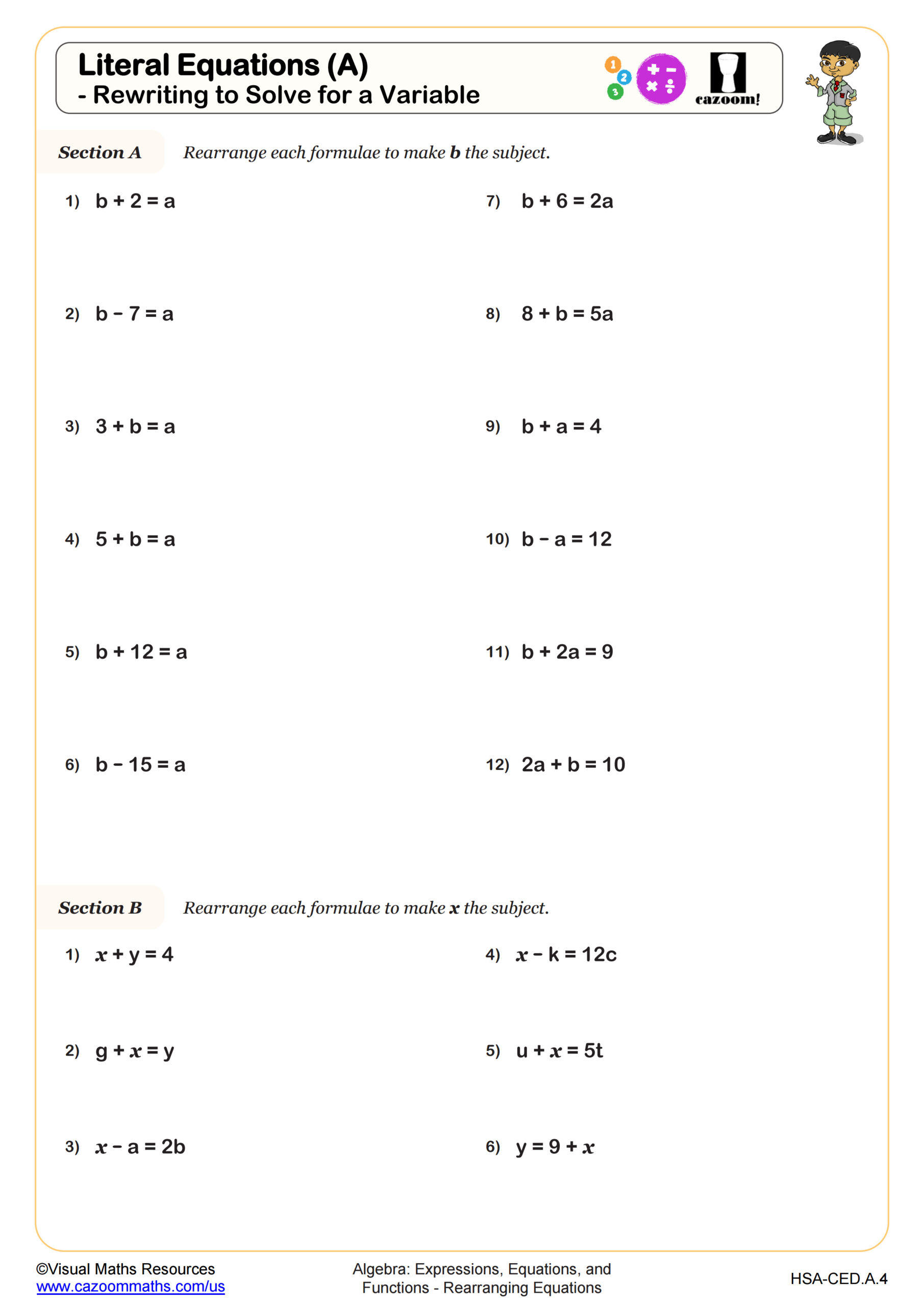
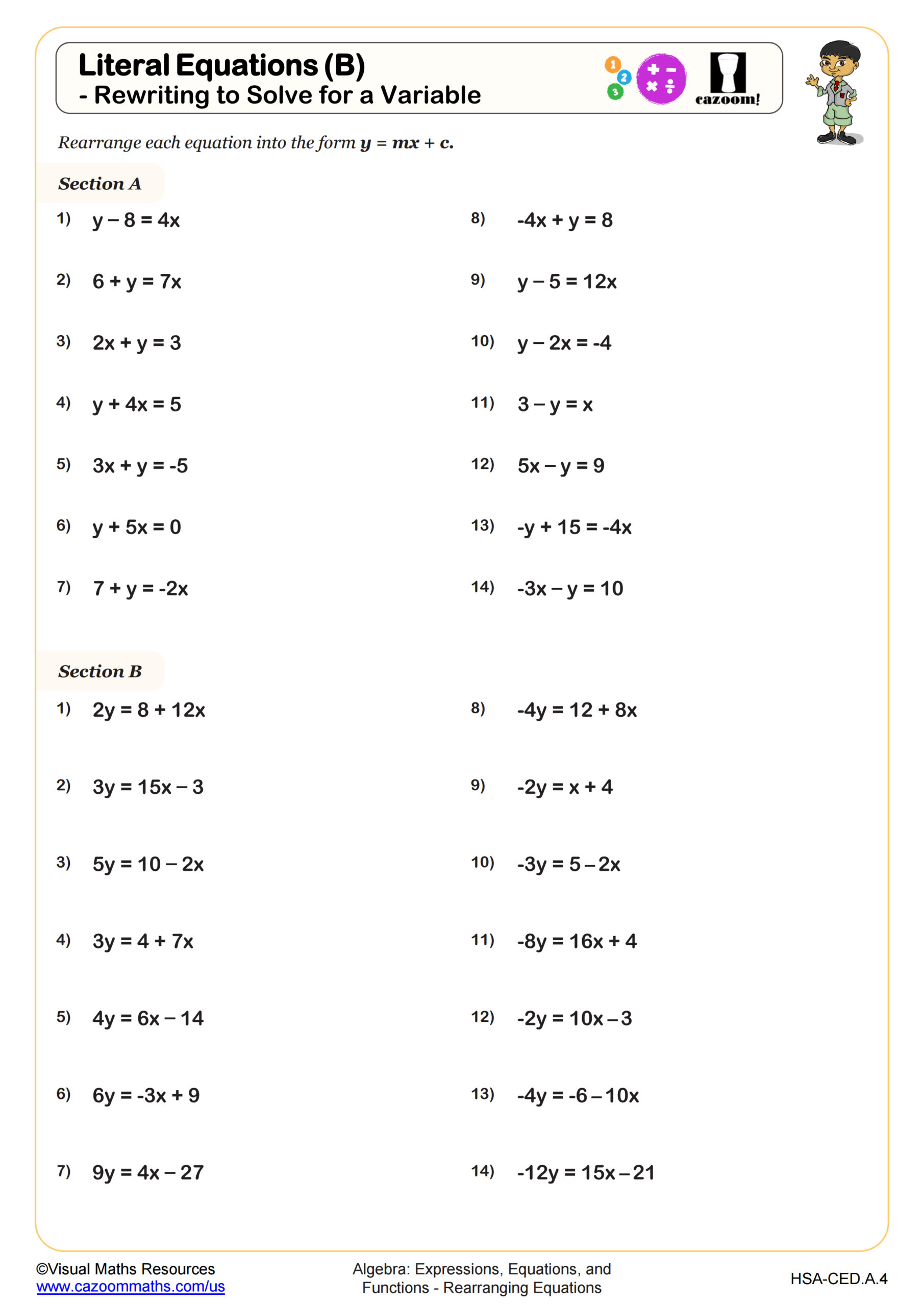
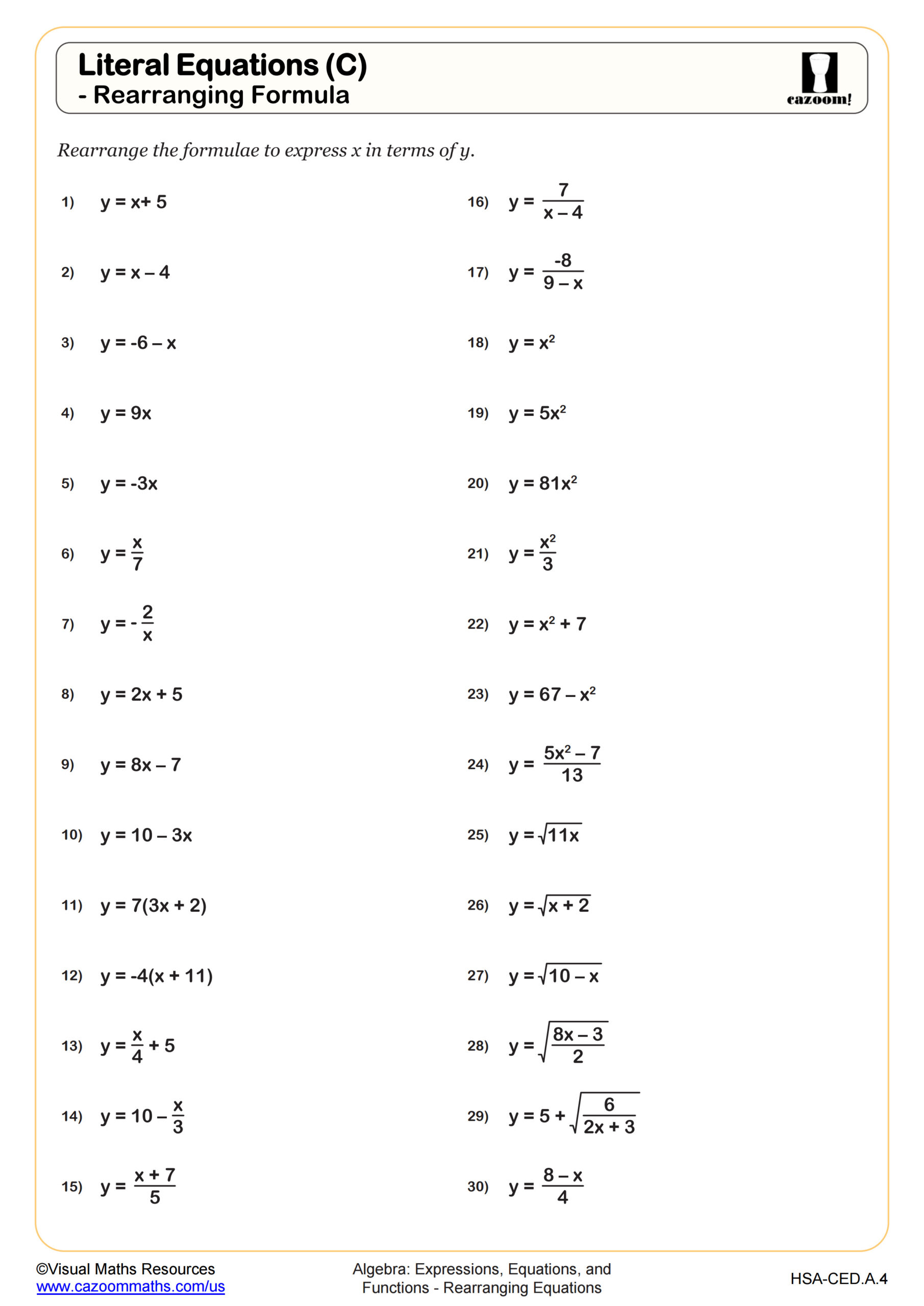
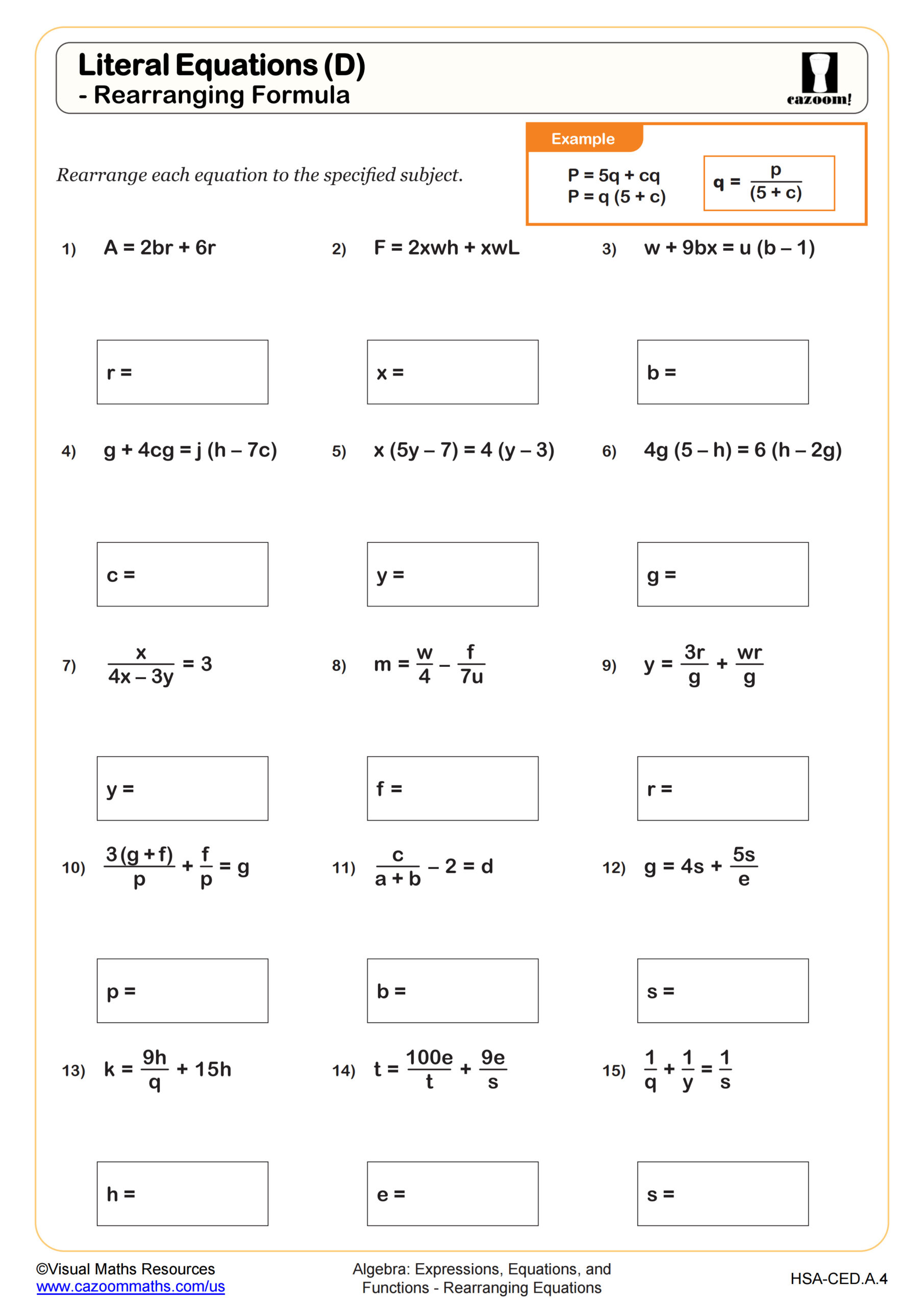
All worksheets are created by the team of experienced teachers at Cazoom Math.
What Do Students Learn When Rearranging Equations in Algebra I?
Students learn to manipulate literal equations by isolating a specified variable, applying the same inverse operations they use with numerical equations but in a more abstract context. This topic directly addresses Common Core standards for creating equations and solving formulas for a particular variable, preparing students for physics, chemistry, and advanced mathematics courses where formula manipulation is routine.
Teachers often notice that students initially treat variables on the right side of an equation differently than those on the left, forgetting that algebraic properties apply regardless of position. A breakthrough typically happens when students recognize that solving for a different variable follows the exact same process as solving for x, just with letters representing multiple quantities instead of a single unknown value.
How Are Literal Equations Tested on the SAT and ACT?
Standardized tests like the SAT and ACT frequently include questions requiring students to rearrange formulas from geometry, physics, or finance to solve for a specific variable. Students must demonstrate fluency in algebraic manipulation without numerical values to guide their thinking, often within time constraints that favor procedural confidence over trial-and-error approaches.
Students lose points when they attempt to substitute numbers prematurely or when they fail to distribute negative signs correctly during the rearrangement process. Another common error involves stopping too soon, leaving the target variable with a coefficient or inside a denominator instead of completely isolated. State assessments similarly expect students to work confidently with abstract representations, making regular practice with literal equations essential for test readiness.
Why Is Solving for Different Variables Important in STEM Fields?
The ability to rearrange equations allows students to adapt formulas to match the information they have and the quantity they need to find. Rather than memorizing dozens of variations, students learn to manipulate a single formula to serve multiple purposes, building mathematical flexibility and reducing cognitive load in problem-solving situations.
This skill appears constantly in science courses where students rearrange density formulas to find mass or volume, manipulate kinematic equations to solve for time or acceleration, and work with electrical formulas like Ohm's Law. Engineers regularly rearrange formulas when designing systems, and college-bound students benefit from automatic fluency with literal equations since physics, chemistry, and economics courses assume this foundational skill from day one.
How Can Teachers Use These Rearranging Equations Worksheets Effectively?
The worksheets progress through carefully scaffolded problems that build from simpler two-step rearrangements to more complex equations involving fractions, parentheses, and variables appearing multiple times. Each worksheet includes clear directions and space for student work, helping teachers assess where students apply procedures correctly and where conceptual gaps emerge. The complete answer keys allow for efficient grading and enable students to check their own work during independent practice.
Many teachers find these worksheets valuable for warm-up activities before introducing related science formulas, as targeted practice for students who need additional support with algebraic manipulation, or as quiz preparation material. The worksheets also work well for partner activities where students can discuss their solution strategies and catch each other's errors, building mathematical communication skills alongside procedural fluency.