Algebra I Substitution Worksheets
All worksheets are created by the team of experienced teachers at Cazoom Math.
What Do Algebra I Substitution Worksheets Cover?
Algebra I substitution worksheets focus on evaluating algebraic expressions and equations by replacing variables with given numbers. Students practice substituting values into expressions with multiple variables, work with function notation like f(x), and apply substitution to variation problems where one variable depends on another. The worksheets align with Common Core standards for creating and interpreting equations in two variables.
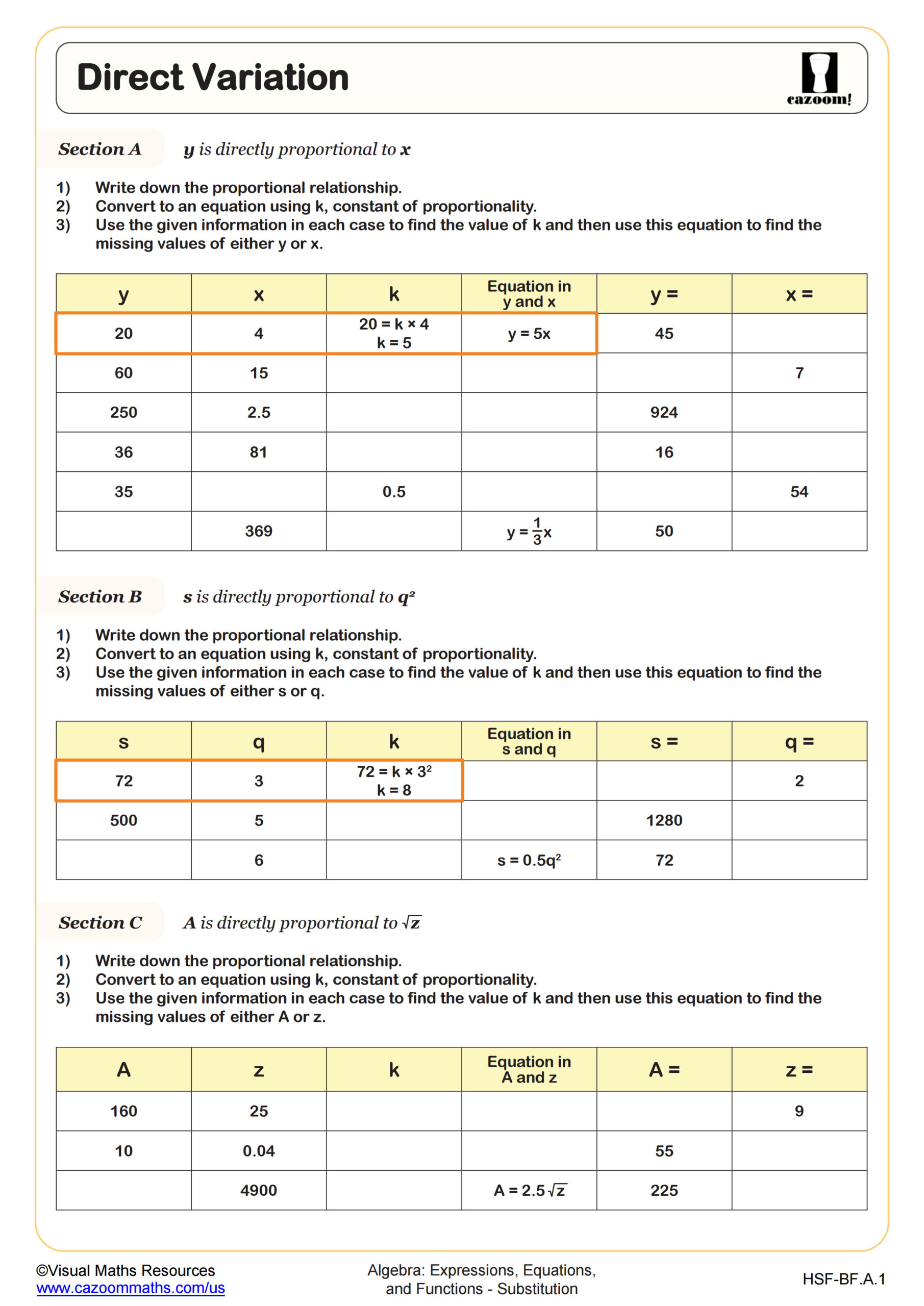
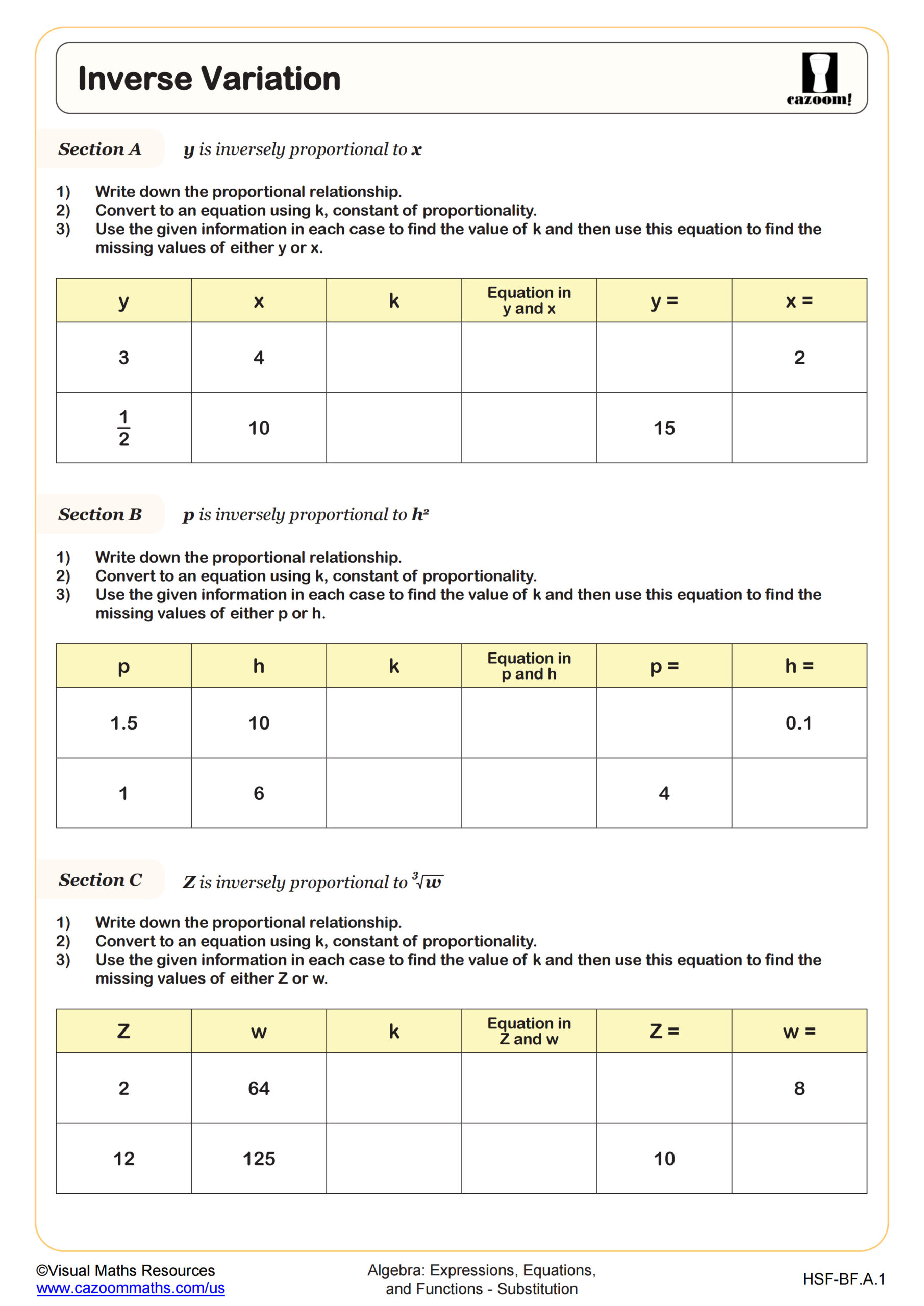
Direct variation problems require students to substitute values into equations of the form y = kx to find constants or missing variables, while inverse variation introduces the relationship y = k/x. A common error occurs when students confuse these two forms, substituting values into the wrong equation structure. Teachers notice that color-coding the constant k versus the variables helps students organize their substitution steps more accurately.
How Does Substitution Appear on Standardized Tests?
The SAT and ACT regularly test substitution within function notation questions, variation problems, and multi-step word problems where students must replace variables with numerical or algebraic expressions. State assessments typically include substitution in context, asking students to evaluate formulas for area, distance, or scientific relationships. Students must demonstrate accuracy with integer operations, fraction arithmetic, and proper use of order of operations when substituting.
Students lose points when they fail to use parentheses around substituted negative numbers, particularly in expressions like x² versus (-x)². Another frequent mistake involves incorrect order of operations after substitution, such as evaluating 2x + 3 when x = 4 as 2(7) instead of 2(4) + 3. Test questions often deliberately include answer choices that reflect these common errors.
What's the Difference Between Direct and Inverse Variation?
Direct variation describes relationships where two variables change proportionally in the same direction, represented by y = kx where k is the constant of variation. As one variable increases, the other increases at a constant rate. Inverse variation represents relationships where variables change in opposite directions, following y = k/x, meaning as one variable increases, the other decreases proportionally. Students confidently tackle variation problems once they recognize which relationship the context describes.
Direct variation appears in real-world situations like distance traveled at constant speed (distance = rate × time) or cost calculations (total cost = price per unit × quantity). Inverse variation models relationships like the time required to complete a job when more workers are added, or the brightness of light as distance from the source increases. STEM fields use these relationships extensively in physics formulas, engineering ratios, and chemistry calculations involving gas laws.
How Can Teachers Use These Substitution Worksheets in Algebra I?
These worksheets provide structured practice that builds from basic substitution into single-variable expressions through more complex variation relationships. The progression allows teachers to assess whether students have mastered prerequisite skills like integer operations and order of operations before moving to abstract algebraic thinking. Answer keys enable quick formative assessment, helping teachers identify whether errors stem from substitution confusion or underlying arithmetic weaknesses.
Many teachers use these worksheets during intervention time for students who struggle with function evaluation or as review before introducing systems of equations, where substitution becomes a solution method. The variation problems work well for paired activities where one student substitutes values while the partner checks the arithmetic, promoting collaborative problem-solving. These materials also serve as targeted practice before unit tests or as homework assignments that reinforce classroom instruction on proportional relationships.