Algebra II Simplification Worksheets
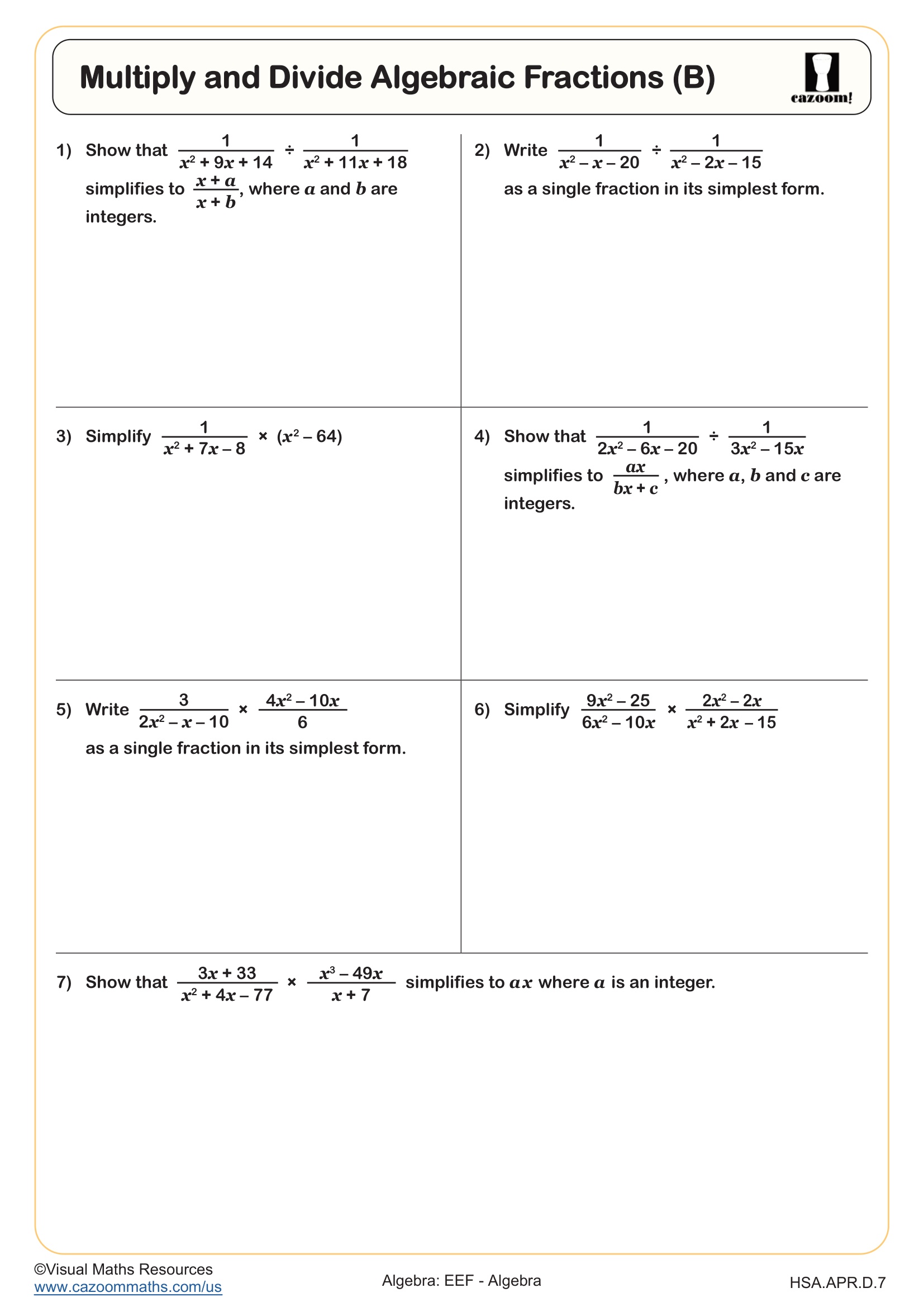
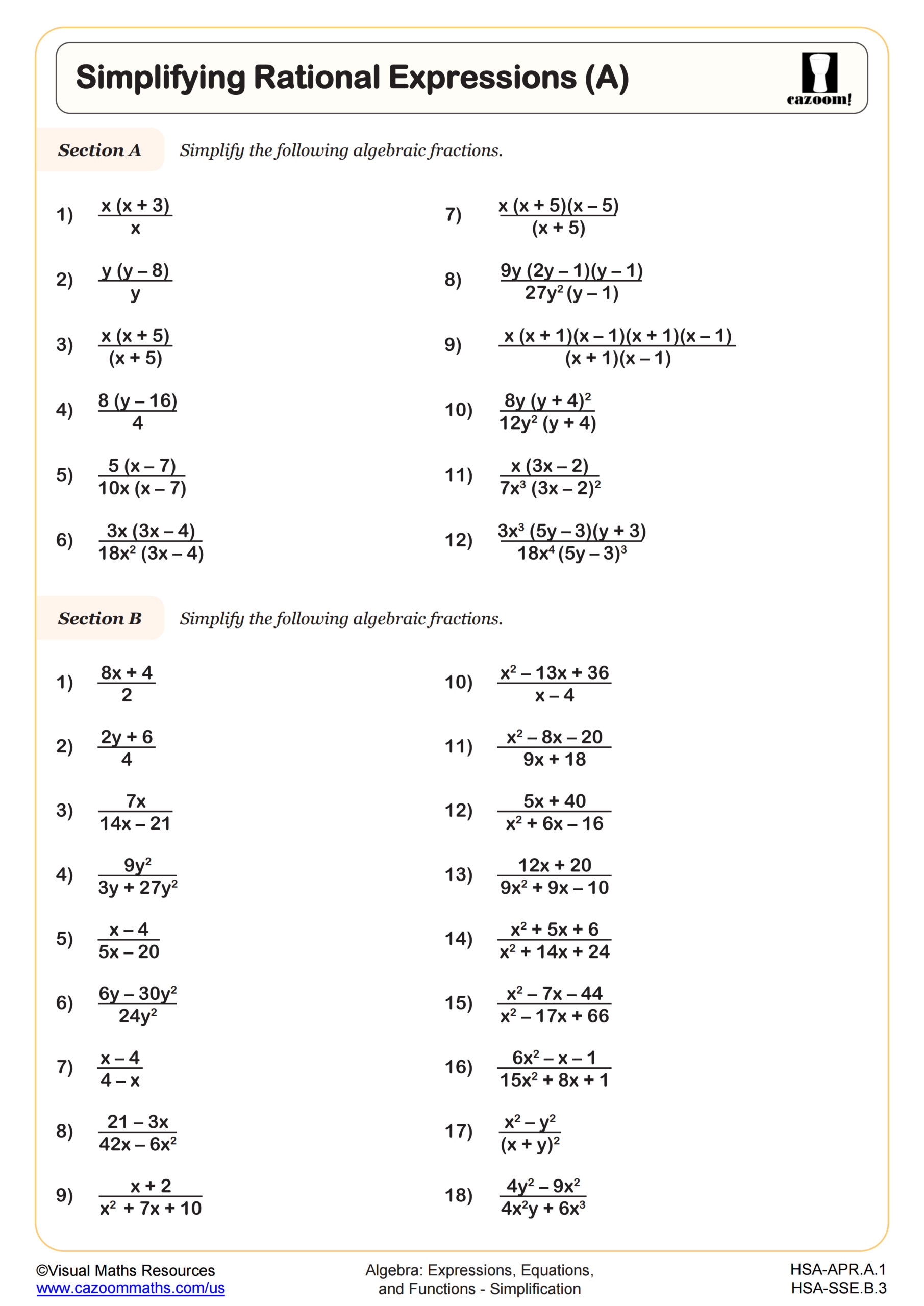
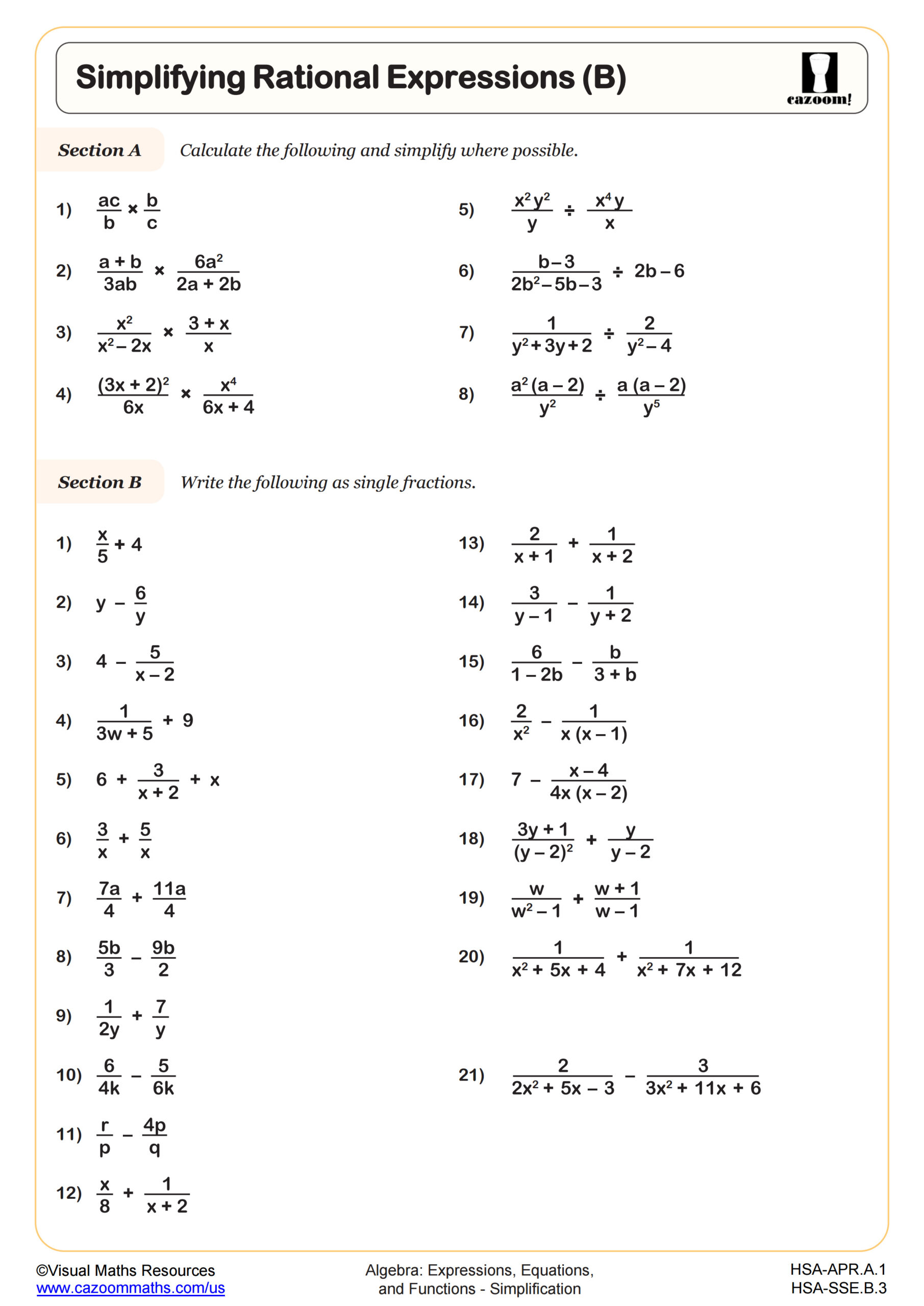
All worksheets are created by the team of experienced teachers at Cazoom Math.
What Skills Do These Algebra II Simplification Worksheets Cover?
These worksheets focus specifically on simplifying rational expressions, which means reducing algebraic fractions to their lowest terms by factoring and canceling common factors. Students work with polynomials in both numerators and denominators, applying factoring techniques including greatest common factors, difference of squares, and trinomial factoring. The worksheets also address multiplying and dividing algebraic fractions, requiring students to factor first, then cancel appropriately before multiplying across or multiplying by the reciprocal.
Teachers frequently observe that students confidently factor polynomials in isolation but freeze when those same polynomials appear in rational expressions. A common misconception involves canceling terms instead of factors, such as incorrectly canceling the x in (x + 3)/x. These worksheets provide targeted practice that helps students distinguish between terms and factors, a distinction that becomes critical in Precalculus and college algebra courses.
How Does Simplifying Rational Expressions Appear on the SAT and ACT?
Standardized tests like the SAT and ACT regularly include questions requiring students to simplify rational expressions, often embedded within larger problem-solving contexts. The SAT calculator section might present a rational expression that must be simplified before evaluating at a specific value, while the no-calculator section tests whether students recognize equivalent forms. Students lose points when they fail to factor completely before canceling or when they incorrectly cancel terms that aren't common factors.
The ACT Math section expects fluency with operations on rational expressions, particularly multiplication and division. Teachers notice that time pressure often causes students to skip the factoring step entirely, leading to incorrect answers. College-bound students benefit from building automaticity with these simplification procedures, as questions involving rational expressions appear across multiple test sections and contribute to the overall math score that colleges evaluate during admissions.
Why Do Students Struggle With Factoring Before Simplifying?
Many students view factoring and simplification as separate skills rather than interconnected processes. Teachers frequently notice that students attempt to cancel before factoring, or they factor only one part of the expression while leaving the other in expanded form. A breakthrough typically happens when students adopt a consistent workflow: factor everything first, identify common factors between numerator and denominator, then cancel. This systematic approach reduces errors and builds confidence with increasingly complex expressions.
Another common challenge involves recognizing opposite factors like (x - 5) and (5 - x), which differ only by a factor of negative one. Students often miss simplification opportunities because they don't see these as cancelable pairs. This skill appears again in calculus when simplifying derivatives and working with limits, making mastery at the Algebra II level essential. Students who practice identifying all forms of common factors develop the algebraic flexibility that advanced mathematics requires.
How Can Teachers Use These Worksheets Most Effectively in Class?
These worksheets work best when teachers use them strategically after introducing factoring review and demonstrating the simplification process with worked examples. Teachers often assign one worksheet as guided practice, working through the first few problems as a class before releasing students to complete the remainder independently. The answer keys allow students to self-check their work immediately, identifying specific factoring errors or canceling mistakes before those misconceptions solidify.
Many teachers find success using these worksheets in differentiated instruction settings. Students who demonstrate proficiency can move quickly through the basic simplification worksheet to the more challenging multiplication and division problems, while students who need additional support can work through multiple examples at the foundational level. The variety across four worksheets provides sufficient practice volume without creating worksheet fatigue, and the consistent format helps students focus on the mathematics rather than decoding new directions with each assignment.