Elementary School Algebra Expressions Equations and Functions Worksheets
Add and Subtract Algebraic Fractions (B)

Algebra Multiplication Pyramids (A)

Algebra Multiplication Pyramids (B)

Changing the Subject: Requires Factorization

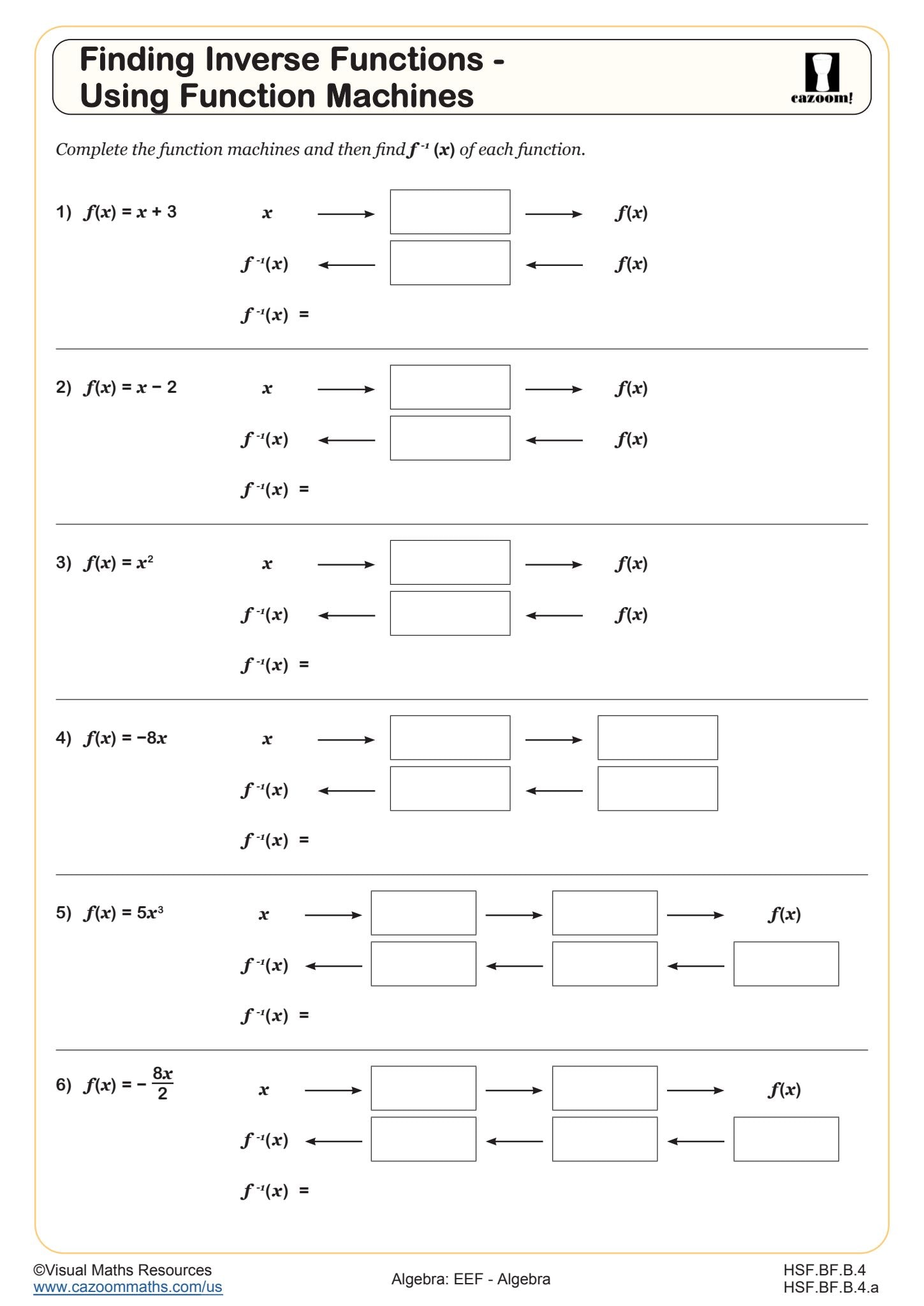
Finding Inverse Functions - Using Function Machines
Finding Quadratic Sequence nth Terms

Finding Slope (A)

Finding Slope (B)

Finding Slope (C)

Form and Solve Linear Simultaneous Equations

Forming Two Step Equations

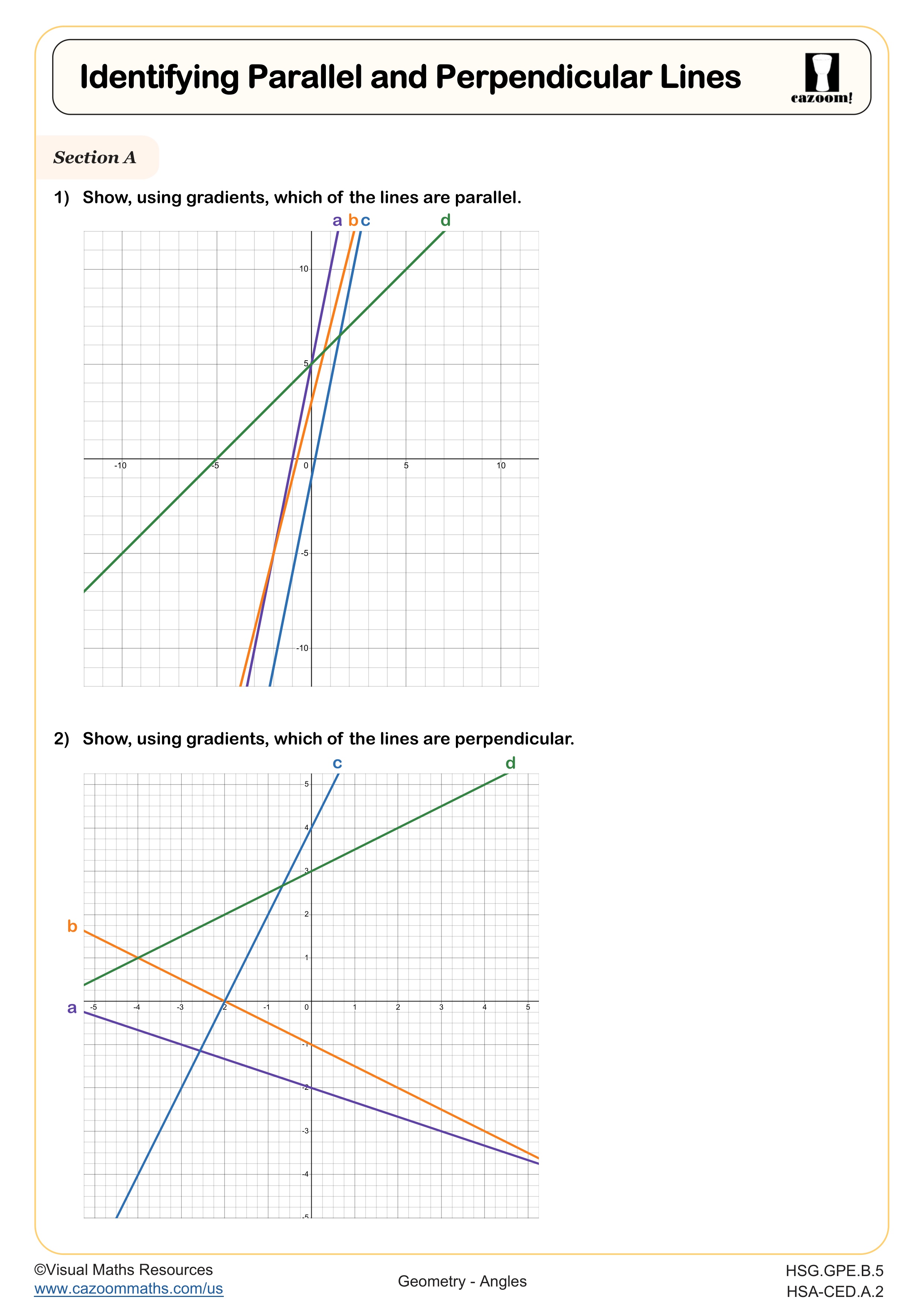
Identifying Parallel and Perpendicular Lines
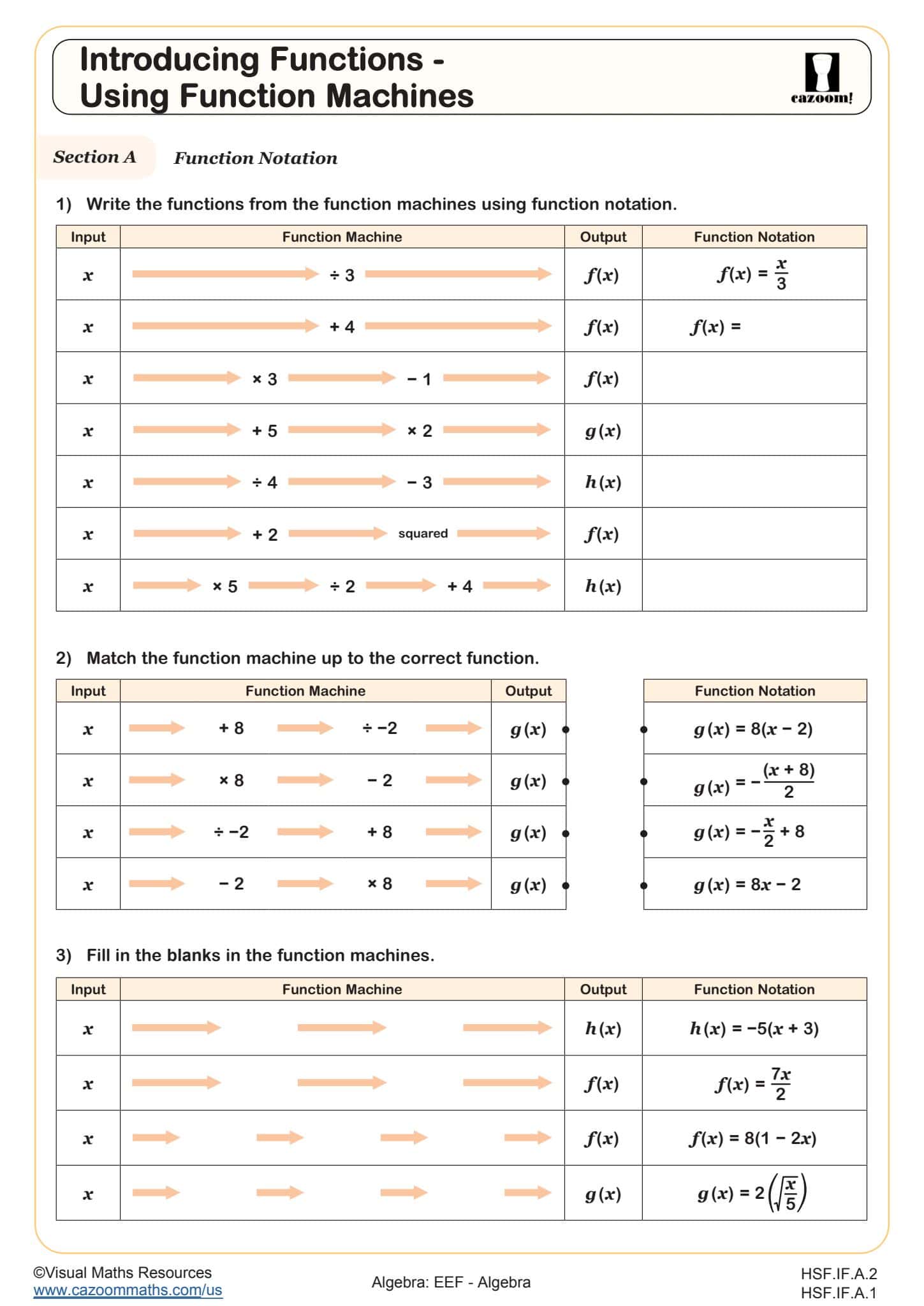
Introducing Functions - Using Function Machines
Language of Algebra

Multiply and Divide Algebraic Fractions (B)

Quadratic Sequences - Using the Quadratic Sequence Formula

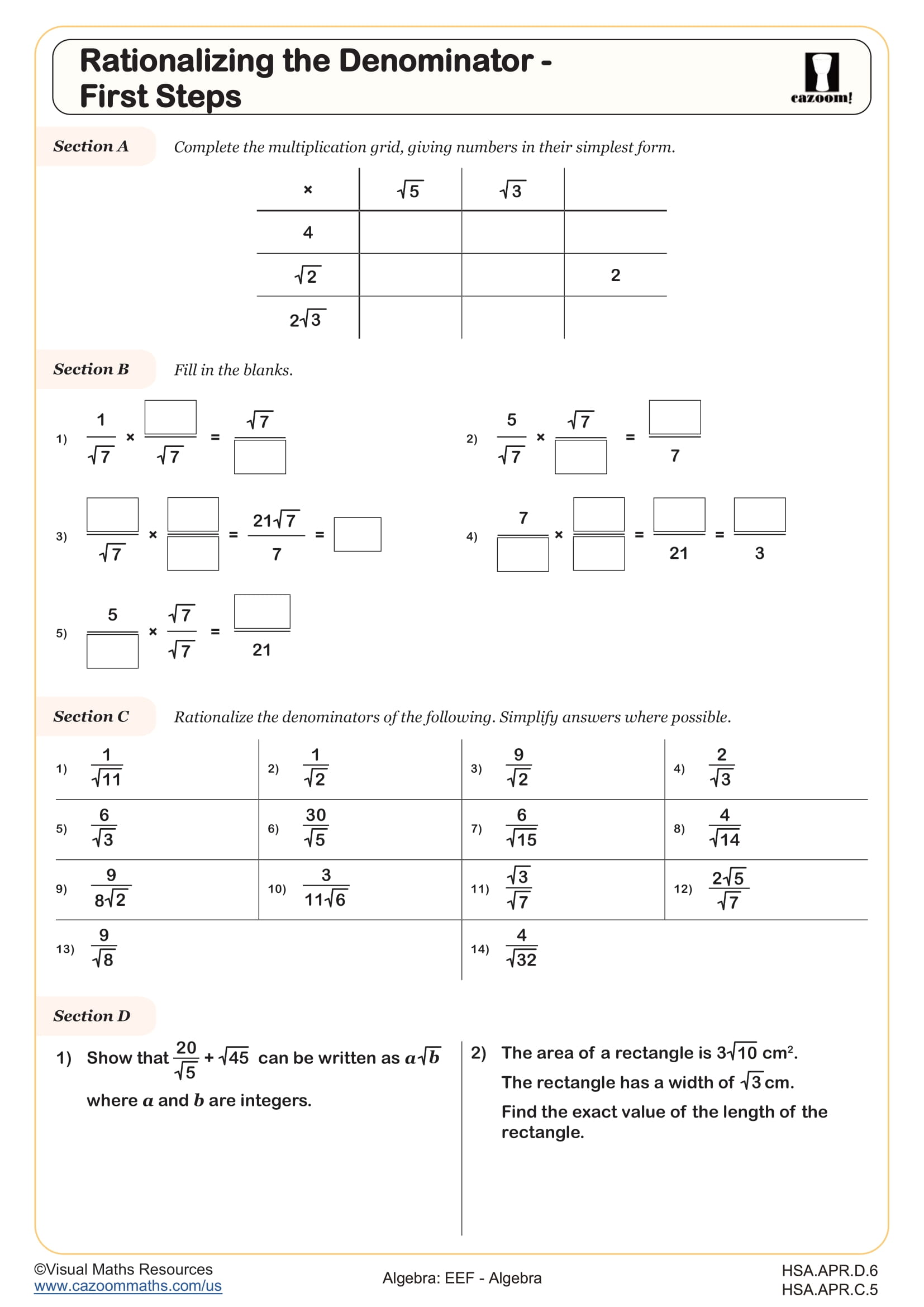
Rationalizing the Denominator - First Steps
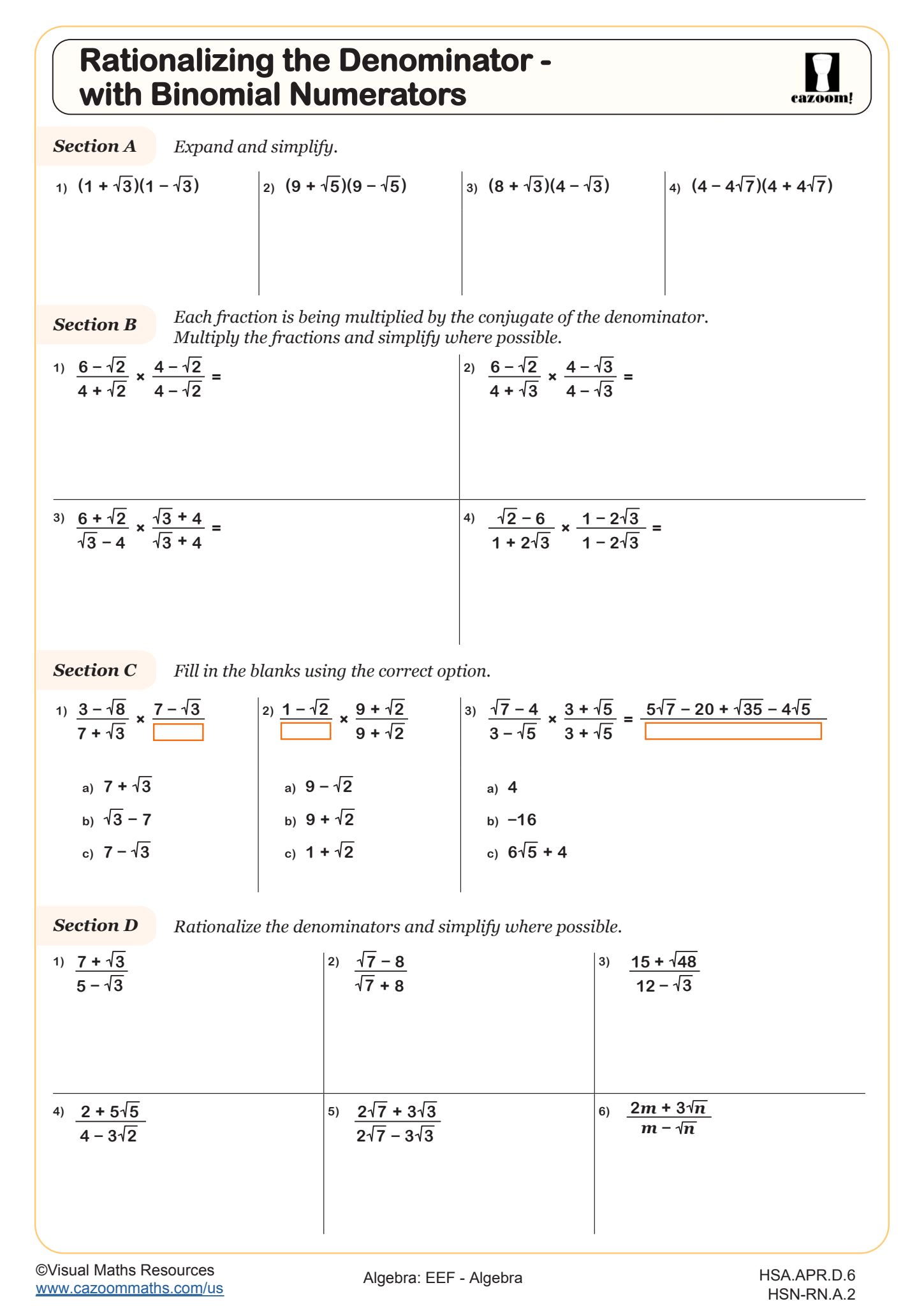
Rationalizing the Denominator - with Binomial Numerators
Simplify Algebraic Fractions (A)

Simplify Algebraic Fractions (B)

Solving a System of Linear Equations - Three Methods

Solving Equations - Unknowns on Both Sides

Solving Equations Involving Fractions

Solving Linear Equations - 15 Minute Challenge (A)

Solving Linear Simultaneous Equations - Change One Equation

Solving Quadratic Equations (E) - Using all Three Methods

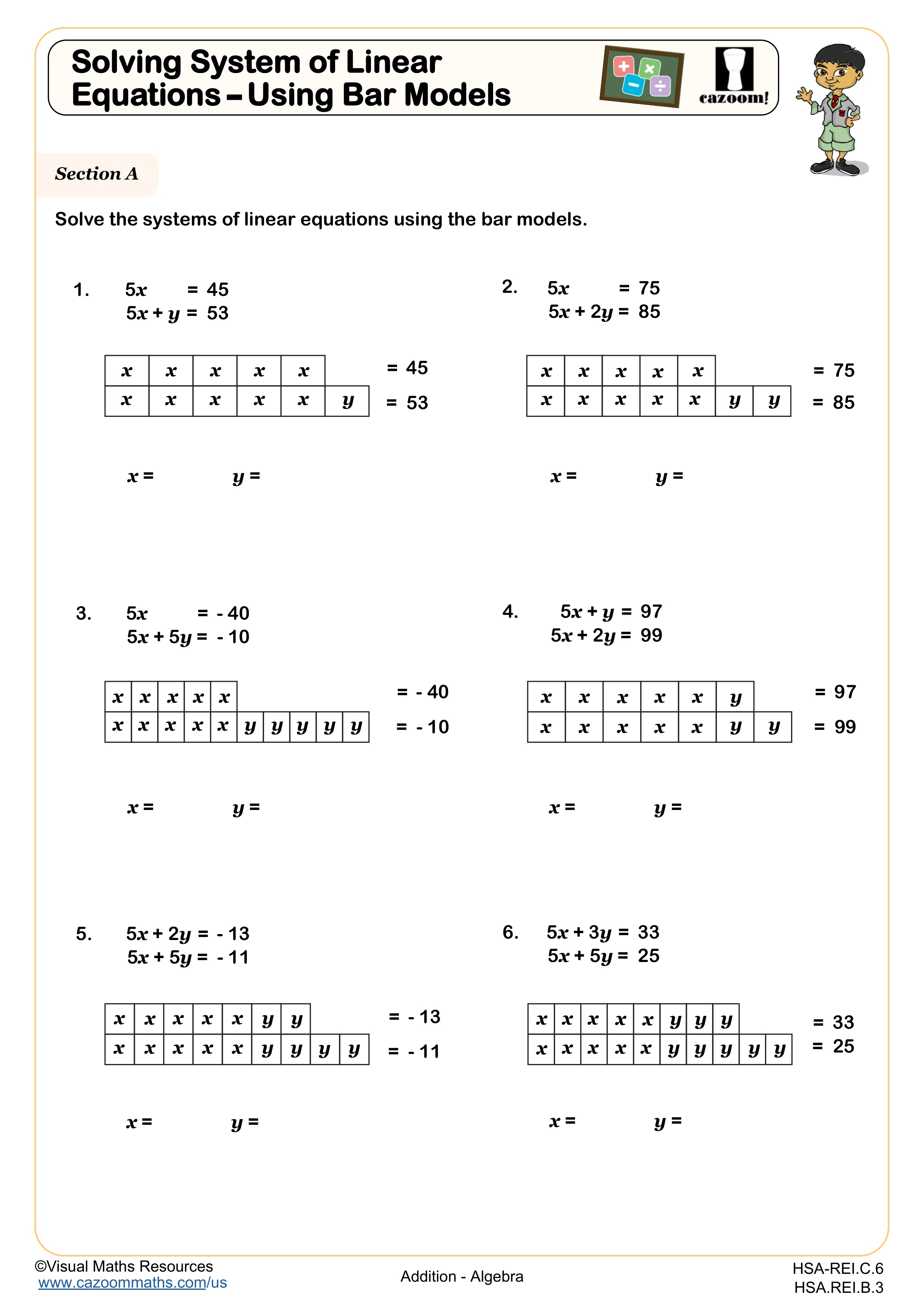
Solving Systems of Linear Equations - Using Bar Models
Substitution - Using Algebra Tiles

Writing Formulas

All worksheets are created by the team of experienced teachers at Cazoom Math.
What topics do elementary algebra worksheets typically cover?
Elementary algebra worksheets focus on pre-algebraic concepts aligned with Common Core standards for grades 3-6. Students practice writing and evaluating simple expressions, solving basic equations with one variable, and exploring function relationships through input-output tables and graphing activities.
Teachers frequently observe that students initially treat variables like specific numbers rather than placeholders. Worksheets address this by starting with concrete examples where students substitute known values into expressions before progressing to solving for unknown variables. This scaffolded approach helps students understand that algebra extends arithmetic patterns.
Which grade levels benefit most from early algebra worksheets?
Early algebra worksheets serve students primarily in grades 4-6, though some concepts appear as early as grade 3 in pattern recognition activities. Fourth graders typically begin with simple expressions using one operation, while sixth graders work with multi-step equations and coordinate graphing.
Many teachers use these worksheets as diagnostic tools to identify students ready for advanced mathematical thinking. Students who master elementary algebra practice often demonstrate stronger problem-solving skills in other mathematical areas, including geometry and measurement, since algebraic reasoning supports logical thinking across mathematics domains.
How do these worksheets introduce function concepts to elementary students?
Function concepts appear through input-output tables, pattern recognition, and simple coordinate graphing activities appropriate for elementary learners. Students explore relationships between quantities using familiar contexts like calculating total cost from unit price or determining perimeter from side length.
Teachers observe that students grasp function concepts more readily when worksheets connect to real-world situations. For example, worksheets might ask students to create tables showing the relationship between hours worked and money earned, helping them recognize that functions describe how one quantity depends on another in predictable ways.
What strategies help teachers use algebra worksheets most effectively?
Teachers find success by introducing worksheets after concrete manipulative activities and before moving to abstract algebraic notation. Starting each lesson with a brief review of previous concepts helps students connect new algebraic ideas to familiar arithmetic operations and problem-solving strategies.
Many educators use the answer keys to create worked examples on the board, showing step-by-step solutions while students follow along. This modeling approach helps students internalize the logical sequence of algebraic problem-solving and builds confidence before independent practice. Regular formative assessment through worksheet problems helps teachers adjust instruction pace.