Elementary School Position and Direction Worksheets
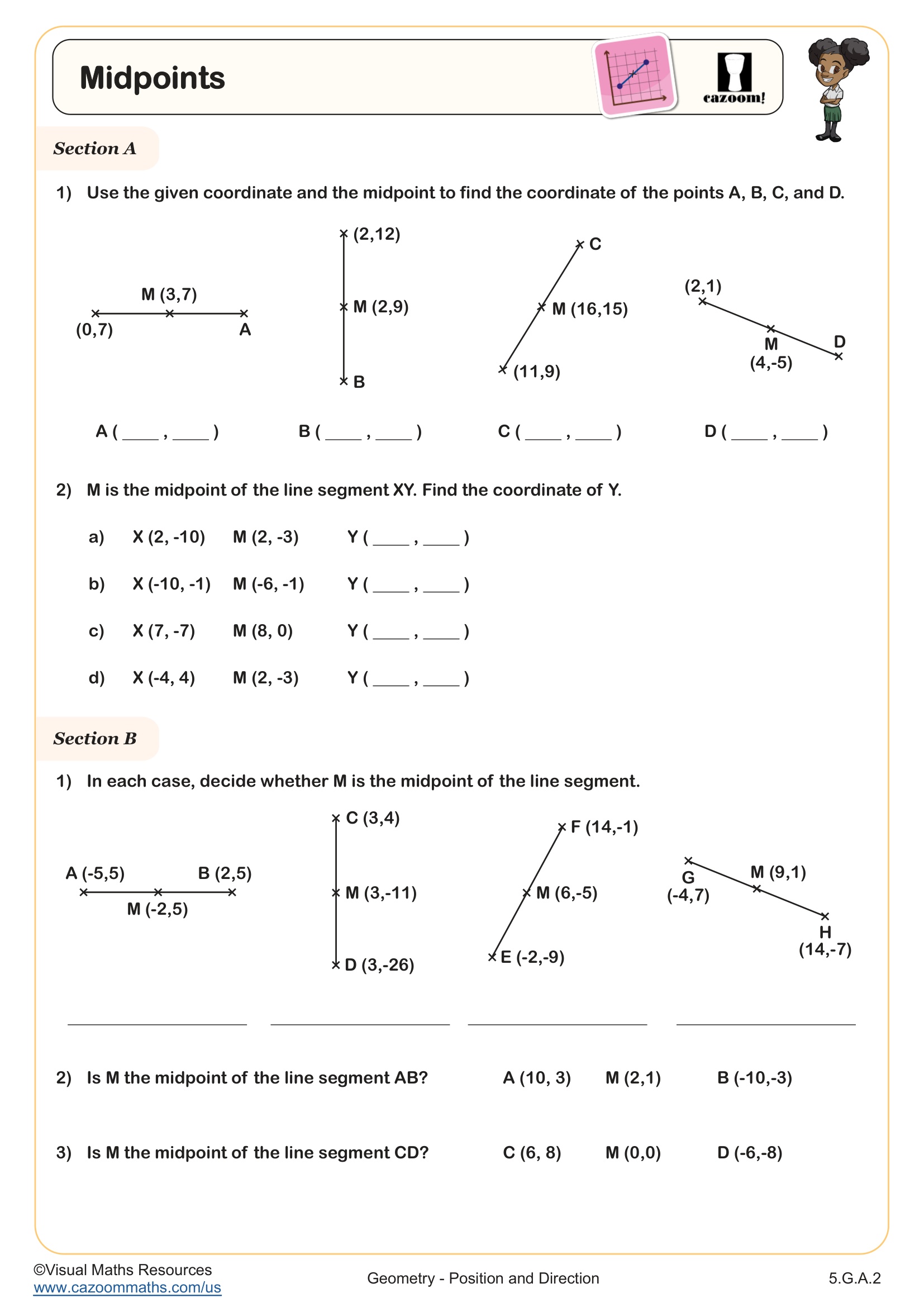
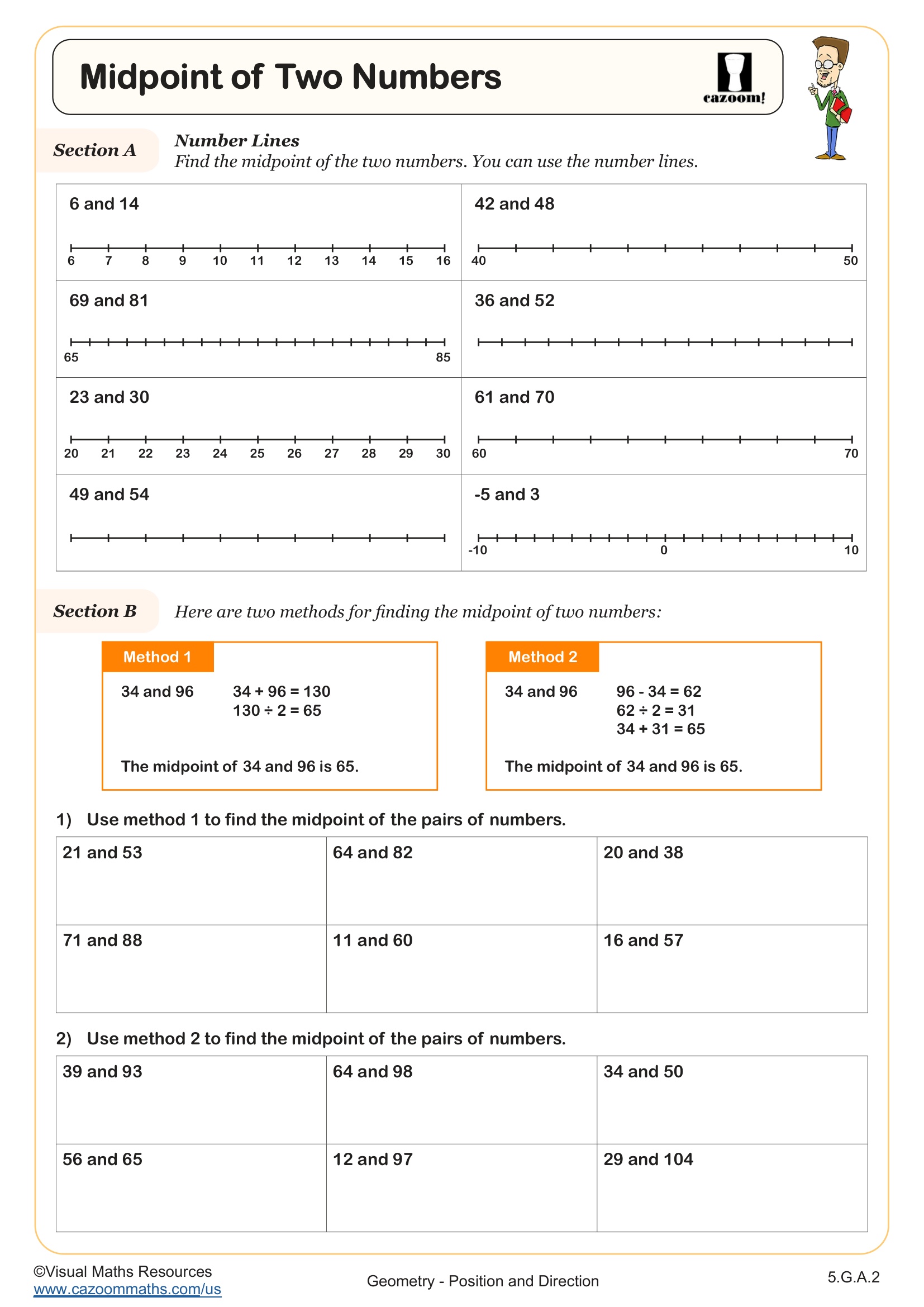
All worksheets are created by the team of experienced teachers at Cazoom Math.
What spatial concepts do position and direction worksheets cover?
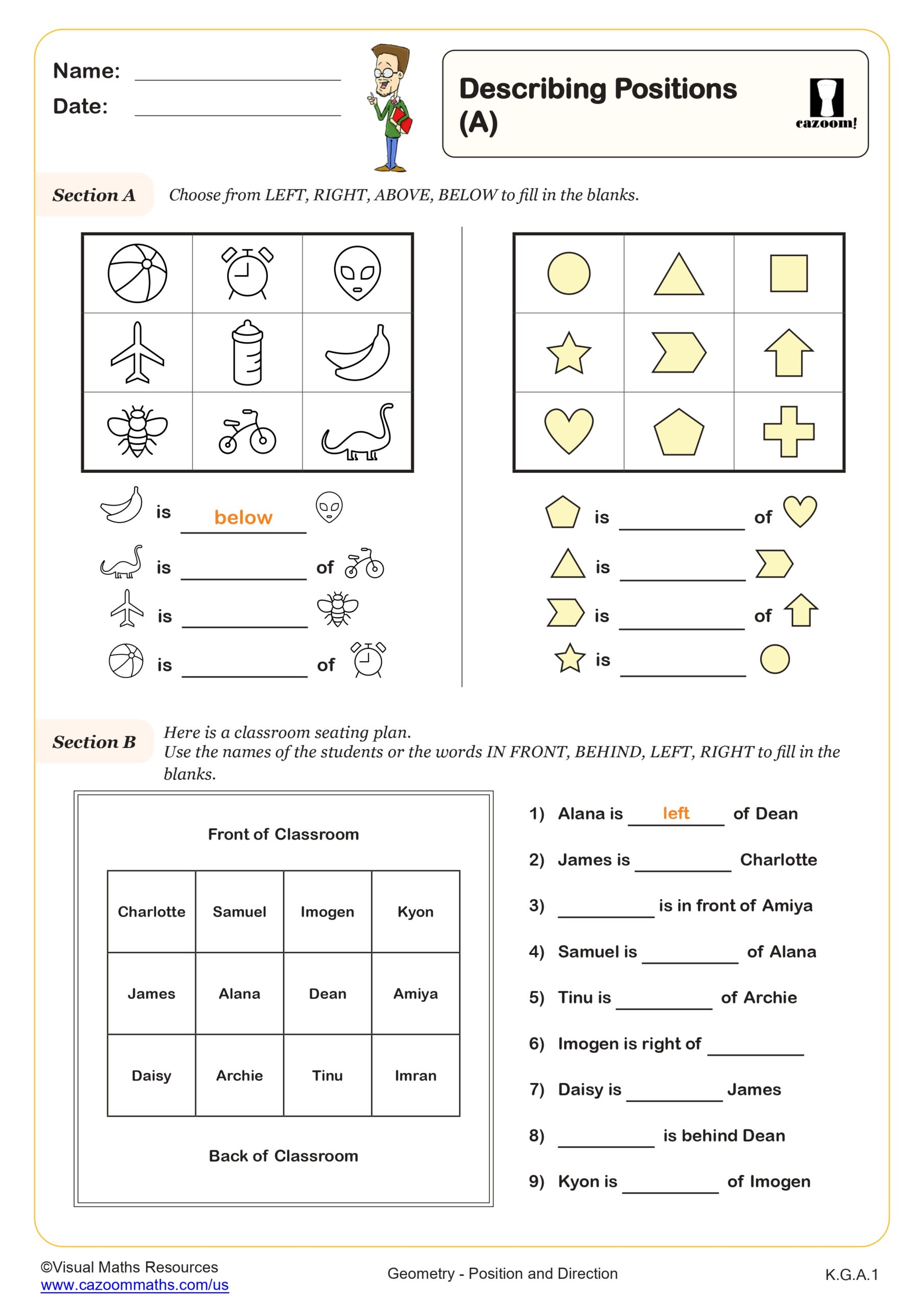
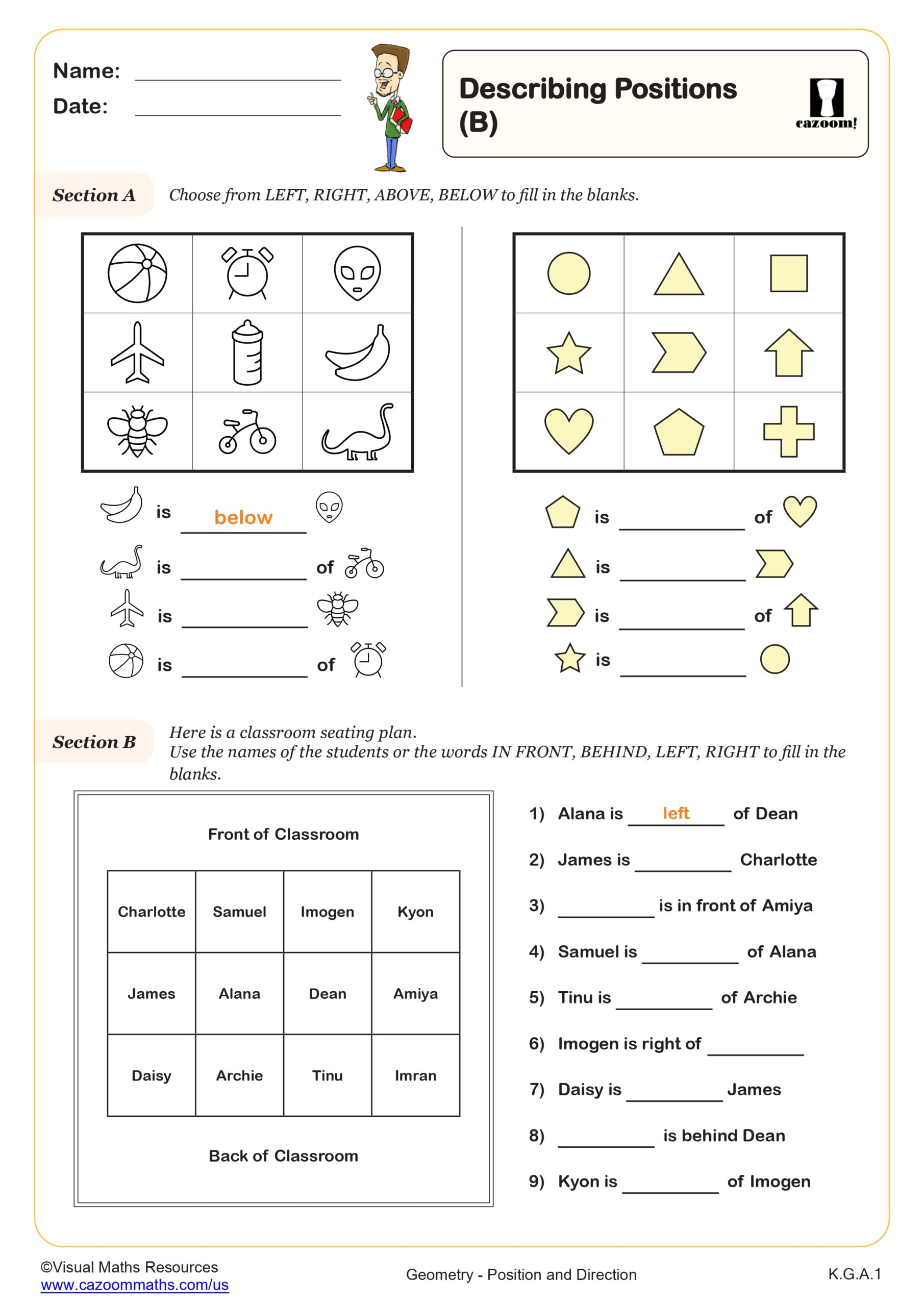
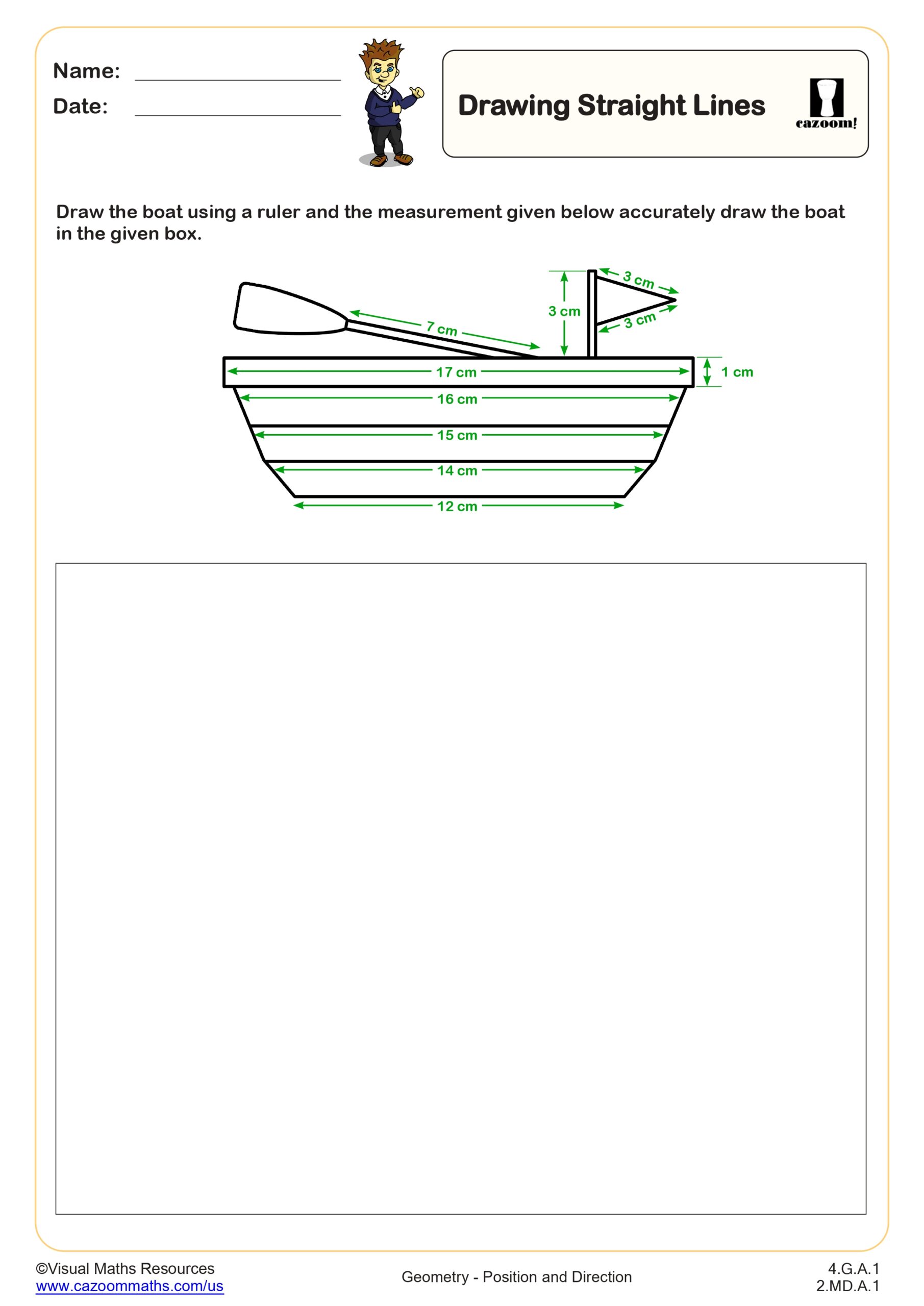
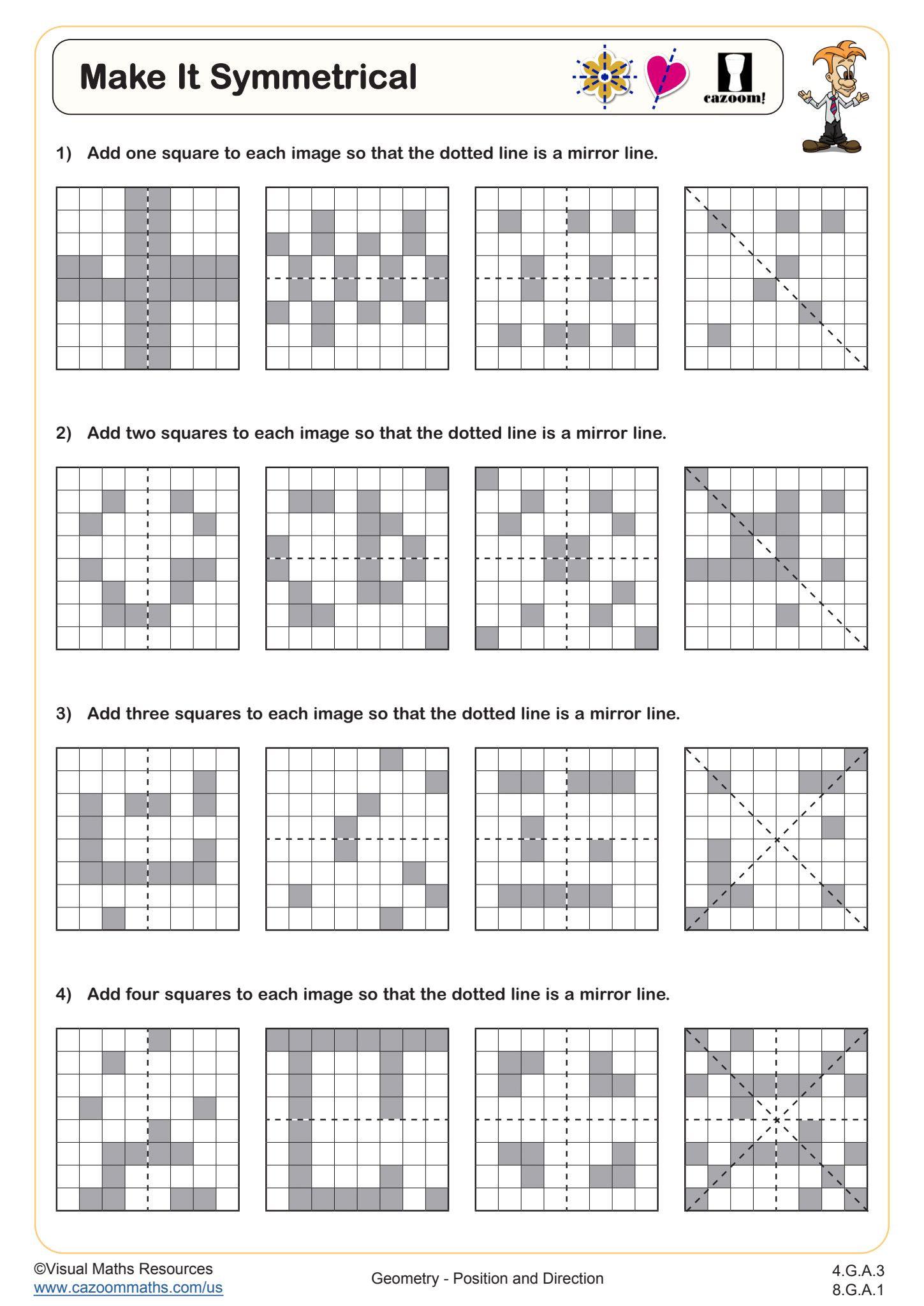
Position and direction worksheets address the spatial reasoning standards outlined in Common Core State Standards for Mathematics, particularly within the Geometry domain. Students practice using positional vocabulary (above, below, beside, in front of, behind), understanding and applying map scales, identifying left and right orientations, drawing straight lines accurately, and recognizing lines of symmetry in shapes and patterns.
A common misconception emerges when students confuse relative position with absolute position. Many students initially describe an object's location from their own perspective rather than using fixed reference points or cardinal directions. Teachers find that having students physically move around objects or use manipulatives helps cement the understanding that positional descriptions depend on the chosen reference frame, particularly when transitioning to more formal coordinate systems in later grades.
Which grade levels use position and direction worksheets?
These position and direction worksheets span the complete elementary school range, from kindergarten through 5th grade. Kindergarten and 1st grade students begin with basic positional language and simple directional concepts, while 2nd and 3rd graders work with more complex spatial relationships, map reading, and symmetry. By 4th and 5th grade, students apply these skills to scale drawings, coordinate systems, and multi-step directional problems.
The progression follows a clear developmental path. Early elementary students focus on vocabulary acquisition and basic orientation, while upper elementary students integrate position and direction concepts with measurement, fractions (when working with map scales), and geometric properties. Teachers observe that students who struggle with symmetry identification in 3rd grade often benefit from revisiting basic positional language, as the ability to describe spatial relationships precisely underlies more advanced geometric reasoning.
How do students learn to work with map scales?
Map scales teach students the relationship between measurements on a representation and actual distances in the real world. Students learn to interpret scale ratios like 1 inch = 10 feet or 1 cm = 5 miles, then apply multiplication or division to calculate actual distances from map measurements. This skill combines spatial reasoning with proportional thinking, bridging geometry and number operations.
Map scale understanding connects directly to urban planning, architecture, and navigation technology that students encounter daily. GPS systems, online maps, and even video game interfaces rely on scaled representations of space. Students who grasp map scales develop stronger estimation skills and better understand how engineers design everything from playgrounds to city transit systems. Standardized tests increasingly include map-based word problems, expecting students to extract information from scaled diagrams and apply mathematical reasoning to spatial scenarios.
How can teachers use position and direction worksheets effectively?
These worksheets provide structured practice with clear visual representations that help students develop spatial vocabulary and geometric intuition. The progression from basic positional descriptions to complex map interpretation allows teachers to differentiate instruction based on student readiness. Answer keys enable students to self-check their work during independent practice, building confidence with spatial reasoning tasks that don't always have obvious solutions.
Many teachers use these worksheets during math centers or stations, pairing them with hands-on activities using blocks, grid paper, or classroom treasure hunts. They work well for morning work review, homework reinforcement, or targeted intervention for students who struggle with geometry vocabulary. The symmetry and line-drawing activities particularly benefit from paired work, where students can explain their thinking to a partner and catch errors in spatial reasoning that often go unnoticed during individual practice.