Elementary School Powers Worksheets
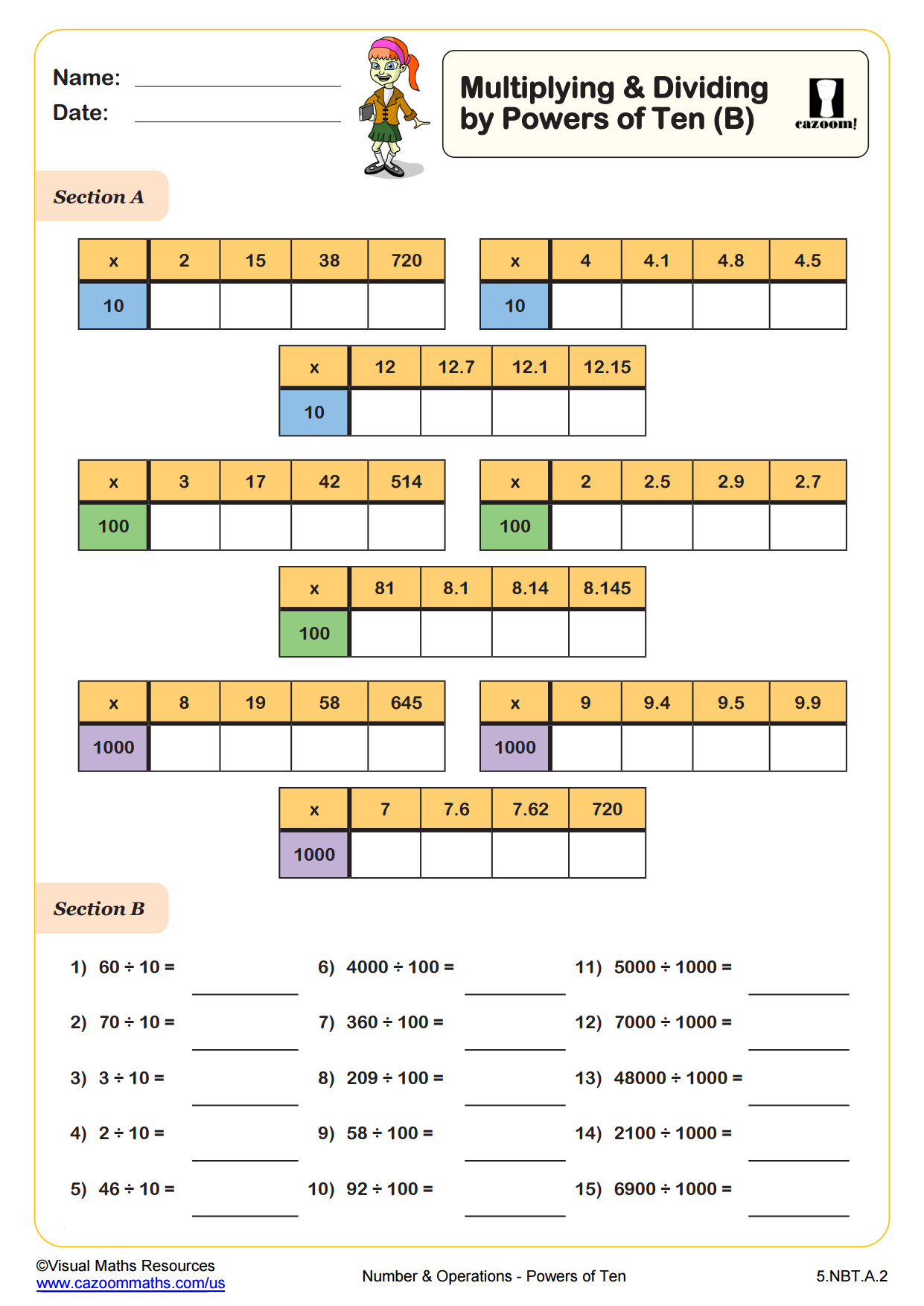
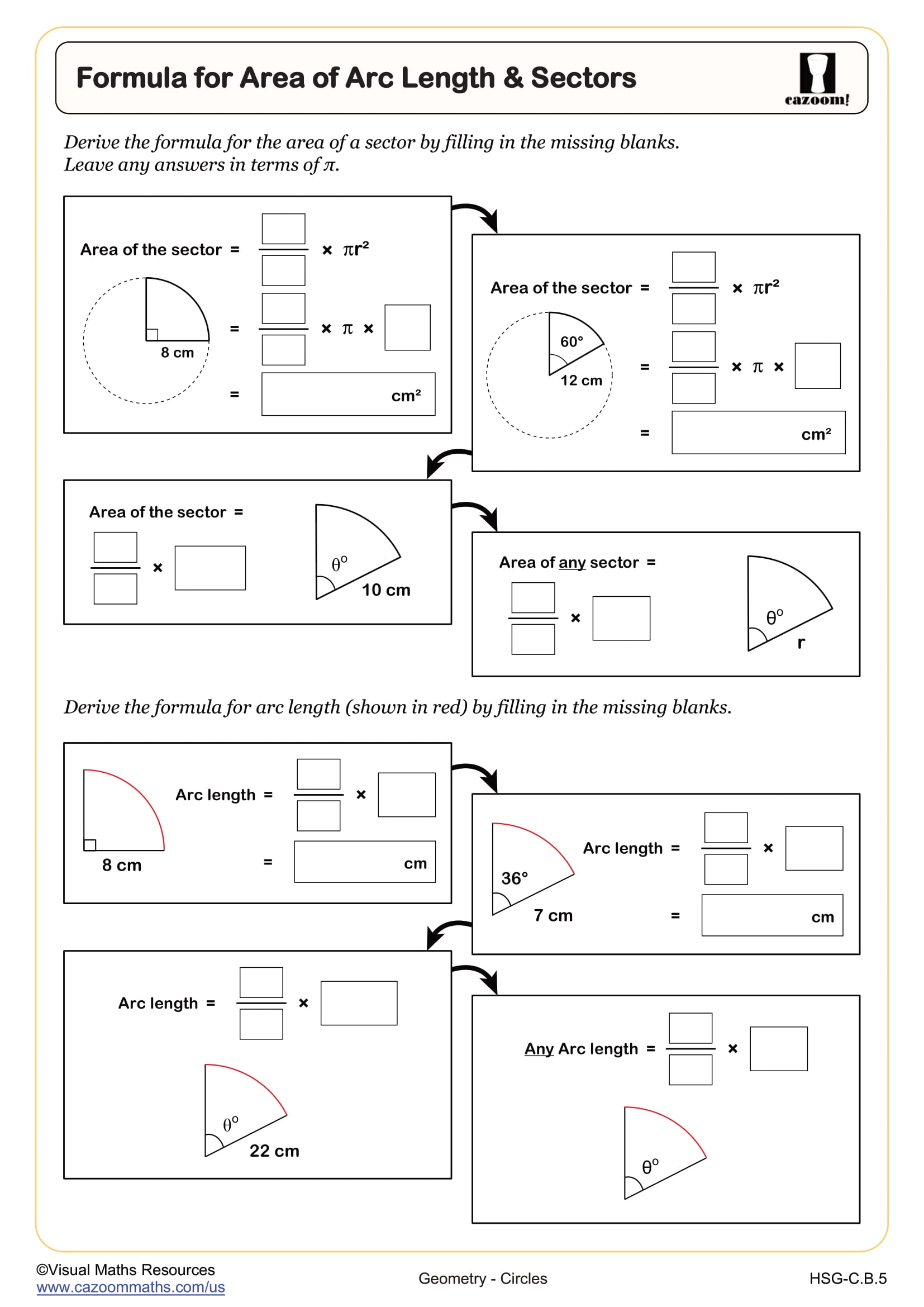
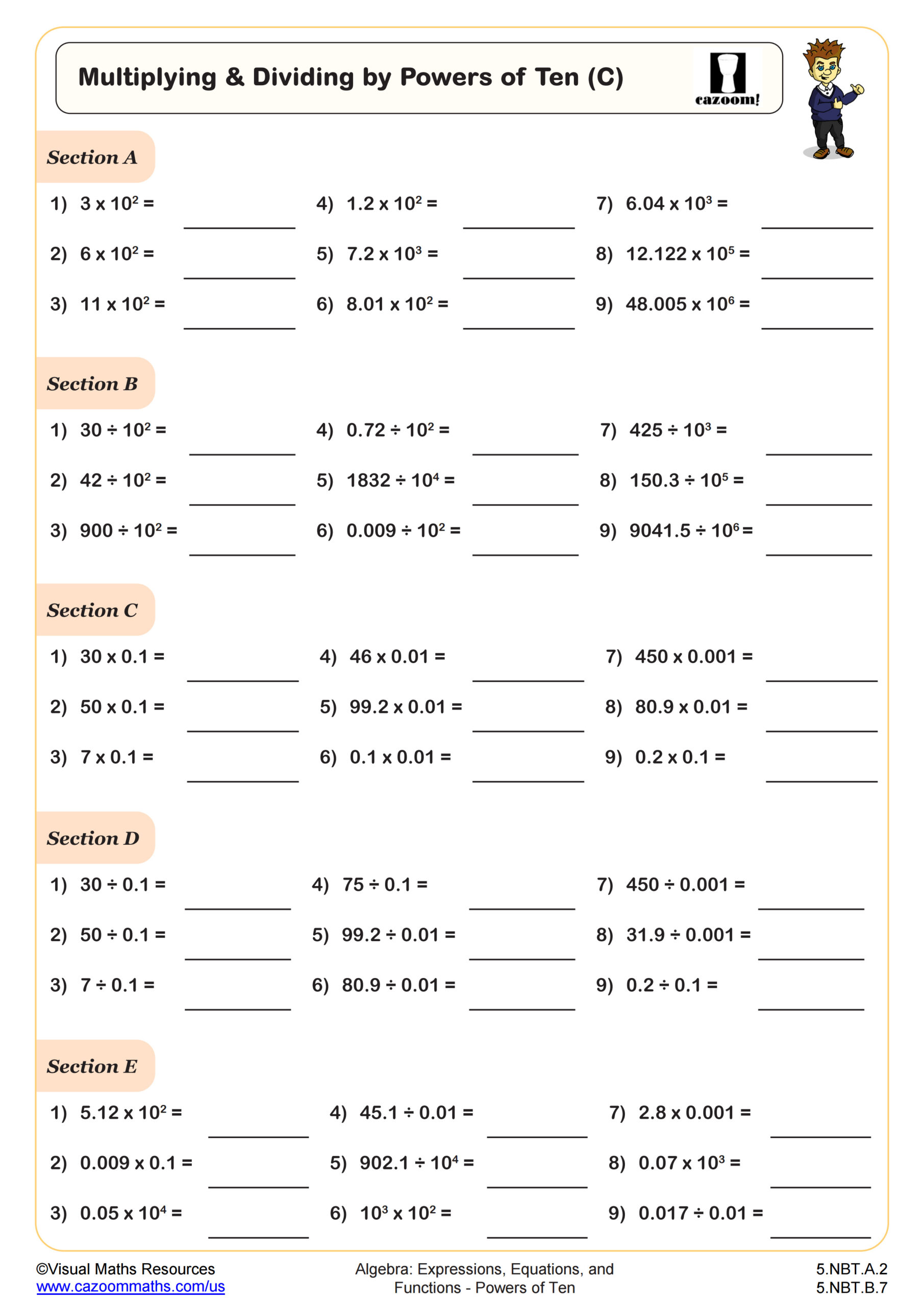
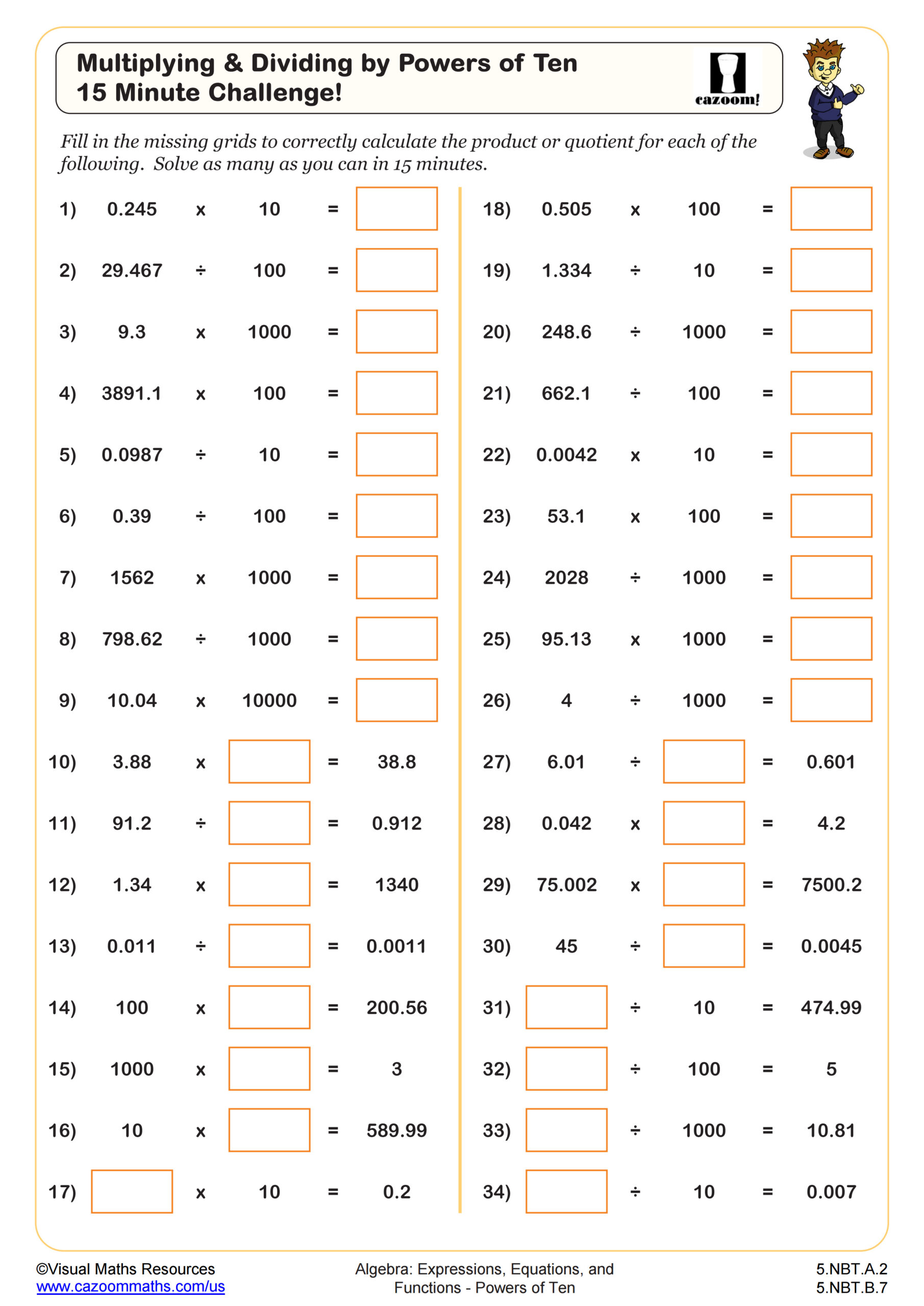
All worksheets are created by the team of experienced teachers at Cazoom Math.
What Are Powers of Ten and Why Do They Matter?
Powers of ten represent numbers like 10, 100, 1,000, and 10,000, written in exponential form as 10¹, 10², 10³, and 10⁴. The exponent tells how many times to multiply 10 by itself, which directly connects to our base-ten number system. Understanding powers of ten helps students grasp place value relationships, work with large numbers efficiently, and prepares them for scientific notation in middle school.
Students often make the connection between the exponent and the number of zeros in the standard form—10³ has three zeros (1,000)—which becomes a helpful shortcut. However, teachers notice students sometimes forget that 10⁰ equals 1, not 0, a conceptual hurdle that requires explicit instruction. Mastering powers of ten also streamlines mental math, since multiplying 47 × 100 becomes as simple as shifting digits two places to the left.
Which Grade Levels Learn Powers of Ten?
These elementary school worksheets span kindergarten through 5th grade, with each grade level building on foundational skills. Kindergarten and early elementary students begin recognizing patterns when counting by tens and hundreds, while upper elementary students multiply and divide multi-digit numbers and decimals by powers of ten with increasing complexity.
The progression typically moves from concrete patterns (3 × 10 = 30) in earlier grades to more abstract applications (3.5 × 10² = 350) by 5th grade. Students in 4th and 5th grade encounter powers of ten as they prepare for state assessments that test place value fluency and decimal operations. Teachers observe that students who master multiplying by powers of ten find division by these same numbers more intuitive, since the operations mirror each other through inverse relationships.
How Do You Multiply and Divide by Powers of Ten?
Multiplying by powers of ten involves shifting digits to the left, effectively making numbers larger. For whole numbers, students add zeros equal to the exponent (6 × 10³ = 6,000). For decimals, the decimal point moves right: 4.2 × 10² becomes 420. Dividing reverses the process—digits shift right, making numbers smaller. Dividing 850 by 10² gives 8.5, as the decimal point moves two places left.
This skill directly applies to unit conversions in science and real-world measurements. When students convert 3.4 kilometers to meters, they multiply by 1,000 (10³), yielding 3,400 meters. Similarly, converting milliliters to liters requires dividing by 1,000. Engineers and scientists use powers of ten constantly when working with measurements across different scales, from nanometers in technology to astronomical units in space exploration.
How Can Teachers Use These Worksheets Effectively?
The worksheets provide structured practice that helps students recognize patterns and develop automaticity with powers of ten operations. Problems progress from straightforward multiplication and division to mixed operations, allowing students to differentiate between moving decimal points left versus right. The answer keys enable quick checking during independent work or partner activities, helping students self-correct and identify mistakes before misconceptions solidify.
Teachers use these worksheets during math centers for targeted skill practice, as warm-up activities to reinforce prior learning, or as intervention materials for students who need additional support with place value concepts. The 15-minute challenge format works well for timed practice sessions that build computational fluency. Many teachers assign these as homework after introducing powers of ten in class, then review common errors the following day to address misunderstandings before moving to more complex decimal operations.