Elementary School Sequences Worksheets
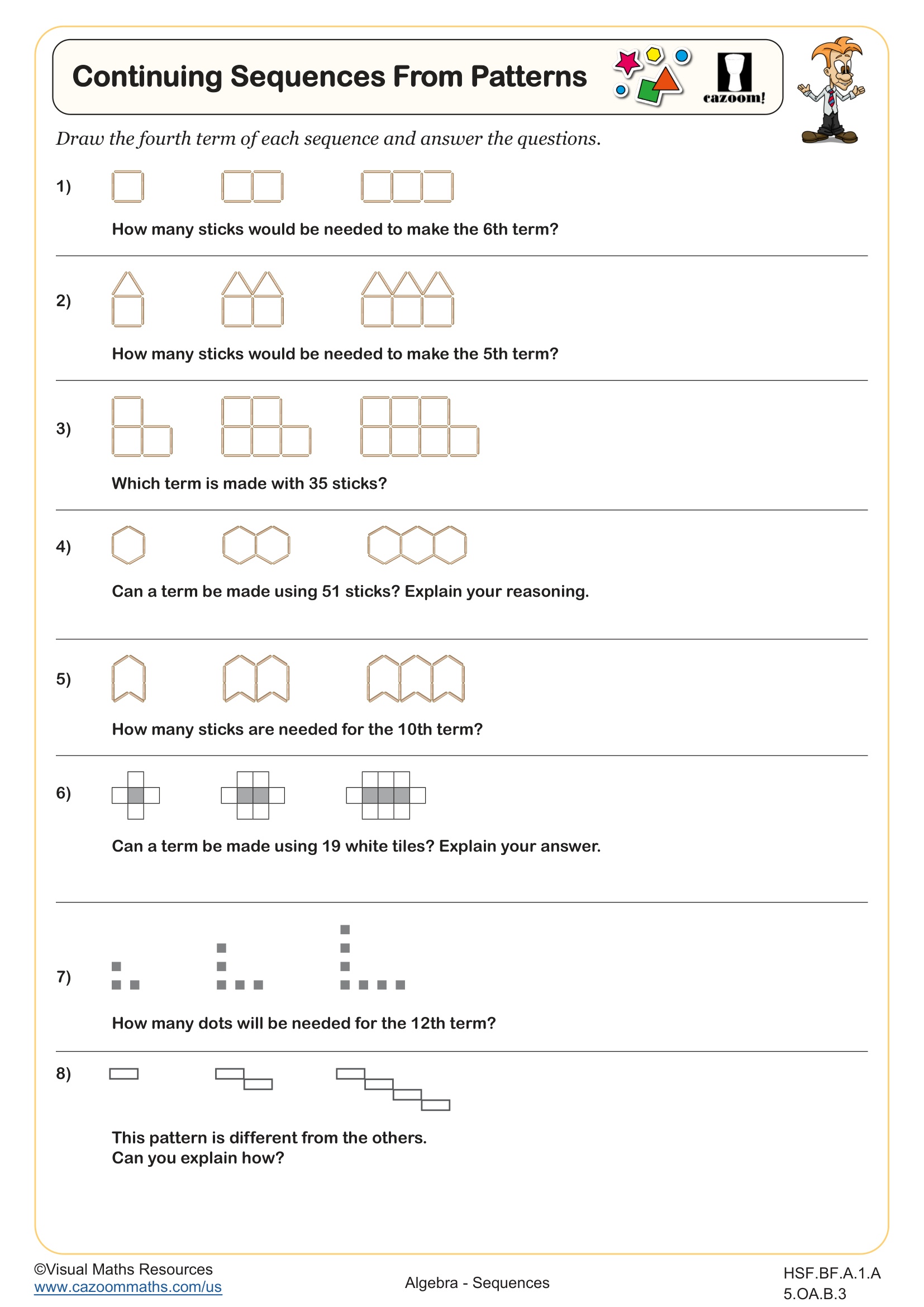
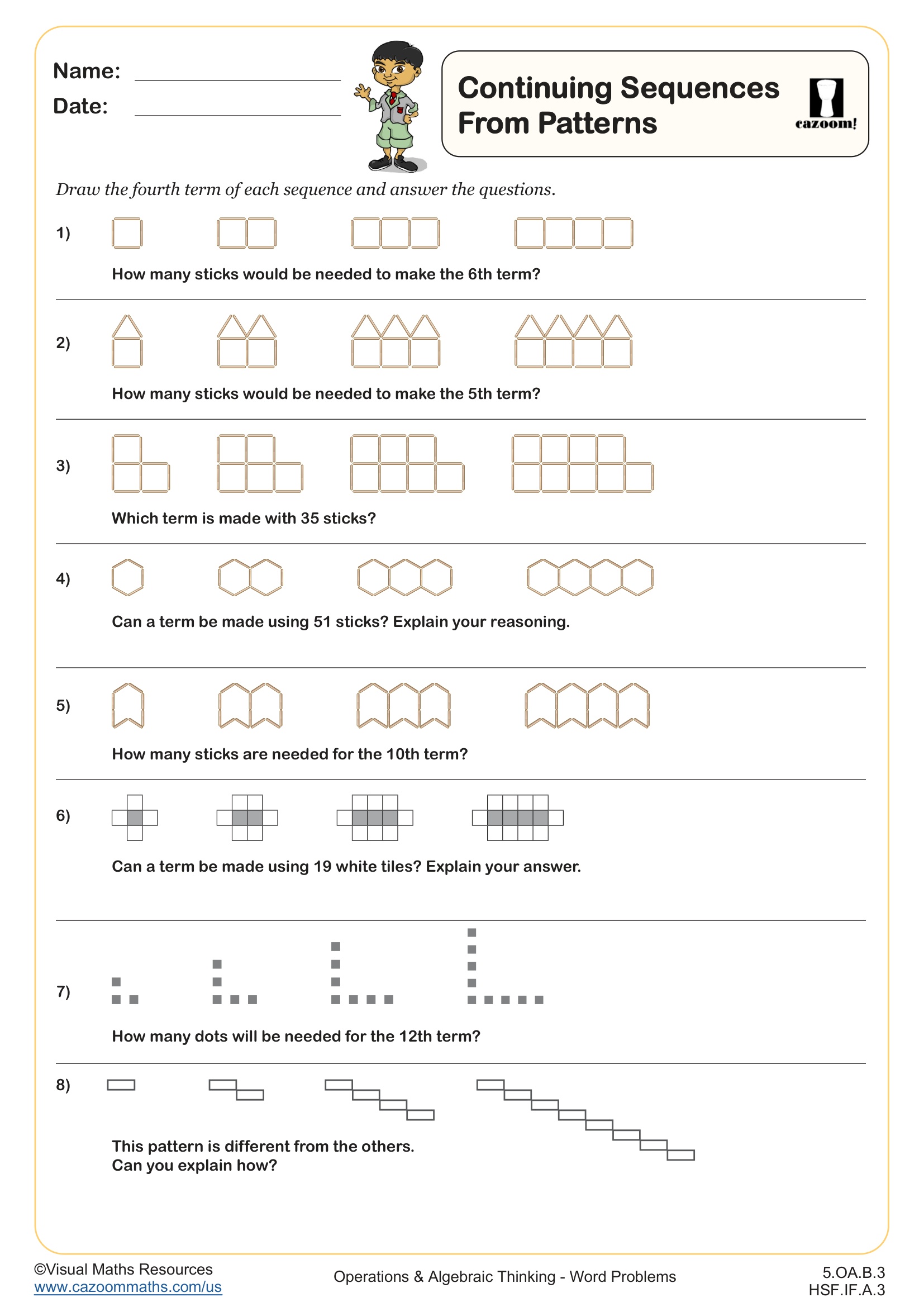
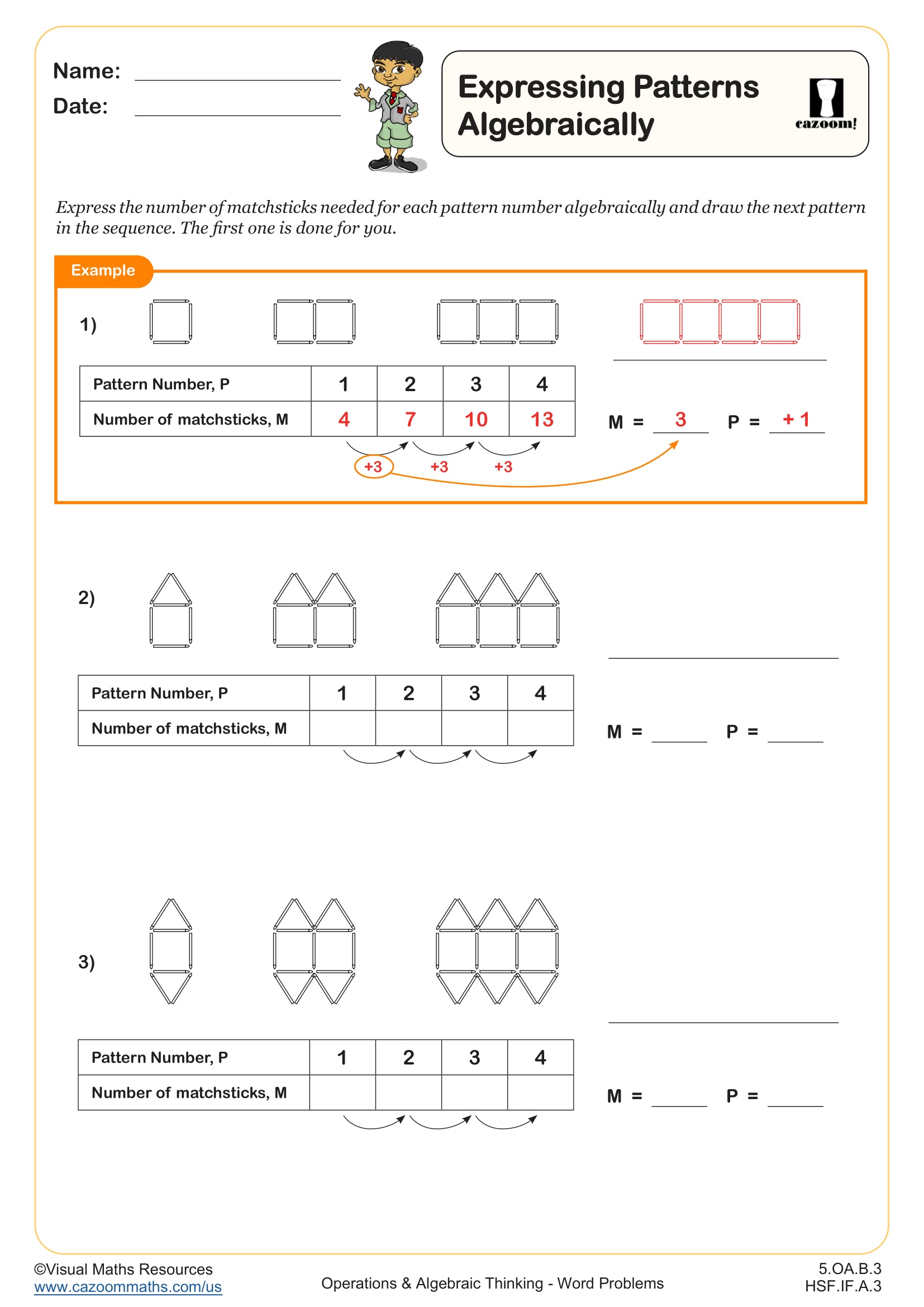
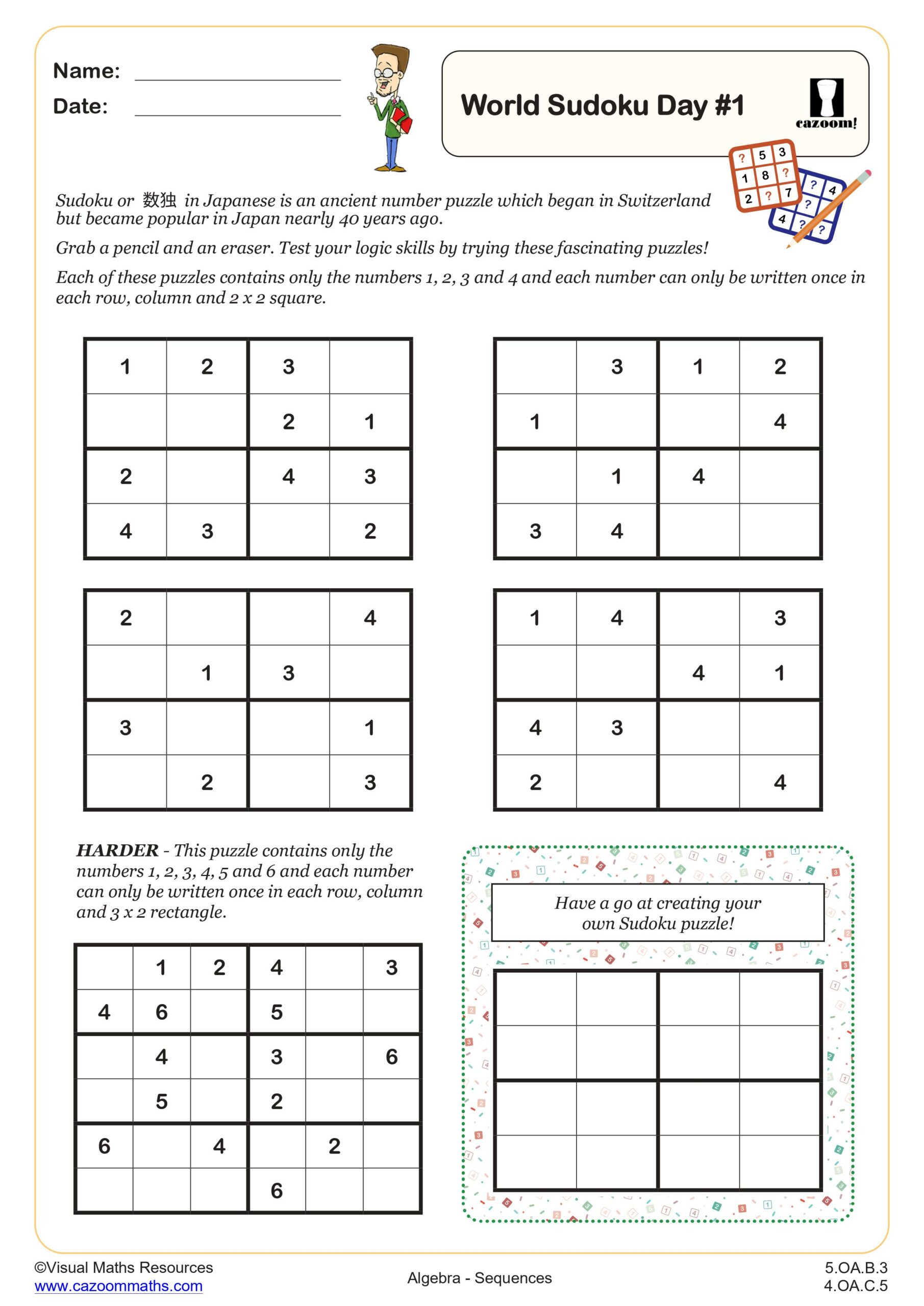
All worksheets are created by the team of experienced teachers at Cazoom Math.
What Are Sequences in Elementary Math?
In elementary mathematics, sequences are ordered lists of numbers or objects that follow a specific rule or pattern. Students learn to identify the pattern, determine the rule governing the sequence, and predict subsequent terms. Sequences build number sense and prepare students for algebra by teaching them to think about relationships between numbers rather than isolated calculations. Common Core State Standards introduce pattern work in kindergarten and progressively increase complexity through fifth grade, connecting to operations, algebraic thinking, and problem-solving skills.
A common misconception occurs when students confuse the pattern rule with the position number. For example, in the sequence 5, 8, 11, 14, students might say the rule is "add 3," which describes the change between consecutive terms, but struggle to find the 10th term without writing all previous terms. Teachers notice students gain flexibility when they practice both extending sequences term-by-term and identifying the relationship between position and value.
Which Grade Levels Use These Sequence Worksheets?
These sequence worksheets cover kindergarten through fifth grade, spanning the complete elementary school stage. Each grade level approaches sequences with age-appropriate complexity, starting with simple visual and numerical patterns in the earliest grades and advancing to multi-step arithmetic sequences and special patterns like the Fibonacci sequence by upper elementary. The worksheets align with standards that expect kindergarten students to identify and duplicate simple repeating patterns, while fifth graders analyze relationships in numerical sequences and apply them to real-world contexts.
The progression builds systematically across grades. Kindergarten and first grade students typically work with repeating patterns using shapes, colors, and single-digit numbers. Second and third graders transition to skip-counting patterns and simple arithmetic sequences. Fourth and fifth graders tackle sequences with larger numbers, negative integers, and fractional steps, while also exploring famous mathematical sequences. Teachers see the most growth when students master skip-counting before moving to sequences with less familiar increments.
What Is the Fibonacci Sequence and Why Teach It?
The Fibonacci sequence is a special pattern where each number equals the sum of the two preceding numbers: 1, 1, 2, 3, 5, 8, 13, 21, and so on. Unlike arithmetic sequences with constant differences, the Fibonacci sequence introduces students to recursive patterns where the rule depends on previous terms rather than position alone. This challenges students to think flexibly about how patterns can be generated and prepares them for more sophisticated mathematical thinking. Advanced elementary students find the Fibonacci sequence engaging because it combines addition practice with pattern recognition in an accessible yet intriguing way.
The Fibonacci sequence appears throughout nature and STEM fields, making it a powerful real-world connection. Students discover this pattern in flower petals, pinecone spirals, nautilus shells, and branching patterns in trees. In technology, the Fibonacci sequence relates to algorithms, data structures, and even stock market analysis. Architecture and art use Fibonacci-based proportions for aesthetically pleasing designs. When students recognize these patterns beyond the classroom, they understand that mathematics describes the natural world, not just abstract exercises on paper.
How Do These Worksheets Build Sequence Skills?
The worksheets scaffold learning through progressive difficulty levels, designated as Equal Steps A through D, allowing teachers to differentiate instruction based on student readiness. Each worksheet presents multiple sequence problems that require students to identify the pattern, fill in missing terms, and sometimes articulate the rule in words or numbers. Answer keys show complete solutions, helping teachers quickly assess understanding and identify which students grasp the underlying concepts versus those who may be guessing. The structured format helps students develop systematic approaches to pattern recognition rather than relying on intuition alone.
Teachers use these worksheets flexibly across different instructional settings. They work well for small-group intervention when students need additional practice with specific sequence types, as warm-up activities to activate prior knowledge, or as independent practice after whole-group instruction. Many teachers assign them as homework because the clear structure and answer keys allow parents to support learning at home. Paired work is particularly effective, where one student extends the sequence while their partner explains the rule, building both computational and communication skills simultaneously.