Elementary School Solve Word Problems Worksheets
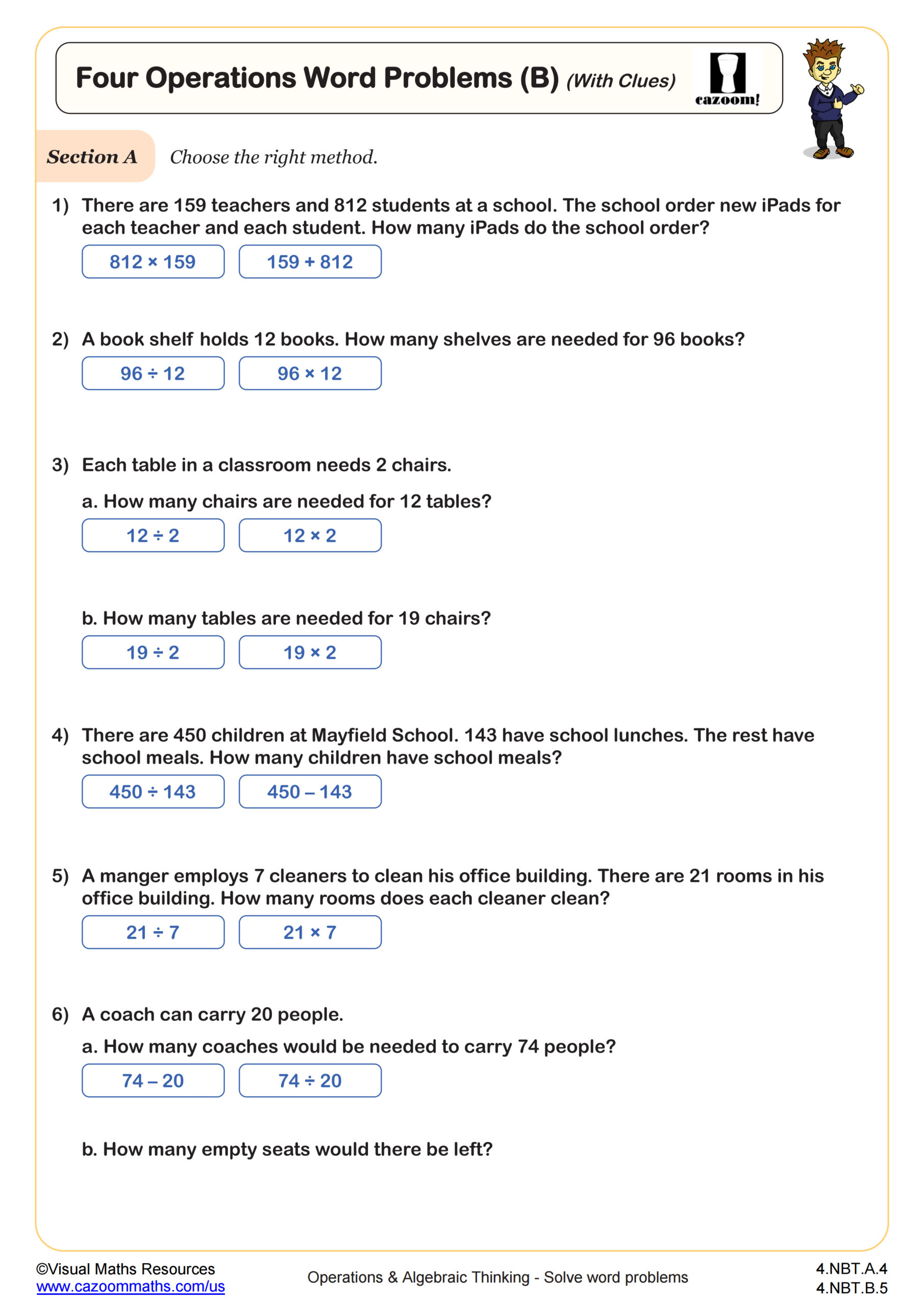
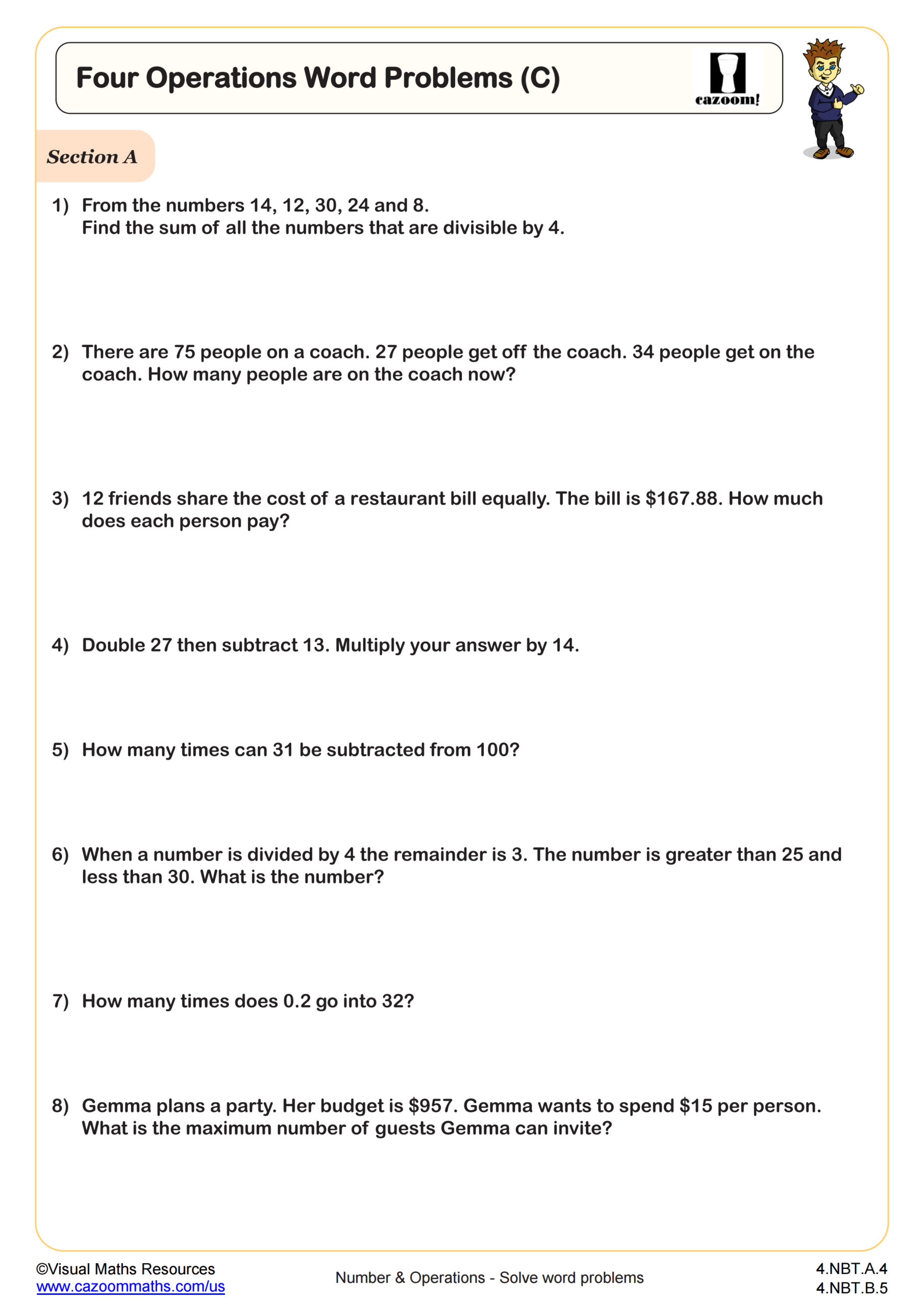
All worksheets are created by the team of experienced teachers at Cazoom Math.
What makes mathematics for primary 2 word problems different from kindergarten math?
Primary 2 mathematics introduces students to more complex word problems that require multi-step thinking and advanced number relationships. Unlike kindergarten's concrete counting scenarios, second-grade students work with problems involving regrouping, measurement comparisons, and basic geometry applications that align with Common Core standards for operations and algebraic thinking.
Teachers observe that students at this level often misinterpret comparison language like "more than" or "fewer than," leading to incorrect operation choices. The transition from manipulative-based problem solving to mental math strategies requires careful scaffolding, with visual supports gradually removed as students develop confidence in abstract reasoning.
How do word problem skills progress across elementary grade levels?
Word problem complexity increases systematically from kindergarten through fifth grade, following Common Core progression standards. Early elementary focuses on single-step problems with small numbers, while upper elementary introduces multi-step problems, fractions, decimals, and algebraic thinking concepts that prepare students for middle school mathematics.
Educators notice distinct developmental patterns: third-graders benefit from problems with familiar contexts, fourth-graders can handle abstract scenarios, and fifth-graders tackle problems requiring multiple mathematical concepts simultaneously. This progression helps teachers select appropriate challenge levels while maintaining student engagement and building problem-solving confidence across grade levels.
Why do students struggle with identifying operations in word problems?
Operation identification challenges stem from students' tendency to focus on keywords rather than understanding problem relationships. Many students automatically add when they see "altogether" or subtract when they see "left," without analyzing the actual mathematical relationship described in the problem context.
Classroom observations reveal that students benefit from explicit instruction in problem analysis strategies, including underlining important information and restating problems in their own words. Teaching students to visualize problems through drawings or diagrams significantly improves their ability to select correct operations and avoid common misconception traps that lead to incorrect solutions.
How can teachers use these word problem worksheets most effectively?
Effective implementation involves using worksheets as guided practice tools rather than independent work initially. Teachers find success by working through the first few problems together, modeling problem-solving strategies and thinking processes aloud before releasing students to work independently with remaining problems.
The included answer keys serve multiple purposes beyond checking student work. Teachers use them to identify common error patterns, plan targeted interventions, and facilitate peer discussion about different solution approaches. Regular analysis of student responses helps teachers adjust instruction and provide differentiated support for students at various skill levels.