Elementary School Transformations Worksheets
All worksheets are created by the team of experienced teachers at Cazoom Math.
What Are Transformations in Elementary Math?
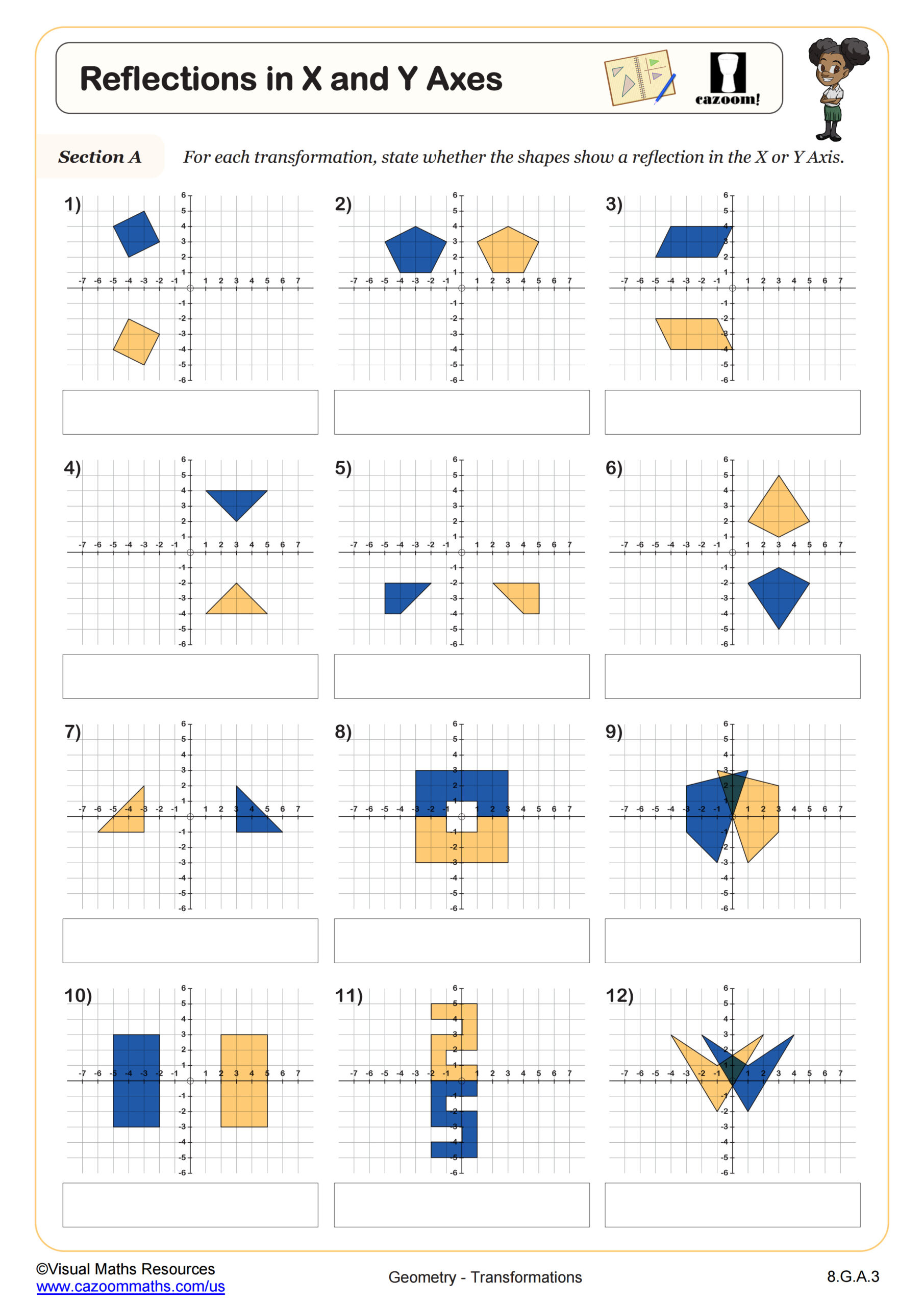
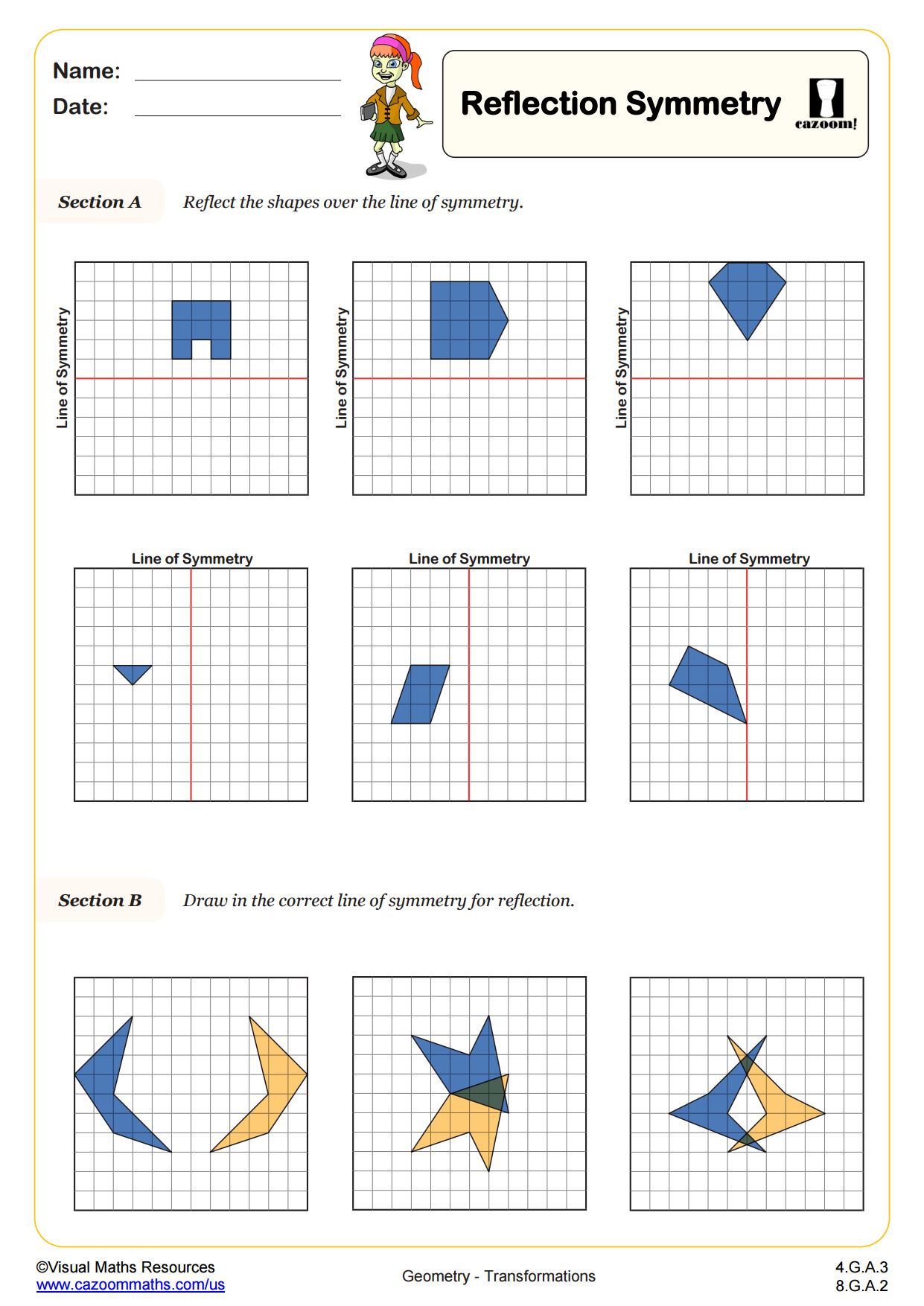
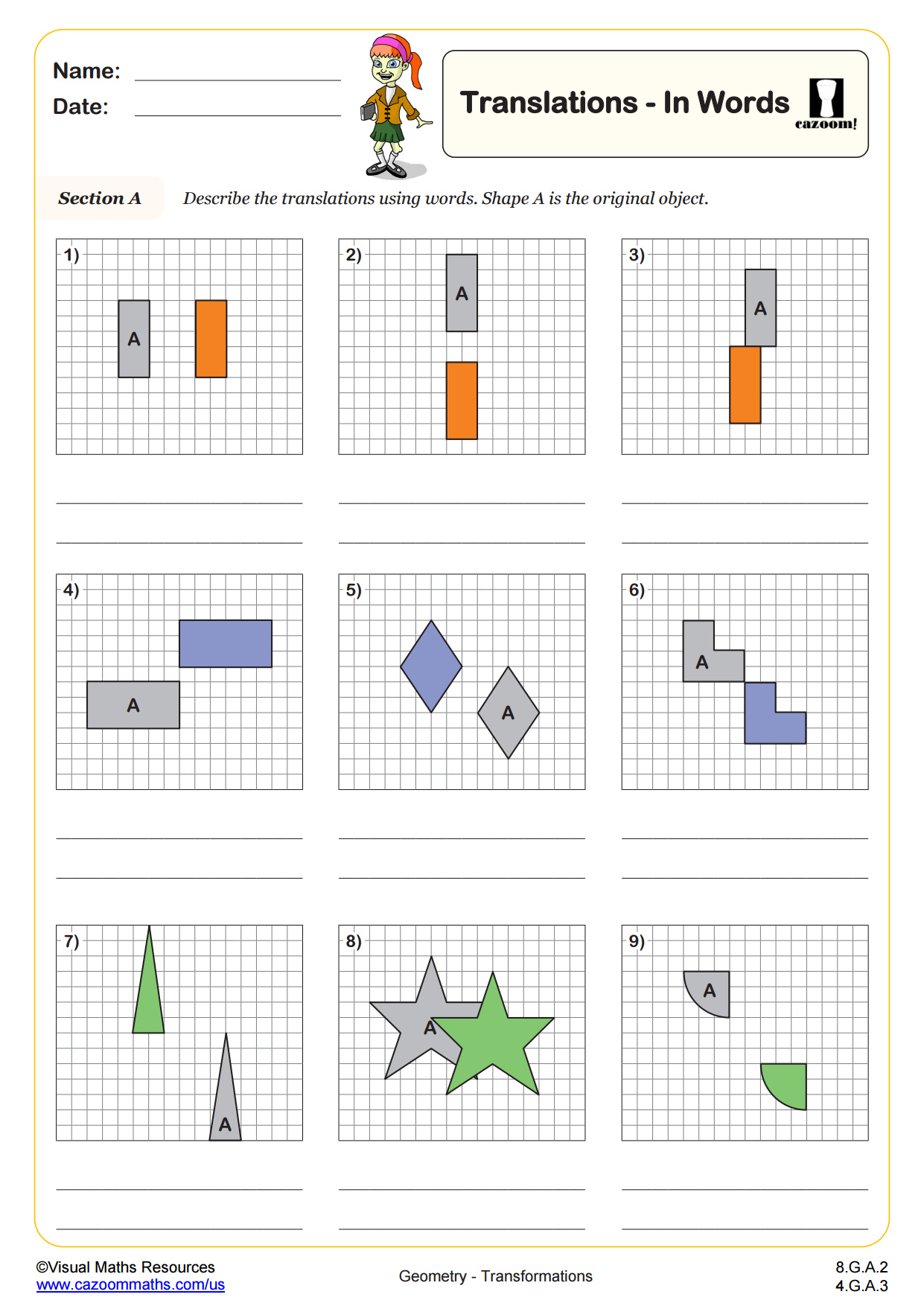
Transformations in elementary mathematics introduce students to how shapes can move in space through slides (translations), flips (reflections), and turns (rotations). At the elementary level, students begin by identifying symmetry in simple shapes and patterns, then progress to creating and describing their own transformations. This foundation connects directly to geometry standards and prepares students for coordinate plane work in middle school.
A common misconception emerges when students think a reflected shape is a different shape entirely rather than recognizing it as the same shape in a new position. Teachers frequently address this by having students trace shapes on patty paper and physically flip or rotate them, making the concept of congruency through transformation concrete and visible rather than abstract.
Which Grade Levels Cover Transformations Worksheets?
These transformation worksheets span kindergarten through fifth grade at the elementary school level. Kindergarten and first grade students begin with basic symmetry recognition and simple pattern completion, while second and third graders identify and create symmetric patterns with increasing complexity. Fourth and fifth grade students work with more formal transformation concepts including rotations, reflections, and understanding congruency and similarity.
The progression builds naturally as students develop stronger spatial reasoning skills. Early elementary students focus on visual identification—does this shape have symmetry?—while upper elementary students describe transformations more precisely and predict outcomes. By fifth grade, students connect transformations to coordinate grids and use mathematical language to describe the degree and direction of rotations, preparing them for the more formal transformation geometry taught in middle school.
How Do Students Learn About Rotation in Transformations?
Rotation involves turning a shape around a fixed point, and elementary students typically work with 90-degree, 180-degree, and 270-degree rotations (quarter turns, half turns, and three-quarter turns). Students learn to identify the center of rotation and predict where points on a shape will move after the turn. The worksheets progress from recognizing completed rotations to performing rotations themselves and describing the degree of turn using mathematical vocabulary.
Rotation concepts connect directly to real-world mechanics and engineering. Students see rotations in action when observing clock hands, ceiling fans, or wheels turning—each demonstrating circular motion around a central point. In robotics programs increasingly common in elementary STEM education, students program turns and rotations to navigate mazes or complete tasks, making the mathematical concept of rotation essential for coding directional commands and predicting movement outcomes.
How Can Teachers Use These Transformation Worksheets Effectively?
The worksheets provide structured practice that moves from visual identification to hands-on creation of transformations. Many include grid backgrounds that help students count spaces and verify their work, while symmetric pattern worksheets challenge students to complete designs by applying their understanding of reflection. The complete answer keys allow students to self-check during independent work or enable quick assessment of student understanding during whole-class review.
Teachers find these worksheets particularly valuable during math centers or station rotations, where students can work at their own pace while the teacher provides small-group instruction. They work well as warm-up activities to activate spatial thinking before geometry lessons, and as homework assignments that parents can easily support since the visual nature makes the concepts accessible. Many teachers also use them for intervention with students who need additional practice recognizing congruent shapes or for enrichment when students explore creating their own symmetric designs.