Geometry Angles Worksheets
All worksheets are created by the team of experienced teachers at Cazoom Math.
What Angle Concepts Do High School Geometry Students Need to Master?
High school Geometry expands angle understanding from basic definitions to complex relationships involving parallel lines, transversals, and polygons. Students encounter corresponding angles, alternate interior angles, and consecutive interior angles when working with parallel and perpendicular lines. Teachers observe that students who can identify these relationships visually perform significantly better on proofs and coordinate geometry problems later in the course.
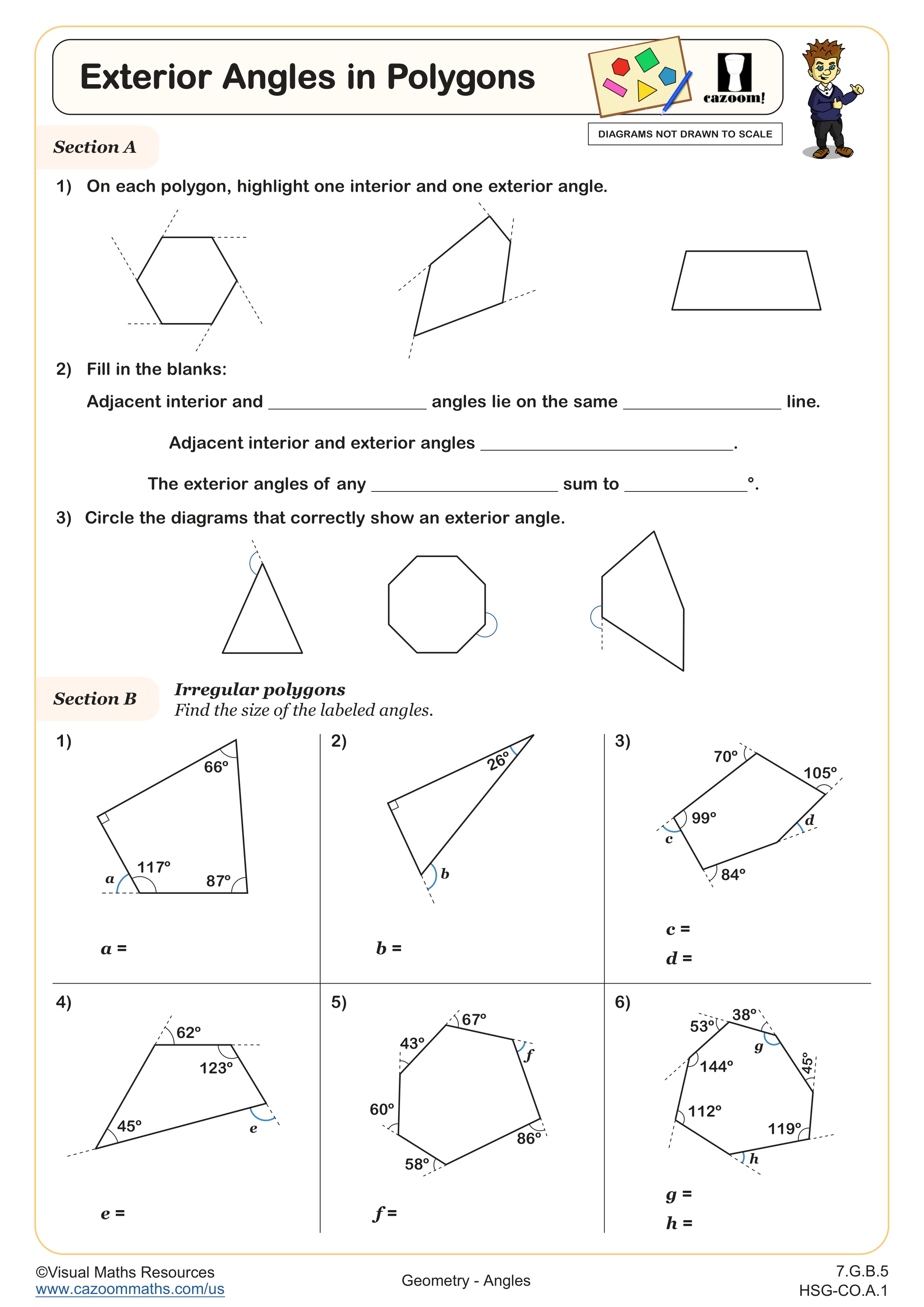
Exterior angles in polygons challenge students to apply the relationship that an exterior angle equals the sum of the two remote interior angles in triangles, then extend this thinking to other polygons. A common misconception occurs when students confuse exterior angle sums with interior angle sums. Students confidently tackle polygon problems once they recognize that exterior angles always sum to 360 degrees regardless of the number of sides, while interior angle sums depend on the polygon type.
How Do Angle Questions Appear on the SAT and ACT?
Standardized tests like the SAT and ACT regularly feature angle problems that require recognizing relationships rather than memorizing formulas. Students lose points when they fail to identify parallel lines cut by transversals or when they cannot determine exterior angles in geometric figures. The SAT Math section particularly emphasizes visual reasoning with angles in coordinate geometry and trigonometric contexts, where students must apply multiple angle relationships simultaneously.
College-bound students benefit from practicing angle identification under timed conditions because these problems often appear early in test sections. Teachers frequently notice that students who practice with varied diagram orientations perform better because standardized tests intentionally present figures in non-standard positions. Questions about perpendicular lines in coordinate geometry connect to slope concepts, making angle recognition essential for success across multiple math domains tested on college entrance exams.
Why Do Students Struggle With Identifying Parallel and Perpendicular Lines?
Students often struggle with parallel and perpendicular line identification because they rely on visual appearance rather than applying angle relationships. A breakthrough typically happens when students recognize that parallel lines create specific angle pairs with predictable measurements when cut by a transversal. Teachers notice that students miss problems involving perpendicular lines when diagrams show right angles without the traditional square symbol, leading them to assume measurements rather than prove them.
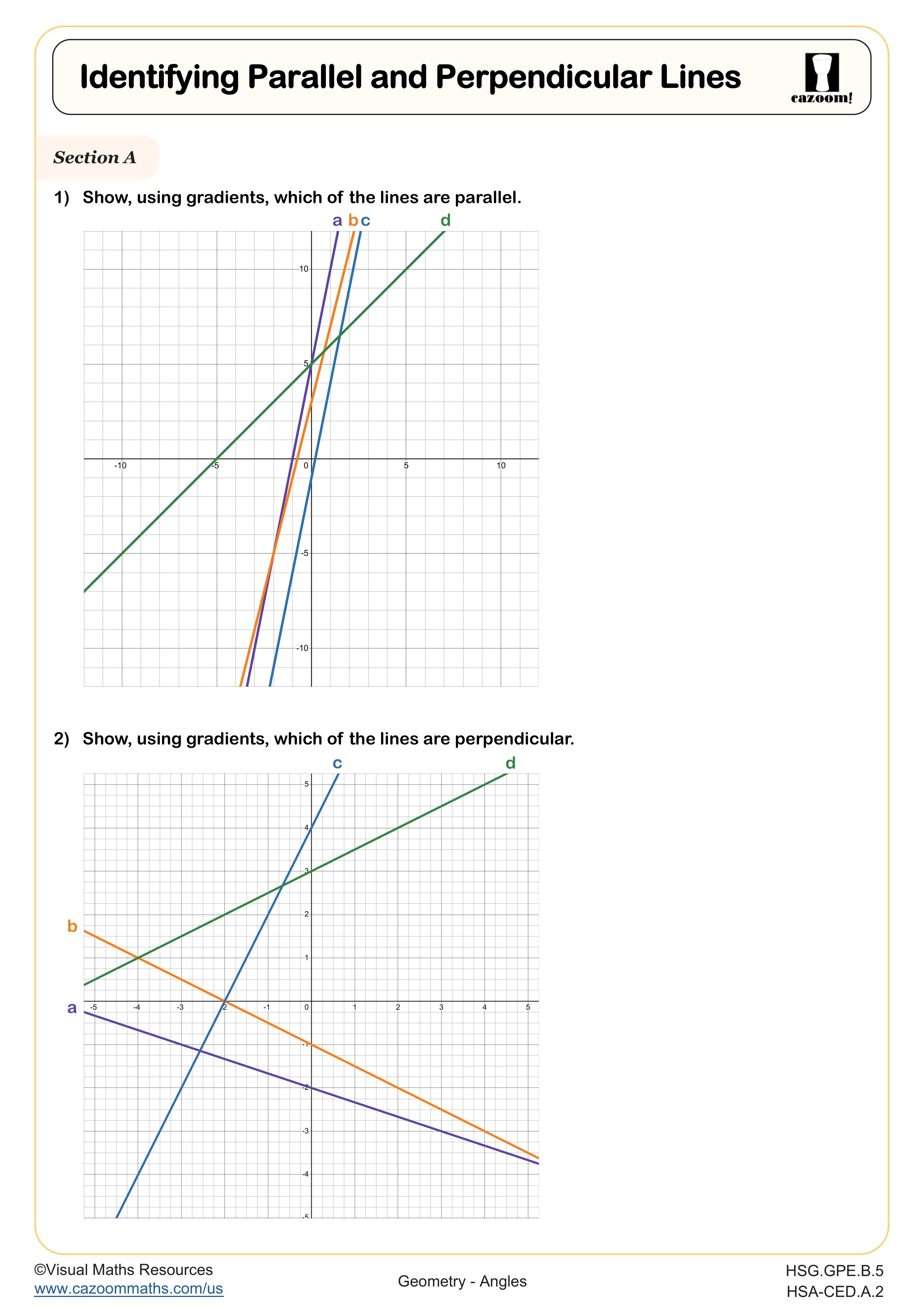
This skill appears again in coordinate geometry when students must determine whether lines are parallel (equal slopes) or perpendicular (negative reciprocal slopes). Many students make the connection between geometric angle relationships and algebraic slope concepts once they practice both representations together. Real-world applications include architecture and engineering, where identifying parallel support beams or perpendicular wall intersections ensures structural integrity. Students confidently tackle construction and design problems when they understand these fundamental angle relationships.
How Should Teachers Use These Angle Worksheets in Geometry Class?
Teachers get the best results when they use these worksheets after introducing angle vocabulary and relationships through hands-on activities with protractors or geometry software. The worksheet on identifying parallel and perpendicular lines works well as guided practice immediately following direct instruction, while the exterior angles worksheet serves as effective independent practice once students grasp triangle angle relationships. Complete answer keys allow students to check their work immediately, reinforcing correct thinking or revealing misunderstandings before they become habits.
This topic becomes easier when students first master basic angle classifications (acute, obtuse, right) and angle pair relationships (complementary, supplementary, vertical). Teachers frequently notice that students benefit from completing one problem type at a time rather than mixing concepts initially. Using these worksheets as formative assessments helps identify which students need additional support with visual recognition versus calculation skills, allowing for targeted intervention before summative assessments or standardized testing.