HSA-APR.B.3 Worksheets
Common Core State Standards HSA.APR.B.3 Worksheets
Strand: Arithmetic with Polynomials and Rational Expressions
Objective: Understand the relationship between zeros and factors of polynomials
CCSS Description: Identify zeros of polynomials when suitable factorizations are available, and use the zeros to construct a rough graph of the function defined by the polynomial.
Cazoom Math is a leading provider of Math Worksheets and used by over 50,000 teachers and parents around the world. Here you can find a set of math worksheets aligned to the common core standard HSA.APR.B.3. These worksheets are perfect for learners to develop critical math skills.
You can click on the images below to find out more about each math worksheet, and download and print the resource.
We have a great range of resources for students in High School. Check out our High School Math Worksheets page for more details.
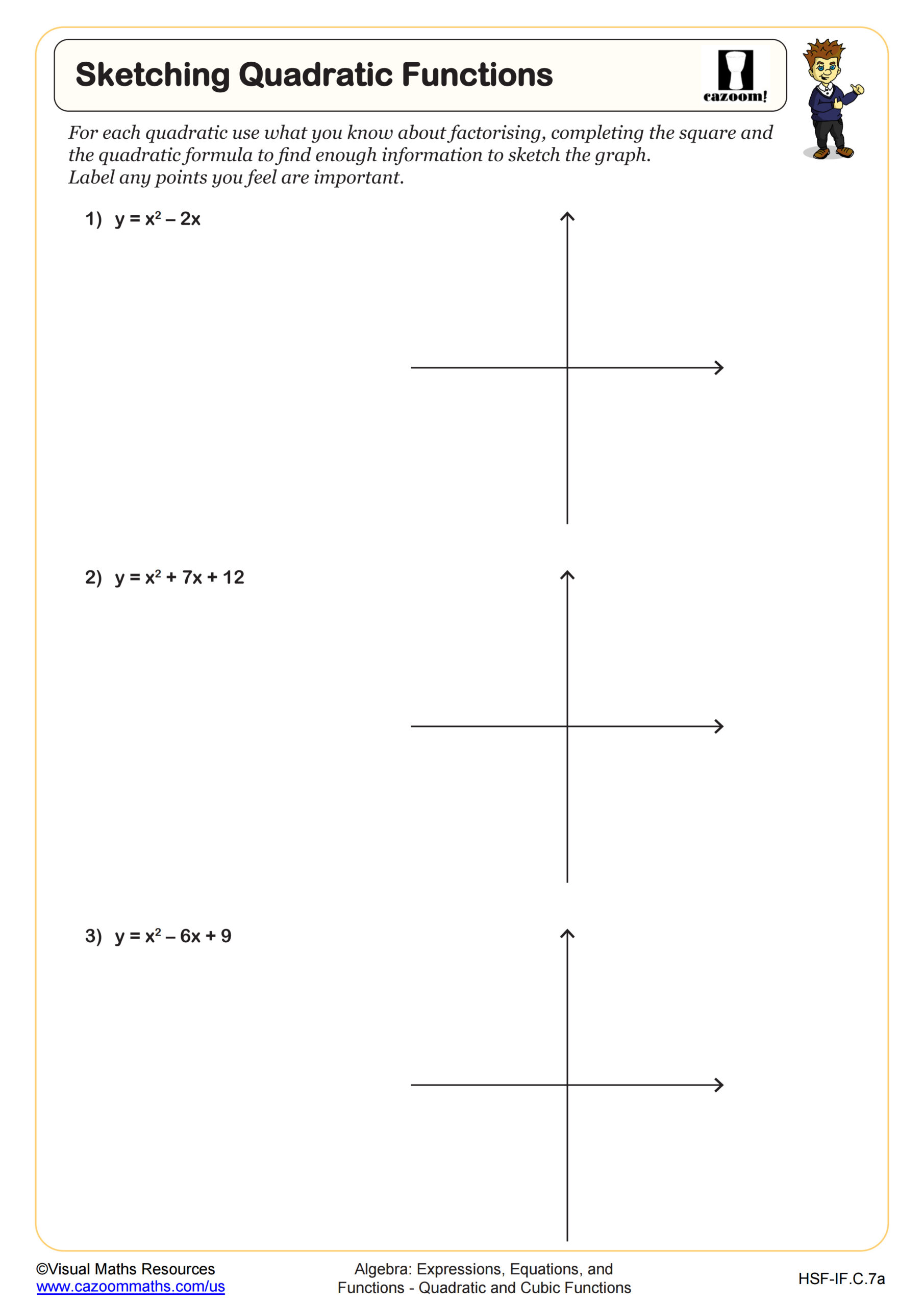
All worksheets are created by the team of experienced teachers at Cazoom Math.
What does HSA-APR.B.3 cover in polynomial graphing?
The hsa-apr.b.3 standard focuses on identifying zeros of polynomials when suitable factorizations are available and using the zeros to construct a rough graph of the function defined by the polynomial. Students learn to find x-intercepts, determine multiplicities, and understand how these features affect graph behavior.
Teachers frequently observe that students struggle with connecting algebraic zeros to graphical x-intercepts, often plotting points incorrectly or missing the significance of repeated roots. The standard emphasizes using factored form to identify key graphical features rather than plotting numerous points, preparing students for more advanced polynomial analysis in precalculus and calculus courses.
Which grade levels typically study polynomial zeros and graphing?
HSA-APR.B.3 appears in Algebra 2 courses, typically taught to students in grades 10-11, though some advanced 9th graders encounter this material in accelerated programs. The standard builds on factoring skills from Algebra 1 and prepares students for polynomial functions in precalculus.
Mathematics teachers note that students need solid factoring foundations before tackling this standard effectively. Schools often sequence this topic after quadratic functions but before rational functions, allowing students to develop graphing intuition with polynomials of increasing complexity. Some districts revisit these concepts in precalculus courses with greater emphasis on transformations and composition of functions.
How do students identify zeros from different polynomial forms?
Students learn to identify zeros from factored form, expanded form requiring factoring, and sometimes from rational root theorem applications. The standard emphasizes recognizing that if (x - a) is a factor, then x = a is a zero, and understanding how multiplicity affects graph behavior at intercepts.
Classroom experience shows students often miss that zeros with even multiplicity touch but don't cross the x-axis, while odd multiplicity zeros cross the axis. Teachers report success when students practice identifying zeros from various factored forms before attempting to sketch complete graphs, building the connection between algebraic manipulation and graphical representation systematically.
How can teachers use these worksheets most effectively in class?
These worksheets work well as guided practice after demonstrating polynomial factoring and graphing connections, allowing students to apply concepts with immediate feedback from included answer keys. Teachers can assign problems progressively, starting with simple factored polynomials before moving to expressions requiring factoring skills.
Many educators use these materials for differentiated instruction, providing additional practice for students who need reinforcement while offering challenge problems for advanced learners. The answer keys enable student self-assessment and peer tutoring opportunities. Teachers often incorporate these worksheets into stations or homework assignments, using the clear solutions to facilitate productive classroom discussions about common errors and alternative solution approaches.