HSF-IF.A.3 Worksheets
Common Core State Standards HSF.IF.A.3 Worksheets
Strand: Interpreting Functions
Objective: Understand the concept of a function and use function notation.
CCSS Description: Recognize that sequences are functions, sometimes defined recursively, whose domain is a subset of the integers. For example, the Fibonacci sequence is defined recursively by f(0) = f(1) = 1, f(n+1) = f(n) + f(n–1) for n ≥ 1.
Cazoom Math is a leading provider of Math Worksheets and used by over 50,000 teachers and parents around the world. Here you can find a set of math worksheets aligned to the common core standard HSF.IF.A.3. These worksheets are perfect for learners to develop critical math skills.
You can click on the images below to find out more about each math worksheet, and download and print the resource.
We have a great range of resources for students in High School. Check out our High School Math Worksheets page for more details.
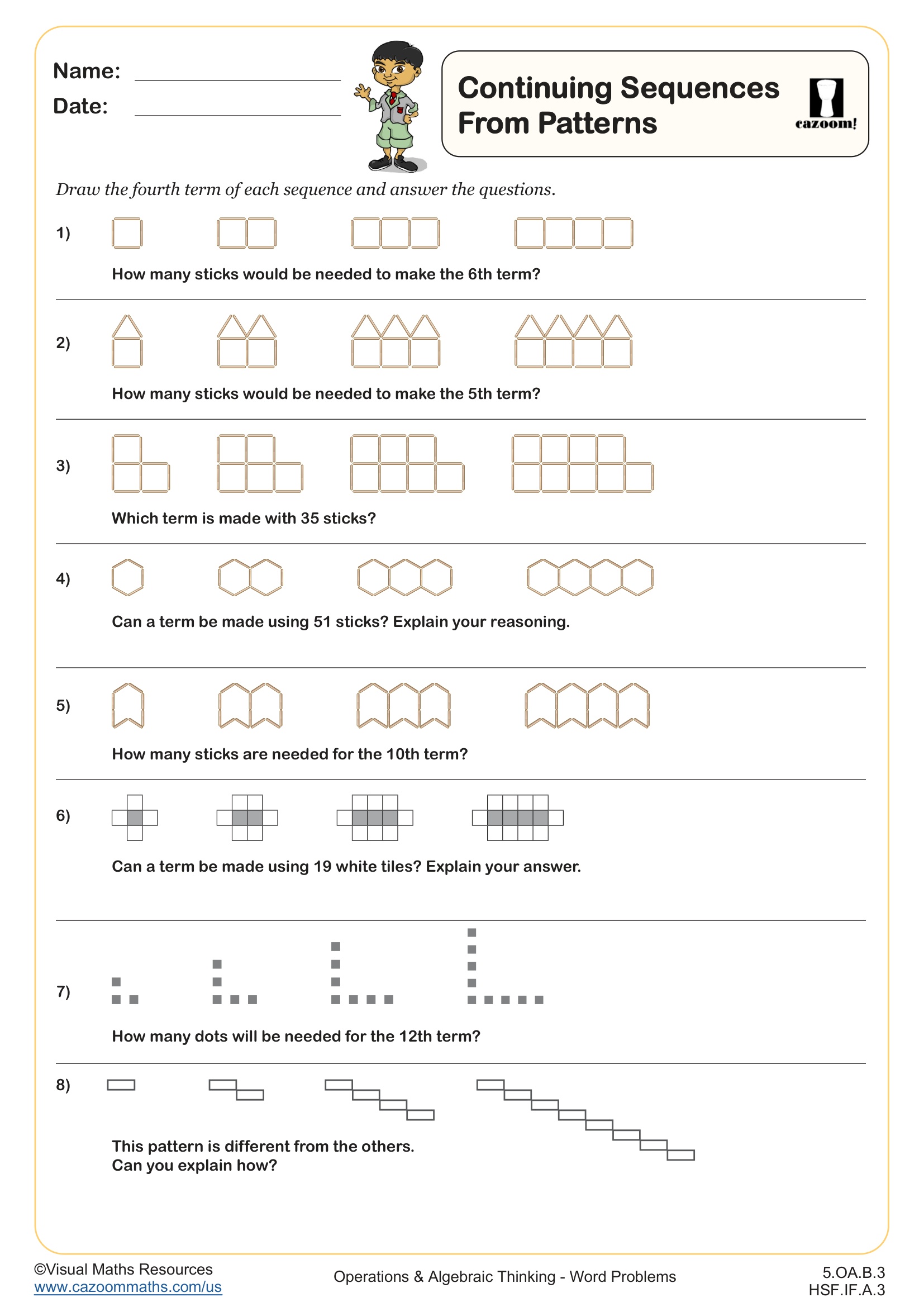
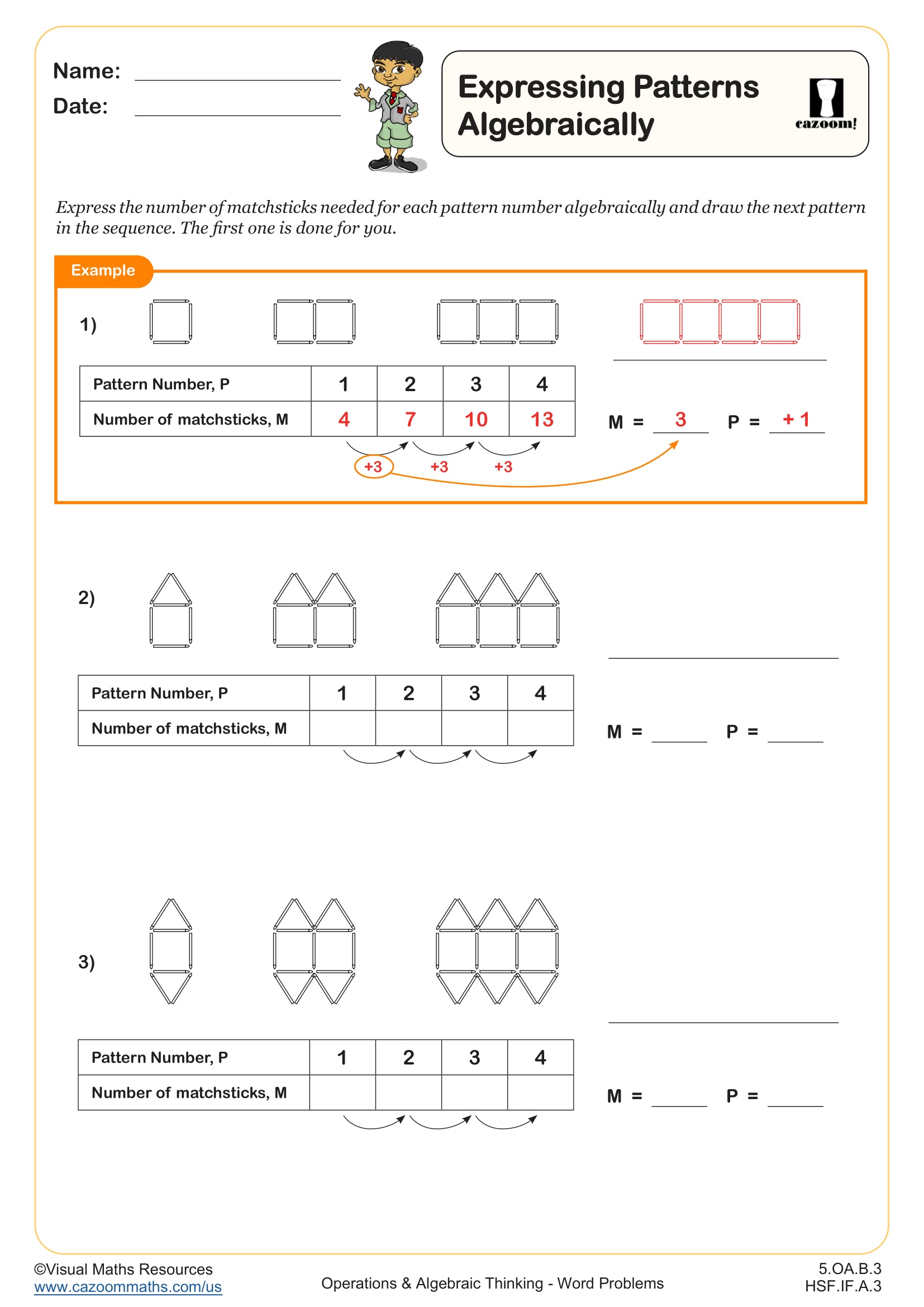
All worksheets are created by the team of experienced teachers at Cazoom Math.
How do you solve if f, of, 1, equals, 2f(1)=2 and f, of, n, equals, 5, f, of, n, minus, 1f(n)=5f(n−1) then find the value of f, of, 5f(5)?
This recursive sequence problem requires applying the rule f(n) = 5f(n-1) starting from f(1) = 2. Students calculate each term systematically: f(2) = 5(2) = 10, f(3) = 5(10) = 50, f(4) = 5(50) = 250, and f(5) = 5(250) = 1250. The Common Core standard HSF.IF.A.3 emphasizes recognizing sequences as functions with domains that are subsets of integers.
Teachers notice students frequently make calculation errors in the middle steps, especially when dealing with larger numbers. The key teaching point involves showing students how to organize their work clearly, writing each intermediate step to avoid computational mistakes that compound through the sequence.
What grade levels use HSF.IF.A.3 recursive sequence worksheets?
HSF.IF.A.3 appears primarily in Algebra 2 and Pre-Calculus courses, typically serving 11th and 12th grade students. However, some advanced Algebra 1 classes introduce basic recursive concepts, while dual enrollment and AP Precalculus courses extend these skills toward more complex applications. The standard builds on earlier function work from HSF.IF.A.1 and HSF.IF.A.2.
Many teachers find that students need significant scaffolding when transitioning from explicit formulas to recursive definitions. The progression typically moves from simple arithmetic sequences to geometric sequences, then to more complex recursive relationships that appear in population modeling and compound interest calculations in STEM fields.
How do geometric recursive sequences differ from arithmetic ones in these worksheets?
Geometric recursive sequences like if f, of, 1, equals, 7f(1)=7 and f, of, n, equals, minus, 5, f, of, n, minus, 1f(n)=−5f(n−1) then find the value of f, of, 5f(5) involve multiplication or division, while arithmetic sequences use addition or subtraction such as if f, of, 1, equals, 6f(1)=6 and f, of, n, equals, f, of, n, minus, 1, minus, 3f(n)=f(n−1)−3 then find the value of f, of, 5f(5). Students must recognize whether the recursive rule multiplies by a constant or adds a constant to the previous term.
Teachers report that students often confuse the two types, particularly when negative coefficients are involved. The worksheets progress from positive integer multipliers to fractional and negative multipliers, helping students recognize patterns in exponential growth and decay that connect to real-world applications in finance and biology.
What strategies help students succeed with these recursive sequence worksheets?
Teachers find success when students create organized tables showing the step-by-step progression from the initial term through each calculated value. This visual approach prevents students from skipping steps and helps identify exactly where errors occur. Encouraging students to double-check their arithmetic at each step significantly improves accuracy rates on complex problems.
Many teachers recommend having students work in pairs to verify calculations, particularly on problems requiring four or five iterations like if f, of, 1, equals, 2f(1)=2 and f, of, n, equals, f, of, n, minus, 1, plus, 5f(n)=f(n−1)+5 then find the value of f, of, 6f(6). The answer keys provide teachers with diagnostic information about whether errors stem from conceptual misunderstandings or computational mistakes, allowing for targeted intervention.