HSF-TF.A.3 Worksheets
Common Core State Standards HSF.TF.A.3 Worksheets
Strand: Trigonometric Functions
Objective: Extend the domain of trigonometric functions using the unit circle
CCSS Description: (+) Use special triangles to determine geometrically the values of sine, cosine, tangent for π/3, π/4 and π/6, and use the unit circle to express the values of sine, cosine, and tangent for π–x, π+x, and 2π–x in terms of their values for x, where x is any real number.
Cazoom Math is a leading provider of Math Worksheets and used by over 50,000 teachers and parents around the world. Here you can find a set of math worksheets aligned to the common core standard HSF.TF.A.3. These worksheets are perfect for learners to develop critical math skills.
You can click on the images below to find out more about each math worksheet, and download and print the resource.
We have a great range of resources for students in High School. Check out our High School Math Worksheets page for more details.
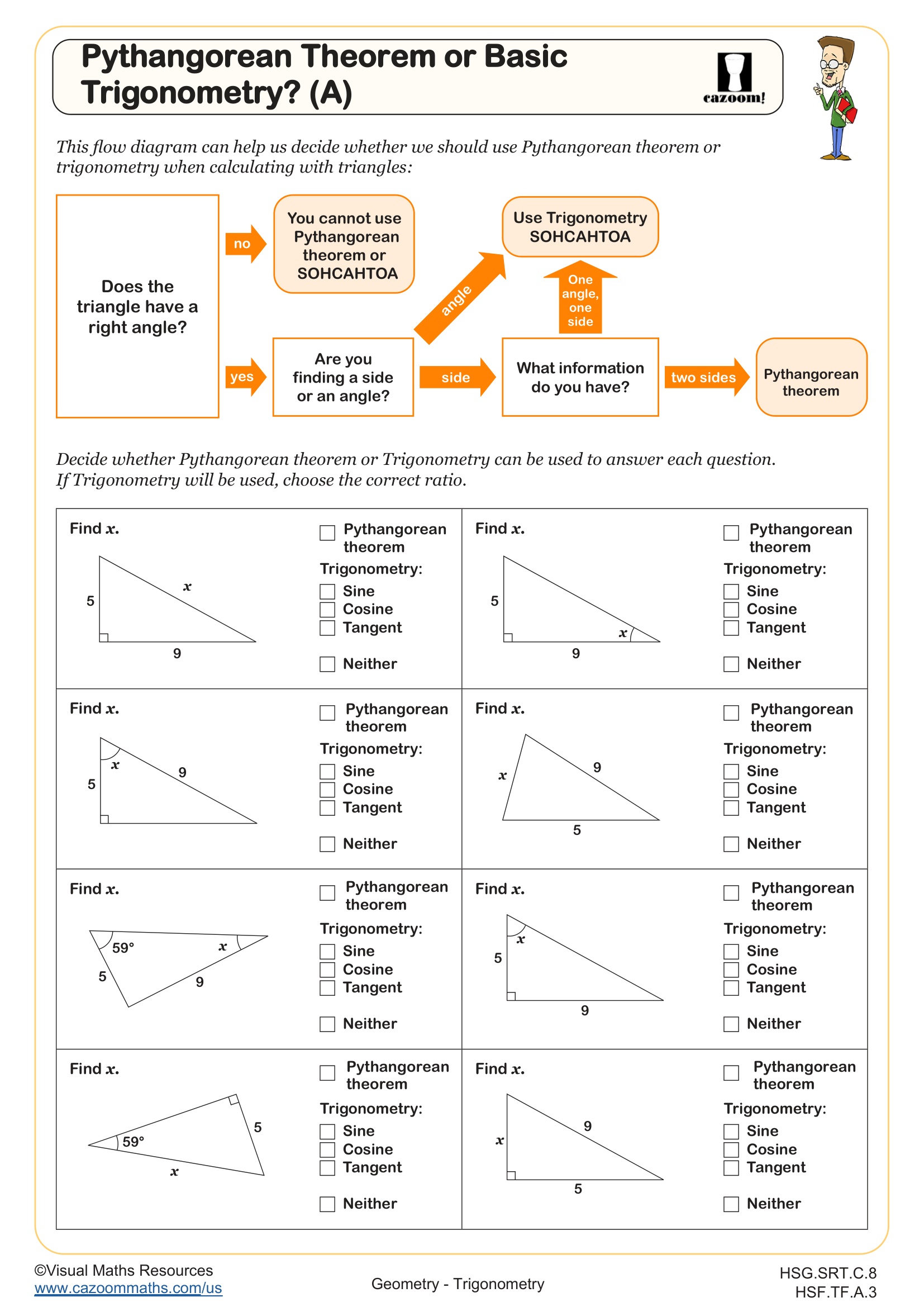
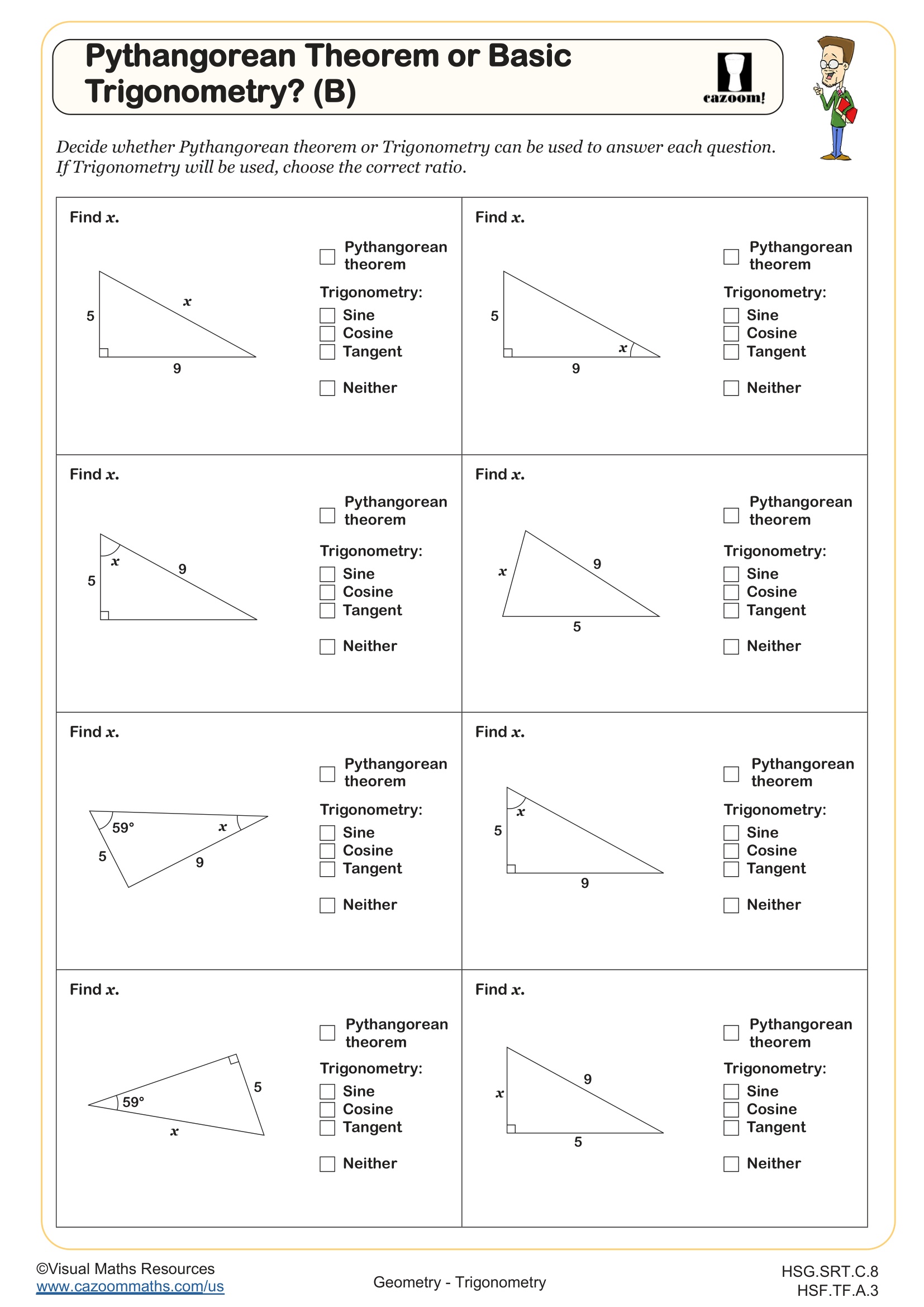
All worksheets are created by the team of experienced teachers at Cazoom Math.
What makes an effective angles and triangles worksheet grade 7?
An effective grade 7 angles and triangles worksheet introduces basic trigonometric concepts through right triangle relationships, focusing on angle measurement and simple ratio work. At this level, students typically explore angle sum properties in triangles and begin understanding complementary and supplementary angle relationships that lay groundwork for future trigonometric study.
Teachers notice that seventh graders benefit most from visual triangle problems with clear labeling and step-by-step ratio setups. Students frequently confuse adjacent and opposite sides when first learning trigonometric ratios, so worksheets with consistent vertex labeling and color-coded sides help prevent these foundational errors that can persist into higher-level courses.
How do trigonometry worksheets progress across different grade levels?
Trigonometry worksheets build systematically from middle school angle relationships through advanced high school applications. Grade 7 and 8 students work with basic triangle properties and angle measurements, while high school students tackle sine, cosine, and tangent functions with increasing complexity through Algebra 2 and Precalculus levels.
The progression moves from identifying angle types and using basic geometric relationships to solving real-world problems involving indirect measurement. Teachers observe that students who master foundational angle work in middle grades demonstrate stronger performance when encountering inverse trigonometric functions and unit circle concepts in later high school mathematics courses.
Why do students struggle with choosing the correct trigonometric ratio?
Students commonly struggle with trigonometric ratio selection because they haven't developed a systematic approach for identifying sides relative to the reference angle. Many students memorize SOH-CAH-TOA without understanding the underlying relationships between angle position and side classification, leading to random guessing rather than strategic problem-solving.
Teachers find that students benefit from consistent practice labeling sides as opposite, adjacent, or hypotenuse before attempting any calculations. Drawing reference angles clearly and using color coding helps students visualize these relationships. Students who skip the labeling step often select ratios incorrectly, even when they can perform the arithmetic calculations accurately.
How can teachers maximize student success with these trigonometry worksheets?
Teachers achieve better results when they model the complete problem-solving process before assigning independent practice, emphasizing the systematic approach of labeling sides and identifying the appropriate ratio. Providing immediate feedback through the included answer keys allows students to self-correct and understand their errors while concepts remain fresh.
Classroom implementation works best when teachers assign problems in small sets rather than entire worksheets at once, allowing time for discussion of common errors and solution strategies. Teachers report that students show improved retention when they explain their ratio selection process aloud to partners before calculating, reinforcing the decision-making skills needed for more advanced trigonometric applications.