HSG-C.A.3 Worksheets
Common Core State Standards HSG.C.A.3 Worksheets
Strand: Circles
Objective: Understand and apply theorems about circles
CCSS Description: Construct the inscribed and circumscribed circles of a triangle, and prove properties of angles for a quadrilateral inscribed in a circle.
Cazoom Math is a leading provider of Math Worksheets and used by over 50,000 teachers and parents around the world. Here you can find a set of math worksheets aligned to the common core standard HSG.C.A.3. These worksheets are perfect for learners to develop critical math skills.
You can click on the images below to find out more about each math worksheet, and download and print the resource.
We have a great range of resources for students in High School. Check out our High School Math Worksheets page for more details.
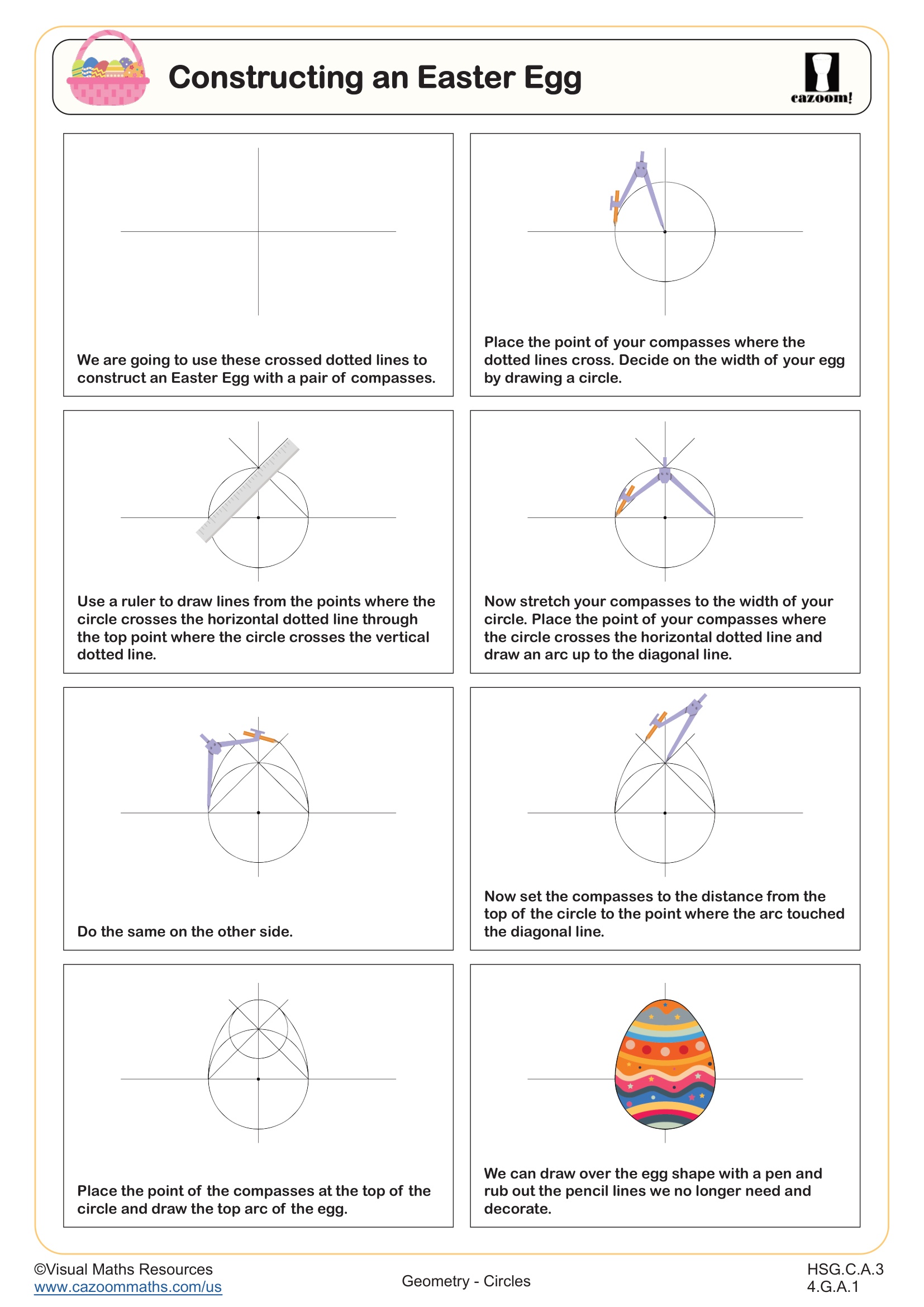
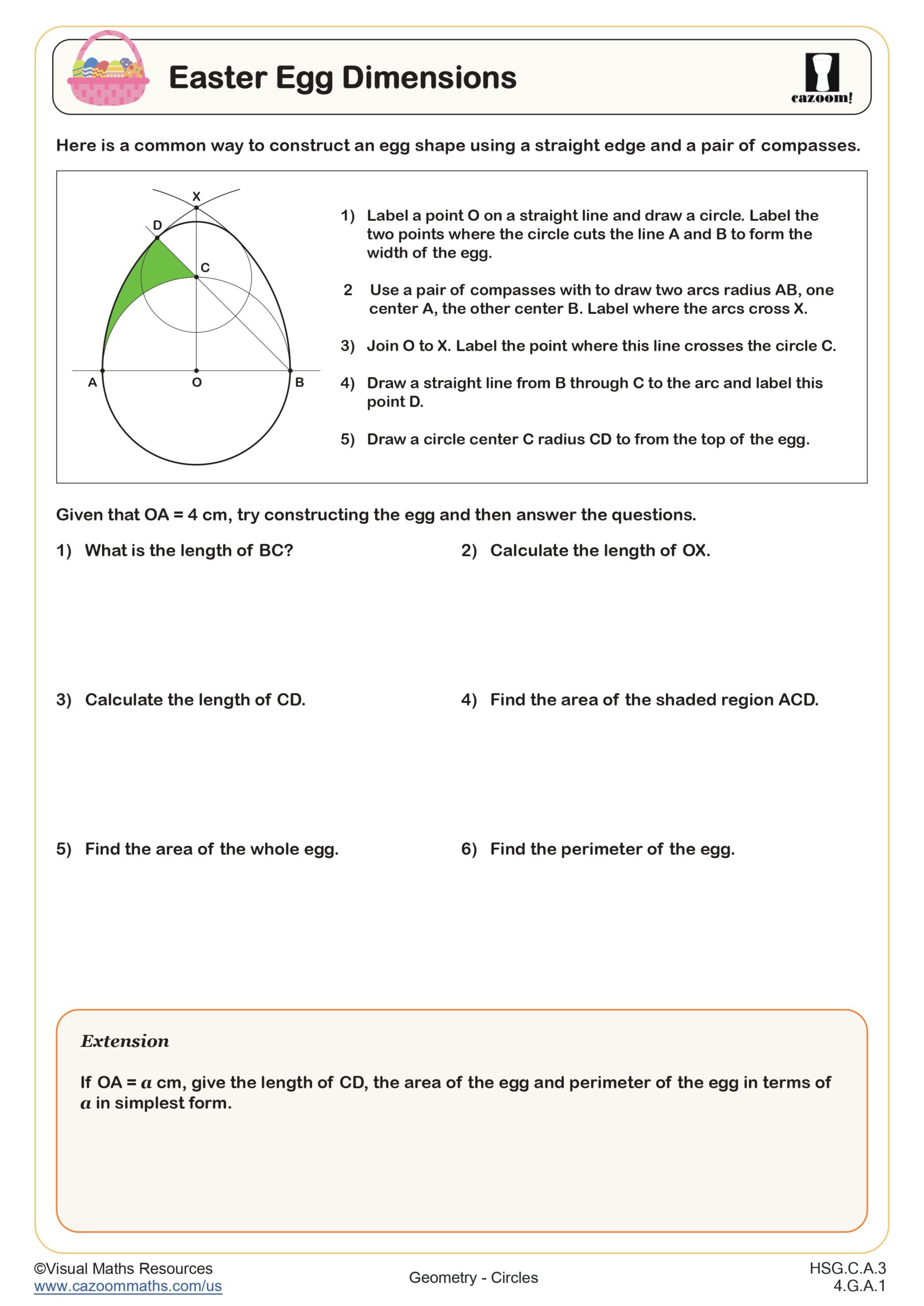
All worksheets are created by the team of experienced teachers at Cazoom Math.
What topics are covered in math 3 high school worksheets for circles?
These worksheets focus on HSG-C.A.3 standards, covering the construction of inscribed and circumscribed circles of triangles, properties of inscribed quadrilaterals, and angle relationships in circles. Students practice identifying centers of circles, using perpendicular bisectors for circumscribed circles, and applying angle theorems for cyclic quadrilaterals.
Teachers notice that students often confuse inscribed and circumscribed circles initially, mixing up whether the triangle is inside or outside the circle. The worksheets provide clear visual examples and step-by-step construction problems that help students distinguish between these concepts and understand when to apply each type of circle construction in geometric proofs.
Which grade levels typically use HSG-C.A.3 circle worksheets?
HSG-C.A.3 standards typically appear in high school geometry courses, most commonly in grades 9-11 depending on the school's math sequence. Students in accelerated programs might encounter these concepts in grade 9, while others work with circle geometry in grade 10 or 11 geometry classes.
The worksheets build on prior knowledge of basic circle properties, coordinate geometry, and triangle constructions that students learn in earlier high school math courses. Teachers find that students need solid understanding of perpendicular bisectors and angle relationships before tackling inscribed and circumscribed circle constructions, making these worksheets most effective after foundational geometry topics are established.
How do students apply inscribed angle theorems in these worksheets?
The worksheets emphasize the inscribed angle theorem, which states that an inscribed angle measures half the central angle that subtends the same arc. Students practice identifying inscribed angles, measuring central angles, and calculating unknown angle measures in circles with inscribed polygons.
Teachers consistently observe that students make calculation errors when working with inscribed quadrilaterals, often forgetting that opposite angles in a cyclic quadrilateral are supplementary. The worksheets include multiple problems that reinforce this relationship, helping students recognize patterns and avoid common mistakes when solving for unknown angles in inscribed figures.
How can teachers use these circle geometry worksheets effectively in class?
Teachers find these worksheets work best when introduced after demonstrating circle constructions with compass and straightedge, allowing students to connect hands-on construction experience with theoretical properties. The answer keys enable teachers to provide immediate feedback during guided practice or use the worksheets for independent assessment.
Many teachers use these worksheets as differentiated practice, assigning different problems based on student readiness levels while maintaining focus on the same HSG-C.A.3 standards. The variety of problem types allows teachers to spiral back to circle concepts throughout the geometry course, reinforcing connections between coordinate geometry, constructions, and angle relationships that students will need for advanced math courses.