Integrated Math 1 Estimation Worksheets
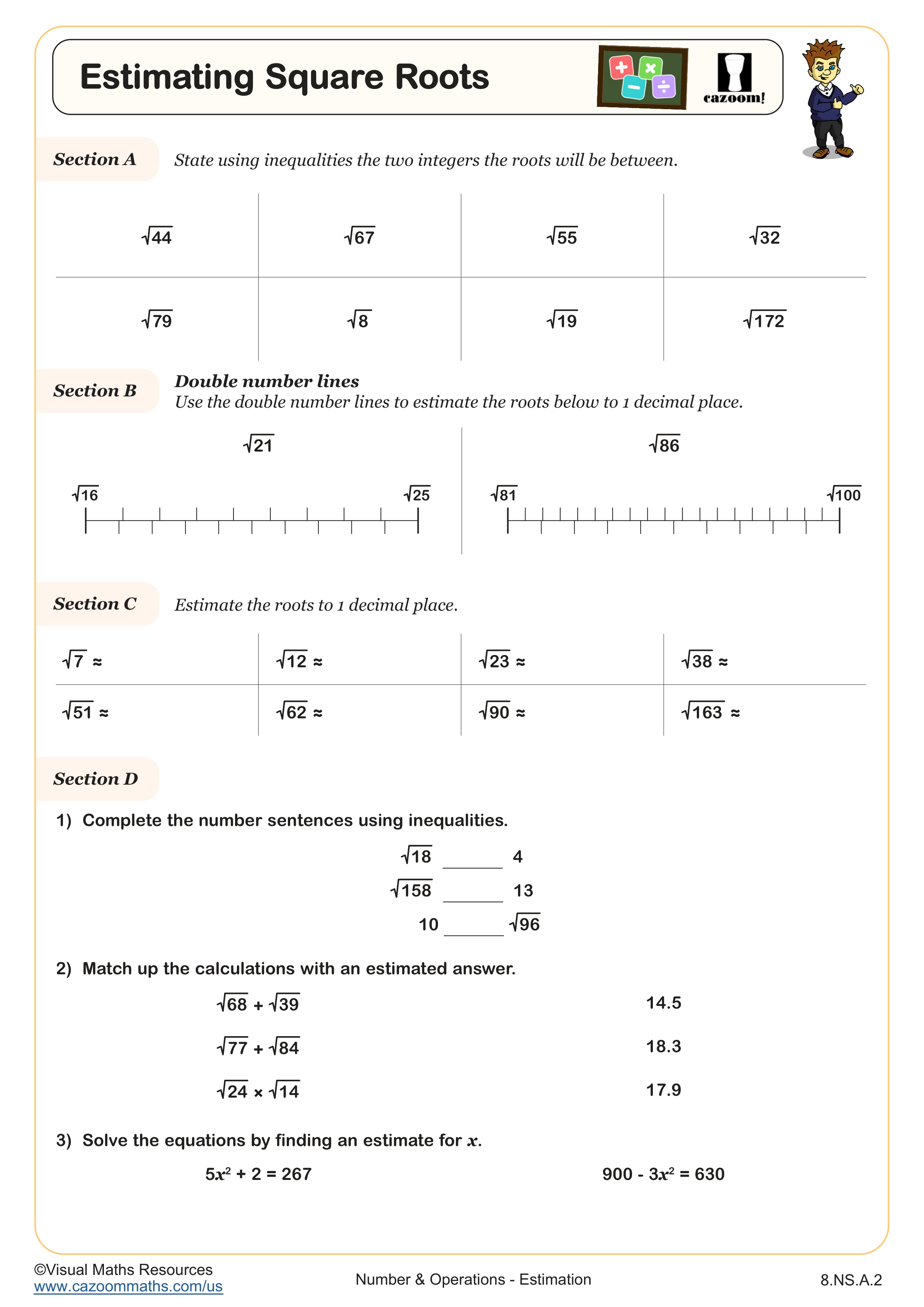
All worksheets are created by the team of experienced teachers at Cazoom Math.
What Estimation Skills Do Integrated Math 1 Students Learn?
In Integrated Math 1, estimation focuses primarily on approximating the values of square roots that aren't perfect squares. Students learn to identify which two consecutive integers a square root falls between, then refine their estimates using knowledge of perfect squares and the number line. This skill reinforces understanding of irrational numbers and prepares students for more complex work with radicals and the Pythagorean theorem.
Many teachers observe that students initially want to reach for calculators rather than using reasoning to estimate. The breakthrough typically happens when students recognize that knowing √16 = 4 and √25 = 5 means √20 must fall between 4 and 5, closer to 4.5. Students who confidently identify benchmark perfect squares (1, 4, 9, 16, 25, 36, 49, 64, 81, 100) find estimation significantly easier and more intuitive.
How Does Estimation Appear on the SAT and State Assessments?
Standardized tests like the SAT and state assessments frequently include estimation questions in no-calculator sections, where students must demonstrate number sense without computational tools. Test questions often ask students to identify which two integers a square root falls between or to compare the relative values of expressions containing radicals. These questions assess whether students understand the magnitude of irrational numbers rather than just memorizing formulas.
Students lose points when they fail to recognize that estimation can eliminate obviously incorrect answer choices. A common mistake occurs when students see √50 and don't immediately identify that it must be slightly greater than 7 (since √49 = 7). Teachers notice that students who practice estimation regularly perform better on multiple-choice questions because they can quickly rule out unreasonable options before performing detailed calculations.
How Do Students Estimate Square Roots Without a Calculator?
The most effective technique involves identifying the perfect squares immediately above and below the number under the radical. For example, to estimate √73, students recognize that 64 < 73 < 81, so √73 falls between √64 = 8 and √81 = 9. Since 73 is closer to 81 than to 64, students can refine their estimate to approximately 8.5 or slightly higher. This method builds on understanding the relationship between squaring and square roots while reinforcing inequality reasoning.
This skill appears frequently in construction, engineering, and design contexts where exact measurements aren't always necessary or practical. Architects estimating diagonal braces, electricians calculating wire lengths through walls, and landscapers determining material quantities all use square root estimation. Students preparing for STEM careers benefit from recognizing that mental math and approximation remain valuable even in technology-driven fields where quick reasonableness checks prevent costly errors.
How Can Teachers Use These Estimation Worksheets in Integrated Math 1?
These worksheets provide structured practice that progresses from identifying perfect squares to estimating values between integers with increasing precision. The exercises reinforce the connection between squares and square roots while building confidence with irrational numbers. Teachers find that students benefit from working several problems in sequence, as pattern recognition develops with repeated exposure to the relationship between consecutive perfect squares.
Many teachers use estimation worksheets as warm-up activities before introducing the Pythagorean theorem or simplifying radicals, since these topics require fluency with square root values. The worksheets also work well for intervention with students who struggle to check whether calculated answers are reasonable. Paired work encourages students to explain their reasoning aloud, which strengthens understanding of why certain estimates make sense while others don't. The complete answer keys allow for self-checking or quick formative assessment during class.