Integrated Math 1 Functions Worksheets
All worksheets are created by the team of experienced teachers at Cazoom Math.
What function concepts do Integrated Math 1 students learn?
Integrated Math 1 introduces students to functions as mathematical relationships where each input produces exactly one output. Teachers frequently notice that students initially struggle distinguishing between equations and functions, particularly when first encountering function notation like f(x). The curriculum covers evaluating functions using both algebraic expressions and graphs, identifying domain and range, and recognizing functions from tables, graphs, and equations. Students learn that function machines transform inputs through consistent rules, building intuition about how changes in x affect f(x).
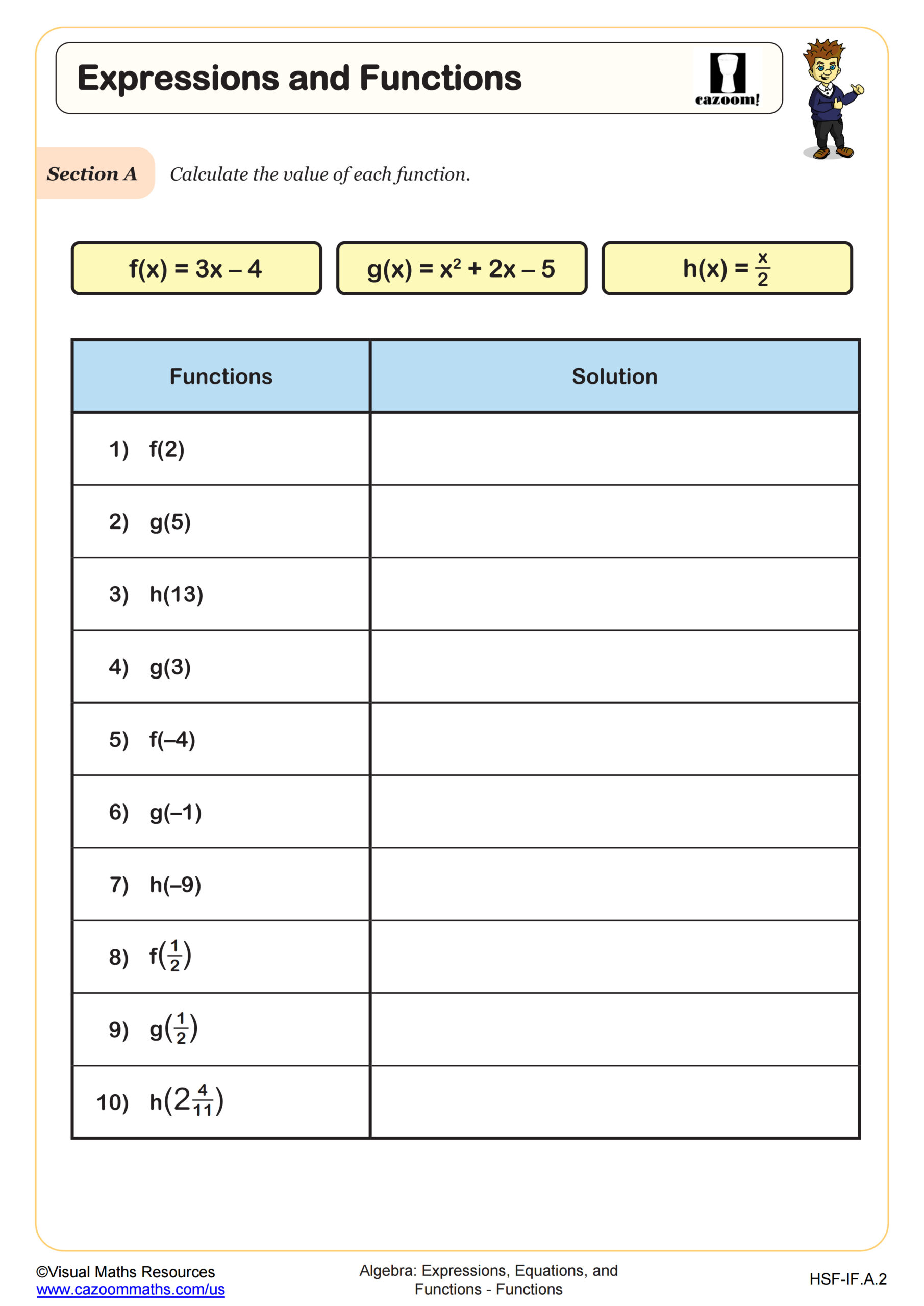
The progression from two-step expressions to formal function notation helps students see functions as generalizations of the patterns they studied in earlier grades. A breakthrough typically happens when students recognize that f(3) means substituting 3 for every x in the function rule. This foundation supports work with linear, exponential, and quadratic functions later in the course. Real-world contexts like calculating phone plan costs or converting temperatures demonstrate how functions model relationships in science, economics, and engineering.
How do SAT and ACT tests assess function knowledge?
Both the SAT and ACT extensively test function concepts, making Integrated Math 1 function skills essential for college-bound students. Standardized tests like the SAT expect students to evaluate functions quickly, interpret graphs to find function values, and determine whether relationships represent functions. Students lose points when they misinterpret function notation, confusing f(2) with f times 2 instead of recognizing it as a substitution instruction. Questions often embed functions within word problems about real-world scenarios, requiring students to translate between verbal descriptions and mathematical notation.
The ACT particularly emphasizes reading function values from graphs and tables, a skill that appears in approximately 15% of math questions. Teachers observe that students who practice evaluating functions from multiple representations perform better under timed conditions. Both tests assume fluency with function notation and the ability to work backward from outputs to inputs. Strong performance on these assessments correlates with consistent practice identifying domains, ranges, and functional relationships across various formats, skills these worksheets specifically target.
Why do students struggle with evaluating functions from graphs?
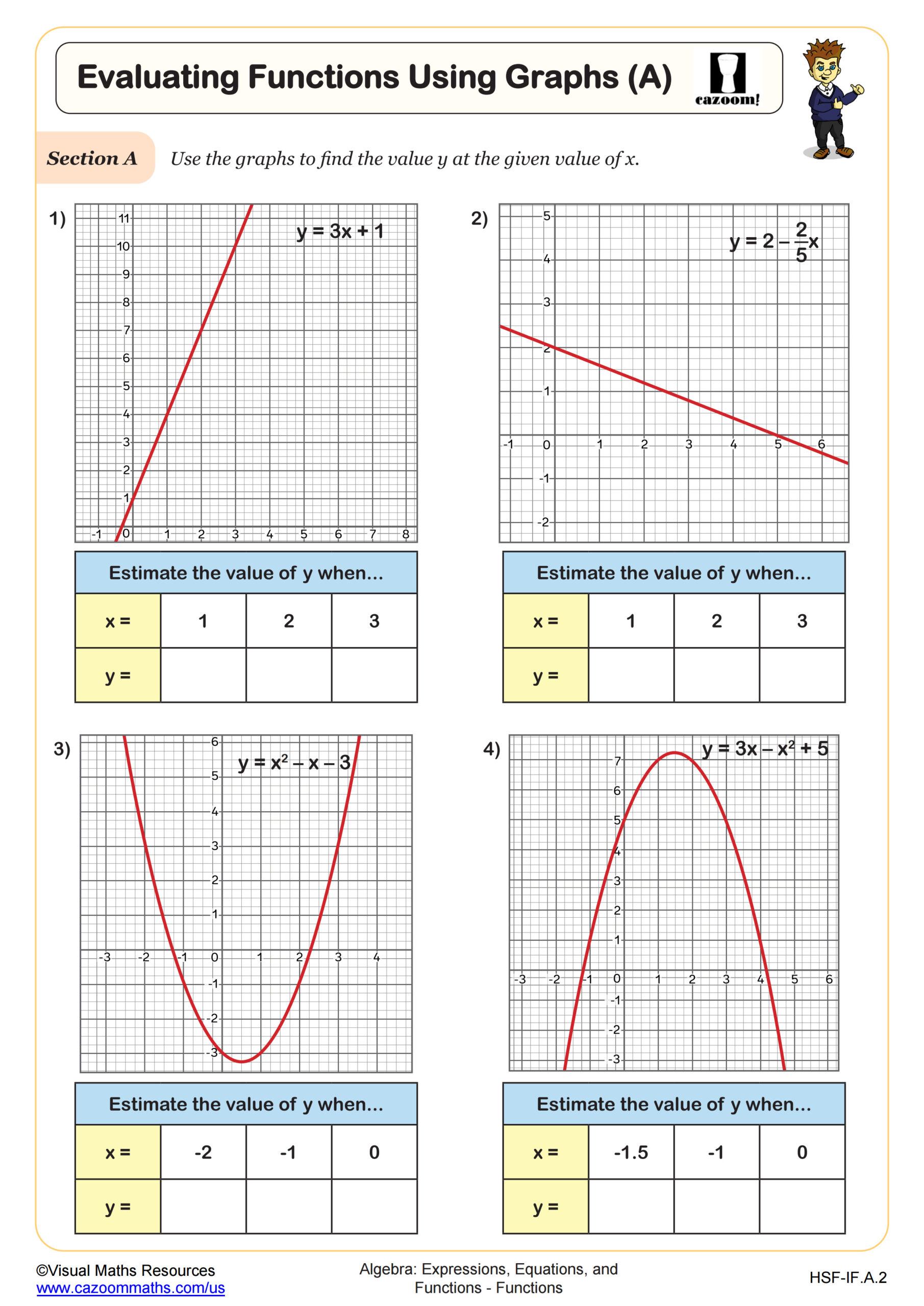
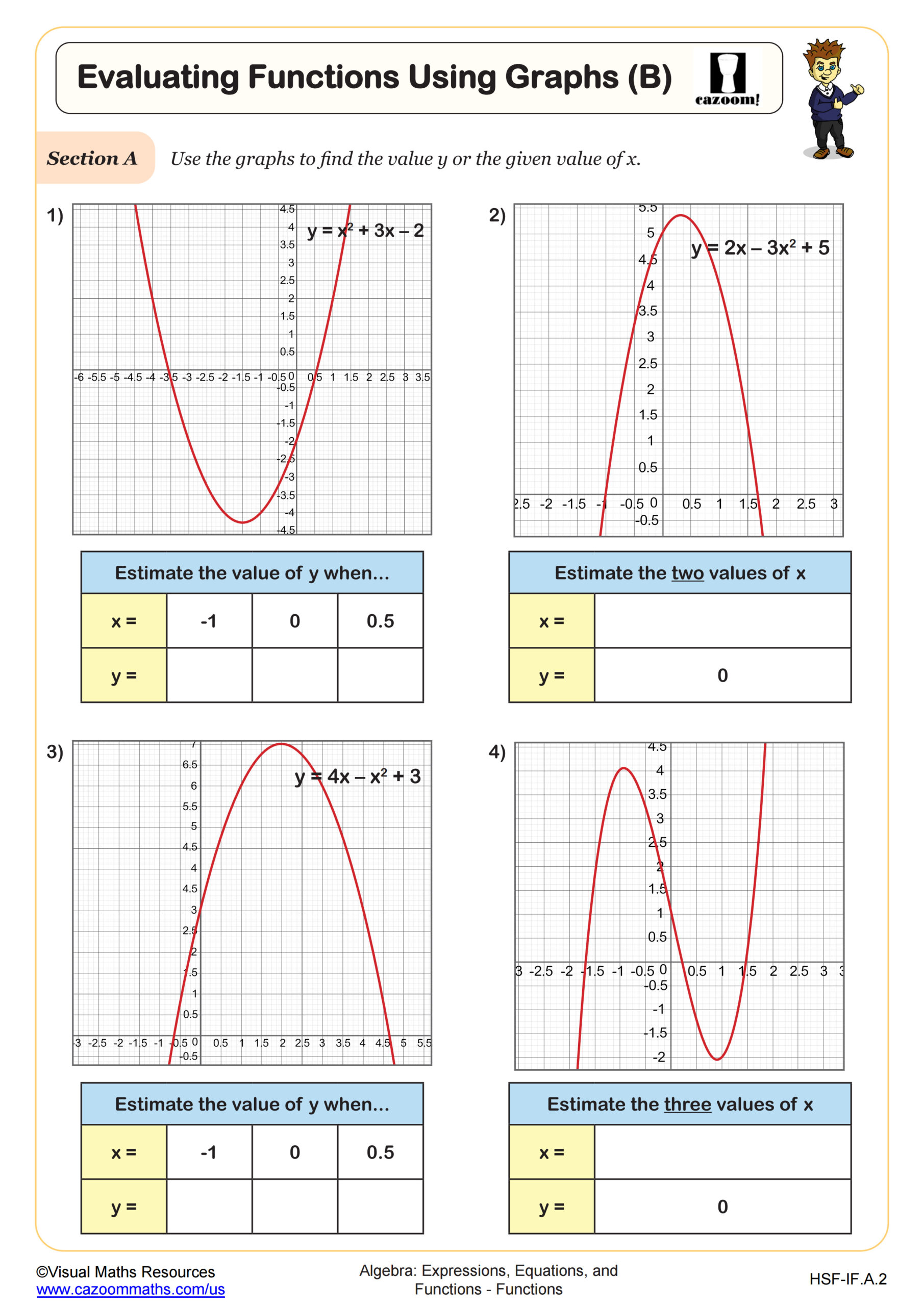
A common misconception occurs when students treat graphed functions like equations to solve rather than visual representations to read. Teachers frequently notice that students search for algebraic methods instead of simply locating coordinates on the graph. To evaluate f(3) from a graph, students need only find x = 3 on the horizontal axis and read the corresponding y-value, yet many overcomplicate this process. Students often struggle with graphs containing multiple points at different heights, unsure which point corresponds to the requested input value.
The breakthrough typically happens when students practice systematic approaches: locate the input on the x-axis, trace vertically to the function curve, then read horizontally to the y-axis. Students confidently tackle graph evaluation once they recognize this pattern works for any function, whether linear, curved, or piecewise. Another challenge appears when graphs use scales other than one unit per grid line, causing students to misread values. Dedicated practice with varied graph formats builds the visual literacy essential for Algebra II and Precalculus, where function transformations and compositions require strong graph interpretation skills.
How should teachers use function worksheets effectively in class?
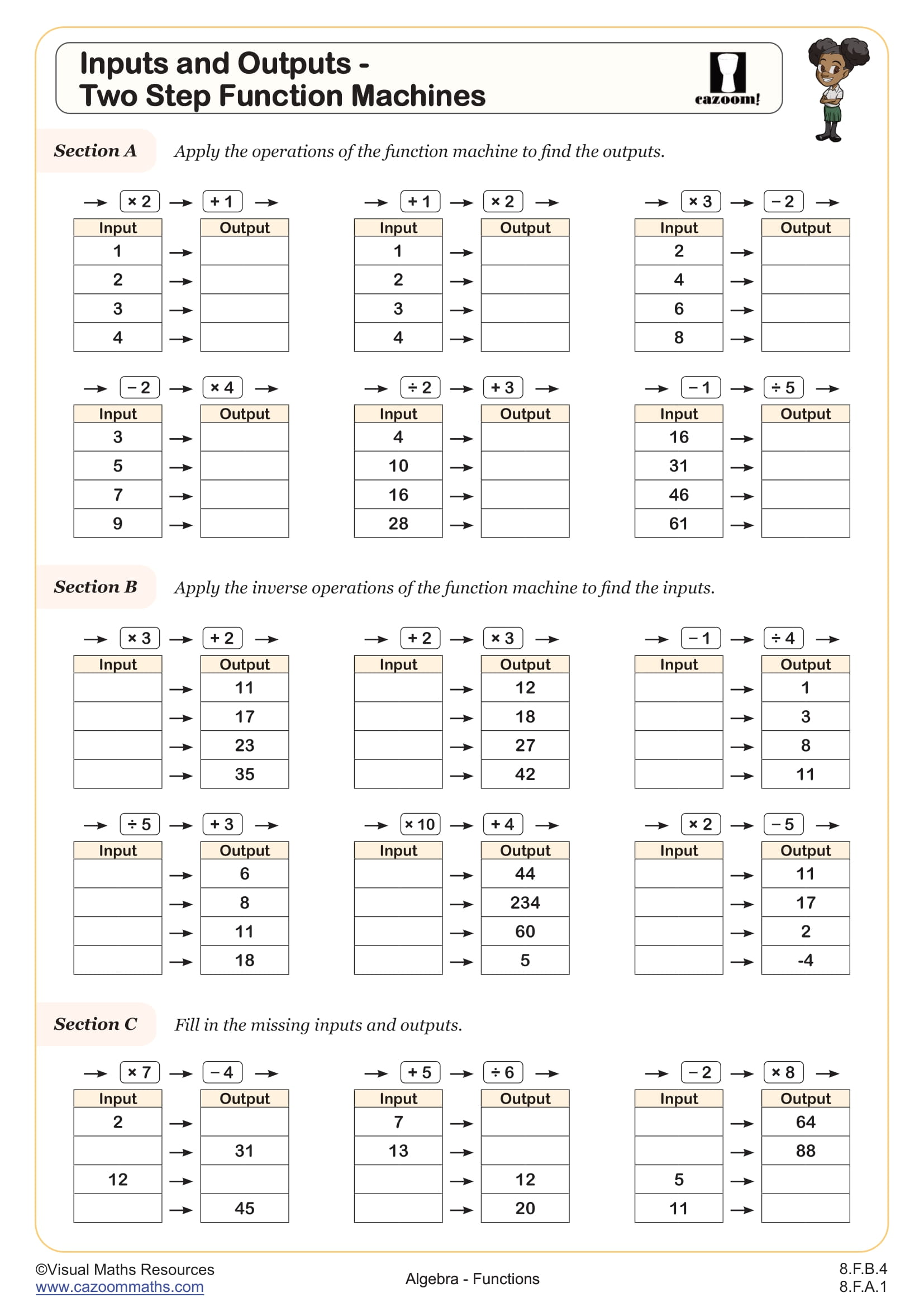
Teachers find that function worksheets work best when integrated into lessons that build from concrete examples to abstract notation. Starting with function machine worksheets helps students visualize the input-output process before introducing formal f(x) notation. Many teachers use these resources for warm-up activities, asking students to complete three to five problems at the lesson start to activate prior knowledge or reinforce previous concepts. The answer keys allow teachers to quickly diagnose misconceptions during independent work, identifying students who need additional support with specific representations.
Differentiation becomes manageable when worksheets progress through skill levels, as seen with the A and B versions of evaluating functions from graphs. Teachers observe that pairing visual graph work with algebraic expression evaluation helps students connect multiple representations of the same function concept. Small group practice followed by whole-class discussion of common errors maximizes learning, particularly when students explain their reasoning for incorrect answers. College-bound students benefit from timed practice sessions that simulate test conditions, building both accuracy and speed with function evaluation across all formats.