Integrated Math 1 Probability Worksheets
All worksheets are created by the team of experienced teachers at Cazoom Math.
What Probability Skills Do Students Learn in Integrated Math 1?
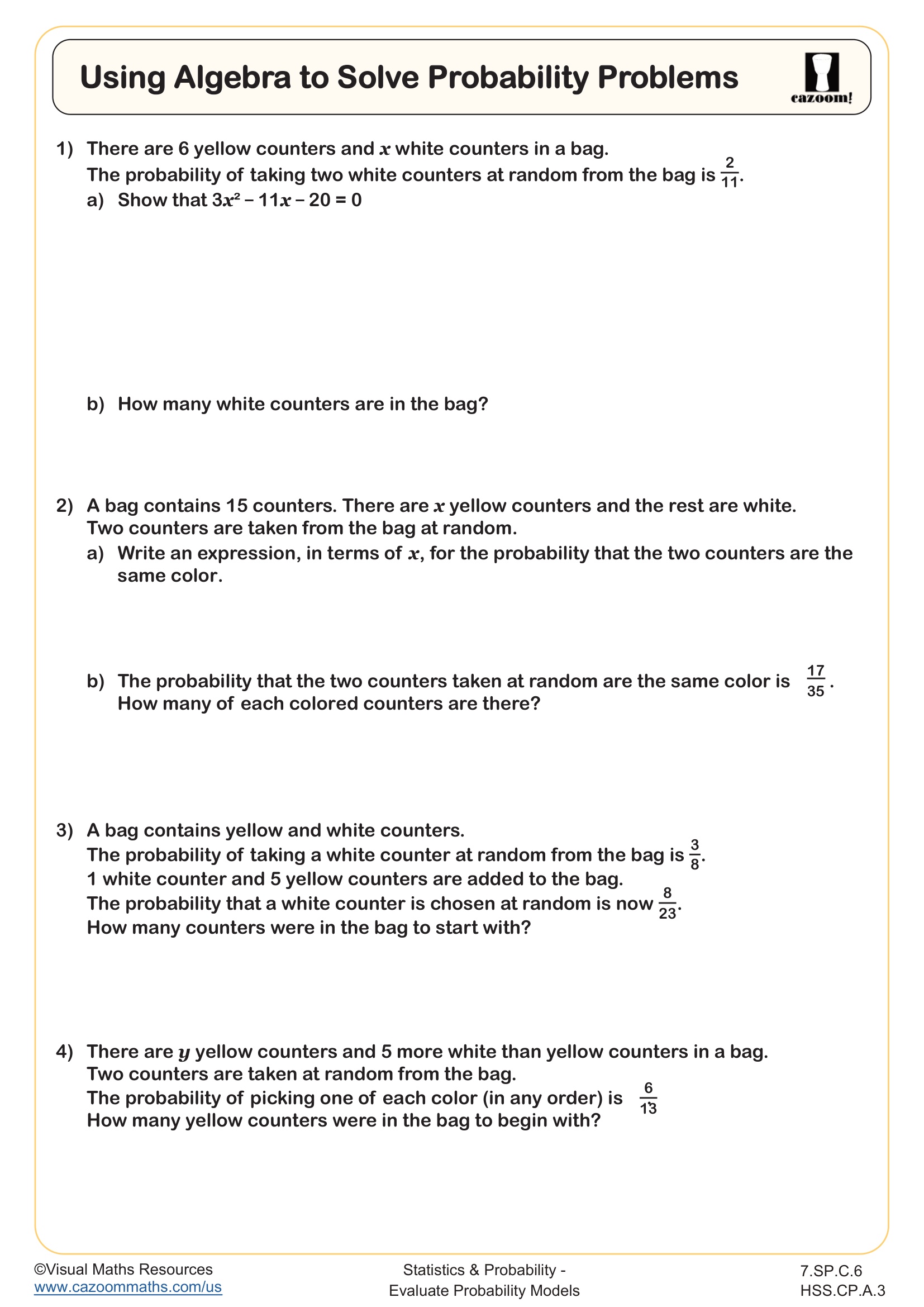
Students in Integrated Math 1 learn to apply algebraic reasoning to probability situations, extending beyond basic fraction calculations. The course introduces probability through the lens of mathematical modeling, where students translate real-world scenarios into equations, use counting principles to determine sample spaces, and solve for unknown probabilities using variables. This approach connects probability to the equation-solving skills students develop throughout the year.
Many students initially set up probability equations incorrectly because they confuse the number of favorable outcomes with the probability value itself. Teachers frequently observe that students write something like P = 3 instead of P = 3/12 when there are three favorable outcomes in a sample space of twelve. Worksheets that require students to explicitly identify the numerator and denominator before writing equations help address this persistent error.
How Does Probability Appear on the SAT and State Assessments?
Standardized tests present probability questions within data analysis and problem-solving sections, often requiring students to set up equations based on contextual information. The SAT typically includes two to three probability questions that test whether students can interpret scenarios, calculate probabilities from tables or descriptions, and reason about compound events. State assessments aligned with Common Core expect students to demonstrate understanding of both theoretical and experimental probability within algebraic contexts.
Students lose points when they fail to recognize that probability values must fall between 0 and 1, leading them to accept unreasonable answers like 1.3 or negative probabilities. Another common error occurs when students add probabilities of non-mutually exclusive events without accounting for overlap. Test preparation should emphasize checking whether answers make sense in context and whether the sum of all possible outcomes equals 1.
What Is the Fundamental Counting Principle and Why Does It Matter?
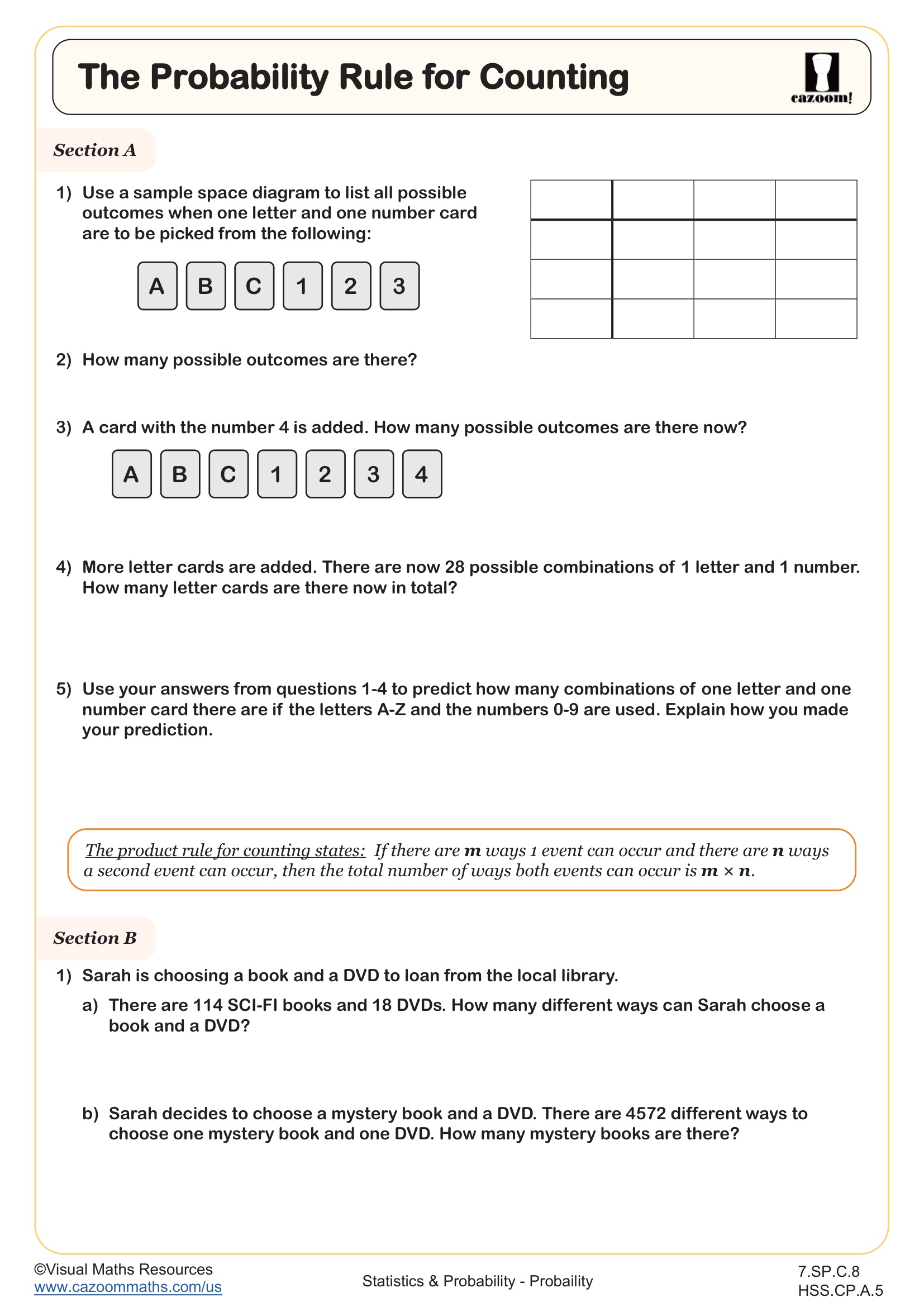
The Fundamental Counting Principle states that if one event can occur in m ways and a second independent event can occur in n ways, then the two events together can occur in m × n ways. This principle allows students to determine the size of sample spaces without listing every possibility, which becomes crucial when dealing with scenarios involving multiple stages or choices. Students apply this principle to calculate denominators in probability fractions and to verify that they've accounted for all possible outcomes.
This counting method appears constantly in computer science, particularly in analyzing algorithm efficiency and database queries. Engineering students encounter it when calculating possible configurations in design problems, while biology students use it to predict genetic combinations in Punnett squares. Understanding this principle in Integrated Math 1 prepares students for combinatorics in higher-level math courses and practical applications across STEM fields.
How Should Teachers Use These Integrated Math 1 Probability Worksheets?
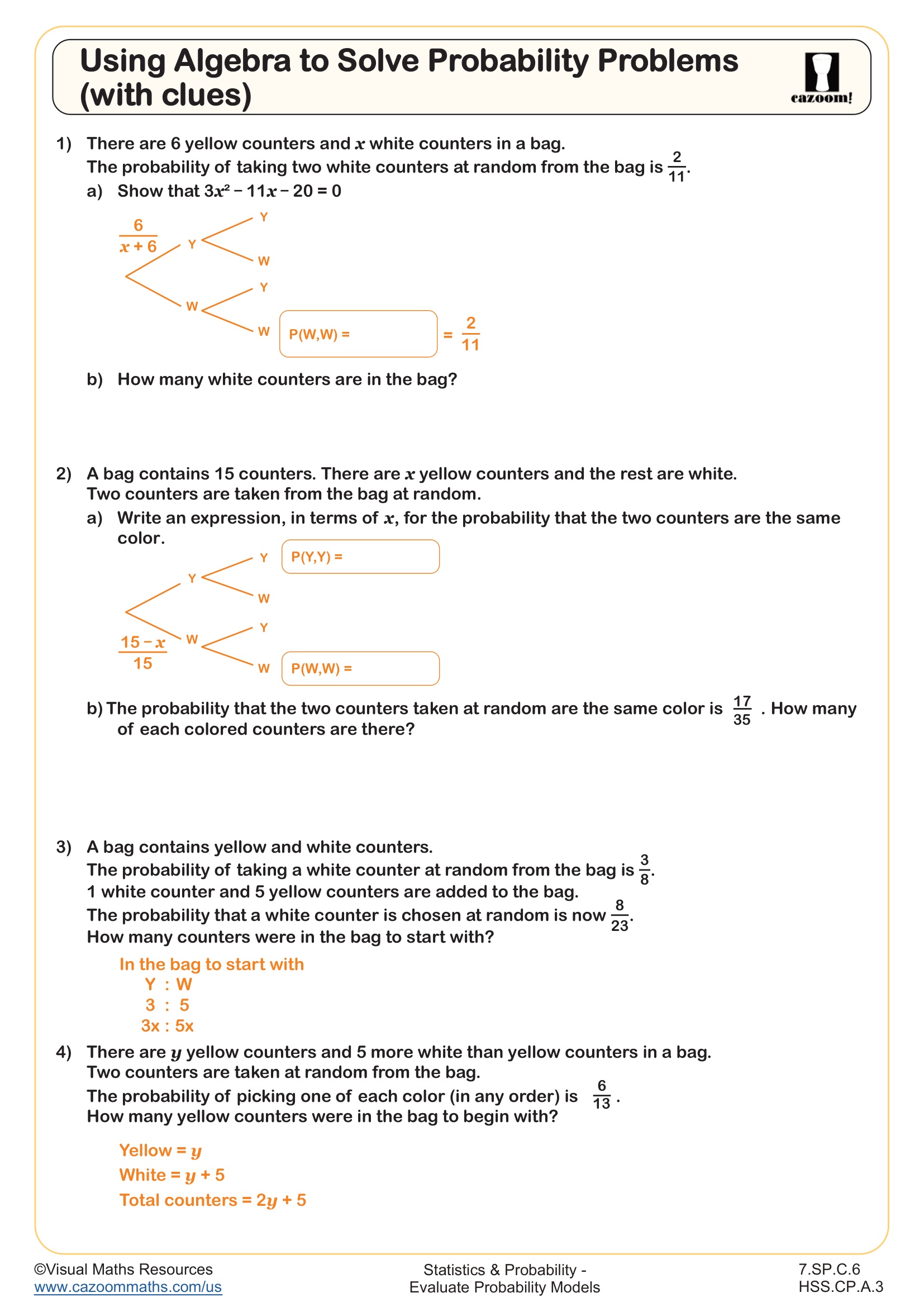
These worksheets provide structured practice that bridges algebraic skills with probability concepts, allowing students to build confidence through progressive problem types. The inclusion of clue-based problems helps students develop the critical skill of translating verbal information into mathematical expressions, which mirrors how probability questions appear on assessments. Answer keys enable students to check their work independently and identify specific steps where errors occurred, promoting metacognitive awareness of their problem-solving process.
Teachers find these worksheets effective for differentiated instruction during probability units, assigning different problem sets based on student readiness with algebraic manipulation. They work well as warm-up activities to reinforce both probability and equation-solving skills simultaneously, or as targeted intervention for students who understand probability conceptually but struggle with the algebraic setup. Paired work allows students to discuss their reasoning before writing equations, which helps catch setup errors before calculation mistakes compound the problem.