Integrated Math 2 Solving Equations Worksheets
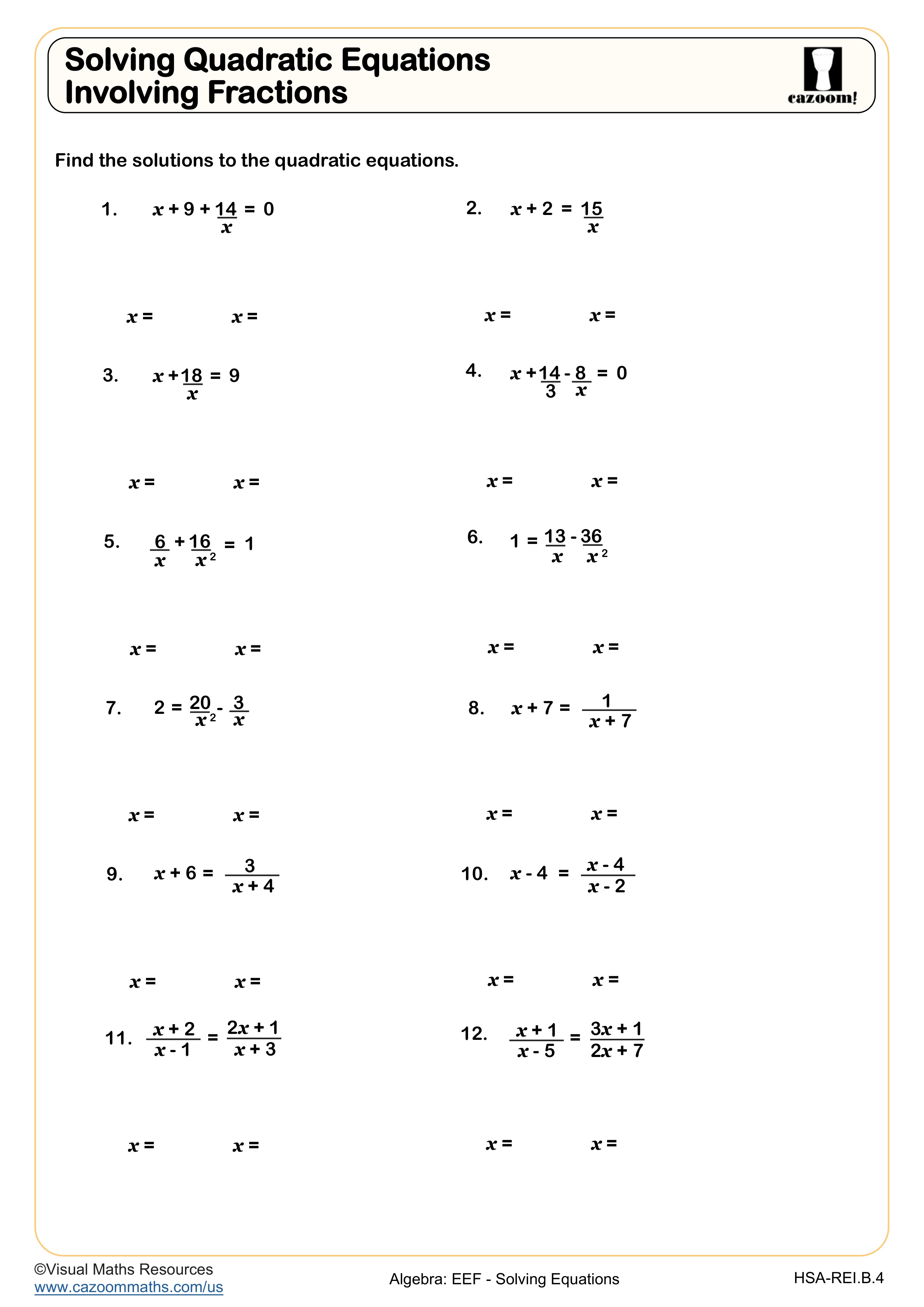

All worksheets are created by the team of experienced teachers at Cazoom Math.
What Does Solving Equations Cover in Integrated Math 2?
In Integrated Math 2, solving equations extends beyond single-variable problems to systems of equations where students find values that satisfy multiple conditions simultaneously. The substitution method teaches students to isolate one variable in terms of another, then substitute that expression into a second equation to solve for specific values. This approach aligns with Common Core standards for creating equations that describe relationships between quantities and reasoning about solutions.
Students often make the error of substituting incorrectly by forgetting to replace every instance of the chosen variable throughout the equation. Teachers frequently observe that students gain confidence once they verify their solutions by substituting both values back into the original equations, catching algebraic errors before finalizing answers. This self-checking habit proves valuable across all equation-solving contexts.
How Does This Topic Appear on the SAT and ACT?
Both the SAT and ACT regularly test systems of equations, expecting students to solve them efficiently using substitution, elimination, or graphical interpretation. Test questions often embed systems within real-world contexts like cost comparisons or rate problems, requiring students to first set up equations before solving. The calculator section allows verification, but the no-calculator section demands fluent algebraic manipulation, making substitution mastery non-negotiable for time management.
Students lose points when they solve for one variable but forget to find the second, answering incomplete questions that ask for specific values or sums. Another common assessment mistake occurs when students misread which variable the question requests, correctly solving the system but reporting the wrong value. Practicing with varied question formats helps students recognize these pitfalls before test day.
What Makes the Substitution Method Effective for Systems?
The substitution method works particularly well when one equation already has a variable isolated or can be easily rearranged to isolate a variable. Students learn to identify equations like y = 3x + 2 as ideal candidates for substitution since the expression 3x + 2 can directly replace y in another equation. This strategic thinking about which variable to isolate and which equation to manipulate first develops mathematical reasoning that transfers to optimization problems and constraint-based scenarios.
Engineers and data scientists regularly apply substitution when modeling systems with interdependent variables, such as calculating optimal resource allocation when production costs depend on labor hours and material quantities. Students preparing for STEM fields encounter this method again in physics when solving systems involving velocity, acceleration, and displacement, where one quantity often expresses naturally in terms of another.
How Can Teachers Use These Worksheets in Integrated Math 2?
These worksheets provide structured practice that helps students develop fluency with the substitution method through problems that progressively build complexity. The included answer keys allow students to check their work step-by-step, identifying exactly where algebraic errors occur rather than simply marking answers right or wrong. Teachers can use the solutions to create guided examples, showing proper notation and organization that students should mirror in their own work.
Many teachers assign these worksheets as targeted review before unit assessments or state testing, ensuring students maintain equation-solving skills throughout the year. The materials work well for differentiated instruction, allowing students who struggle with elimination methods to focus on strengthening substitution as their primary approach. Paired practice sessions where students compare solution strategies help them articulate mathematical reasoning and catch errors through peer discussion.