Integrated Math 3 Properties of Shapes Worksheets
All worksheets are created by the team of experienced teachers at Cazoom Math.
What Do Properties of Shapes Worksheets Cover in Integrated Math 3?
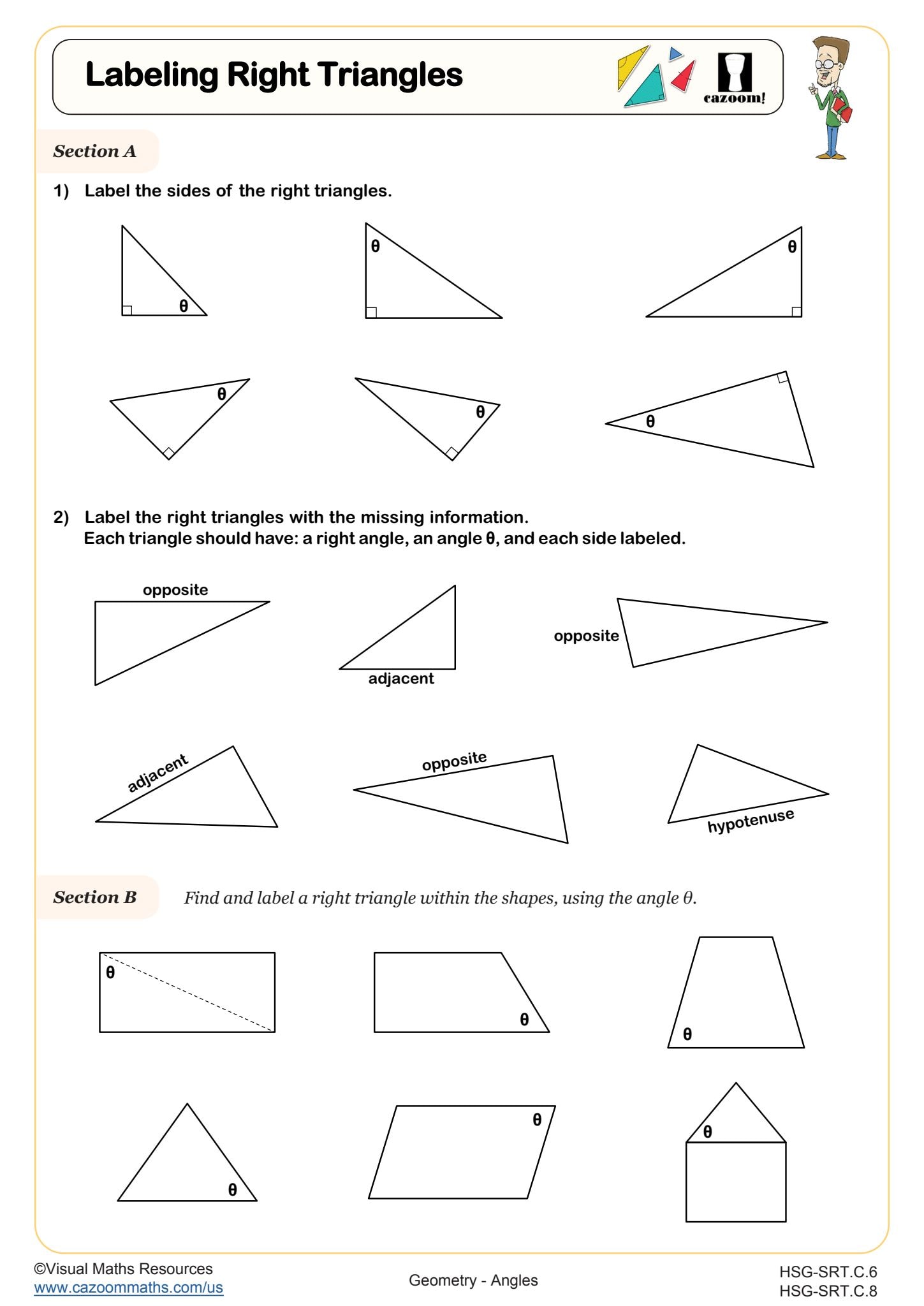
These worksheets address geometric properties that appear throughout Integrated Math 3, with particular emphasis on right triangles and the relationships between sides and angles. Students work with labeling conventions that establish the foundation for trigonometry, including identifying opposite and adjacent sides relative to specific angles, recognizing hypotenuse placement, and understanding how angle measures relate to side lengths. The practice reinforces vocabulary and notation standards that students will use throughout the course.
A common error occurs when students inconsistently label vertices and sides, leading to confusion when setting up trigonometric ratios or applying the Pythagorean theorem. Teachers frequently observe that students who take time to carefully label diagrams before calculating make significantly fewer mistakes on multi-step problems. The worksheets emphasize this systematic approach to shape analysis that supports accuracy in more complex geometric proofs and calculations.
How Do Properties of Shapes Appear on Standardized Tests?
Standardized tests like the SAT and ACT regularly include questions requiring students to identify relationships within geometric figures, apply properties to solve for unknown measures, and interpret diagrams with given constraints. Test questions often embed shape properties within word problems or require students to recognize which geometric principle applies to a given situation. Students need to quickly identify key features like right angles, parallel sides, or congruent segments to select appropriate problem-solving strategies.
Students lose points when they misinterpret diagram labels or assume properties that aren't explicitly stated or marked. Many students incorrectly assume triangles are right triangles without a right angle indicator, or they apply properties of special quadrilaterals to general figures. State assessments often test whether students can distinguish between what's given in a diagram and what must be proven, making careful analysis of shape properties particularly important for test performance.
Why Is Labeling Right Triangles Important for Trigonometry?
Labeling right triangles correctly establishes the reference frame that determines which sides are opposite, adjacent, and hypotenuse relative to a given angle. This labeling directly affects how students set up sine, cosine, and tangent ratios, making it a foundational skill for all trigonometric work. Students must understand that these designations change depending on which acute angle serves as the reference angle, and worksheets provide practice switching perspectives within the same triangle.
This skill connects directly to STEM fields where angle measurements guide real-world applications. Surveyors use angle-based calculations to determine distances and elevations, while engineers apply trigonometric relationships to analyze forces acting on structures. Architecture and construction rely on precise angle and side relationships to ensure stability and proper fit. College-bound students heading into physics, engineering, or computer graphics courses will encounter these same labeling conventions repeatedly, making mastery now a significant advantage later.
How Can Teachers Use These Worksheets in Integrated Math 3?
The worksheets provide structured practice that helps students develop the spatial reasoning and labeling precision required for success in Integrated Math 3. Teachers can use them as introductory activities before launching into trigonometric ratios, ensuring students have solid foundation skills before tackling more abstract concepts. The consistent format allows students to focus on the geometric relationships without being overwhelmed by varied problem types, building confidence through repetition with clear answer keys for immediate feedback.
Many teachers find these worksheets effective for warm-up activities that refresh geometric vocabulary before lessons on the Law of Sines or unit circle concepts. They work well for intervention with students who struggle on assessments involving diagram interpretation, and they're useful for paired work where students explain their labeling choices to partners. The worksheets also serve as quick formative assessments, helping teachers identify which students need additional support with geometric notation before progressing to more complex applications in coordinate geometry or three-dimensional figures.