K.CC.C.6 Worksheets
Common Core State Standards K.CC.C.6 Worksheets
Strand: Counting and Cardinality
Objective: Compare numbers.
CCSS Description: Identify whether the number of objects in one group is greater than, less than, or equal to the number of objects in another group, e.g., by using matching and counting strategies.
Cazoom Math is a leading provider of Math Worksheets and used by over 50,000 teachers and parents around the world. Here you can find a set of math worksheets aligned to the common core standard K.CC.C.6. These worksheets are perfect for learners to develop critical math skills.
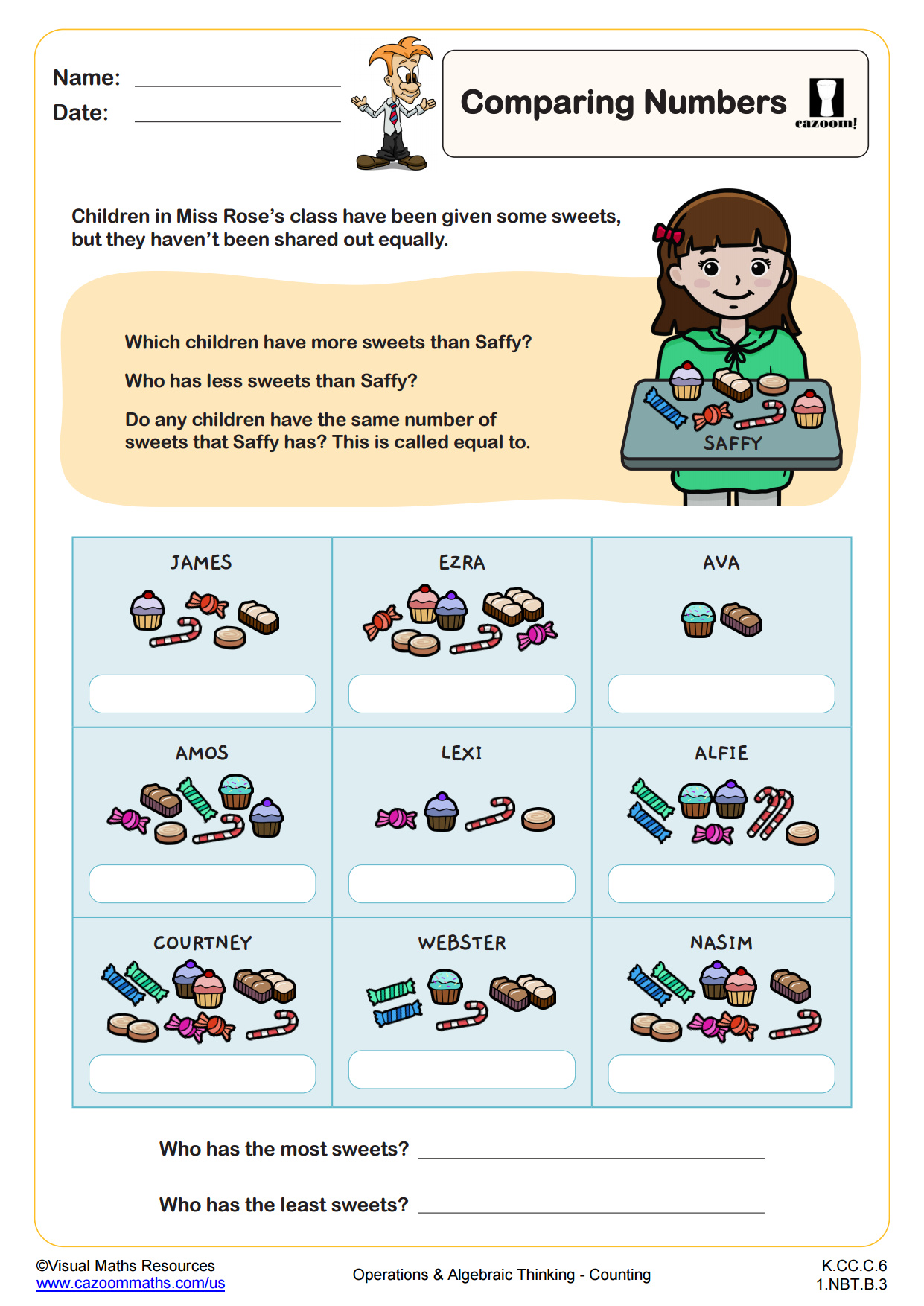
You can click on the images below to find out more about each math worksheet, and download and print the resource.
We have a great range of resources for students in Kindergarten. Check out our Kindergarten Math Worksheets page for more details.
All worksheets are created by the team of experienced teachers at Cazoom Math.
What does the K.CC.6 standard require students to learn?
The Common Core K.CC.6 standard text requires kindergarten students to "identify whether the number of objects in one group is greater than, less than, or equal to the number of objects in another group." This standard focuses on comparing quantities through one-to-one correspondence and visual comparison strategies, laying groundwork for future number relationships and algebraic thinking.
Teachers notice that students often master "more than" and "less than" comparisons first, but struggle with "equal to" because they haven't yet developed the concept that different-looking groups can contain the same quantity. Many kindergarteners will count correctly but still claim that a spread-out group of five objects has more than a clustered group of five objects, revealing the need for concrete practice with various arrangements and object types.
Which grade levels use K.CC.6 comparison skills?
While K.CC.6 is specifically a kindergarten standard, the comparison skills it develops extend through elementary mathematics and beyond. First-grade students build on these foundations when comparing two-digit numbers, and second-graders apply similar reasoning to hundreds. The visual comparison strategies learned in kindergarten support fraction comparisons in later grades.
Teachers working across grade levels report that students who struggle with algebraic inequalities in middle school often trace back to weak foundational skills in object comparison from kindergarten. Students who master K.CC.6 thoroughly show greater confidence with number relationships in first grade, particularly when working with teen numbers and place value concepts where comparison becomes more abstract.
How do students develop one-to-one correspondence through K.CC.6?
One-to-one correspondence - matching each object in one group to exactly one object in another group - forms the core strategy for K.CC.6 comparisons. Students learn to line up objects, draw connecting lines, or use physical manipulatives to create visual matches that reveal which group has more, fewer, or the same amount.
Classroom observations show that students initially want to count both groups separately and compare the final numbers, but this approach often leads to counting errors. Teachers find more success when students first practice the physical matching strategy, then gradually transition to counting as a verification tool. Students who rush to counting without developing strong one-to-one correspondence skills often make mistakes with scattered or irregularly arranged object groups.
How can teachers maximize learning with K.CC.6 worksheets?
Teachers achieve the best results by starting with concrete manipulatives before introducing worksheet practice, allowing students to physically move objects and create one-to-one matches. The included answer keys help teachers quickly identify students who may be guessing rather than using systematic comparison strategies, enabling targeted intervention during independent work time.
Effective implementation involves mixing worksheet practice with real-world comparisons throughout the day - comparing pencils to erasers, crackers to napkins, or students wearing sneakers versus boots. Teachers notice that students who only practice with worksheet images sometimes struggle to transfer their skills to three-dimensional objects, so alternating between paper practice and hands-on activities strengthens conceptual understanding and prevents the mechanical completion that doesn't build genuine number sense.