K.G.A.3 Worksheets
Common Core State Standards K.G.A.3 Worksheets
Strand: Geometry
Objective: Identify and describe shapes (squares, circles, triangles, rectangles, hexagons, cubes, cones, cylinders, and spheres).
CCSS Description: Identify shapes as two-dimensional (lying in a plane, “flat”) or three-dimensional (“solid”).
Cazoom Math is a leading provider of Math Worksheets and used by over 50,000 teachers and parents around the world. Here you can find a set of math worksheets aligned to the common core standard K.G.A.3. These worksheets are perfect for learners to develop critical math skills.
You can click on the images below to find out more about each math worksheet, and download and print the resource.
We have a great range of resources for students in Kindergarten. Check out our Kindergarten Math Worksheets page for more details.
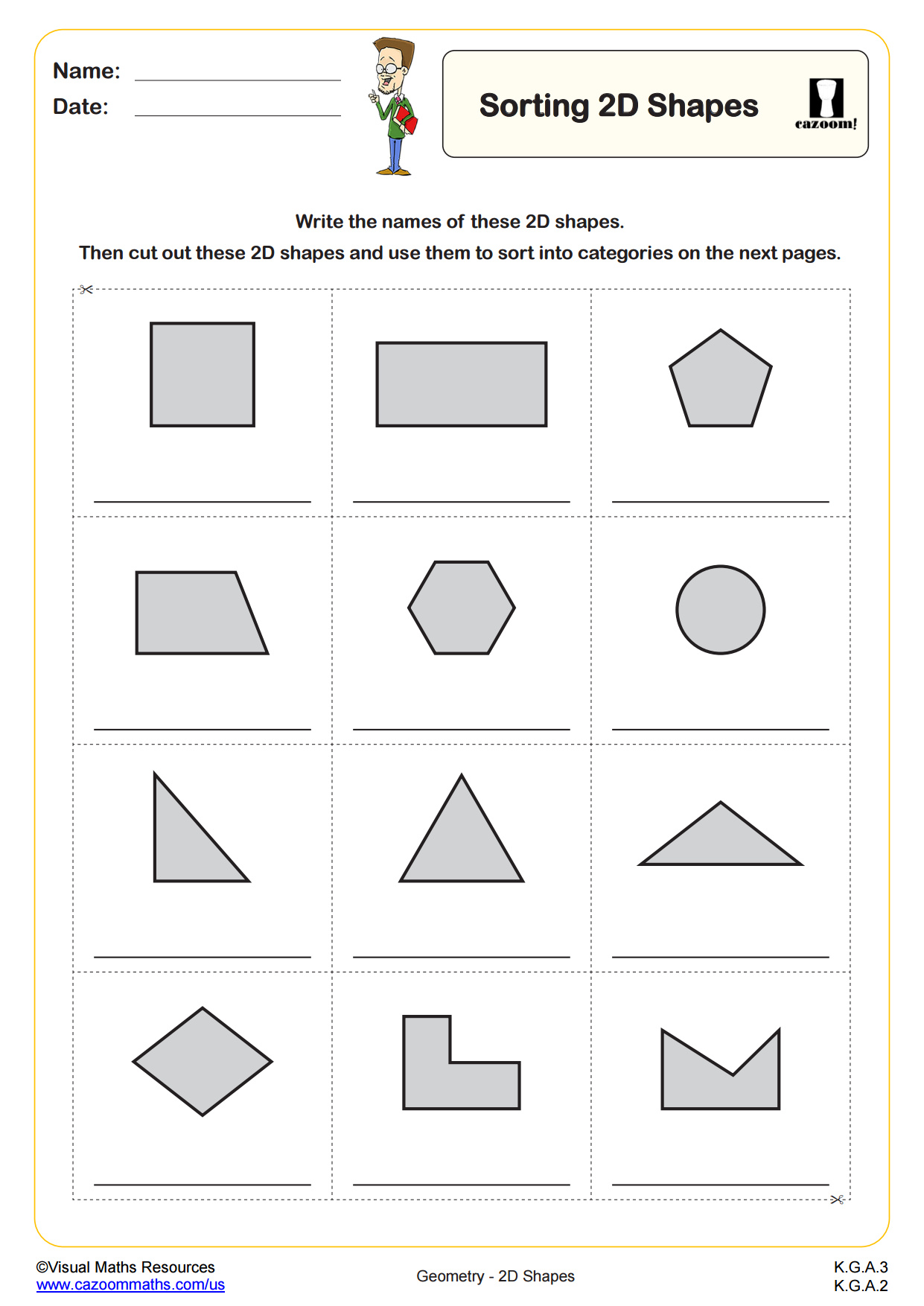
All worksheets are created by the team of experienced teachers at Cazoom Math.
What does KGA3 cover in the Common Core kindergarten curriculum?
KGA3 focuses on identifying shapes as two-dimensional or three-dimensional, and describing objects in the environment using names of shapes regardless of their size or orientation. Students learn to recognize basic shapes like circles, triangles, rectangles, and squares in various positions and sizes, understanding that a shape's identity remains constant even when rotated or scaled.
Teachers frequently notice that students master identifying shapes in standard positions first but struggle when the same shapes appear rotated or in unusual orientations. For example, many kindergarteners can identify a triangle pointing upward but may not recognize the same triangle when it points downward or sideways. This standard specifically addresses this challenge by emphasizing shape recognition across different presentations.
How does K.G.A.3 prepare students for later geometry standards?
K.G.A.3 establishes the foundational shape recognition skills that students build upon in first grade and beyond. This standard connects directly to 1.G.A.1, where students learn to distinguish between defining and non-defining attributes of shapes, and later standards involving shape composition and decomposition.
The orientation independence taught in K.G.A.3 becomes particularly important when students begin working with coordinate geometry and transformations in middle school. Students who struggle with this kindergarten standard often have difficulty later when shapes undergo rotations, reflections, or translations. Strong mastery at this level prevents misconceptions about shape identity that can persist through elementary grades.
What are the key differences between 2D and 3D shape identification in K.G.A.3?
K.G.A.3 requires students to distinguish between flat shapes they can draw on paper and solid shapes they can hold. Two-dimensional shapes include circles, squares, triangles, and rectangles, while three-dimensional shapes include spheres, cubes, cones, and cylinders. Students learn to identify these shapes in real-world objects and classroom materials.
Teachers often observe that students initially confuse circles with spheres or squares with cubes when examining physical objects. Many kindergarteners will call a ball a "circle" rather than a "sphere" because they focus on the round appearance rather than the dimensional properties. Effective instruction uses manipulatives and real objects to help students feel the difference between flat and solid shapes.
How can teachers use these worksheets to address common K.G.A.3 misconceptions?
These worksheets work best when combined with hands-on shape exploration and real-world shape hunts. Teachers should start with physical manipulatives before moving to worksheet practice, allowing students to rotate and examine shapes from multiple angles. The answer keys help teachers identify patterns in student errors and adjust instruction accordingly.
Many educators find success using these worksheets as formative assessment tools rather than just practice. When students mark a rotated triangle as "not a triangle," teachers can immediately address the misconception through guided discussion and additional hands-on exploration. The worksheets also work well for homework practice after students have had sufficient concrete experience with shape identification in the classroom setting.