K.OA.A.1 Worksheets
Common Core State Standards K.OA.A.1 Worksheets
Strand: Operations and Algebraic Thinking
Objective: Understand addition as putting together and adding to, and understand subtraction as taking apart and taking from.
CCSS Description: Represent addition and subtraction with objects, fingers, mental images, drawings, sounds (e.g., claps), acting out situations, verbal explanations, expressions, or equations.
Cazoom Math is a leading provider of Math Worksheets and used by over 50,000 teachers and parents around the world. Here you can find a set of math worksheets aligned to the common core standard K.OA.A.1. These worksheets are perfect for learners to develop critical math skills.
You can click on the images below to find out more about each math worksheet, and download and print the resource.
We have a great range of resources for students in Kindergarten. Check out our Kindergarten Math Worksheets page for more details.
Addition with Number Lines (up to 10)
Grades: Kindergarten

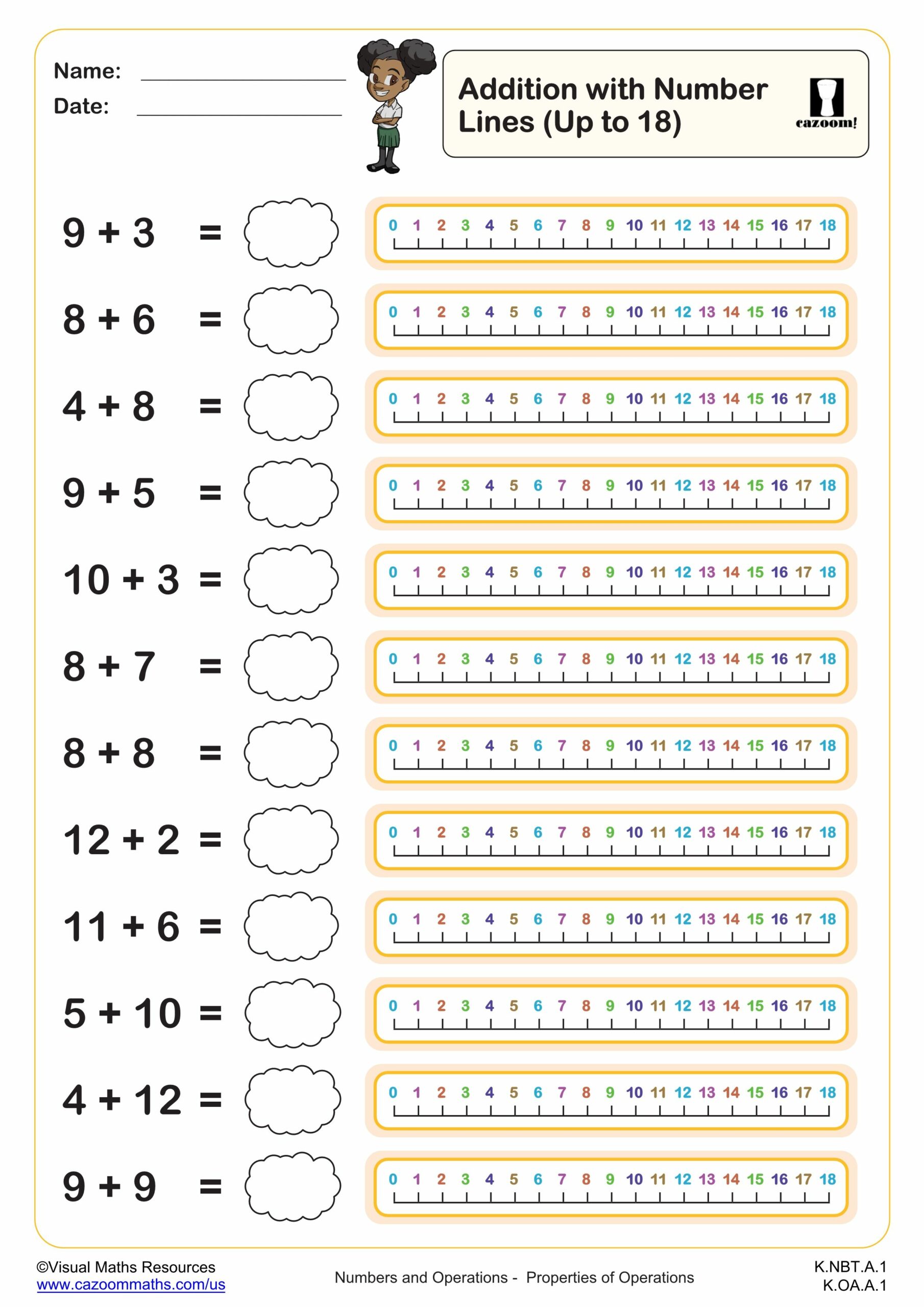
Addition with Number Lines (up to 18)
Grades: Kindergarten
Addition with Number Lines (up to 5)
Grades: Kindergarten

Addition with Pictures (A)
Grades: Kindergarten

Addition with Pictures (B)
Grades: Kindergarten

Addition with Sticks (A)
Grades: Kindergarten

Addition with Sticks (B)
Grades: Kindergarten

Addition with Sticks (C)
Grades: Kindergarten

Writing Addition Number Sentences
Grades: Kindergarten

All worksheets are created by the team of experienced teachers at Cazoom Math.
What does k.oa.a.1 cover in kindergarten math?
The k.oa.a.1 standard focuses on representing addition as putting together and adding to situations with sums within 10. Students use concrete objects, drawings, and verbal descriptions to show addition problems rather than formal equations at this introductory level.
Teachers observe that kindergarteners benefit most from hands-on activities before moving to abstract representations. Students often need multiple exposures to recognize that when they put together 3 blocks and 2 blocks, they create one group of 5 blocks total. The worksheets progress from concrete visual problems to more abstract number combinations.
Which grade levels use k.oa.a.1 addition concepts?
While k.oa.a.1 specifically targets kindergarten, the putting together concept builds throughout elementary grades. First grade extends these ideas to addition within 20, while second grade develops fluency with sums within 100.
Some first grade teachers use these kindergarten worksheets as review materials at the beginning of the year, particularly for students who need reinforcement with basic addition concepts. The visual nature of kindergarten addition problems helps older students who still struggle with abstract number relationships understand the fundamental meaning of addition operations.
How do students show their thinking with k.oa.a.1 problems?
Students demonstrate understanding through multiple representation methods including drawing pictures, using manipulatives, creating number stories, and explaining their reasoning verbally. The standard emphasizes process over computation speed.
Teachers notice that students who can explain their thinking using words like "I put together" or "I added to" show stronger conceptual understanding than those who simply count objects. Many kindergarteners initially draw random circles or lines, but with practice learn to draw clear groups that match the problem situation, such as 4 apples plus 2 apples equals 6 apples total.
What makes these k.oa.a.1 worksheets effective for classroom instruction?
The worksheets feature clear visual problems that mirror real classroom manipulative activities, helping students transfer concrete learning to paper-based practice. Each problem includes space for students to draw their thinking and write simple number combinations.
Teachers find the answer keys particularly helpful for identifying common student errors, such as drawing the correct number of objects but failing to circle or group them appropriately. The progression from simple combining situations to slightly more complex adding to problems allows teachers to differentiate instruction based on individual student readiness levels within the same standard.