K.OA.A.2 Worksheets
Common Core State Standards K.OA.A.2 Worksheets
Strand: Operations and Algebraic Thinking
Objective: Understand addition as putting together and adding to, and understand subtraction as taking apart and taking from.
CCSS Description: Solve addition and subtraction word problems, and add and subtract within 10, e.g., by using objects or drawings to represent the problem.
Cazoom Math is a leading provider of Math Worksheets and used by over 50,000 teachers and parents around the world. Here you can find a set of math worksheets aligned to the common core standard K.OA.A.2. These worksheets are perfect for learners to develop critical math skills.
You can click on the images below to find out more about each math worksheet, and download and print the resource.
We have a great range of resources for students in Kindergarten. Check out our Kindergarten Math Worksheets page for more details.
All worksheets are created by the team of experienced teachers at Cazoom Math.
What does k.oa.a.2 cover in kindergarten math curriculum?
The k.oa.2 standard focuses on solving addition and subtraction word problems within 10 using various representations including objects, drawings, and verbal explanations. Students must demonstrate understanding of problem situations rather than simply performing calculations, making this a foundational reasoning standard.
Teachers often observe that students who master this standard show stronger number sense development throughout elementary school. The key challenge lies in helping students visualize problem scenarios before jumping to operations, which requires consistent practice with diverse problem contexts and solution strategies.
What grade levels use these word problem worksheets?
While specifically designed for kindergarten students working on K.OA.A.2, these worksheets serve multiple grade levels depending on student needs. First-grade teachers use them for review and intervention, while pre-K programs incorporate them for advanced learners ready for structured problem solving.
The progression typically moves from concrete manipulatives in kindergarten to more abstract thinking in first grade. Teachers report that students who struggle with later addition and subtraction standards often benefit from returning to these foundational word problem types to rebuild conceptual understanding.
How do students show their work on K.OA.A.2 problems?
Kindergarten students demonstrate their thinking through drawings, manipulatives, finger counting, or simple number sentences rather than formal written algorithms. The standard emphasizes multiple representation methods, allowing students to choose strategies that match their developmental level.
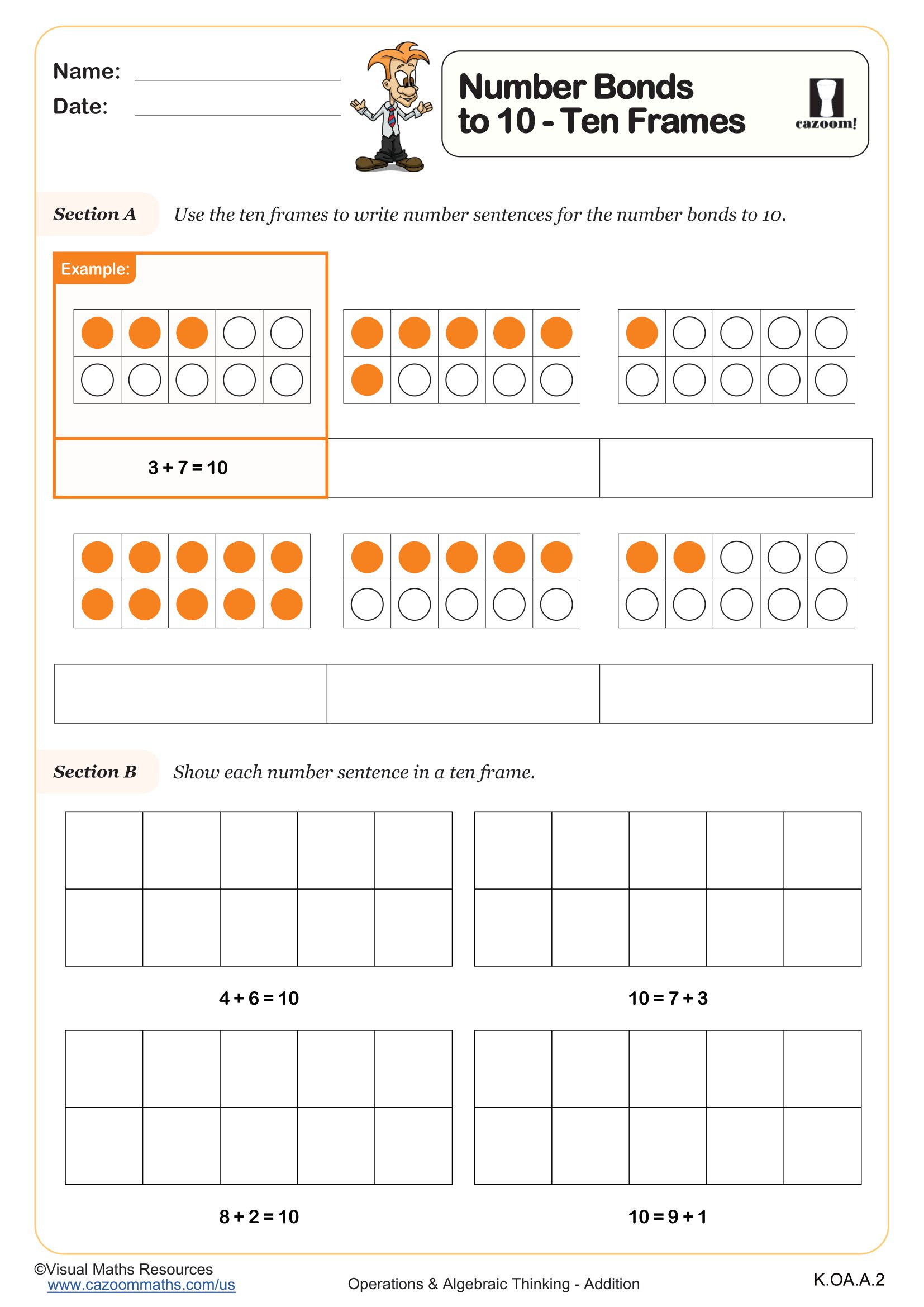
Many teachers notice that students initially draw every single object mentioned in problems, which can become cumbersome with larger numbers. Successful instruction gradually introduces more efficient strategies like tally marks or ten frames while still honoring students' natural problem-solving approaches and building confidence in mathematical communication.
How can teachers effectively use these worksheets in math instruction?
These worksheets work best when integrated with hands-on activities and discussion rather than used as isolated practice. Teachers report success using them as warm-ups, math center activities, or assessment tools after students have explored problems with concrete materials.
The answer keys enable quick progress monitoring and help identify students who need additional support with problem comprehension versus calculation skills. Many educators find that reading problems aloud initially helps students focus on mathematical thinking rather than decoding text, gradually building independence in both reading and mathematical reasoning.