K.OA.A.4 Worksheets
Common Core State Standards K.OA.A.4 Worksheets
Strand: Operations and Algebraic Thinking
Objective: Understand addition as putting together and adding to, and understand subtraction as taking apart and taking from.
CCSS Description: For any number from 1 to 9, find the number that makes 10 when added to the given number, e.g., by using objects or drawings, and record the answer with a drawing or equation.
Cazoom Math is a leading provider of Math Worksheets and used by over 50,000 teachers and parents around the world. Here you can find a set of math worksheets aligned to the common core standard K.OA.A.4. These worksheets are perfect for learners to develop critical math skills.
You can click on the images below to find out more about each math worksheet, and download and print the resource.
We have a great range of resources for students in Kindergarten. Check out our Kindergarten Math Worksheets page for more details.
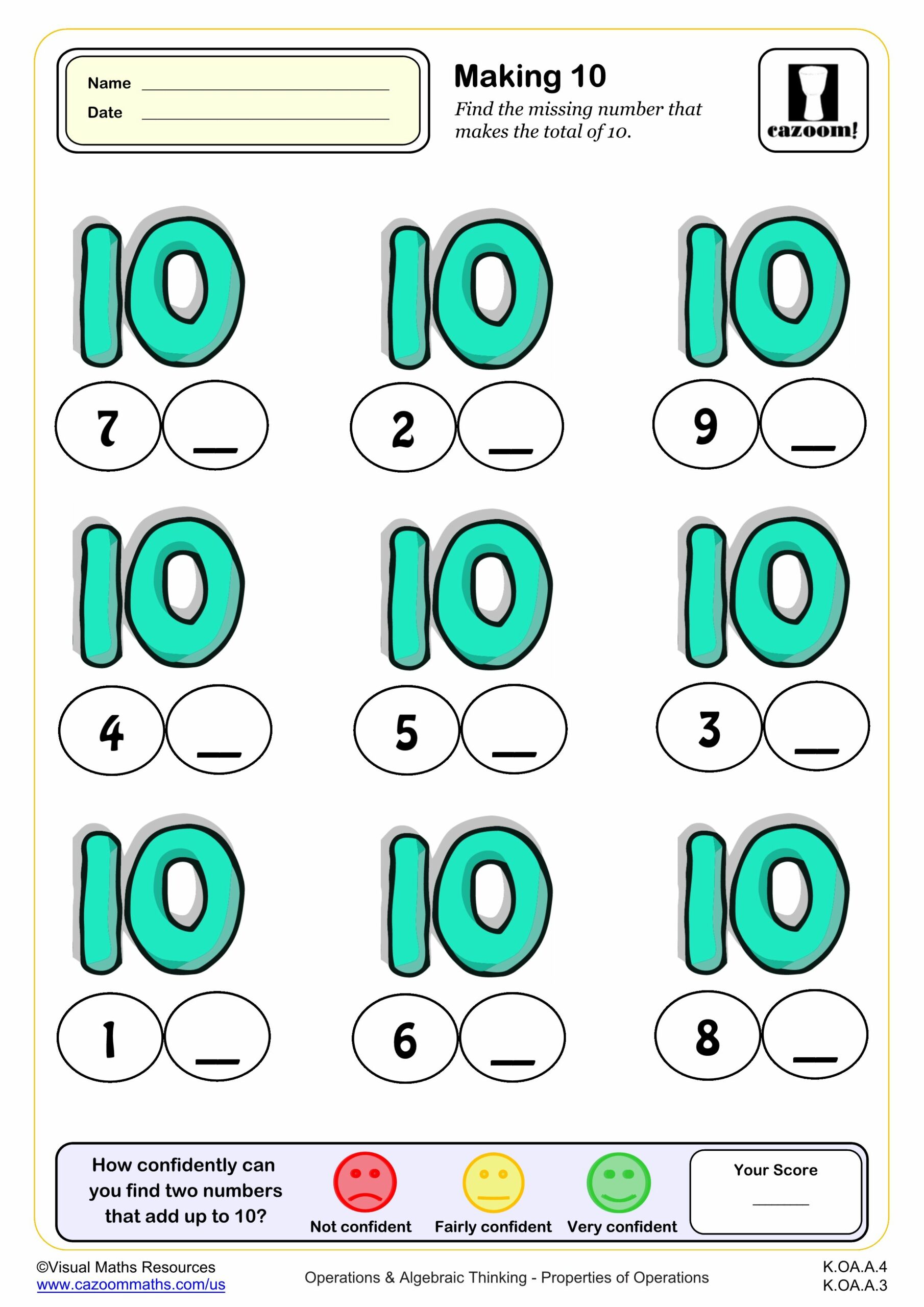
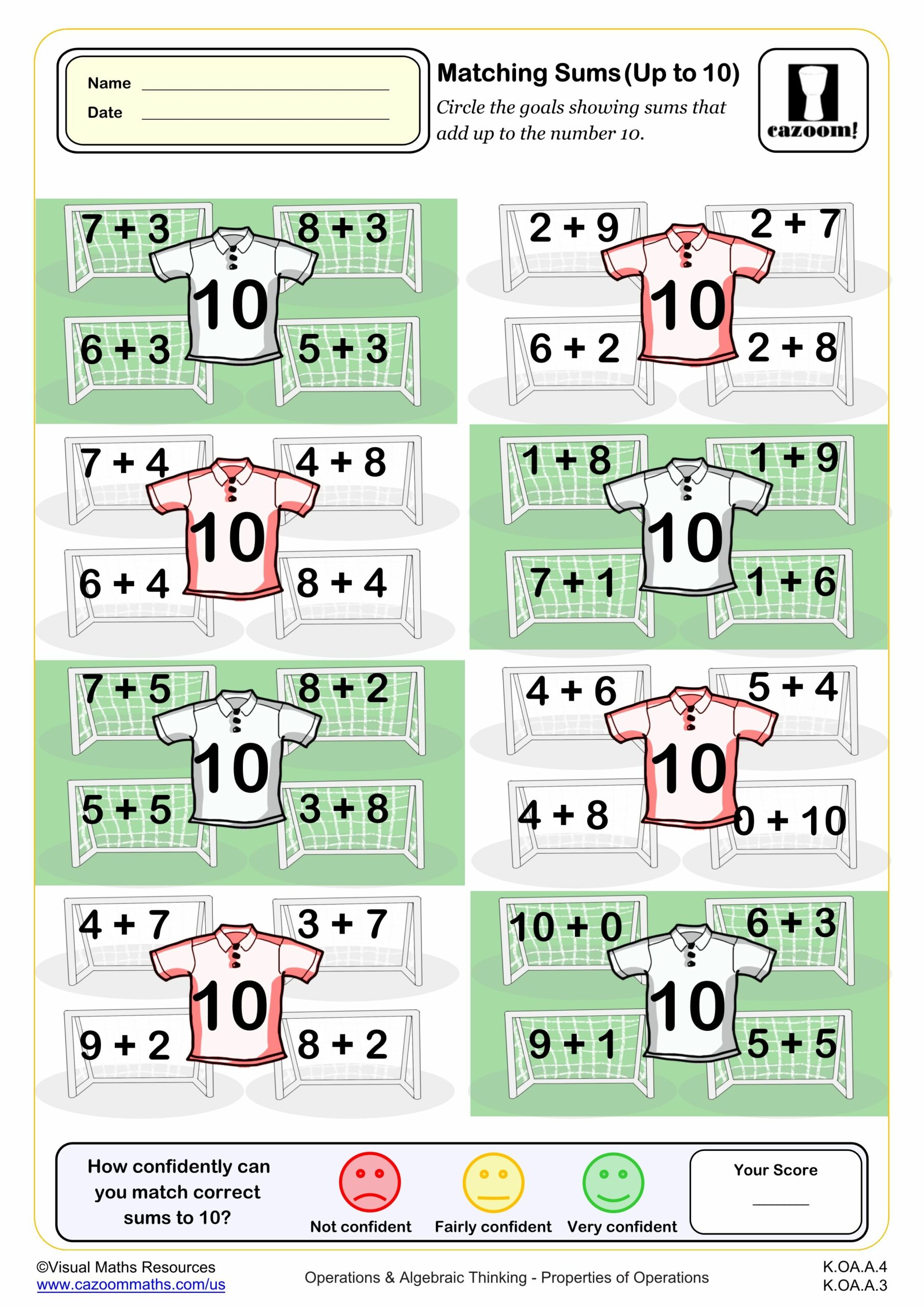
All worksheets are created by the team of experienced teachers at Cazoom Math.
What does k.oa.a.4 cover in kindergarten math?
The k.oa.a.4 standard requires students to solve addition and subtraction word problems within 10 using objects, drawings, mental math, or simple equations. This Common Core standard emphasizes understanding the relationship between addition and subtraction while developing problem-solving strategies that extend beyond rote calculation.
Teachers frequently notice that students at this level need extensive practice distinguishing between joining situations (addition) and separating situations (subtraction). Many kindergartners will successfully solve 3 + 2 when presented as numbers but struggle when the same problem appears as 'Sam has 3 toys and gets 2 more. How many toys does Sam have now?' This disconnect highlights why repeated exposure to varied word problem formats proves so valuable for building mathematical reasoning.
Which grade levels should use k.oa.a.4 worksheets?
While k.oa.a.4 specifically targets kindergarten students, these worksheets benefit learners across multiple grade levels depending on their mathematical development. Kindergarten teachers use these materials as core instruction, while first grade teachers often incorporate them for review or intervention with students who need additional support with basic addition and subtraction concepts.
Special education teachers and math interventionists frequently find k.oa.a.4 worksheets valuable for older students who require foundational skill reinforcement. The visual nature of problems involving objects and drawings makes these materials particularly effective for students with learning differences or those who benefit from concrete representations before moving to abstract number work.
How do k.oa.a.4 worksheets help students represent their thinking?
These worksheets emphasize multiple representation strategies, encouraging students to solve problems using objects, drawings, mental math, or equations rather than memorized procedures. Students might use counting bears for a physical approach, draw pictures to visualize the problem, or write simple number sentences like 4 + 3 = 7 to show their mathematical thinking.
Teachers report that students who initially rely heavily on finger counting or physical manipulatives gradually develop more sophisticated strategies when given consistent practice with varied representation methods. The progression from concrete objects to abstract symbols happens naturally when students have multiple ways to approach each problem, building both conceptual understanding and computational fluency simultaneously.
How can teachers maximize the effectiveness of k.oa.a.4 practice?
Successful implementation involves encouraging students to explain their thinking process after solving each problem, not just providing the correct answer. Teachers should model different solution strategies and celebrate multiple approaches to the same problem, helping students understand that mathematics offers various pathways to correct solutions.
Regular assessment using the included answer keys allows teachers to identify common misconceptions quickly and adjust instruction accordingly. Many educators find success pairing these worksheets with manipulatives during initial instruction, then gradually transitioning to paper-and-pencil work as students gain confidence. This scaffolded approach helps students internalize problem-solving strategies while building independence in mathematical reasoning.