Kindergarten 3D Shapes Worksheets
All worksheets are created by the team of experienced teachers at Cazoom Math.
What 3D Shapes Do Kindergarten Students Learn?
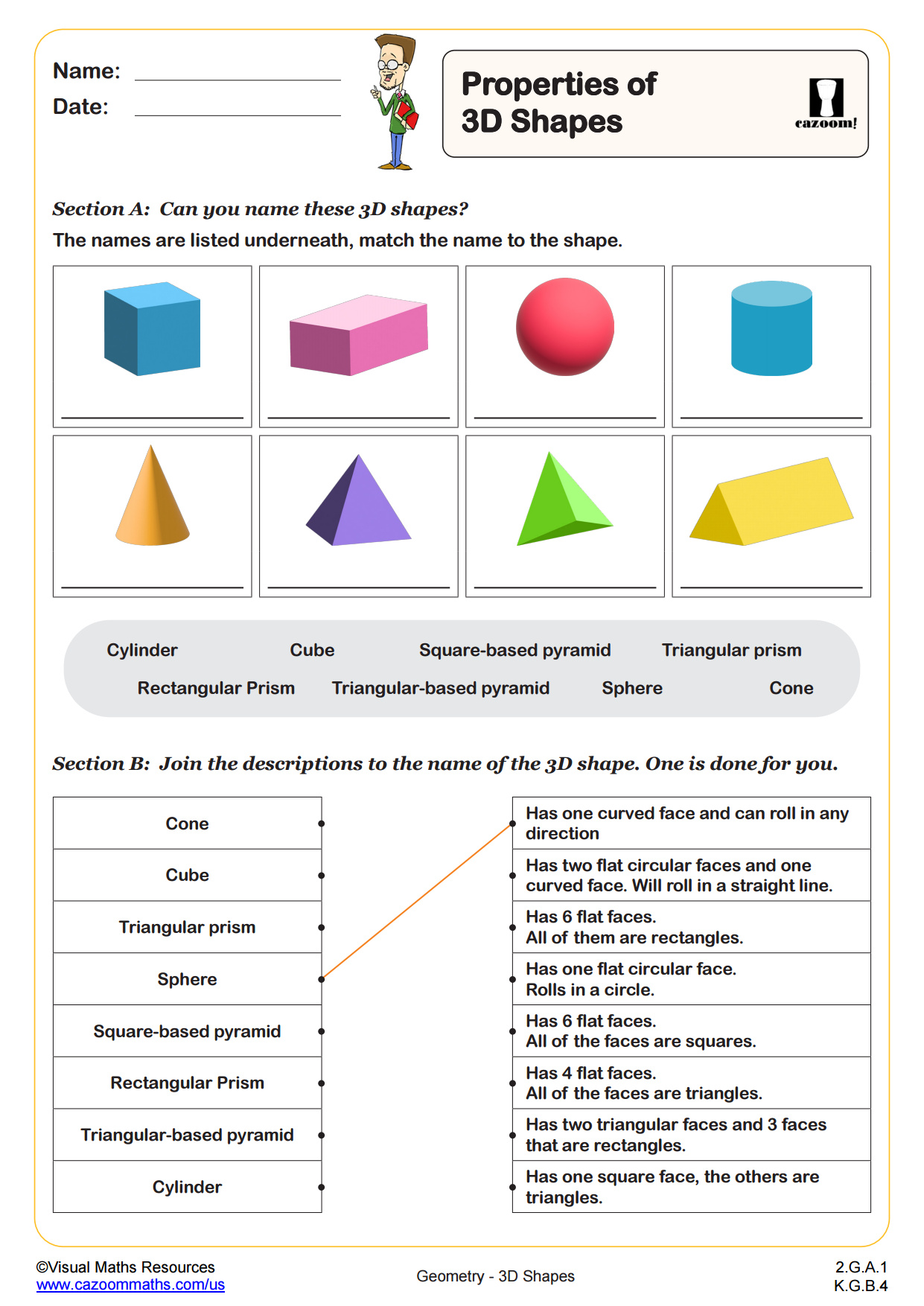
Kindergarten students typically focus on four basic 3D shapes: cubes, spheres, cones, and cylinders. According to kindergarten geometry standards, students should be able to name these shapes regardless of orientation or size, and describe their attributes using everyday language. They learn to distinguish solid shapes from flat shapes and identify 3D objects in their environment.
Teachers frequently notice that students grasp spheres and cubes most quickly because they're familiar from toys and blocks, while cones and cylinders require more exposure. A common error occurs when students call any pointed 3D shape a "cone" or any rounded shape a "ball," so worksheets that emphasize specific attributes like flat versus curved surfaces help students develop more precise geometric vocabulary and recognition skills.
What Should Kindergarteners Know About 3D Shapes?
By the end of kindergarten, students should correctly name cubes, spheres, cones, and cylinders when presented in various orientations and sizes. They should describe these shapes using terms like "flat," "curved," "pointy," and "round," and identify them in everyday objects like soup cans, ice cream cones, and dice. Kindergarten standards emphasize recognizing and describing shapes rather than formal measurement of faces or vertices.
This early geometry work builds directly on preschool experiences with sorting and matching objects. The spatial reasoning developed through 3D shape recognition prepares students for first grade geometry, where they'll begin analyzing attributes more formally, composing shapes to create new figures, and understanding the relationship between 2D faces and 3D solids. Students who master basic shape identification in kindergarten approach measurement and fraction concepts with greater confidence in later grades.
How Do Students Learn to Identify Faces on 3D Shapes?
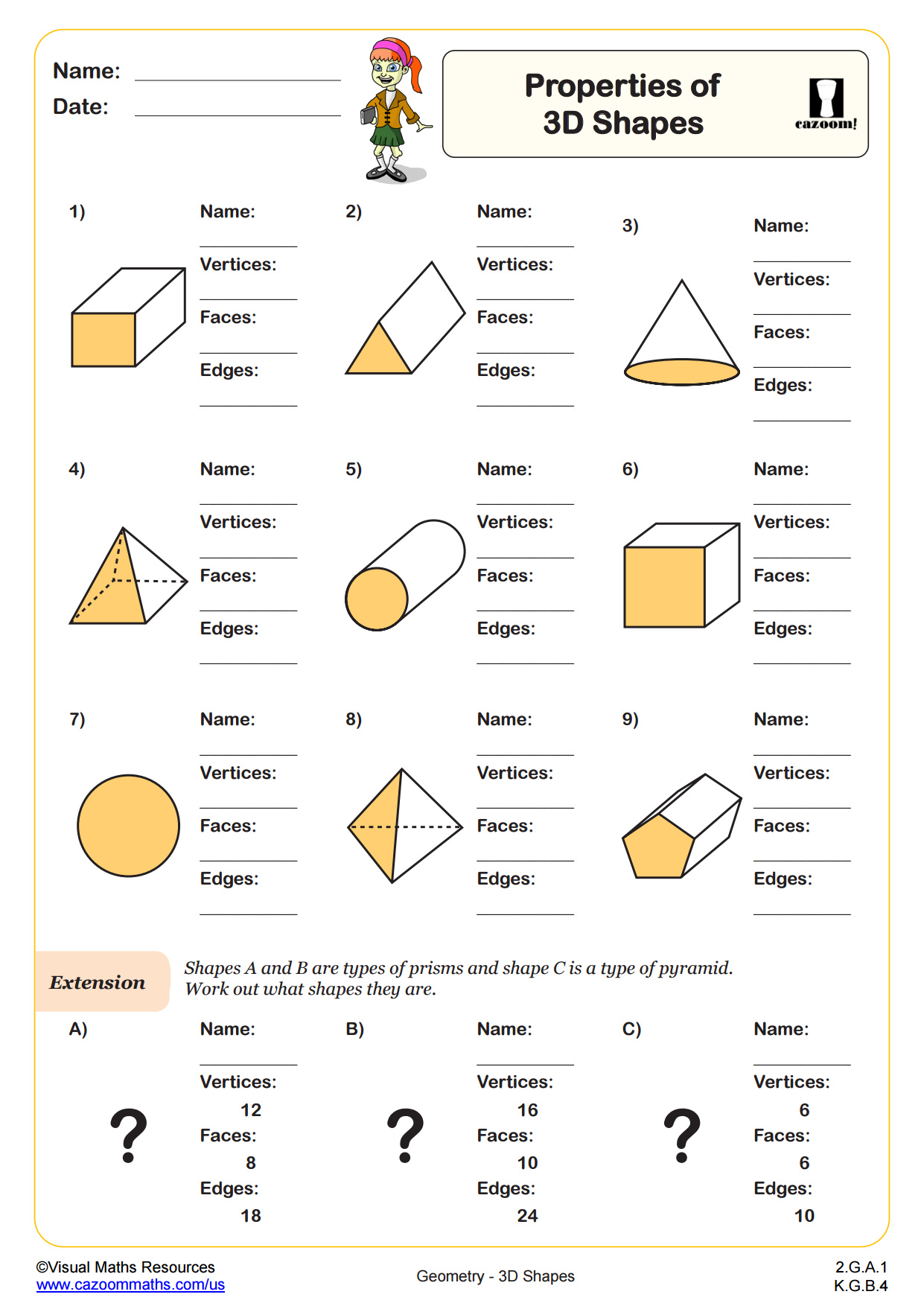
Identifying faces on 3D shapes begins with hands-on exploration where students trace the flat surfaces of solid objects onto paper. Kindergarteners learn that faces are the flat parts of a 3D shape, understanding that a cube has square faces while a cylinder has circular faces. Worksheets reinforce this concept by showing 3D shapes with highlighted faces, helping students count and recognize the 2D shapes that form the surfaces of solids.
This skill connects directly to real-world problem solving and early engineering concepts. When students build structures with blocks, they're using face recognition to determine which surfaces will stack or connect. Packaging designers use this same understanding to create boxes that fit together efficiently, and architects consider how faces meet to form stable buildings. Students who understand faces and surfaces develop stronger spatial visualization skills needed for STEM fields and everyday tasks like packing a suitcase or arranging furniture.
How Can Teachers Use These 3D Shapes Worksheets Effectively?
These worksheets work best when paired with hands-on manipulation of actual 3D objects. Teachers can have students handle wooden blocks, balls, and containers before completing worksheets, bridging the gap between concrete objects and two-dimensional representations. The answer keys allow for quick assessment of whether students can translate their tactile understanding to visual recognition, revealing which shapes need additional practice with physical models.
Many teachers use these worksheets during math centers while working with small groups on building activities, allowing independent students to reinforce shape recognition at their own pace. The materials also serve well as formative assessments before parent-teacher conferences, showing families exactly which shapes their child recognizes confidently. Some kindergarten teachers send worksheets home as weekend practice, asking families to find household objects matching each shape, which strengthens the home-school connection and helps parents understand geometry standards.