Kindergarten Measurement Worksheets
All worksheets are created by the team of experienced teachers at Cazoom Math.
What measurement skills do kindergarten students learn?
Kindergarten measurement focuses on direct comparison rather than standard units. Students learn to compare objects by physical attributes such as weight (heavier/lighter), length (longer/shorter), height (taller/shorter), and capacity (holds more/holds less). This aligns with kindergarten Common Core standards that emphasize describing measurable attributes and making direct comparisons between two objects.
Teachers notice that students grasp comparison concepts most effectively when they can physically manipulate objects before working with pictorial representations. A common challenge occurs when students confuse size with weight, assuming larger objects are always heavier. Worksheet practice reinforces the vocabulary and visual discrimination skills needed to make accurate comparisons, preparing students for the introduction of non-standard measurement units in first grade.
How does kindergarten measurement prepare students for later grades?
Kindergarten measurement establishes the conceptual foundation that students need before they can meaningfully use rulers, scales, or other measuring tools. At this stage, students develop the understanding that objects have measurable attributes and that these attributes can be compared. This comparative thinking is prerequisite knowledge for first grade, when students begin measuring with non-standard units like paper clips or blocks.
The vocabulary and reasoning skills developed in kindergarten measurement directly support second and third grade work with standard units like inches, centimeters, pounds, and grams. Students who confidently compare objects in kindergarten transition more smoothly to understanding that measurement assigns numerical values to physical attributes. This progression from direct comparison to non-standard units to standard measurement creates a coherent learning pathway throughout elementary school.
Why is comparing weight important for young learners?
Comparing weight helps kindergarteners develop spatial reasoning and challenges their assumptions about physical properties. Weight comparison requires students to move beyond visual appearance and consider an attribute they cannot directly see, which builds critical thinking skills. Students learn that weight is independent of size, a counterintuitive concept that deepens their understanding of object properties.
This skill connects to real-world experiences that kindergarteners encounter daily. Students apply weight comparison when carrying their backpacks, sharing toys, helping set the table, or choosing which grocery bag to carry. In STEM contexts, understanding weight differences lays groundwork for future science concepts including mass, density, and force. These early experiences with comparing weight also support later work in data collection and measurement in science experiments throughout elementary school.
How can teachers use kindergarten measurement worksheets effectively?
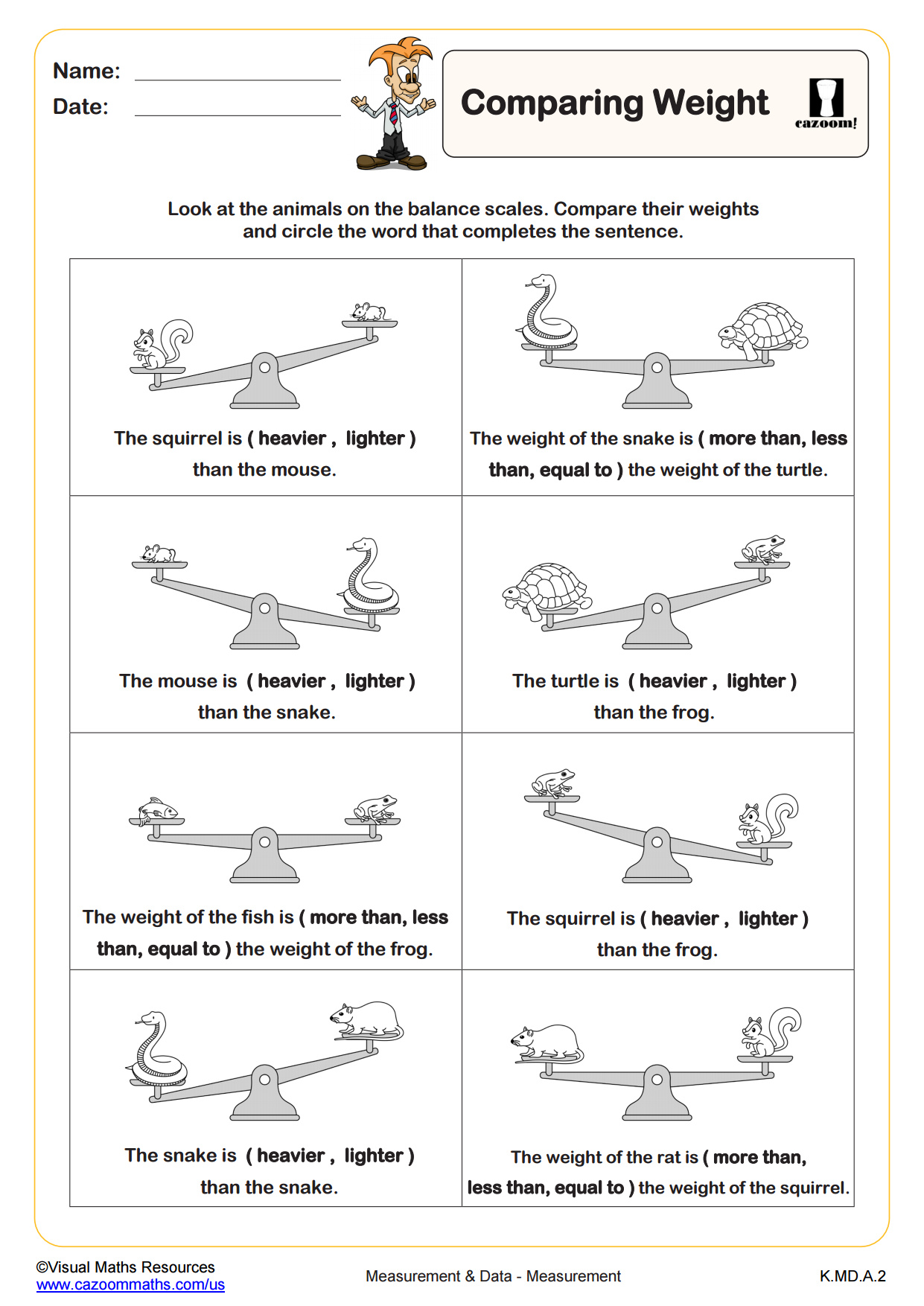
These worksheets work best when paired with hands-on exploration using classroom objects. Teachers often use worksheets as a follow-up to concrete activities where students have physically compared items using balance scales or by holding objects. The visual format helps students transition from tactile experiences to pictorial representations, a critical step in mathematical abstraction for young learners.
The worksheets serve multiple classroom purposes including small group instruction, math center activities, or independent practice for students who grasp concepts quickly. Many teachers use them during intervention time to reinforce vocabulary with students who need additional support distinguishing between measurement terms. The included answer keys make these worksheets practical for parent volunteers or classroom aides to use with individual students, and they work equally well as take-home practice that families can complete together to reinforce classroom learning.