Kindergarten Position and Direction Worksheets
All worksheets are created by the team of experienced teachers at Cazoom Math.
What Are Position and Direction Skills in Kindergarten Math?
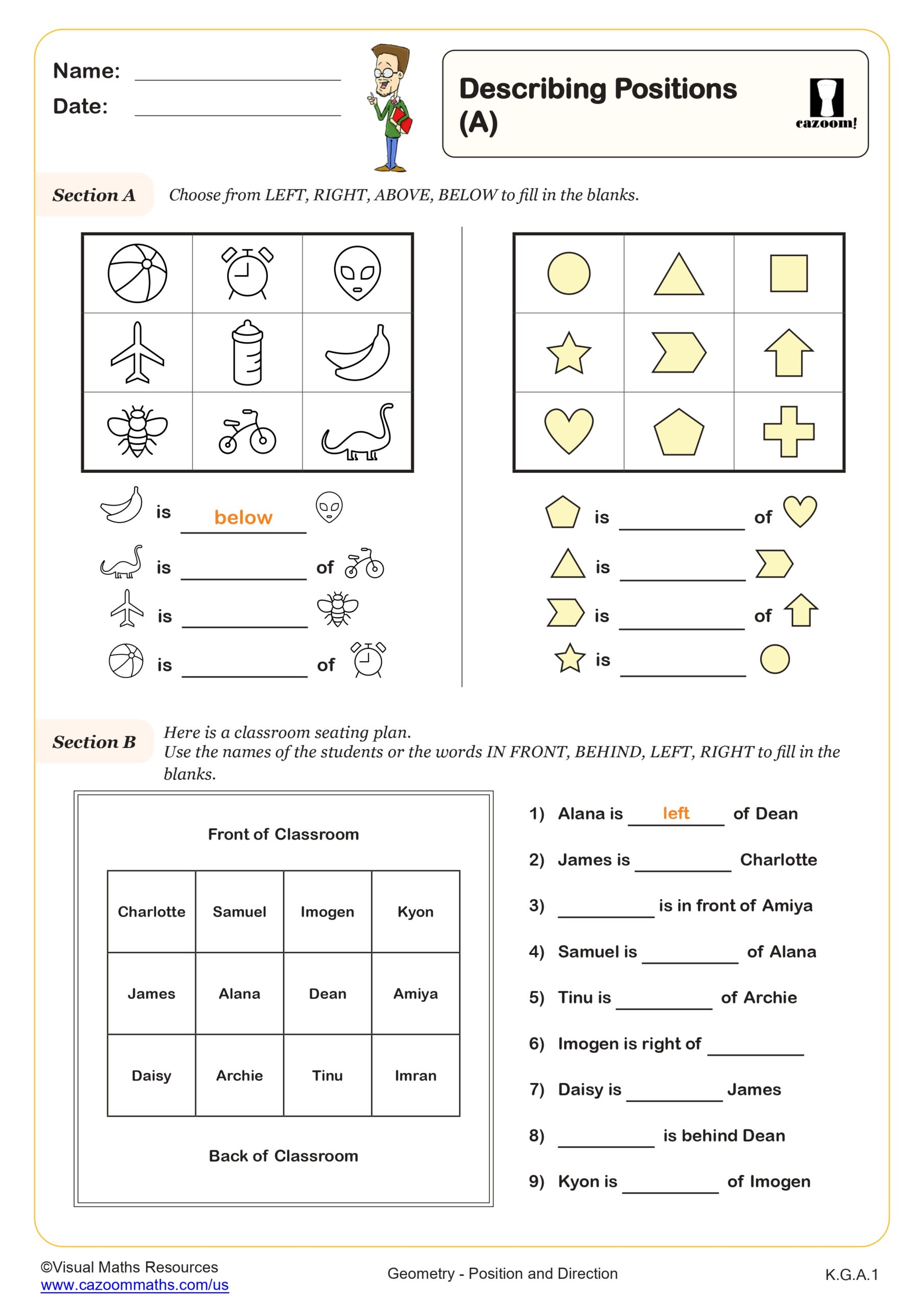
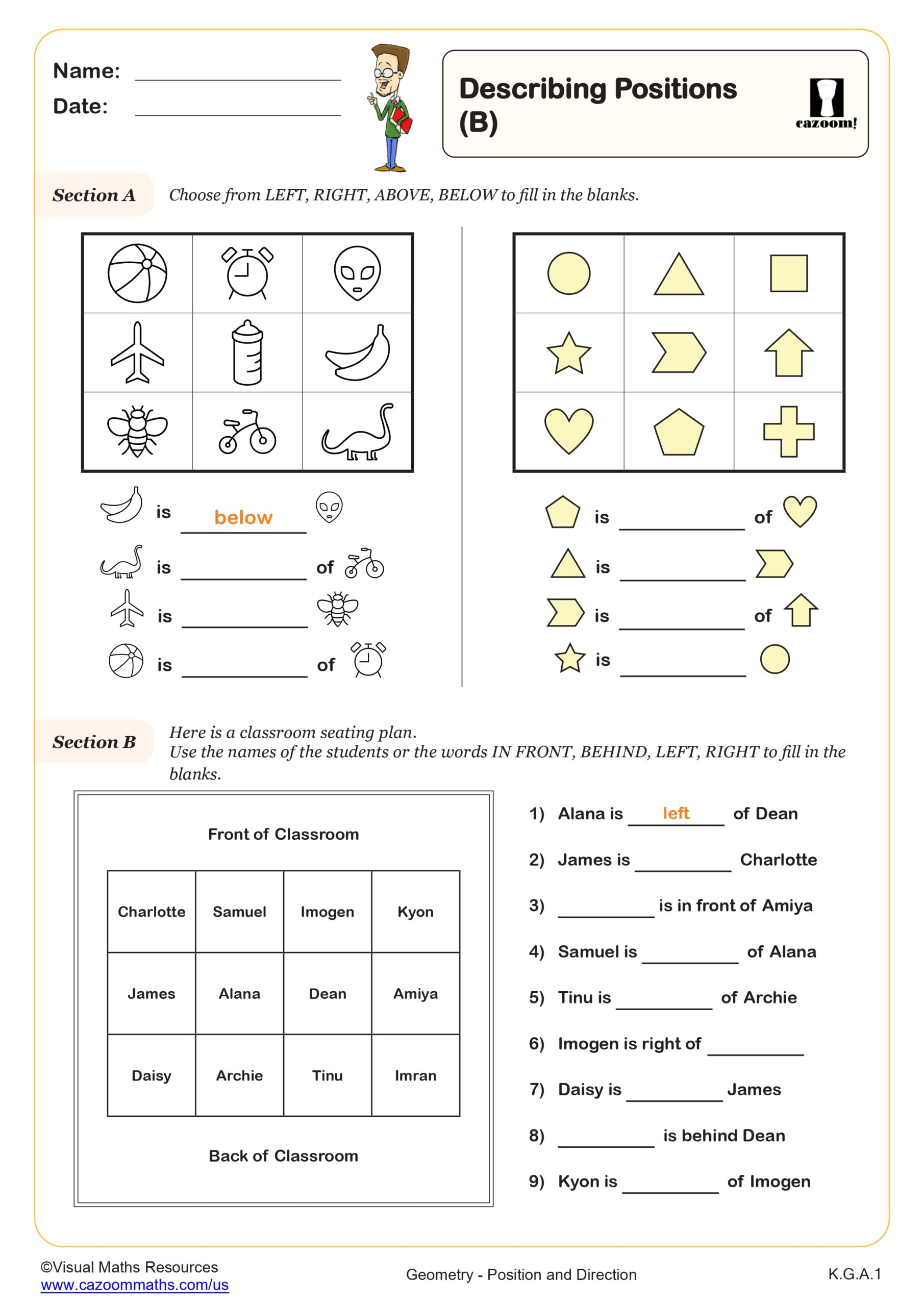
Position and direction skills involve using precise vocabulary to describe where objects are located in space relative to other objects or reference points. Kindergarten students learn terms like above, below, beside, in front of, behind, next to, on top of, under, left, and right. This vocabulary connects to the Common Core State Standards for Geometry in Kindergarten, specifically describing the position of objects using these spatial relationship words.
Students often confuse directional terms that require a reference point, particularly "in front of" versus "behind," since these terms change depending on which direction the observer faces. Teachers notice significant improvement when students physically act out positional relationships before completing written work, helping them internalize that spatial vocabulary describes relationships between objects rather than qualities of individual objects themselves.
What Should Kindergarten Students Know About Position and Direction?
Kindergarten students should confidently identify and describe the position of objects using common spatial vocabulary words. They should understand that positional words describe relationships and can identify when an object is above, below, beside, or between other objects in pictures or real-world settings. Students should also begin recognizing that some directional terms like left and right are relative to the observer's perspective.
This topic builds naturally from preschool experiences with simple positional concepts like up and down. Mastering position and direction in kindergarten creates the foundation for first grade work with ordering objects, understanding before and after in sequences, and eventually for second and third grade coordinate grid work where students must describe exact locations using two reference points simultaneously.
How Do Students Learn Left and Right Direction in Kindergarten?
Learning left and right presents unique challenges because these terms are perspective-dependent, meaning they change based on which way someone faces. Kindergarten students typically master recognizing their own left and right first, often using memory aids like identifying their dominant hand or remembering which hand they use to write. Teachers often see breakthrough moments when students realize that their left and their neighbor's left point in opposite directions when facing each other.
This spatial reasoning connects directly to navigation and coding skills used in STEM education. When students understand directional vocabulary, they can follow sequential directions for robotics activities, create simple maps of their classroom or school, and eventually program robots to move in specific patterns. Architecture and engineering professionals use these same spatial relationship concepts when creating blueprints and designing structures that people navigate through daily.
How Can Teachers Use Position and Direction Worksheets Effectively?
These worksheets provide structured practice for students to apply positional vocabulary to visual representations after hands-on exploration with concrete objects. The worksheets work best when students have already manipulated physical objects and described their positions orally, as the transition from three-dimensional experience to two-dimensional representation requires additional cognitive processing. The included answer keys allow teachers to quickly identify which specific positional terms individual students struggle with most.
Many teachers use these worksheets during math centers or stations, pairing them with manipulative activities where students arrange objects according to verbal directions. The worksheets also serve as effective formative assessments before introducing more complex spatial concepts. Some teachers send them home as practice after sufficient classroom instruction, while others use them for one-on-one intervention with students who need additional support visualizing spatial relationships on paper.