Kindergarten Shapes Worksheets
All worksheets are created by the team of experienced teachers at Cazoom Math.
What shapes should kindergarten students recognize?
Kindergarten students should recognize and name basic two-dimensional shapes including circles, squares, triangles, and rectangles. Most state standards align with Common Core expectations that kindergarteners identify shapes regardless of their orientation or size, understanding that a triangle rotated on its side is still a triangle. Students at this level should also describe shapes using everyday language like "corners" and "sides" before transitioning to formal geometric vocabulary.
Teachers frequently observe that students master circle identification first since it's the only shape without corners, making it distinctly different. Squares and rectangles cause more confusion because students focus on the four sides without noticing the angle differences. Regular practice sorting and counting shapes helps kindergarteners move beyond memorizing what shapes look like to understanding their defining attributes, which becomes crucial when they start comparing and classifying shapes in first grade.
How does shape recognition fit into kindergarten math standards?
Kindergarten geometry standards focus on identifying and describing shapes in the environment, which includes recognizing two-dimensional shapes like circles, squares, triangles, and rectangles. Students should distinguish between flat shapes and solid figures, though kindergarten emphasizes two-dimensional shapes more heavily. This aligns with the Common Core standard K.G.A.2, where students correctly name shapes regardless of their orientations or overall size, building the foundation for spatial reasoning.
Shape recognition in kindergarten prepares students for first grade geometry, where they'll begin composing shapes to create new shapes and partitioning shapes into equal parts. Teachers notice that kindergarteners who develop strong shape vocabulary and can explain why a figure is a specific shape (counting sides and corners) transition more smoothly to analyzing attributes in later grades. This early geometry work also connects to counting practice, as students count sides and corners, reinforcing number sense alongside spatial skills.
Why is counting shapes an important kindergarten skill?
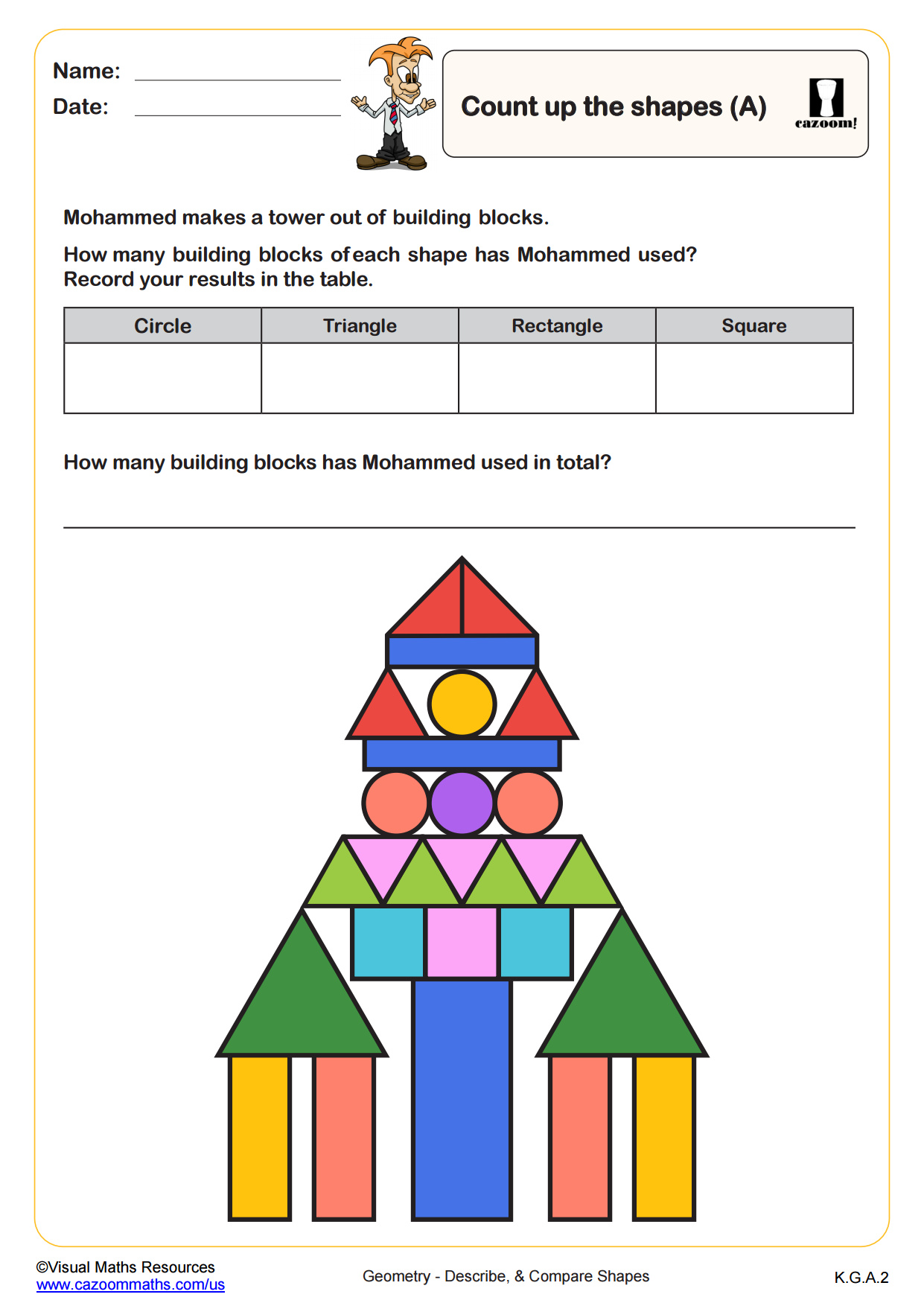
Counting shapes combines two fundamental kindergarten skills: shape recognition and counting practice. When students count how many circles, squares, or triangles appear in a collection, they practice one-to-one correspondence while reinforcing shape attributes. This skill requires students to visually scan an image, identify each shape by its characteristics, and keep an accurate count, developing both geometric understanding and number sense simultaneously.
This skill connects directly to real-world applications students encounter daily. Kindergarteners who can identify and count shapes notice patterns in their environment, from the rectangular windows in a building to the circular wheels on vehicles. In early STEM learning, recognizing shapes supports basic engineering concepts like symmetry and structure. Teachers observe that students who excel at counting shapes often show stronger spatial reasoning when working with pattern blocks or building activities, skills that translate to problem-solving in science and technology contexts throughout their education.
How can teachers use kindergarten shapes worksheets effectively?
Kindergarten shapes worksheets work best when used alongside hands-on manipulatives like pattern blocks or shape tiles. The worksheets provide structured practice that helps students transfer their tactile shape experiences to visual recognition on paper, a skill needed for formal assessments. Teachers can use these worksheets to assess which shapes individual students have mastered and which require additional concrete practice, making instructional decisions more targeted and efficient.
Many teachers use shapes worksheets during math centers, pairing students so they can verbalize their thinking as they identify and count shapes together. The included answer keys make these worksheets suitable for independent work once students understand the task, freeing teachers to work with small groups needing intervention. Some teachers send shapes worksheets home as practice, since parents easily understand the task and can reinforce shape vocabulary. During morning work or transition times, quick shape counting activities keep students engaged while building fundamental geometry skills that standardized kindergarten assessments measure.