Middle School 3D Shapes Worksheets
All worksheets are created by the team of experienced teachers at Cazoom Math.
What Are 3D Shapes and Why Do Middle School Students Study Them?
Three-dimensional shapes, or geometric solids, are figures with length, width, and height. Middle school students study prisms, pyramids, cylinders, cones, and spheres to build spatial reasoning skills required for higher-level geometry, architecture, engineering, and design fields. Understanding 3D shapes bridges students from basic geometry to more complex topics like surface area, volume, and cross-sections.
A common misconception occurs when students confuse faces with surfaces on curved objects. Teachers notice students counting the curved surface of a cylinder as multiple faces rather than recognizing it as a single curved surface. Worksheets that ask students to identify shapes in everyday objects help clarify these distinctions by connecting abstract geometric concepts to tangible items like soda cans, storage boxes, and traffic cones.
Which Grade Levels Use These 3D Shapes Worksheets?
These worksheets support 6th grade, 7th grade, and 8th grade students throughout middle school. The Common Core State Standards introduce three-dimensional figures formally in 6th grade and expand applications through 7th and 8th grade as students work with volume, surface area, and cross-sections of geometric solids.
The progression across these grades moves from basic identification and visualization to more sophisticated applications. Sixth graders typically work with recognizing 3D shapes and drawing simple representations, while 7th and 8th graders tackle plans and elevations, analyze lines of symmetry in three-dimensional contexts, and connect isometric drawings to algebraic concepts. Students confidently tackle elevation views once they recognize that each view represents what an observer sees from a specific vantage point.
How Do Plans and Elevations Help Students Understand 3D Shapes?
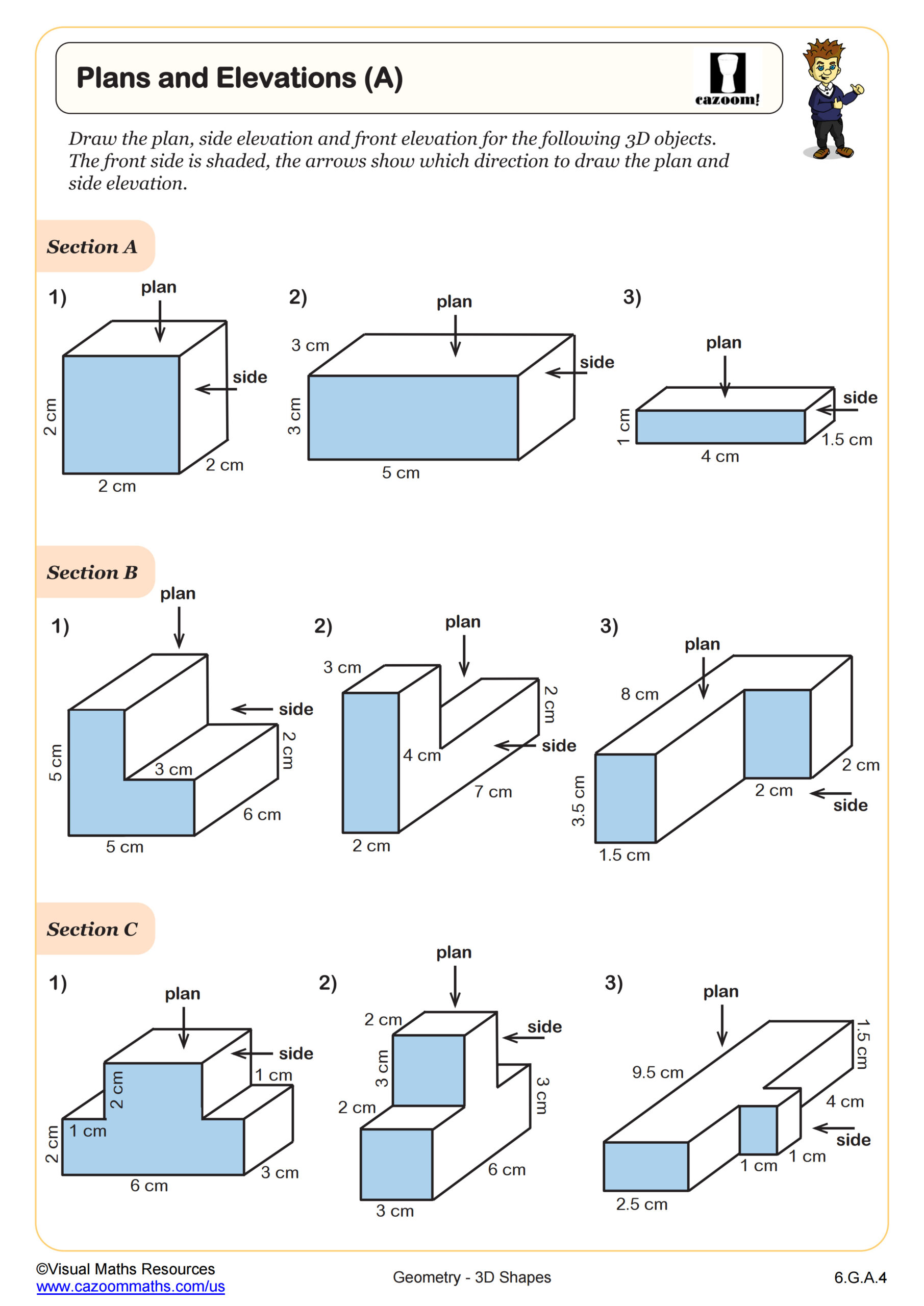
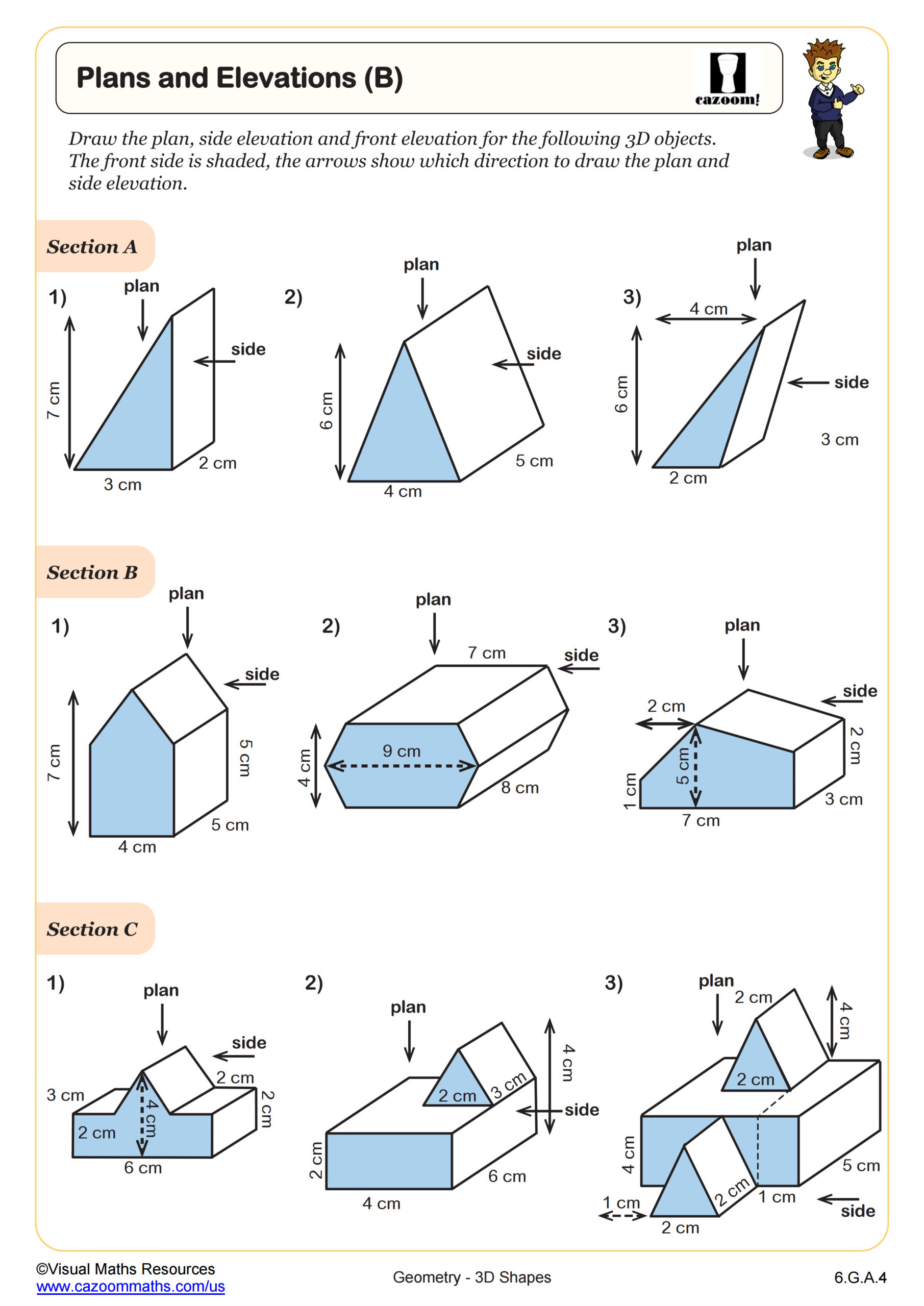
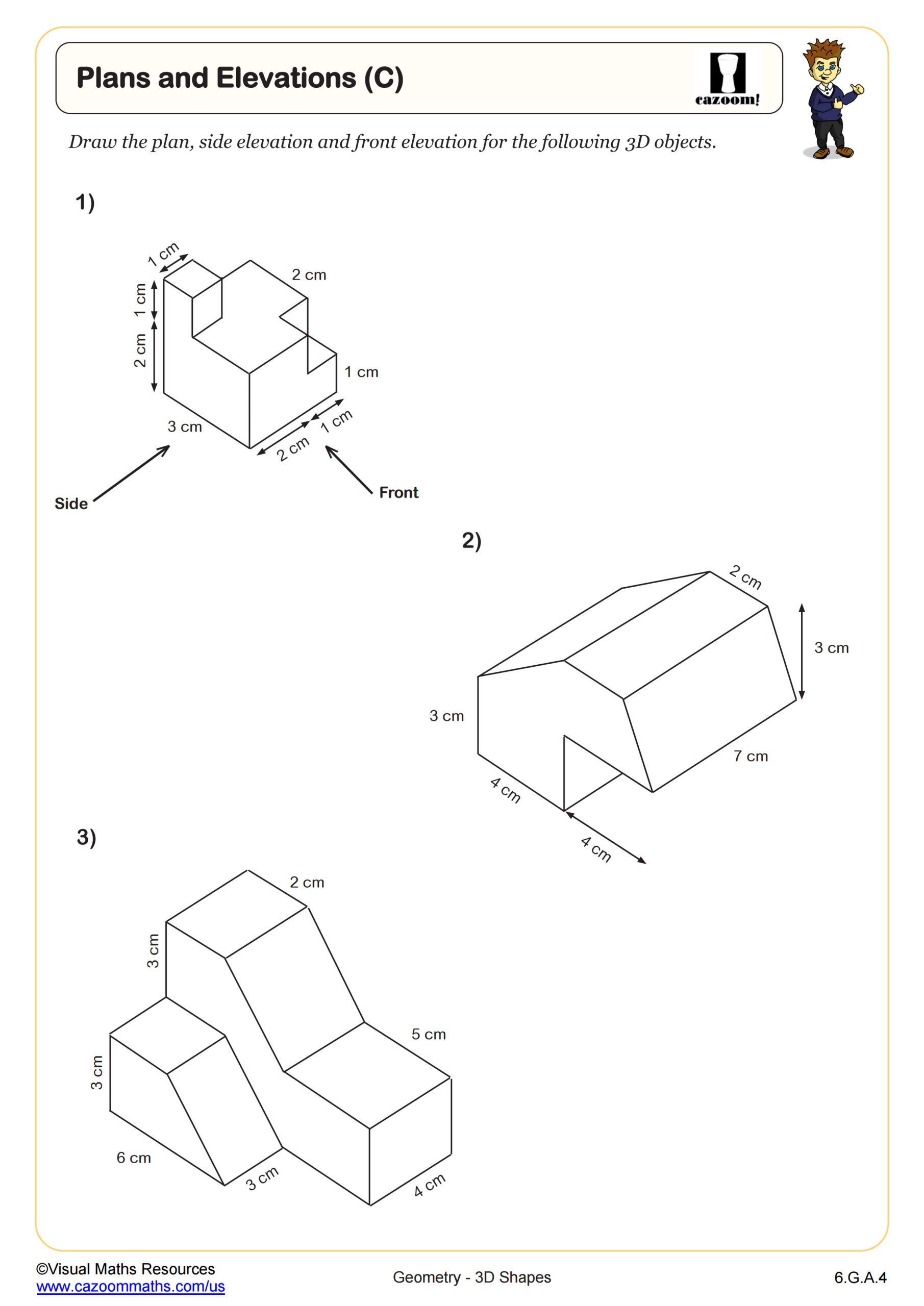
Plans and elevations are orthographic projections that show different views of a three-dimensional object from the top (plan), front, and side (elevations). This technique teaches students to visualize how a 3D object appears from multiple perspectives, requiring them to mentally rotate objects and understand spatial relationships. Students learn that a single 3D shape produces distinct 2D views depending on the viewing angle.
Architects, engineers, and manufacturers rely on plans and elevations daily to communicate design specifications. Before constructing a building, bridge, or product, professionals create these technical drawings to ensure all dimensions are accurate and every team member understands the structure. Students recognize the practical value of this skill when they realize that misreading an elevation view could mean ordering the wrong materials or building a structure that doesn't meet specifications.
How Can Teachers Use These 3D Shapes Worksheets in the Classroom?
The worksheets provide structured practice with isometric and triangle grid paper that scaffolds drawing skills before students attempt freehand sketches. Starting with pre-printed grids reduces frustration and helps students focus on understanding angles and proportions rather than struggling with blank paper. Answer keys allow teachers to quickly identify whether errors stem from visualization difficulties or mechanical drawing mistakes.
Many teachers use these worksheets for differentiated instruction, assigning grid paper exercises to students who need additional structure while challenging advanced learners with plans and elevations tasks. The symmetry worksheets work well as warm-up activities or exit tickets to assess understanding, while the everyday objects identification sheets make effective homework assignments since students can verify their answers by examining household items. Paired work with isometric drawings encourages mathematical discussion as partners compare their representations and identify differences.