Middle School Describe and Compare Shapes Worksheets
All worksheets are created by the team of experienced teachers at Cazoom Math.
What geometric skills do students practice when describing and comparing shapes?
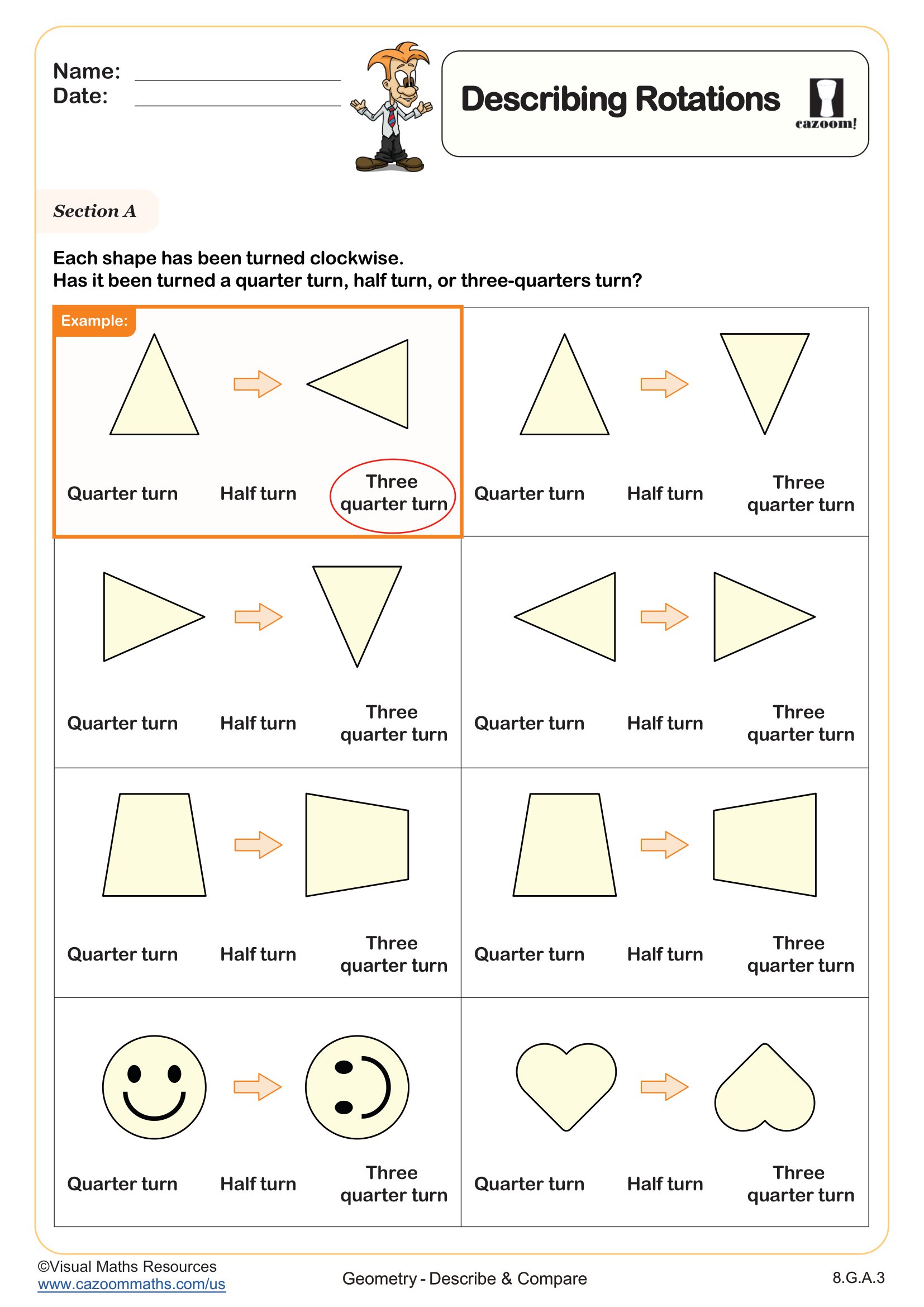
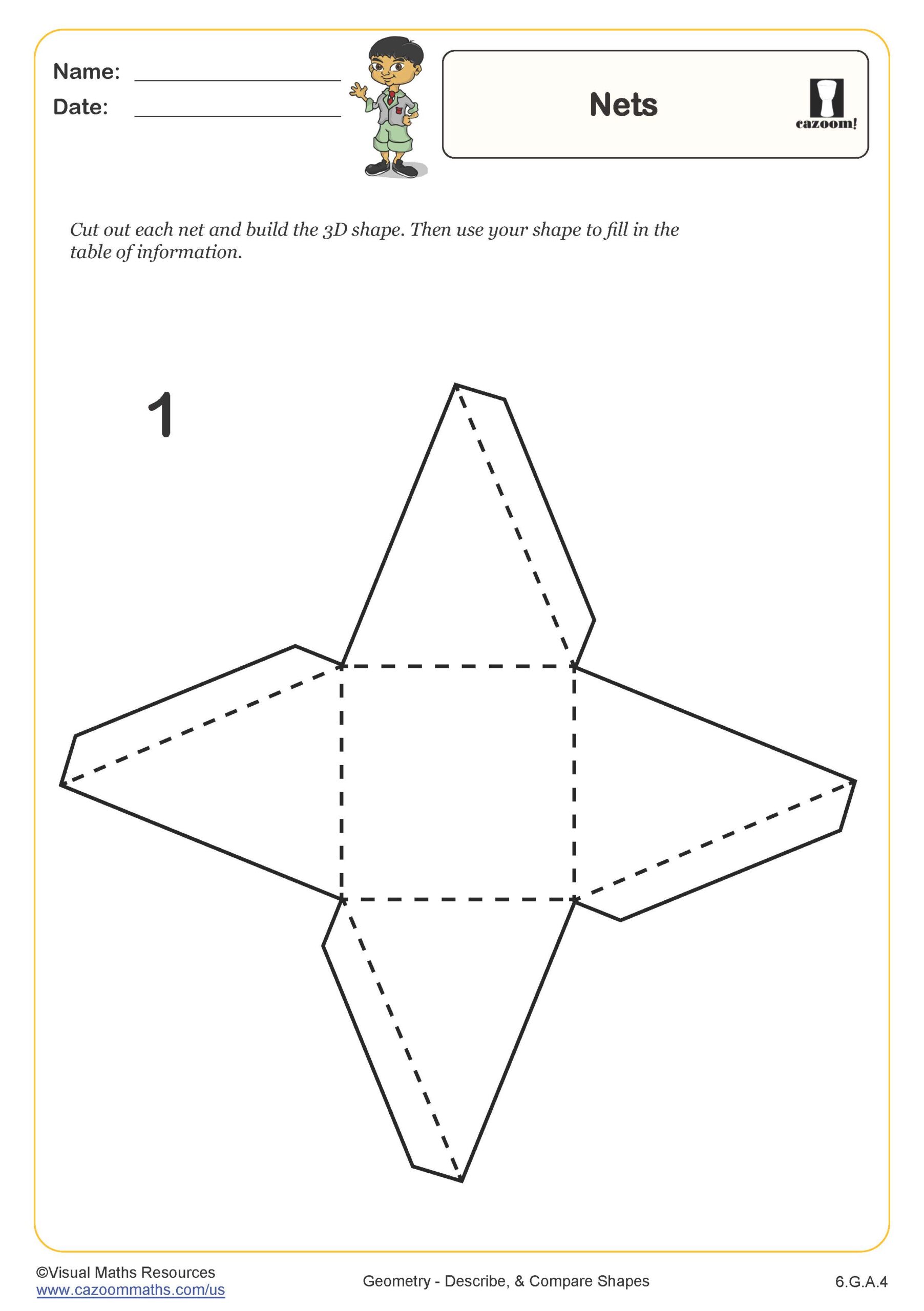
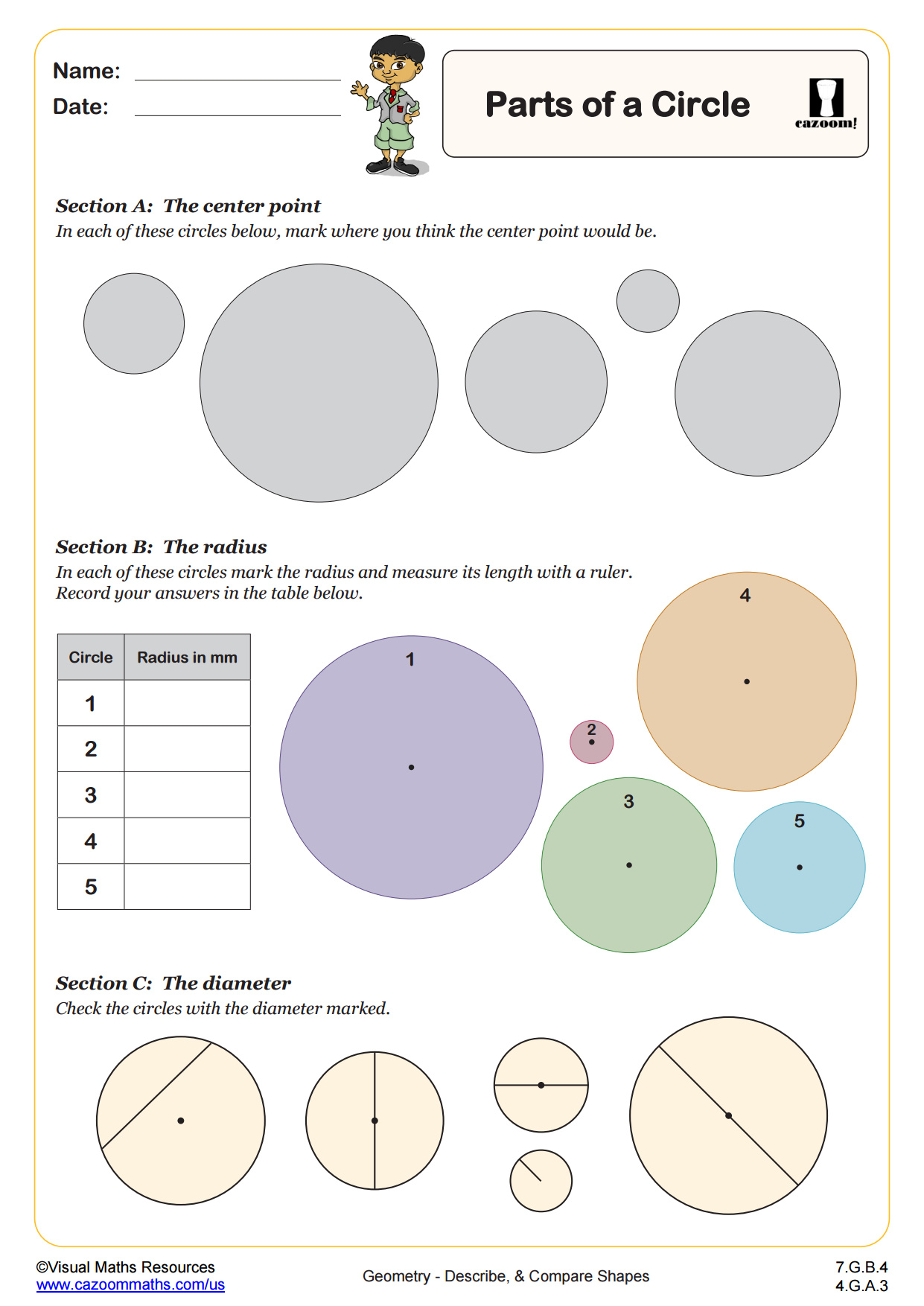
Students develop multiple interconnected geometry skills including identifying and counting sides and vertices, describing rotations with precise degree measures and directional language, and articulating how shapes move through translations. These worksheets also address shape recognition when figures appear in different orientations and the ability to compare properties across multiple geometric figures.
Teachers frequently observe that students lose points on standardized assessments not because they can't visualize the transformation, but because they omit critical details in their descriptions. A student might correctly identify a rotation but forget to specify clockwise versus counterclockwise, or describe a translation without including units. The worksheets reinforce complete, mathematically accurate descriptions that meet assessment expectations.
Which grade levels use worksheets for describing and comparing shapes?
This collection serves middle school students in 6th grade, 7th grade, and 8th grade. At this stage, students move beyond basic shape identification to analyzing geometric transformations and properties with mathematical precision, building the foundation for high school geometry and coordinate plane work.
The progression across these grades shows increasing complexity: 6th graders typically focus on counting vertices and sides while beginning to describe simple rotations, 7th graders work with more complex transformations and multiple-step movements, and 8th graders integrate these skills with coordinate geometry and algebraic descriptions of transformations. Many students make significant progress once they connect transformation vocabulary to the visual changes they observe.
How do rotations work in middle school geometry?
Rotations turn a shape around a fixed point (the center of rotation) by a specific angle measure in either a clockwise or counterclockwise direction. Students learn to describe rotations with three essential components: the angle of rotation (typically 90°, 180°, or 270°), the direction of turn, and the center point. Common angles correspond to quarter-turns, half-turns, and three-quarter-turns around a point.
This skill connects directly to real-world engineering and design applications. Computer graphics programmers use rotation descriptions to animate objects in video games, architects rotate floor plan elements when designing spaces, and mechanical engineers specify rotational movements for robotic arms in manufacturing. Students who master precise rotation language in middle school find these STEM pathways more accessible because they already think in terms of exact angles and directional movements.
How can teachers use these worksheets effectively in class?
The worksheets provide scaffolded practice that moves from concrete shape identification to abstract transformation descriptions. Teachers can use the vertex-counting and shape-recognition activities as foundational exercises before introducing rotation and translation vocabulary. The answer keys allow students to self-check during independent work or let teachers quickly identify which specific aspects of shape description need reteaching.
Many teachers find these worksheets valuable for differentiated instruction—struggling students benefit from the counting and identification exercises to build confidence, while advanced students can tackle rotation descriptions and complex comparisons. They work well as warm-up activities to activate prior knowledge before new transformation lessons, as homework to reinforce classroom instruction, or as intervention materials for students who need additional support with geometric vocabulary and spatial reasoning before assessments.