Middle School Function Machines Worksheets
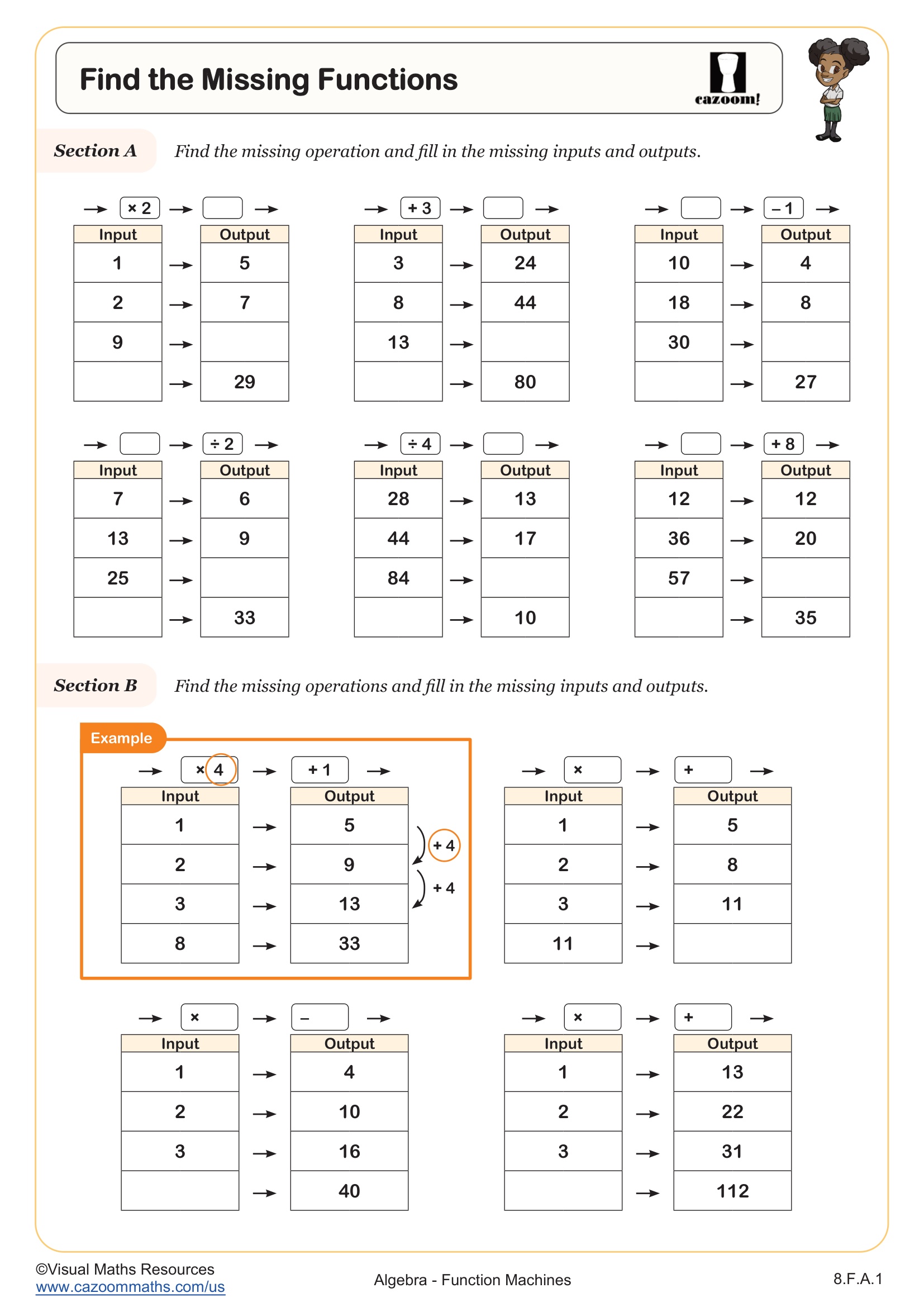
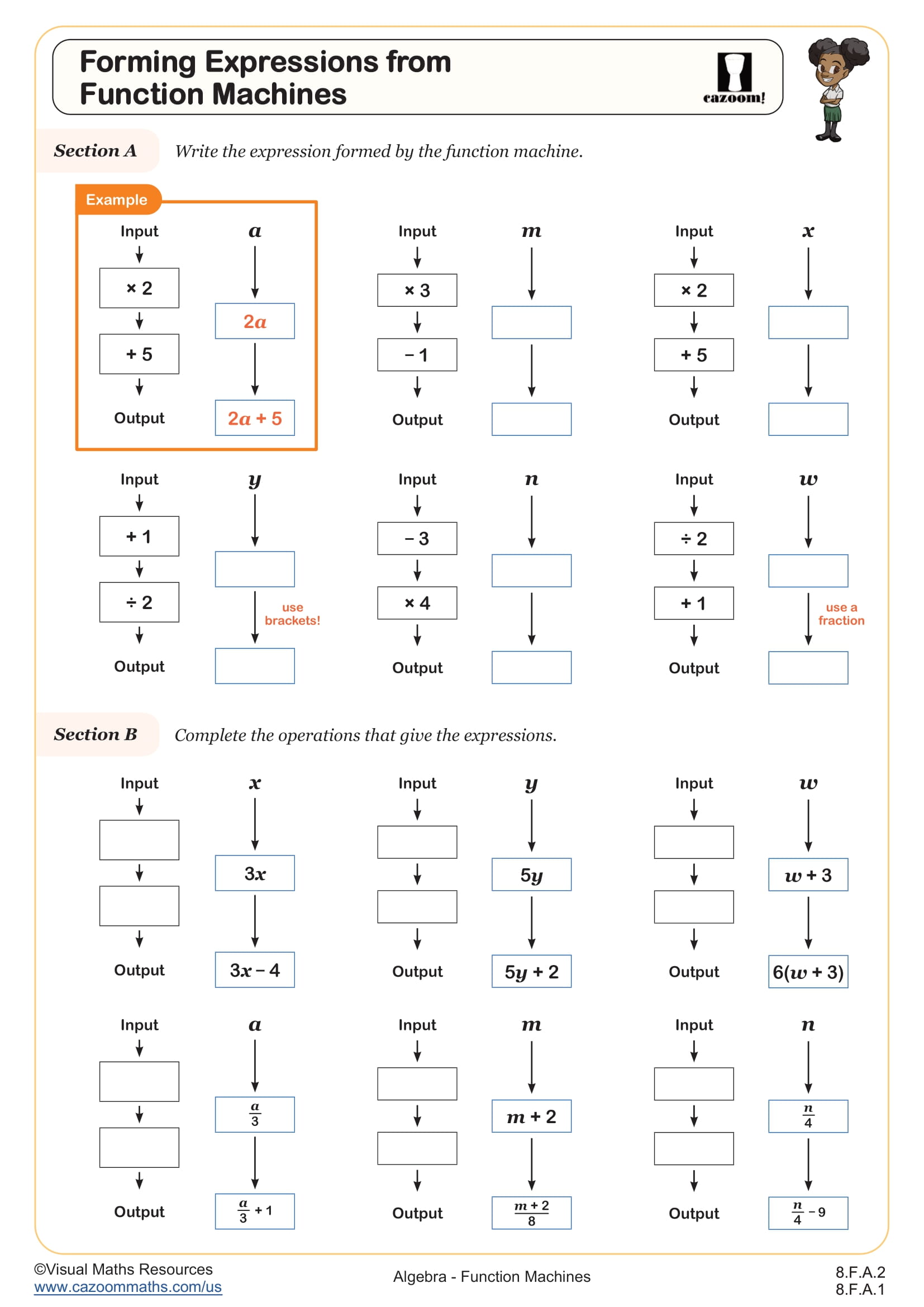
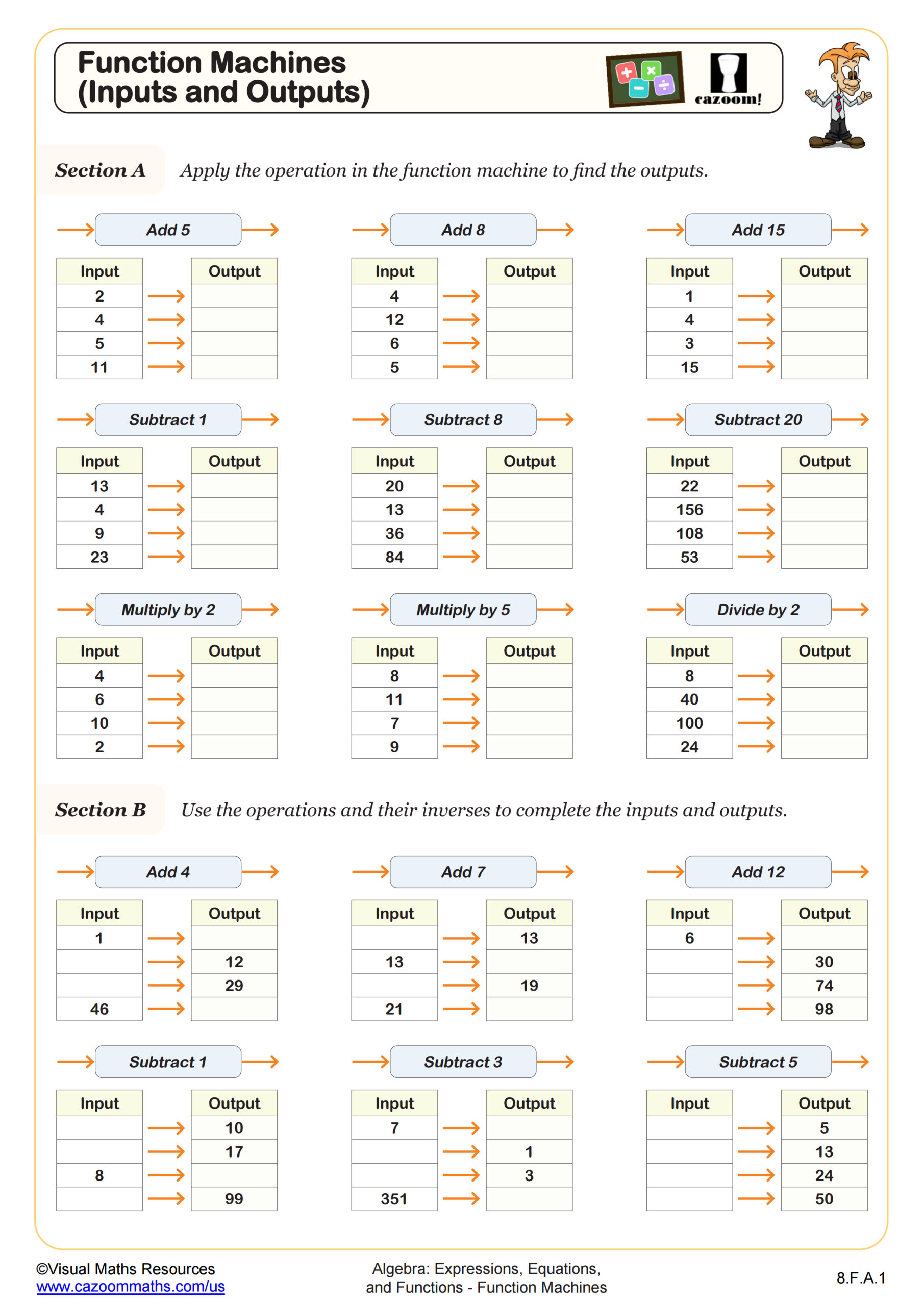
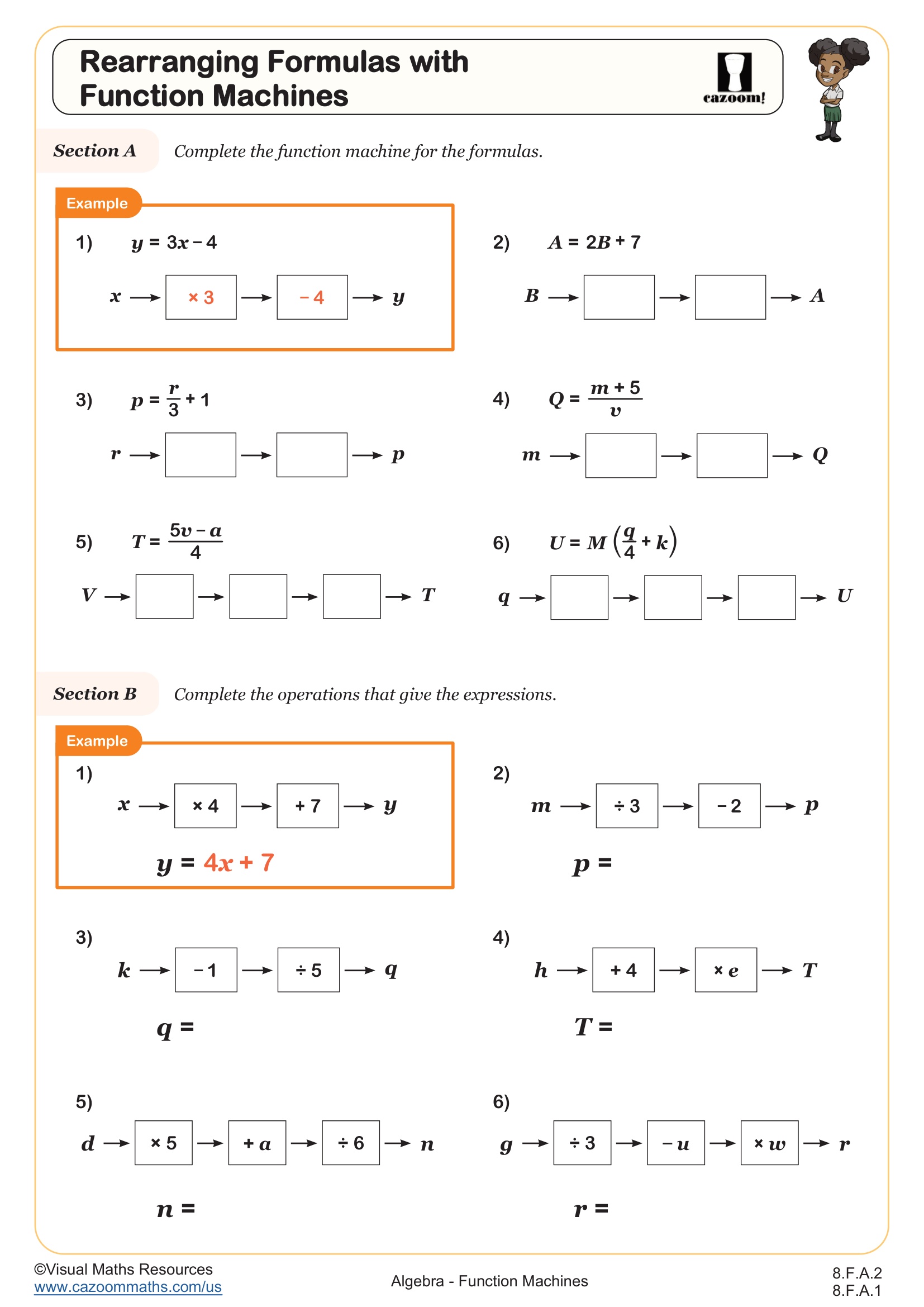
All worksheets are created by the team of experienced teachers at Cazoom Math.
What Are Function Machines and Why Do Students Learn Them?
Function machines are visual tools that show how a mathematical rule transforms input values into output values. Students learn this concept because it builds the foundation for understanding functions, algebraic expressions, and relationships between variables that appear throughout algebra, geometry, and data analysis. The concrete, step-by-step nature of function machines makes abstract algebraic thinking accessible to middle schoolers.
A common misconception occurs when students confuse the order of operations within multi-step function machines. For instance, with a rule "multiply by 3, then add 5," students often apply the operations in reverse or calculate (input + 5) × 3 instead of (input × 3) + 5. Teachers find that having students write out each step separately before combining operations significantly reduces this error pattern.
Which Grade Levels Use Function Machine Worksheets?
These function machine worksheets align with middle school curriculum standards, specifically designed for 6th grade, 7th grade, and 8th grade students. The material bridges arithmetic and algebra, appearing in the expressions and equations domain of the Common Core State Standards where students learn to represent and analyze quantitative relationships.
The progression across grade levels builds systematically. Sixth graders typically work with single-operation functions and simple patterns, while seventh graders tackle two-step functions and begin forming algebraic expressions from function diagrams. By eighth grade, students work with more complex multi-step functions, reverse operations to find inputs, and connect function machines to linear equations and graphing concepts that prepare them for high school algebra.
How Do Students Form Expressions from Function Machines?
Forming expressions from function machines requires students to translate visual diagrams into algebraic notation. Students examine the operations shown in the function machine, then write an expression using a variable (typically x or n) to represent the input. For example, a machine showing "multiply by 4, then subtract 7" becomes the expression 4x - 7. This skill bridges visual reasoning and symbolic representation.
This translation skill appears constantly in STEM fields, particularly computer programming where functions transform inputs into outputs following specific algorithms. Engineers use similar thinking when designing systems that convert raw measurements into calibrated readings, such as temperature sensors that take voltage inputs and apply formulas to display degrees. Students who master expressing function rules algebraically find coding concepts significantly more intuitive when they encounter them later.
How Can Teachers Use These Function Machine Worksheets Effectively?
The worksheets provide scaffolded practice that moves from identifying simple patterns to writing complex algebraic expressions. Many worksheets include worked examples that demonstrate the thinking process, helping students develop systematic approaches to analyzing function rules. The answer keys allow students to check their understanding immediately, which is particularly valuable for identifying whether errors stem from calculation mistakes or conceptual misunderstandings about how the function operates.
Teachers frequently use these worksheets during differentiated instruction, assigning simpler function machines to students still mastering basic operations while challenging advanced learners with multi-step functions or missing function problems. The visual nature makes them effective for paired work where students can discuss patterns and justify their reasoning. Many teachers also assign function machine practice as homework before introducing formal algebraic notation, since the concrete format helps parents support student learning even if they're unfamiliar with current teaching methods.