Middle School Probability Worksheets
Calculating Probability

Compound Events

Evaluating Probability Statements

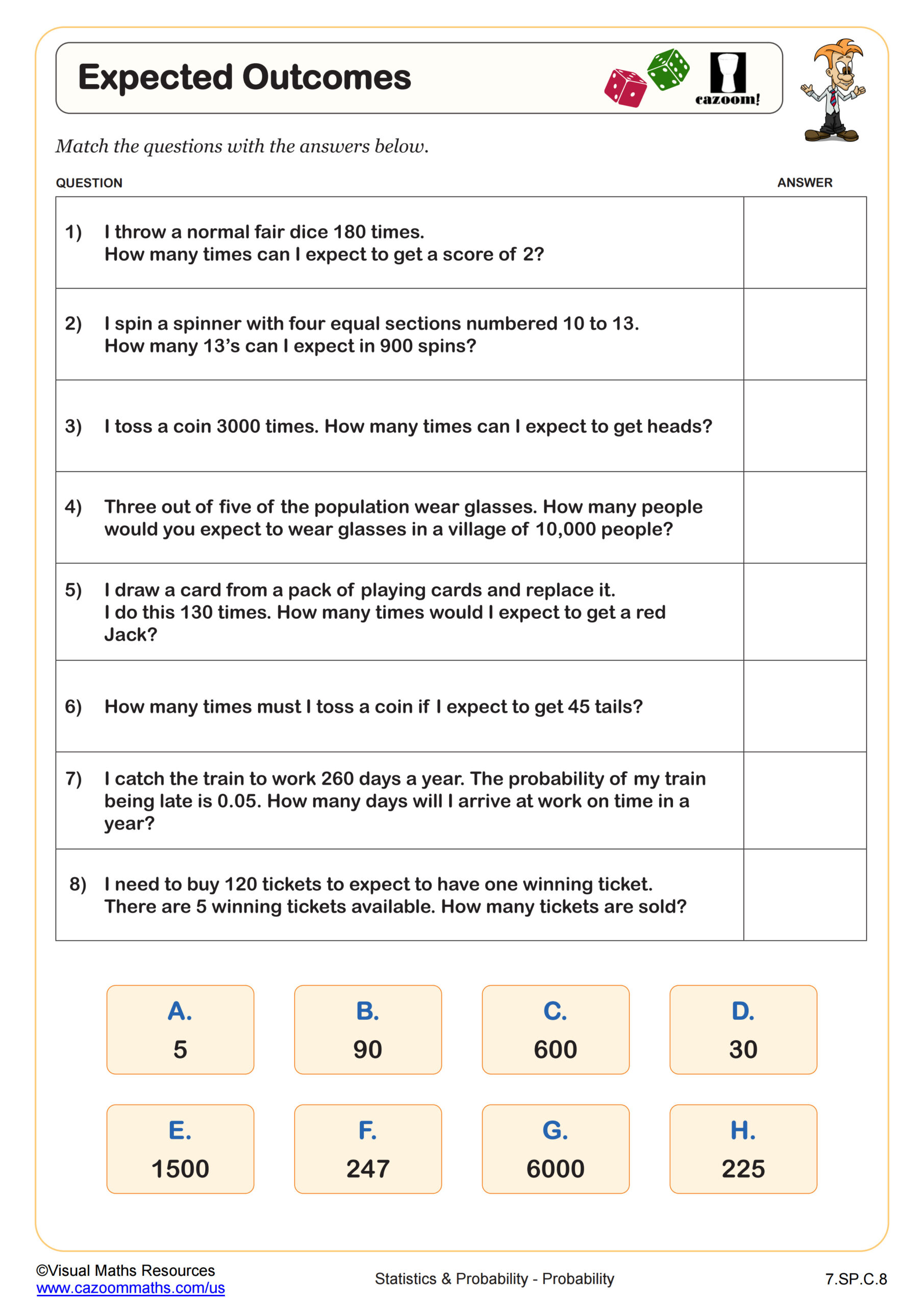
Expected Outcomes
Experimental Probability

Grouped Frequency Tables

Probability Ranges (Impossible to Certain)

Probability with a Deck of Cards

Probability with Dice

Relative Frequency

Sample Space Lists

Sample Space Tree Diagrams

The Probability Rule for Counting

Tree Diagrams (A)

Tree Diagrams (B)

Using Algebra to Solve Probability Problems

Using Algebra to Solve Probability Problems (with clues)

Writing Probability as a Fraction

All worksheets are created by the team of experienced teachers at Cazoom Math.
What topics do these probability worksheets cover for middle school students?
The probability worksheet collection covers fundamental concepts required by Common Core standards for grades 6-8, including simple probability with single events, compound probability using multiplication and addition rules, and experimental versus theoretical probability comparisons. Students work through problems involving dice, spinners, cards, and real-world scenarios like weather prediction and sports outcomes.
Teachers frequently observe that students need extensive practice distinguishing between dependent and independent events, especially when calculating compound probabilities. The probability grade 7 worksheets with answers include step-by-step solutions that help students understand why certain events affect each other while others remain independent, a concept that proves crucial for advanced statistics courses.
Which grade levels can use these middle school probability resources effectively?
While designed primarily for grades 6-8, these probability worksheets adapt well across different levels depending on student readiness and curriculum pacing. Grade 6 students typically focus on basic probability concepts using fractions and simple events, while grades 7-8 extend into compound events and probability trees. Some advanced elementary students in grade 5 can handle introductory probability concepts with teacher support.
The likelihood worksheet problems progress systematically from concrete manipulatives like coins and dice to abstract scenarios involving multiple variables. Teachers notice that students who struggle with fraction operations often need additional support before tackling probability calculations, since probability fundamentally relies on part-to-whole relationships expressed as fractions, decimals, or percentages.
How do these worksheets help students understand experimental versus theoretical probability?
The worksheets include problems that require students to conduct experiments, record results, and compare their findings to theoretical predictions. Students might flip coins 50 times, then compare their actual results to the expected 50% heads outcome, helping them understand that experimental results approach theoretical probability with larger sample sizes.
Teachers consistently observe that students initially expect experimental results to match theoretical predictions exactly, leading to confusion when outcomes vary from expected values. The middle school probability worksheet problems address this misconception by providing multiple trials and encouraging students to analyze patterns over many repetitions rather than focusing on individual results.
What strategies help teachers use these probability worksheets most effectively in class?
Teachers find success using these worksheets as guided practice after introducing concepts with physical manipulatives and real experiments. Starting with concrete activities like rolling dice or drawing from bags helps students visualize probability before moving to abstract calculations. The answer keys allow for immediate feedback during independent work or homework review sessions.
Many teachers use the probability worksheets in small group rotations, allowing students to discuss reasoning and check their understanding with peers. The real-world contexts in these problems, such as weather forecasting and quality control in manufacturing, help students connect probability concepts to STEM careers and everyday decision-making situations.