Middle School Properties of Shapes Worksheets
All worksheets are created by the team of experienced teachers at Cazoom Math.
What Geometric Properties Do Students Learn in Middle School?
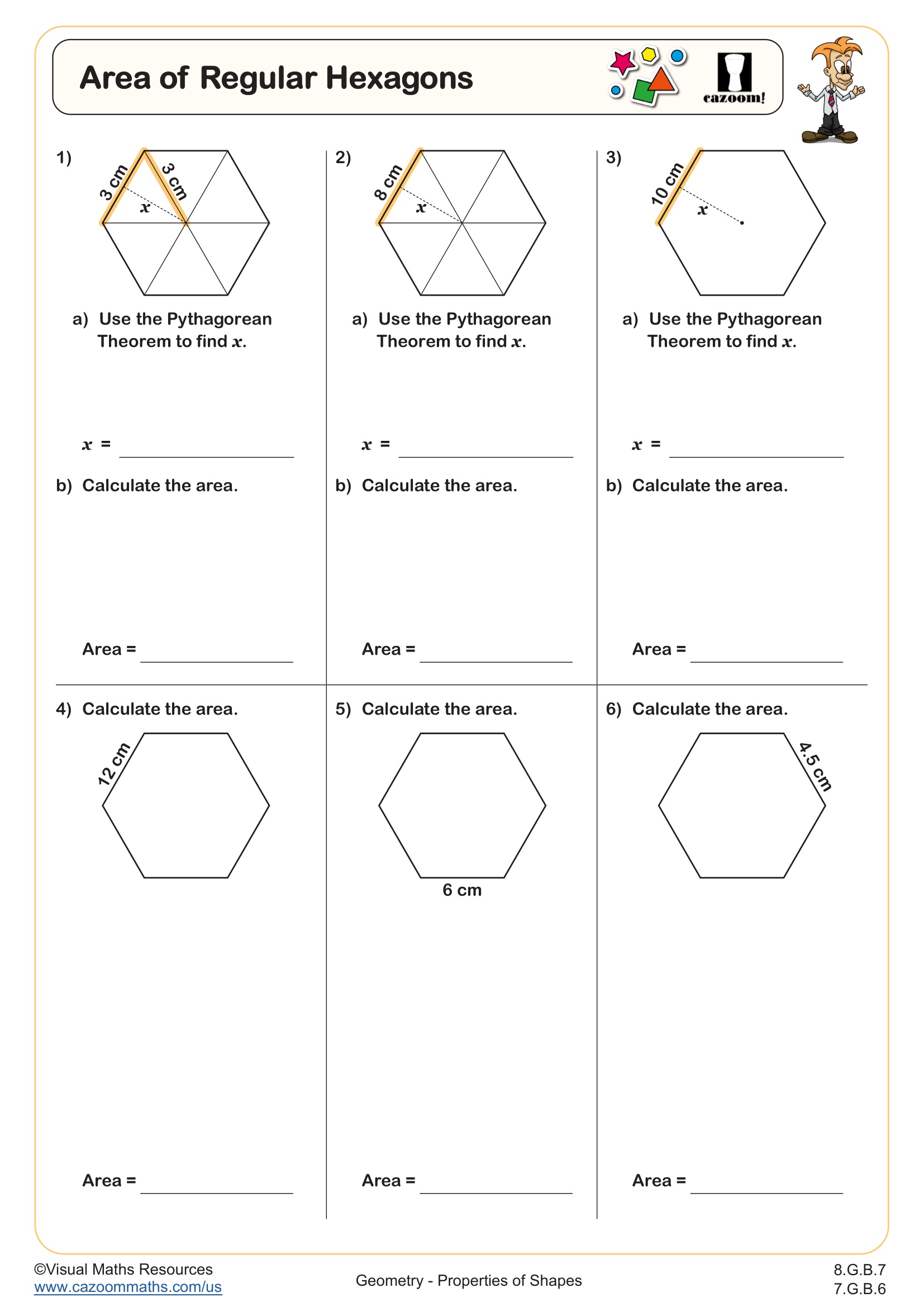
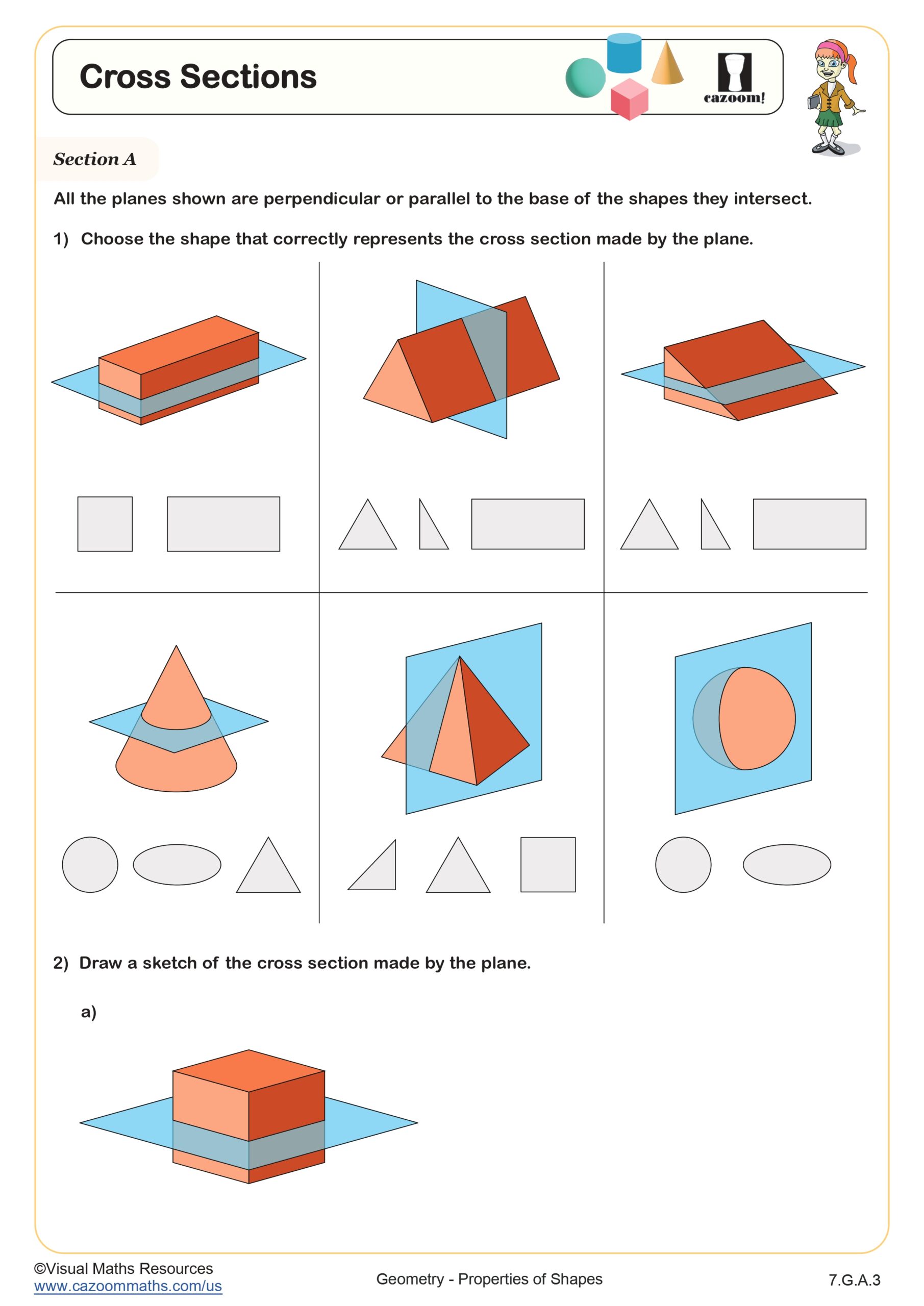
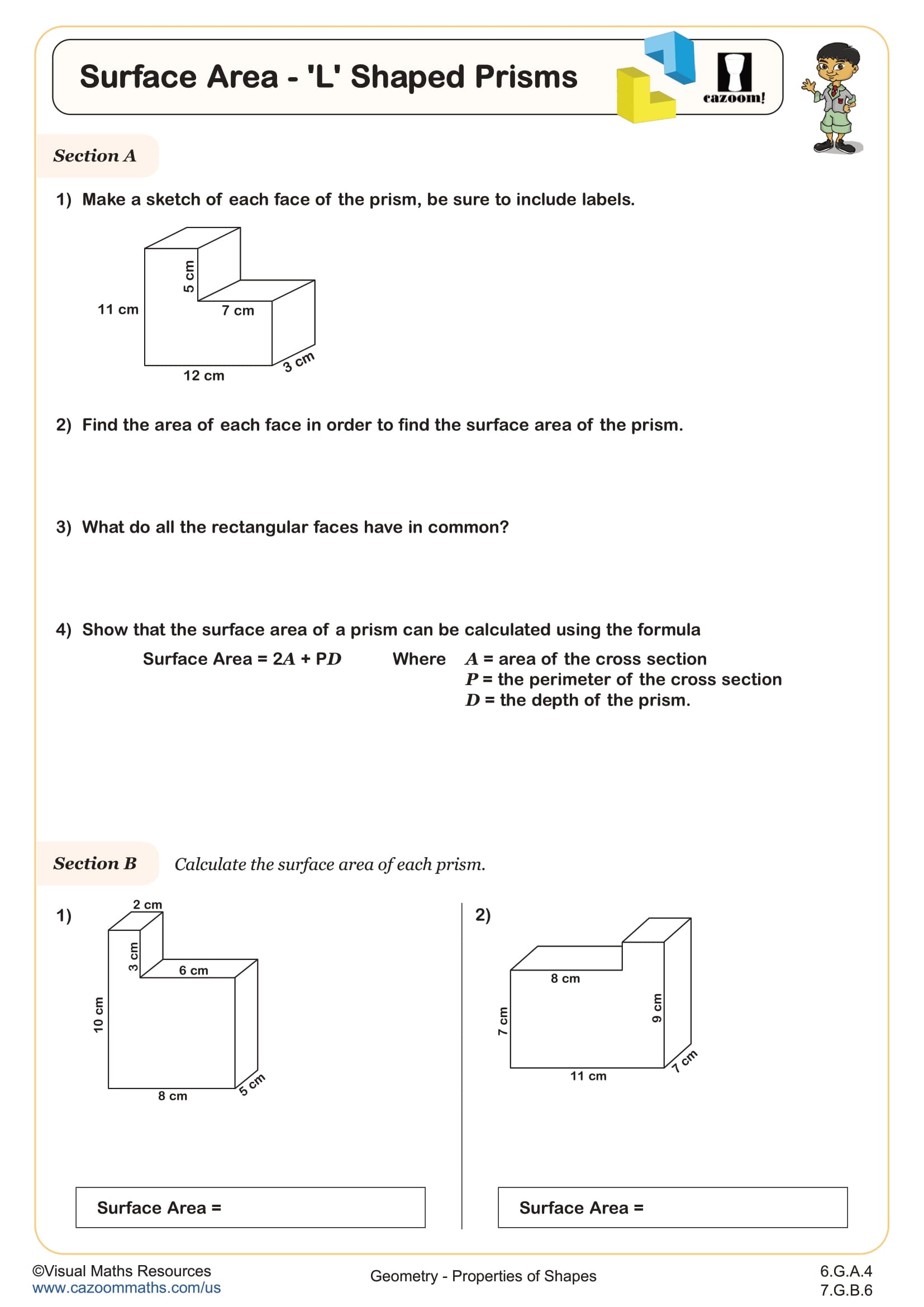
Middle school geometry builds on elementary foundation work by introducing formal properties of 2D and 3D shapes, including angle relationships, symmetry, congruence, and similarity. Students learn to calculate area and perimeter of regular and irregular polygons, understand how transformations affect shape properties, and apply geometric reasoning to solve multi-step problems aligned with Common Core State Standards.
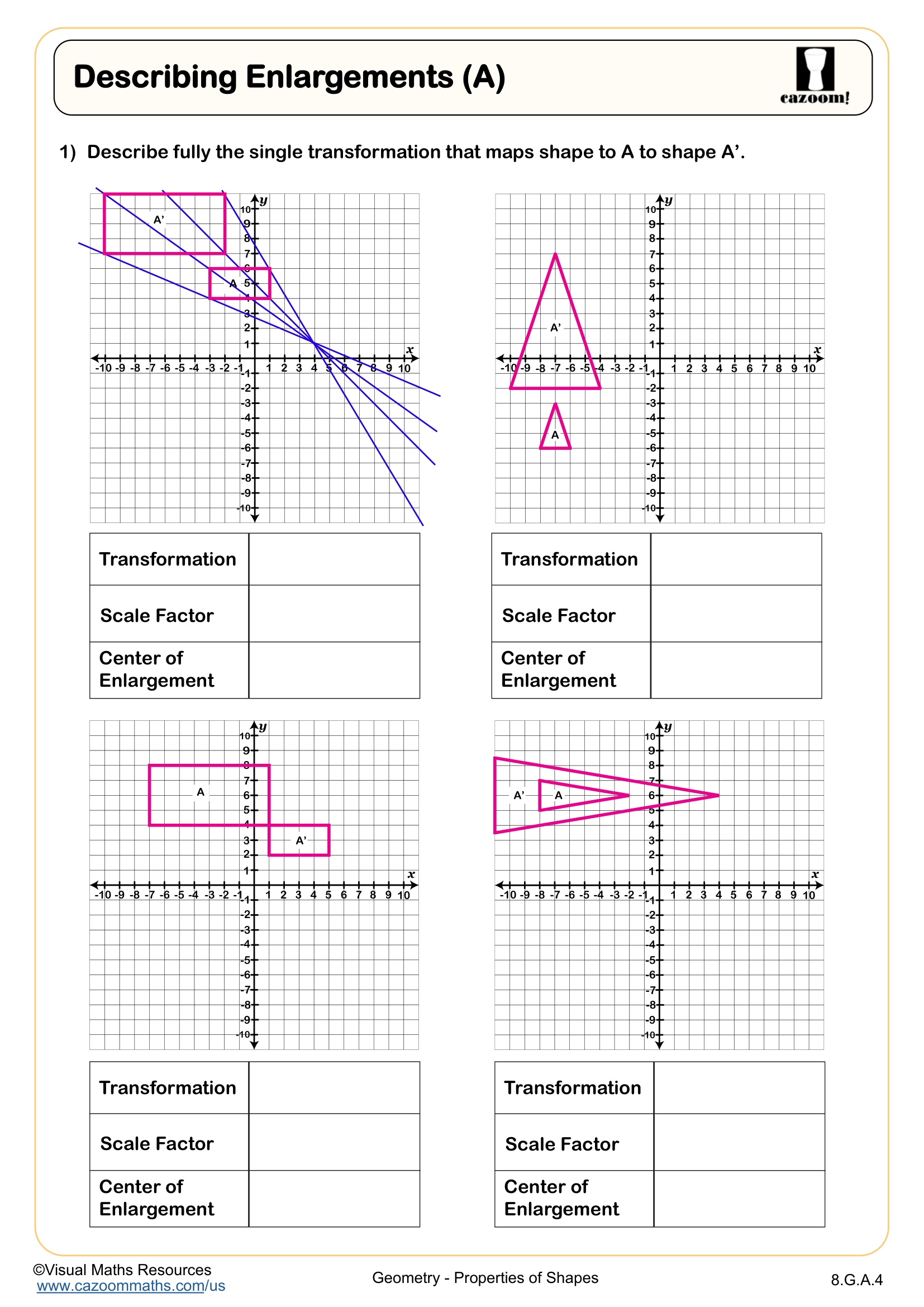
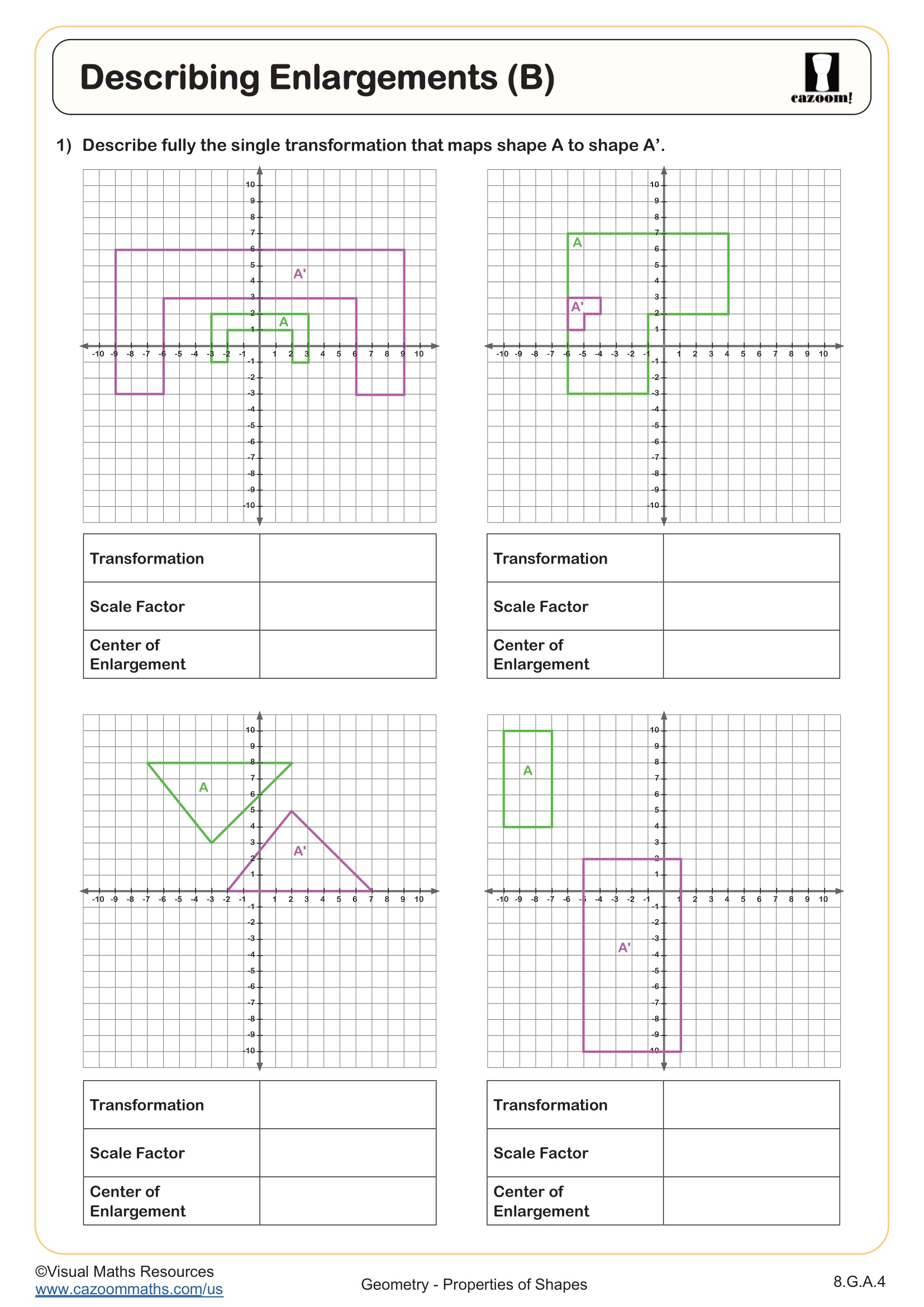
A common misconception surfaces when students assume all properties change during transformations. Many mistakenly believe that enlargements alter angles when only side lengths and area change proportionally. Teachers find that having students measure corresponding angles before and after dilations helps solidify the understanding that angle measures remain invariant under similarity transformations, a concept that appears frequently on standardized assessments.
Which Grade Levels Cover Properties of Shapes?
This collection supports middle school students in 6th, 7th, and 8th grades as they develop increasingly sophisticated geometric reasoning skills. The worksheets align with the progression outlined in Common Core standards, where shape properties transition from concrete measurement tasks to abstract reasoning about transformations and coordinate geometry.
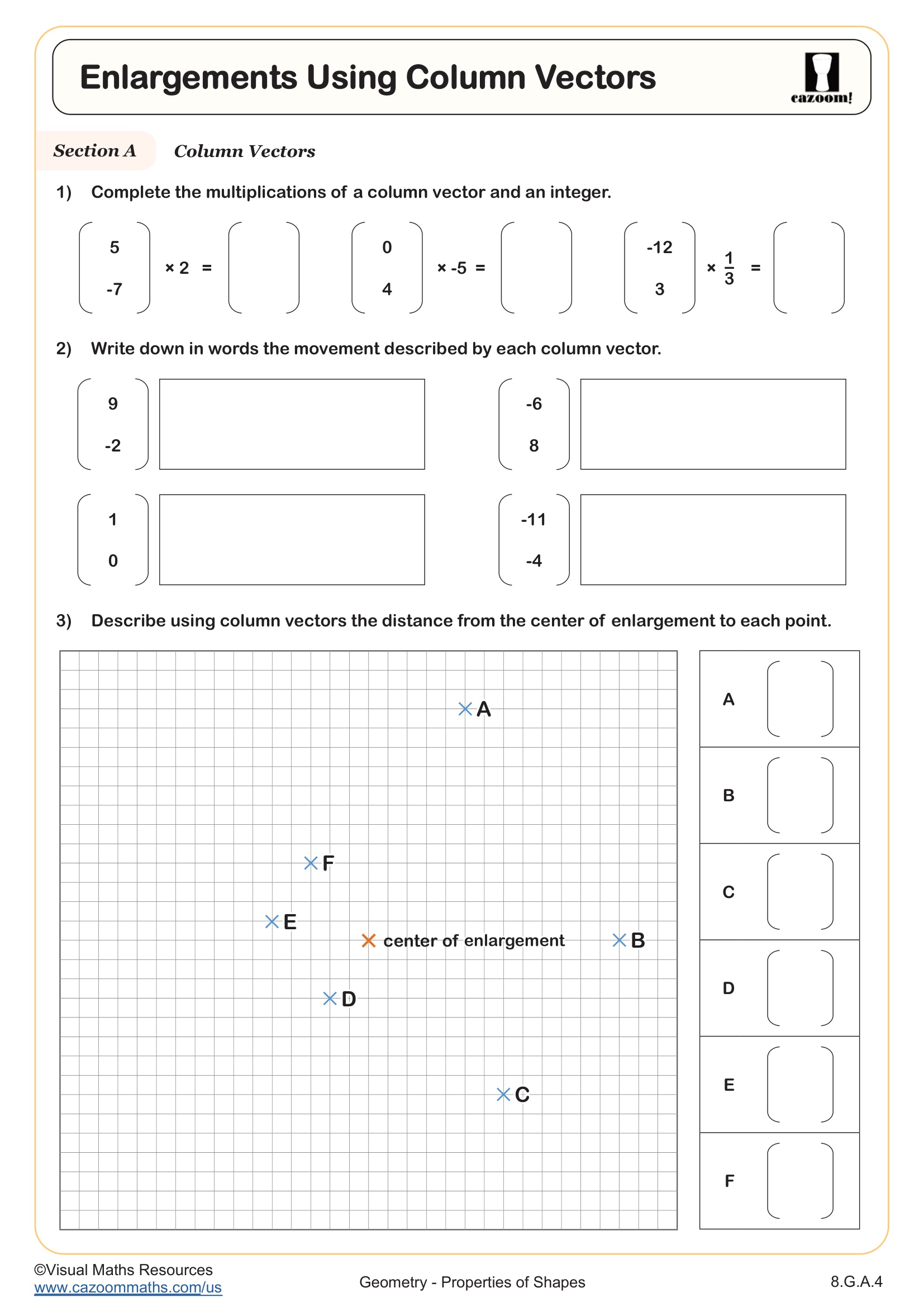
The difficulty increases strategically across grade levels. Sixth graders typically work with area formulas for standard polygons and basic shape classification. Seventh grade introduces scale factors and proportional reasoning with similar figures. By eighth grade, students tackle transformations using column vectors and analyze how dilations affect measurements, building the foundation for high school geometry proofs and coordinate transformations.
How Do Enlargements Using Column Vectors Work?
Enlargements using column vectors combine transformation geometry with algebraic notation, helping students understand dilations through a coordinate approach. Students multiply position vectors by a scale factor centered at the origin or another point, seeing how each coordinate changes proportionally. This method makes the mathematics of scaling explicit and prepares students for matrix transformations in high school.
This skill connects directly to computer graphics and digital design, fields where vector-based transformations create scalable images. Graphic designers use the same mathematical principles when resizing logos or creating responsive web layouts that maintain proportions across different screen sizes. Understanding how scale factors affect coordinates gives students insight into the mathematics behind image editing software and CAD programs used in architecture and engineering.
How Can Teachers Use These Worksheets Most Effectively?
The worksheets provide varied entry points through different subtopics, allowing teachers to match student needs with appropriate challenges. Answer keys enable students to self-check during independent practice or help teachers quickly assess understanding during classroom circulation. The range from vocabulary-building activities like word searches to calculation-intensive area problems supports differentiation within the same unit.
Many teachers use these worksheets for targeted intervention when assessment data reveals specific gaps, such as students confusing perimeter and area or struggling with scale factor applications. The worksheets also work well for homework assignments that reinforce classroom instruction, partner activities where students compare solution methods, or station rotations during geometry units. Teachers report success using the shape recognition exercises as warm-ups before diving into more complex transformation problems.