Middle School Proportion Worksheets
Creating Equivalent Ratios (A)

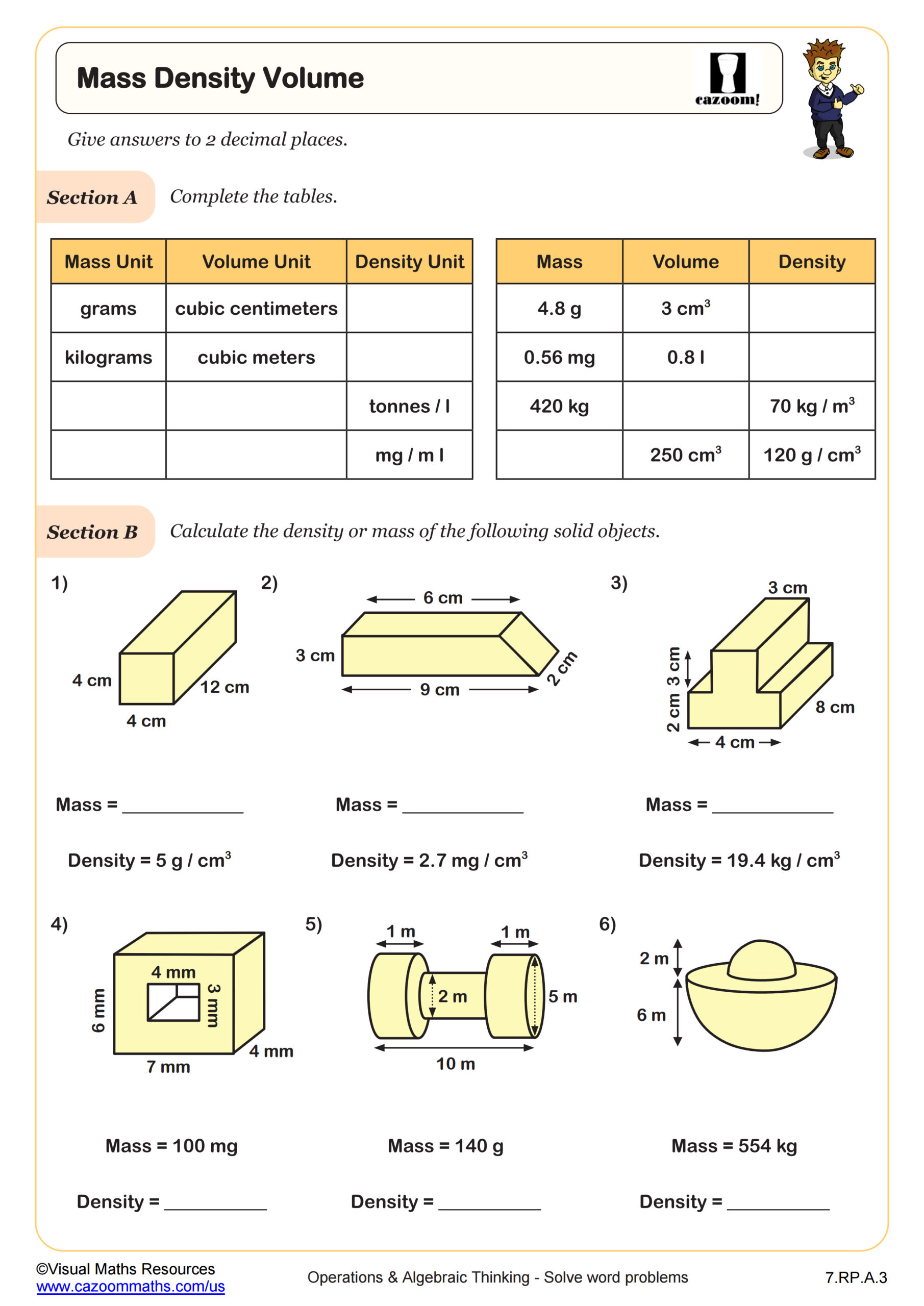
Density, Mass, and Volume
Distance, Speed, and Time (A)

Diwali Food Ingredient Proportion Problems

Equations of Proportionality

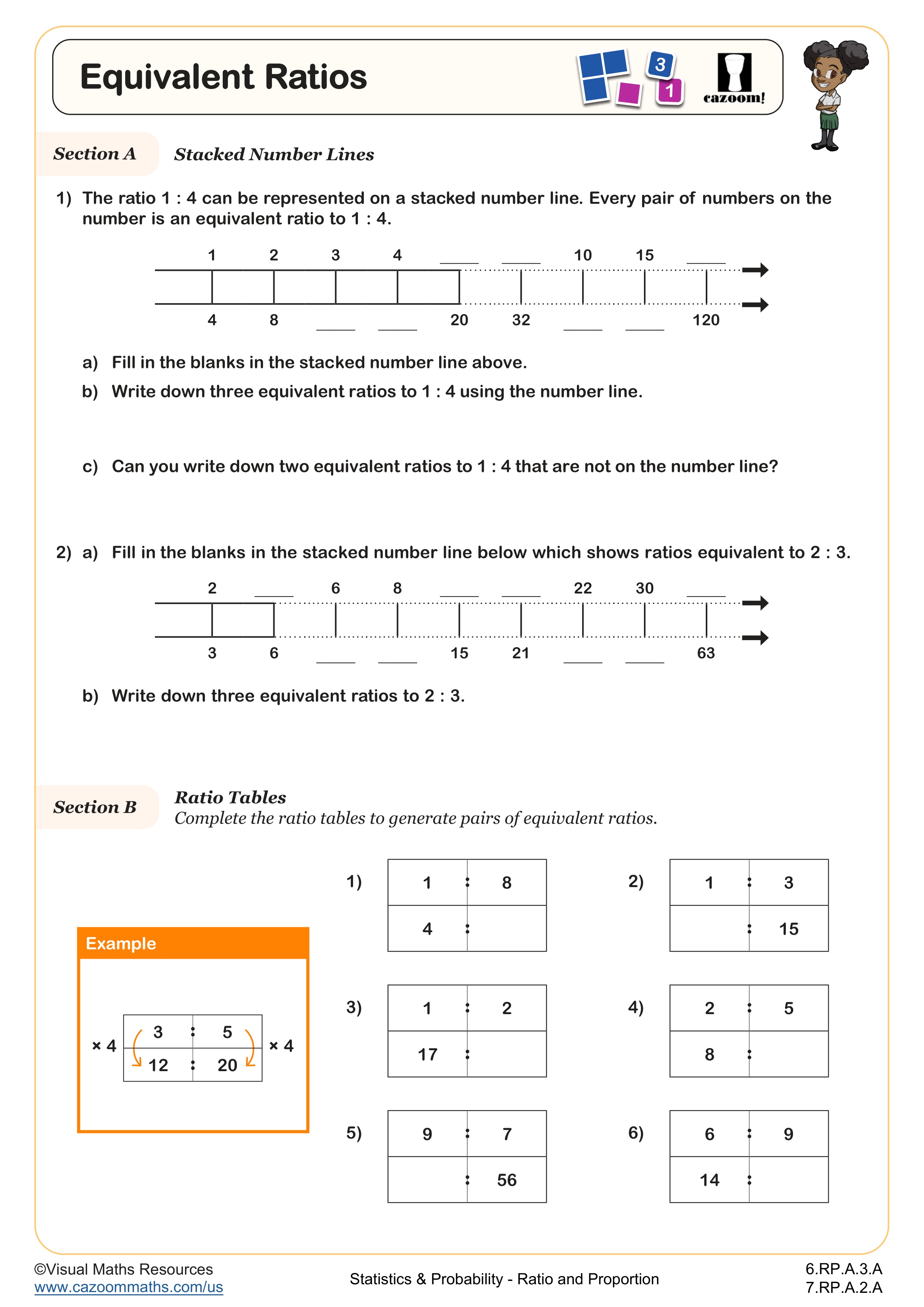
Equivalent Ratios
Exchange Rates

Exploring Direct Proportion Using Stacked Number Lines (B)

Population Density

Ratios and Proportions Synthesis

Recipe Proportions (A)

Recipe Proportions (B)

Recipe Proportions (C)

Recipes (A)

Recipes (B)

Representing Ratios with Tape Diagrams

Scale Lengths

Solving Proportions Algebraically

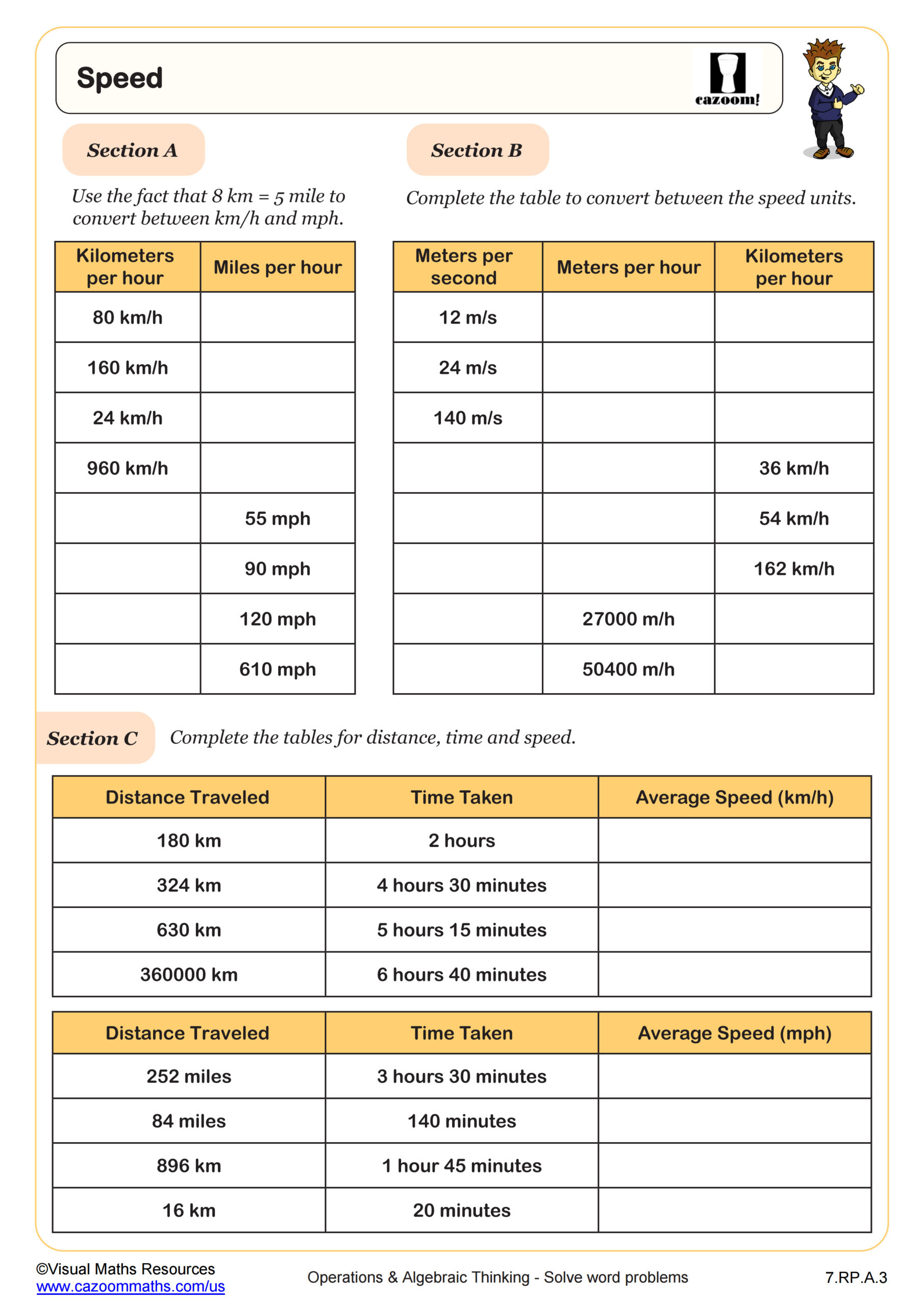
Speed
Unit Rates Involving Fractions

Using Conversion Graphs

All worksheets are created by the team of experienced teachers at Cazoom Math.
What makes a good proportions worksheet for middle school students?
A quality proportions worksheet should align with Common Core standards 7.RP.A.2 and 7.RP.A.2c, focusing on solving proportion problems through cross multiplication and equivalent ratios. The worksheet should progress from simple numerical proportions to more complex scenarios involving decimals, fractions, and real-world applications.
Teachers notice that students often make calculation errors when cross multiplying, particularly with fractions. Effective proportion worksheets include varied problem types that require students to identify missing values in different positions within the proportion, helping them recognize the relationship between corresponding terms rather than memorizing a procedure.
What grade levels typically use proportion worksheets?
Proportion worksheets are most commonly used in grades 6-8, with formal introduction typically occurring in 7th grade according to Common Core standards. Students build on their understanding of ratios from 6th grade to work with more complex proportional relationships and cross multiplication strategies.
By 8th grade, students apply proportional reasoning to geometry problems involving similar figures and scale factors. Teachers observe that students who master basic proportion problems in 7th grade show greater success with functions and linear relationships in high school algebra, making this foundational skill particularly important for mathematical progression.
How do cross multiplication and equivalent ratios differ on proportion worksheet problems?
Cross multiplication provides a systematic algorithm for solving proportions by multiplying diagonally across the equal sign, while equivalent ratios focus on multiplicative relationships between corresponding terms. Both methods appear on thorough proportion problems worksheet sets to give students multiple solution strategies.
Teachers find that students who rely solely on cross multiplication often struggle to recognize proportional relationships conceptually. Worksheets that emphasize both approaches help students understand that 3/4 = 6/8 because both ratios represent the same multiplicative relationship, not just because cross multiplication yields equal products.
How can teachers use these worksheet on proportions most effectively?
Teachers get the best results when they use proportion worksheets as guided practice after introducing the concept through hands-on activities like recipe scaling or map work. Starting with concrete examples helps students understand why proportions matter before moving to abstract calculations.
Many teachers find success in having students work through problems in pairs, discussing their reasoning before checking answers. The included answer keys allow for immediate feedback during practice, but teachers report that requiring students to explain their thinking prevents them from simply checking for correct numerical answers without understanding the underlying proportional relationship.