Middle School Space Worksheets
All worksheets are created by the team of experienced teachers at Cazoom Math.
How Do Space Worksheets Teach Math Concepts?
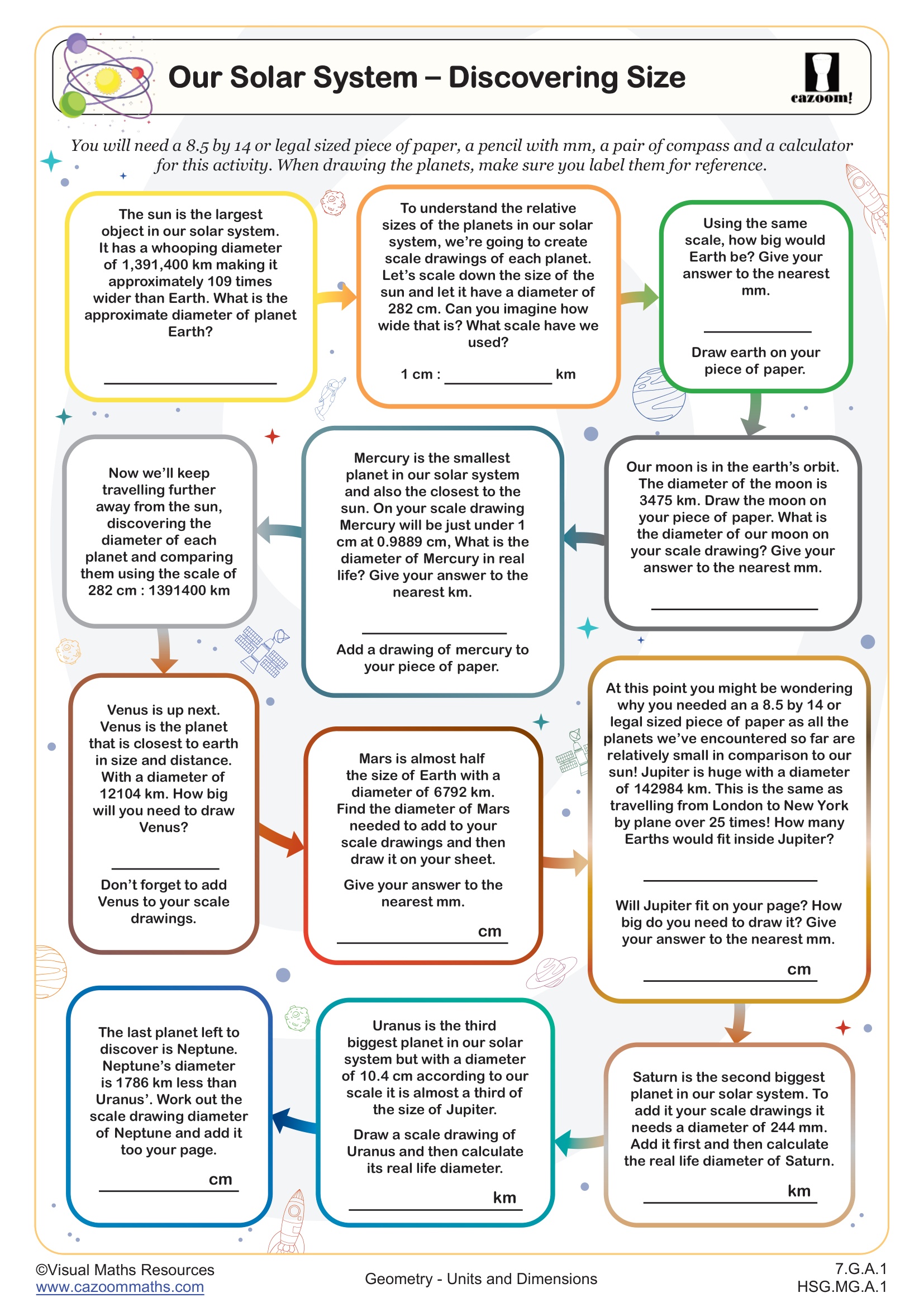
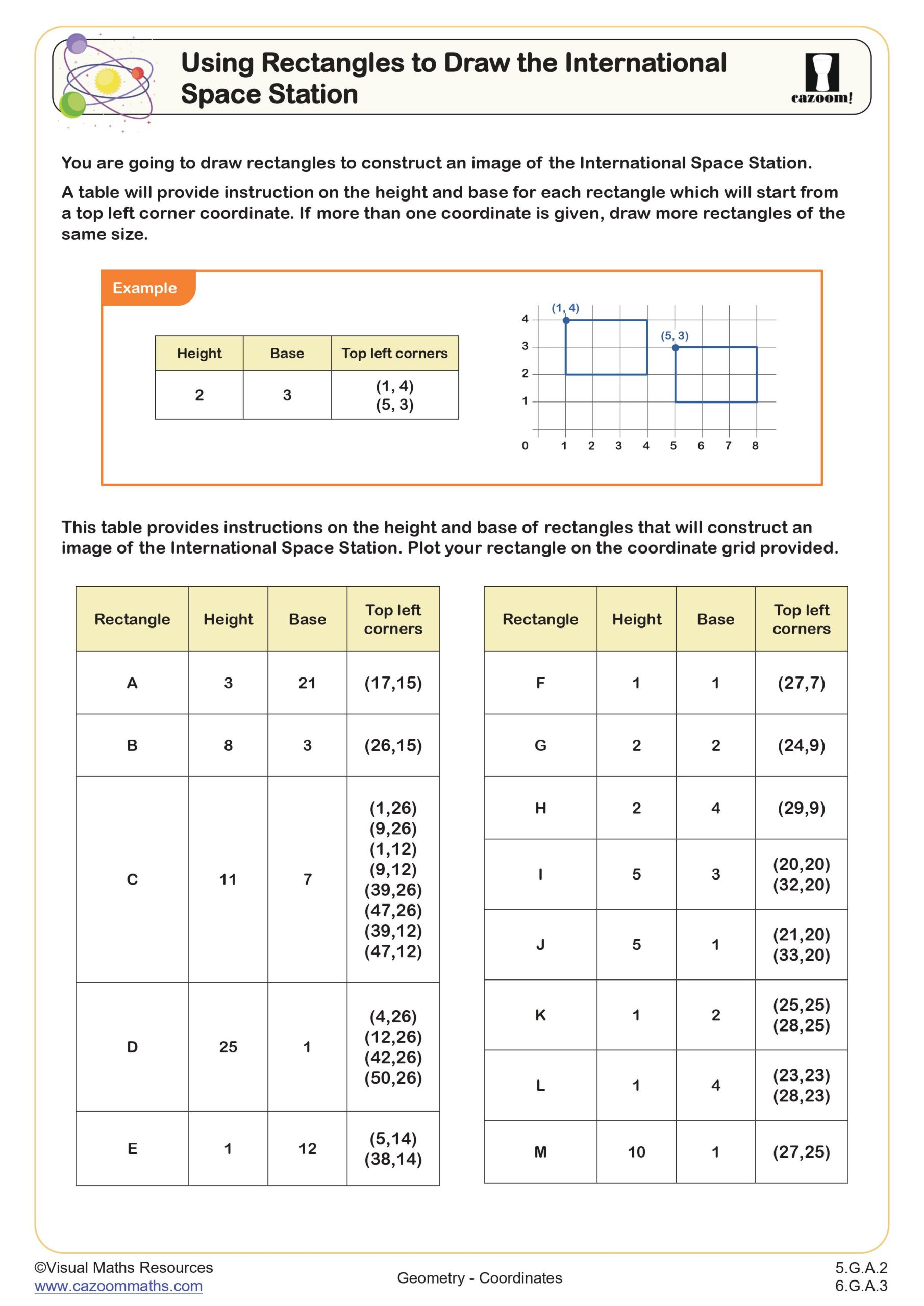
Space-themed math worksheets use astronomical contexts to teach core middle school standards including geometric properties, proportional relationships, coordinate geometry, and transformations. Rather than practicing these skills in isolation, students apply them to authentic scenarios like calculating planetary distances using scale factors, constructing space stations on coordinate planes, or analyzing the elliptical paths of orbits using geometric definitions.
Teachers observe that students make fewer calculation errors when working with space problems because the context provides natural checkpoints—a student who calculates that Jupiter is smaller than Earth immediately recognizes something went wrong with their ratio work. This self-checking aspect helps students develop better number sense around proportions and scale, skills that standardized assessments regularly test through real-world application problems.
What Grade Levels Are These Space Math Worksheets For?
These worksheets align with 6th grade, 7th grade, and 8th grade mathematics standards, covering the full middle school progression. The collection addresses standards across these grade levels, from basic ratio work with planetary sizes in 6th grade to more sophisticated geometric constructions and transformations in 7th and 8th grades.
The progression mirrors how space concepts build complexity: 6th graders work with straightforward size comparisons and scale models of the solar system, 7th graders tackle more complex distance calculations requiring multi-step proportional reasoning, and 8th graders apply transformation geometry to spacecraft models and analyze elliptical orbits using coordinate geometry. This scaffolding matches Common Core's vertical alignment for ratios, geometry, and the coordinate plane across middle school years.
Why Do Students Learn About Elliptical Orbits in Math Class?
Elliptical orbits provide a practical application of geometric definitions, specifically the property that an ellipse maintains a constant sum of distances from any point on the curve to two fixed points called foci. Students use this definition to construct ellipses accurately, measuring distances and applying the geometric constraints that define these shapes—the same mathematics Kepler used to describe planetary motion.
This connection appears directly in STEM careers: aerospace engineers use elliptical orbit calculations to plan satellite trajectories and space missions, applying the same geometric principles students practice on these worksheets. Understanding how mathematical constraints create curved paths helps students grasp why spacecraft don't travel in straight lines and why fuel-efficient transfers between orbits follow specific geometric curves. These calculations determine everything from GPS satellite positioning to Mars mission planning.
How Can Teachers Use These Space Math Worksheets Effectively?
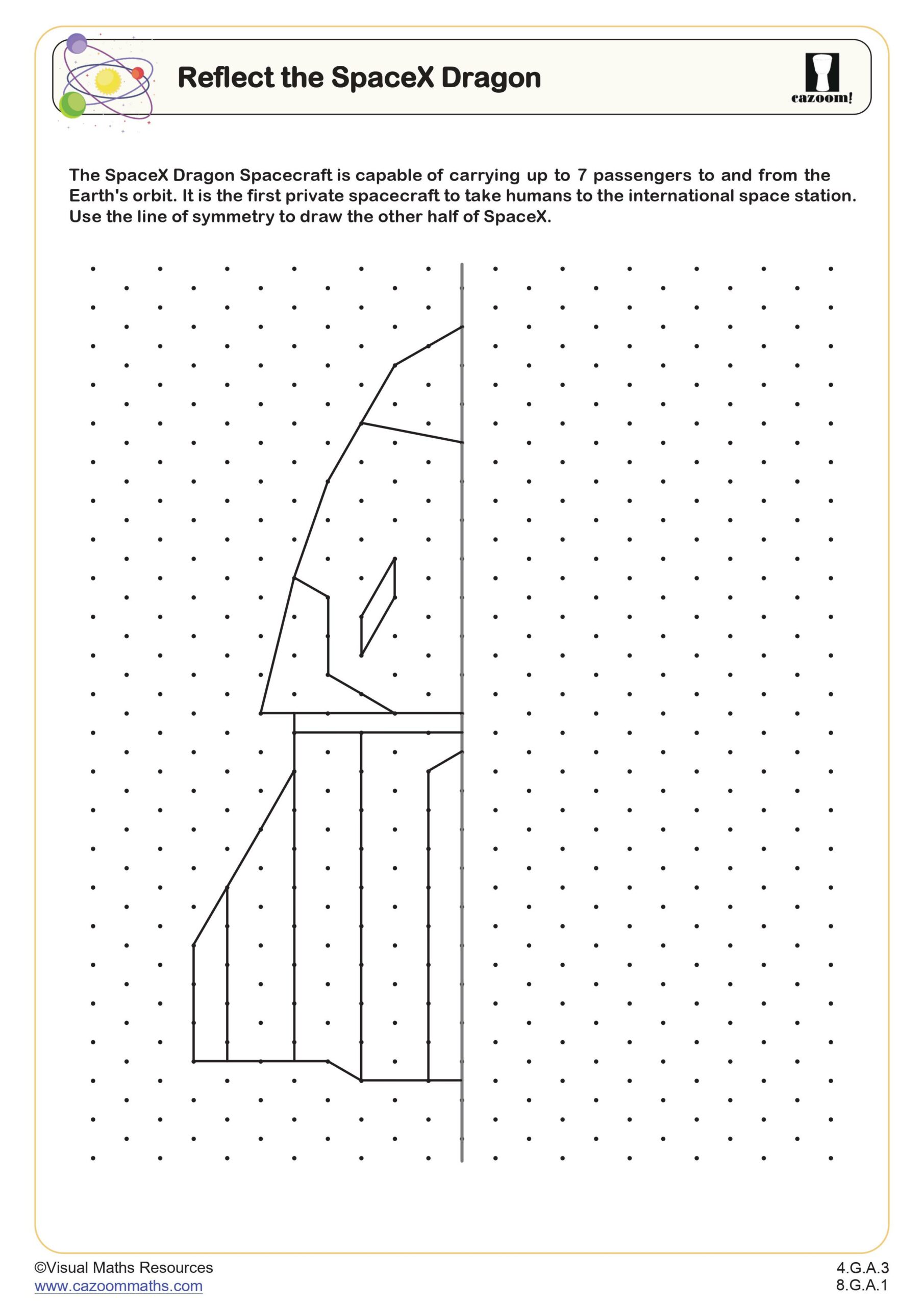
The worksheets build from concrete measurements and constructions to more abstract calculations, allowing teachers to differentiate by starting students at different entry points based on their comfort with scale, geometry, or coordinate work. The International Space Station construction worksheet, for example, provides a structured introduction to coordinate geometry before students tackle more open-ended transformation problems with the SpaceX Dragon reflection activity.
Many teachers use these worksheets during interdisciplinary units with science classes, as homework that connects to current space missions in the news, or as engaging review before standardized testing windows when students need applications of ratios and geometry. The answer keys make them practical for independent work during intervention blocks or as anchor activities for students who finish assessments early, since students can check their own work and identify where their geometric reasoning needs adjustment.