Back to:
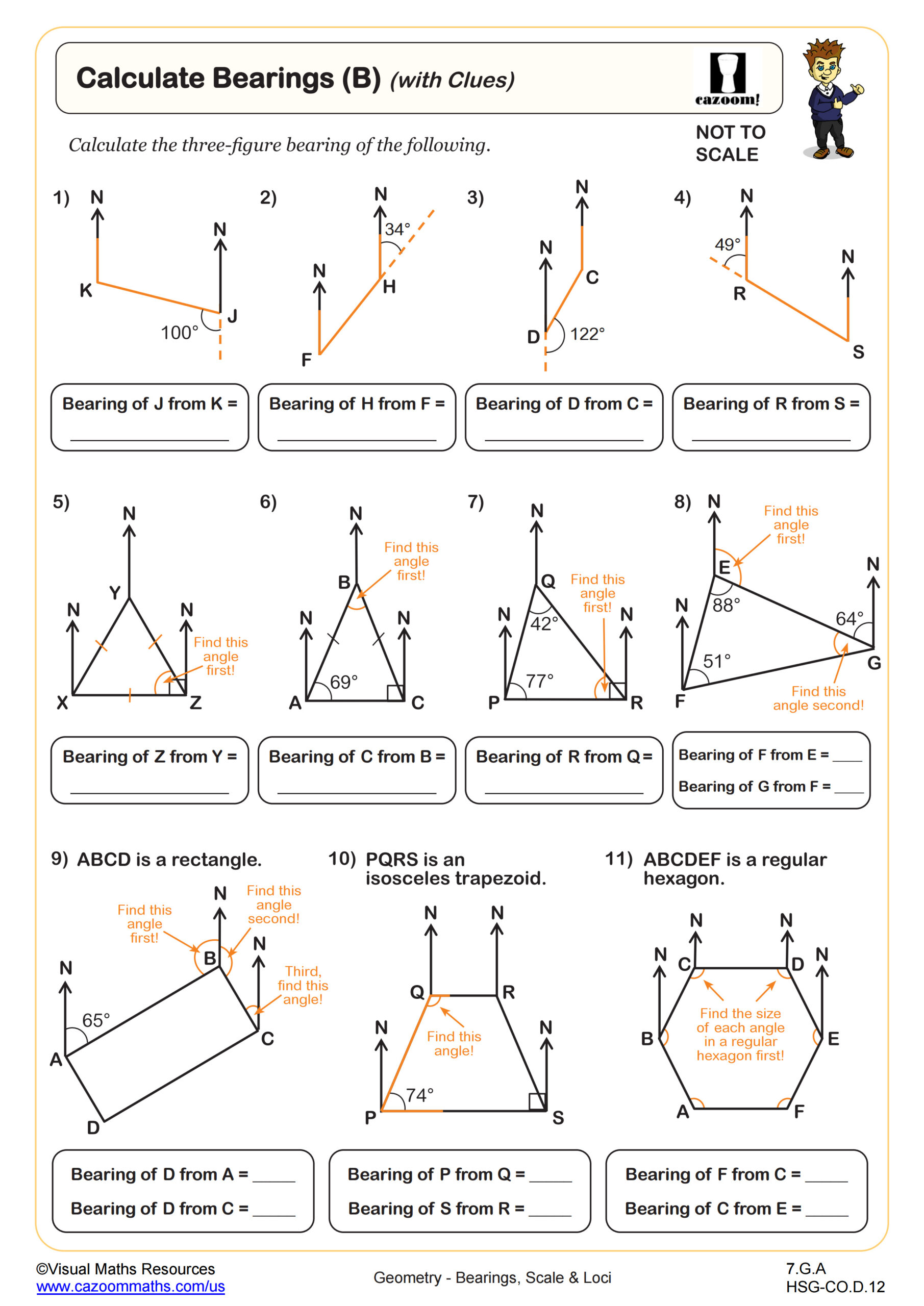
Calculating Bearings (B) (With Clues) WORKSHEET
Suitable for Grades: 7th Grade, Geometry
CCSS: 7.G.A.1, HSG.CO.D.12
CCSS Description: Solve problems involving scale drawings of geometric figures, including computing actual lengths and areas from a scale drawing and reproducing a scale drawing at a different scale.
Make formal geometric constructions with a variety of tools and methods (compass and straightedge, string, reflective devices, paper folding, dynamic geometric software, etc.). Copying a segment; copying an angle; bisecting a segment; bisecting an angle; constructing perpendicular lines, including the perpendicular bisector of a line segment; and constructing a line parallel to a given line through a point not on the line.
Make formal geometric constructions with a variety of tools and methods (compass and straightedge, string, reflective devices, paper folding, dynamic geometric software, etc.). Copying a segment; copying an angle; bisecting a segment; bisecting an angle; constructing perpendicular lines, including the perpendicular bisector of a line segment; and constructing a line parallel to a given line through a point not on the line.
Calculating Bearings (B) (With Clues) WORKSHEET DESCRIPTION
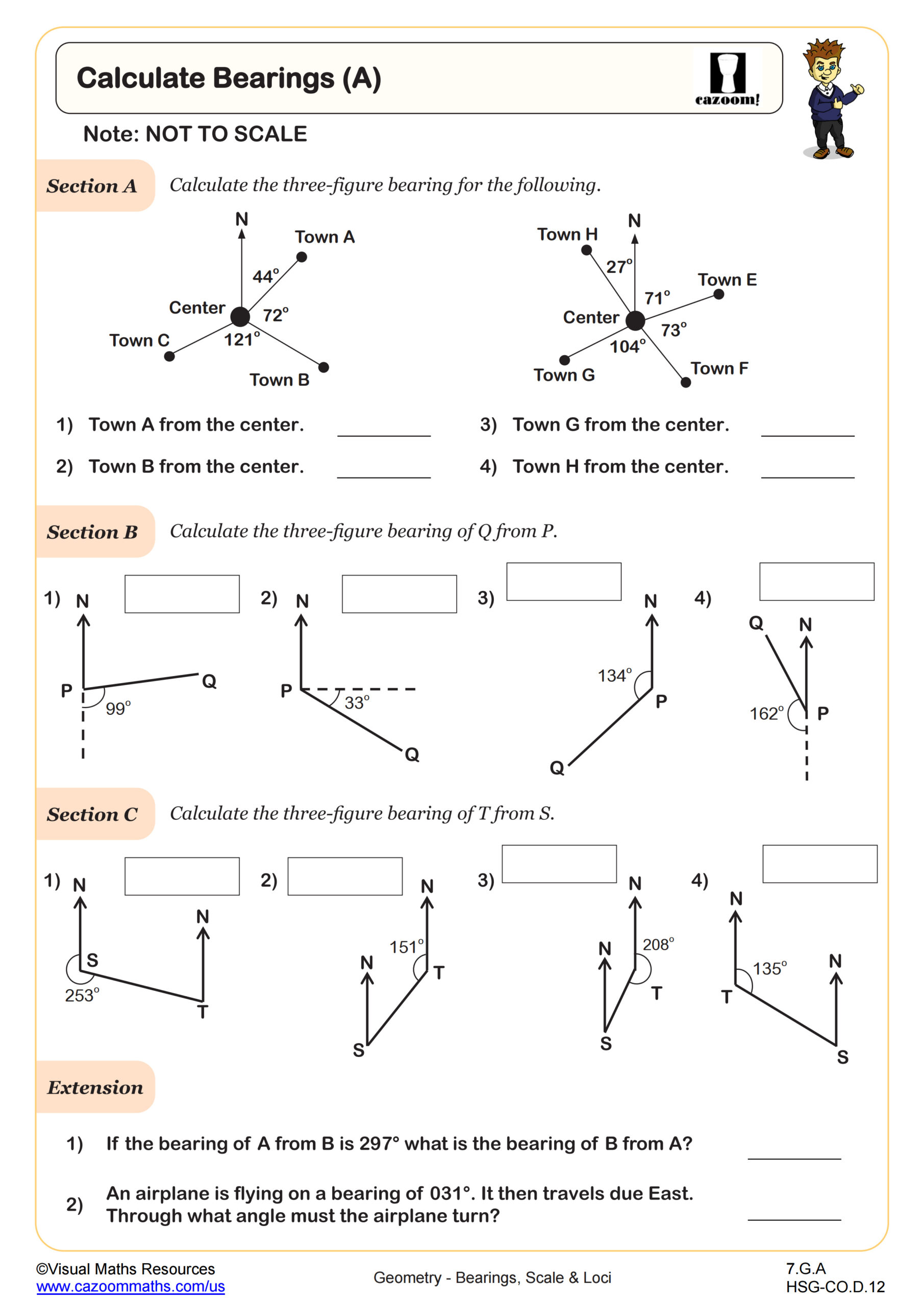
This worksheet follows on from Calculating Bearings (A). Learners will need to use more angle knowledge such as angles in parallel lines, angles in isosceles triangles, and angles in polygons to help them calculate the unknown bearings. Another version of this worksheet is available without the added clues to provide less scaffolding.
All worksheets are created by the team of experienced teachers at Cazoom Math.
RELATED TO Calculating Bearings (B) (With Clues) WORKSHEET
Frequently Asked Questions
This Calculating Bearings (B) worksheet incorporates multiple geometric concepts beyond basic bearing calculations. Students will apply their understanding of parallel line relationships, properties of isosceles triangles, and polygon angle rules to solve more complex bearing problems that require multi-step reasoning.