Middle School Bearings Scale and Loci Worksheets
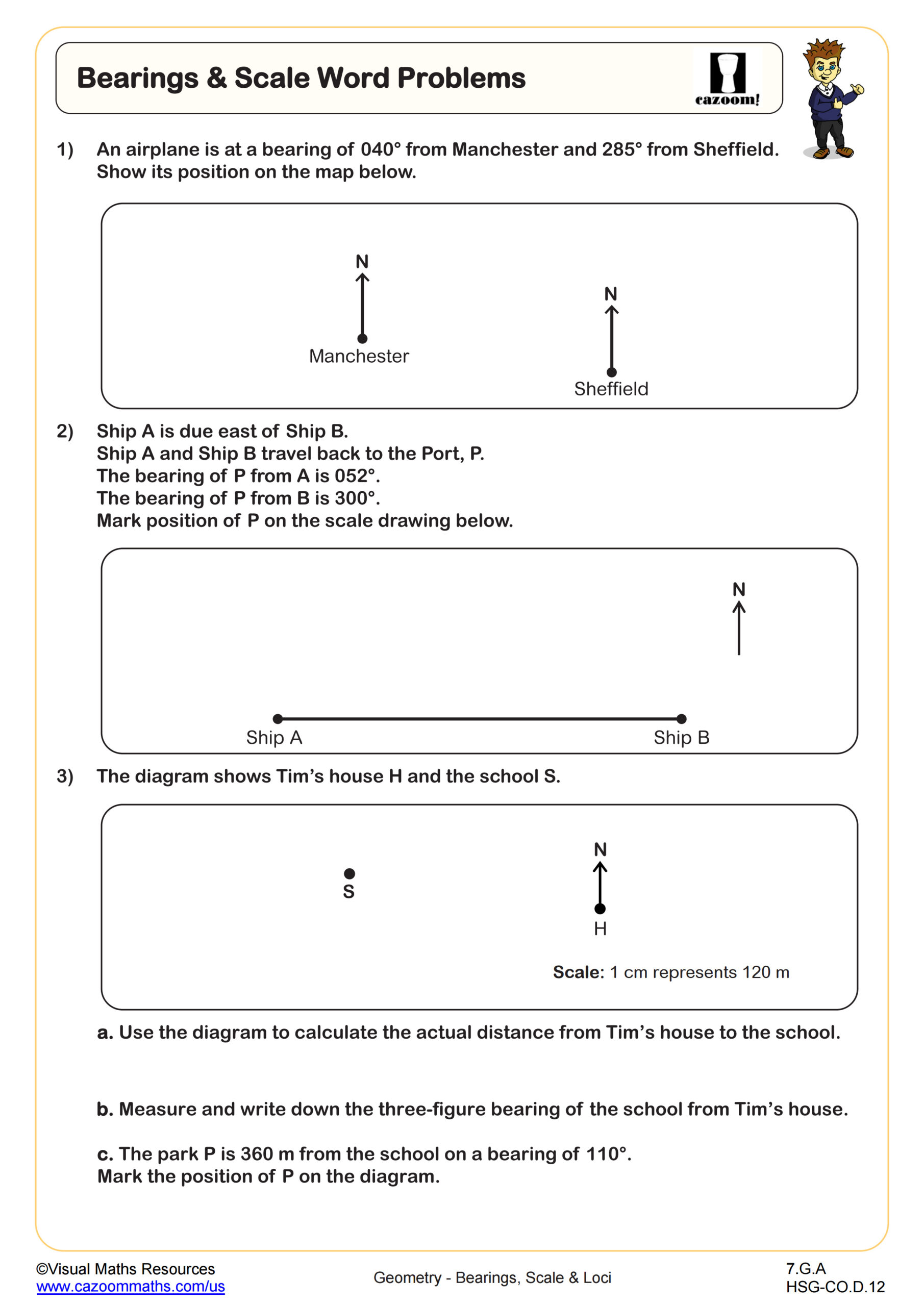
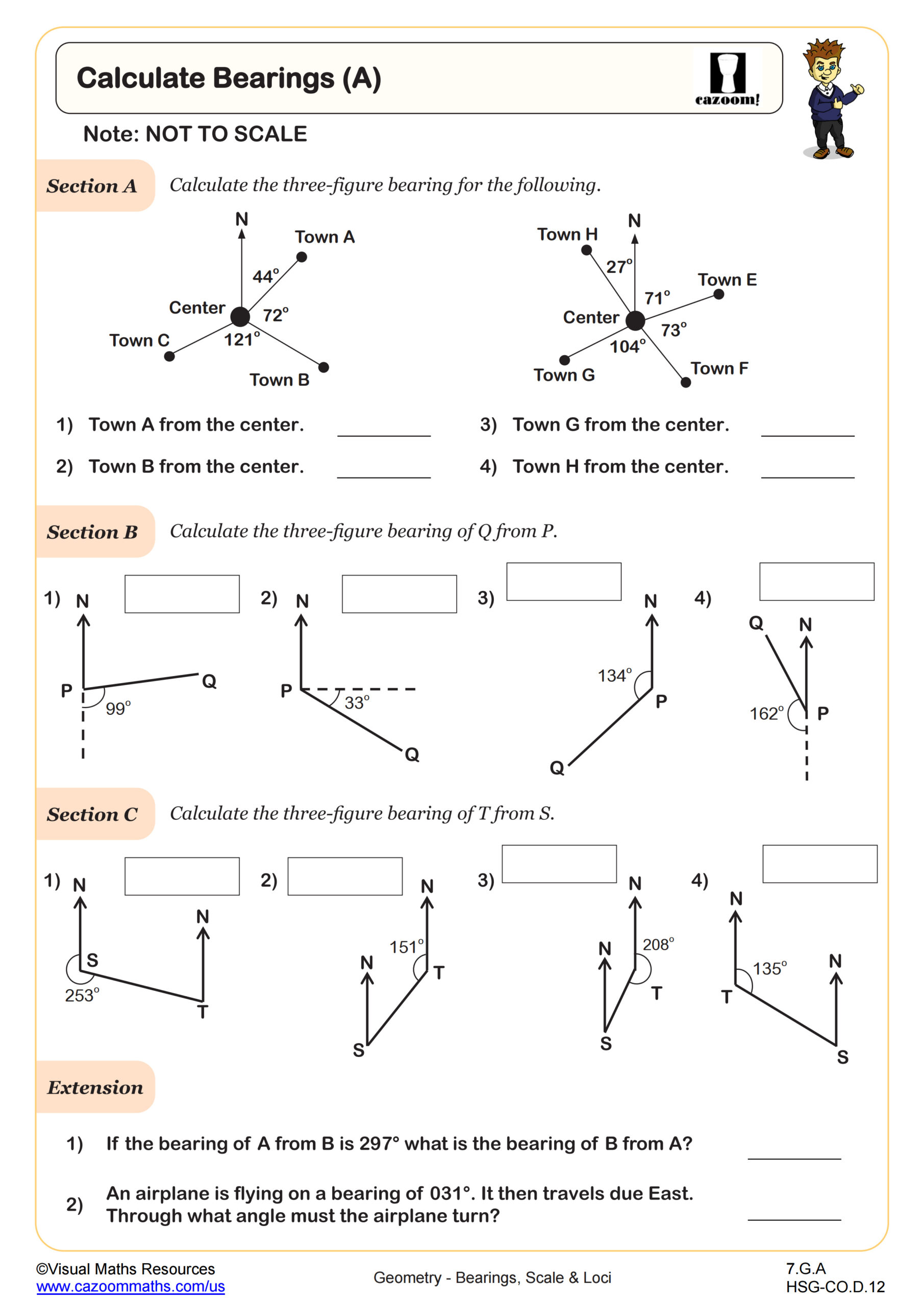
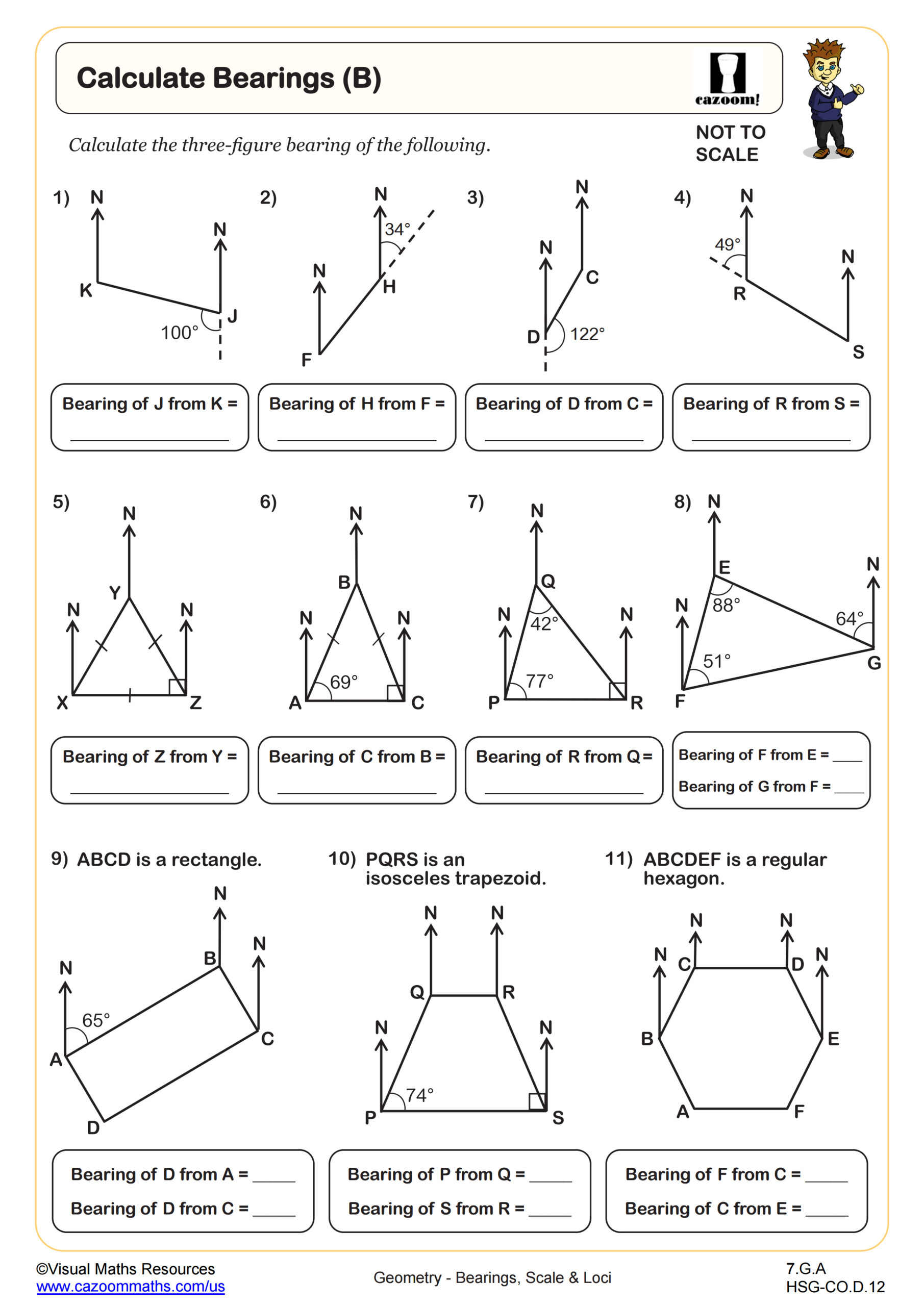
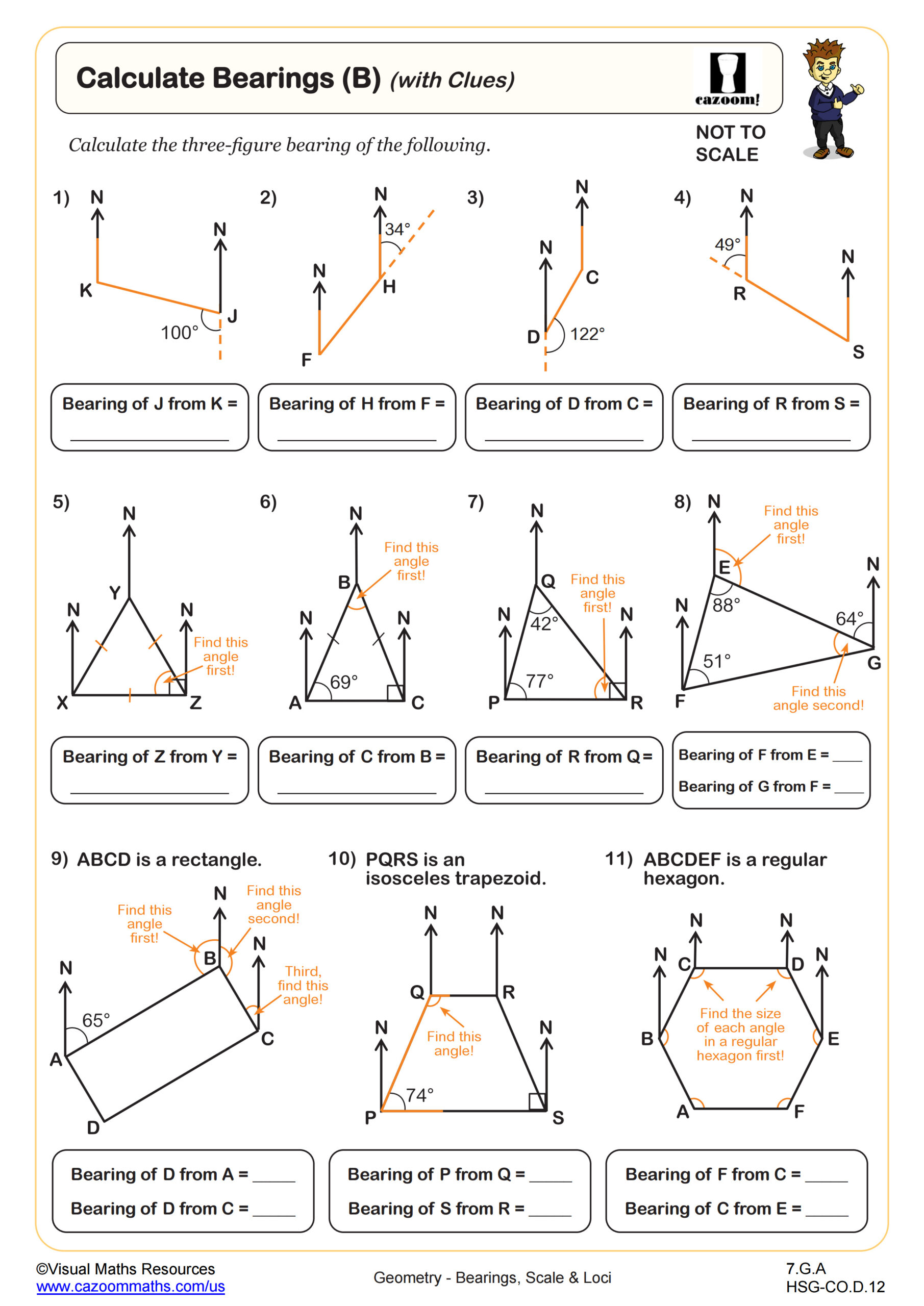
All worksheets are created by the team of experienced teachers at Cazoom Math.
What Are Bearings and Why Do Students Need to Learn Them?
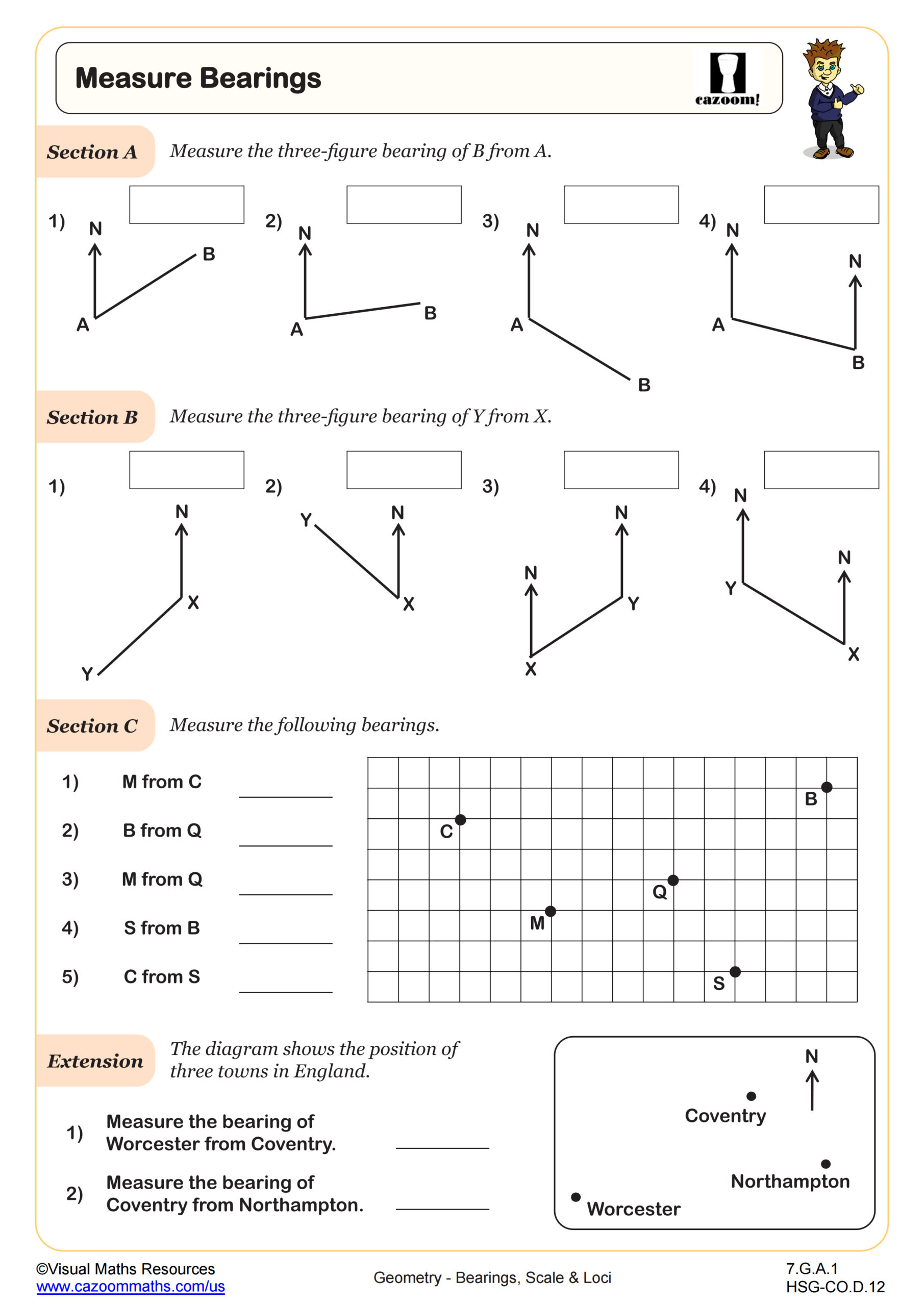
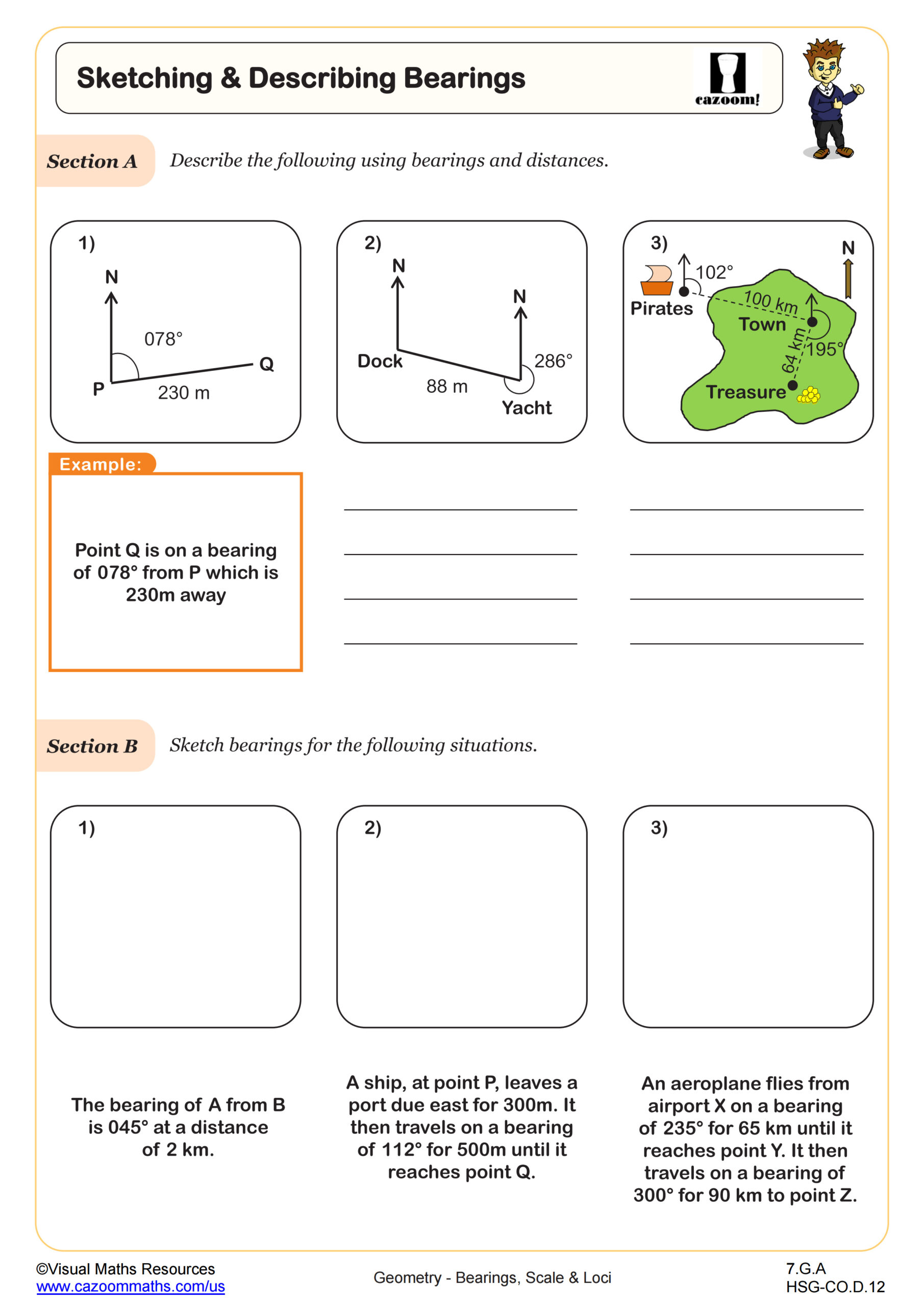
Bearings are a method of describing direction using three-digit angles measured clockwise from north, always expressed with three digits (such as 045° or 270°). This system appears throughout middle school geometry curricula and connects directly to coordinate geometry, transformations, and angle measurement standards. Students encounter bearings in map reading, navigation problems, and surveying contexts where precise directional information matters.
Many students lose points on assessments because they forget the three-digit convention, writing 45° instead of 045°, or they measure angles counterclockwise from east as they would on a coordinate plane. Teachers often find that practicing with actual compass diagrams and physical protractors helps students internalize the clockwise-from-north rule more effectively than abstract explanations alone. The breakthrough typically happens when students recognize that bearings provide a universal language for describing direction that works regardless of map orientation.
Which Grade Levels Cover Bearings, Scale, and Loci?
These worksheets address middle school mathematics standards for 6th grade, 7th grade, and 8th grade students. The topic connects to geometry standards involving angles, scale drawings, and geometric constructions that appear throughout the middle school progression. While some states introduce basic bearing concepts in 6th grade alongside angle measurement, most comprehensive work with bearings and loci occurs in 7th and 8th grade.
The difficulty progression moves from straightforward bearing calculations with clearly marked north lines to problems requiring students to identify north, apply scale conversions, and solve multi-step word problems. Eighth grade students typically encounter loci construction—the set of points satisfying specific conditions—which requires combining compass-and-straightedge skills with logical reasoning. Teachers notice that students handle scale problems more confidently once they've mastered proportional reasoning in earlier grades, making 7th grade prerequisite work with ratios particularly important for success with these integrated problems.
How Do Loci Constructions Work in These Worksheets?
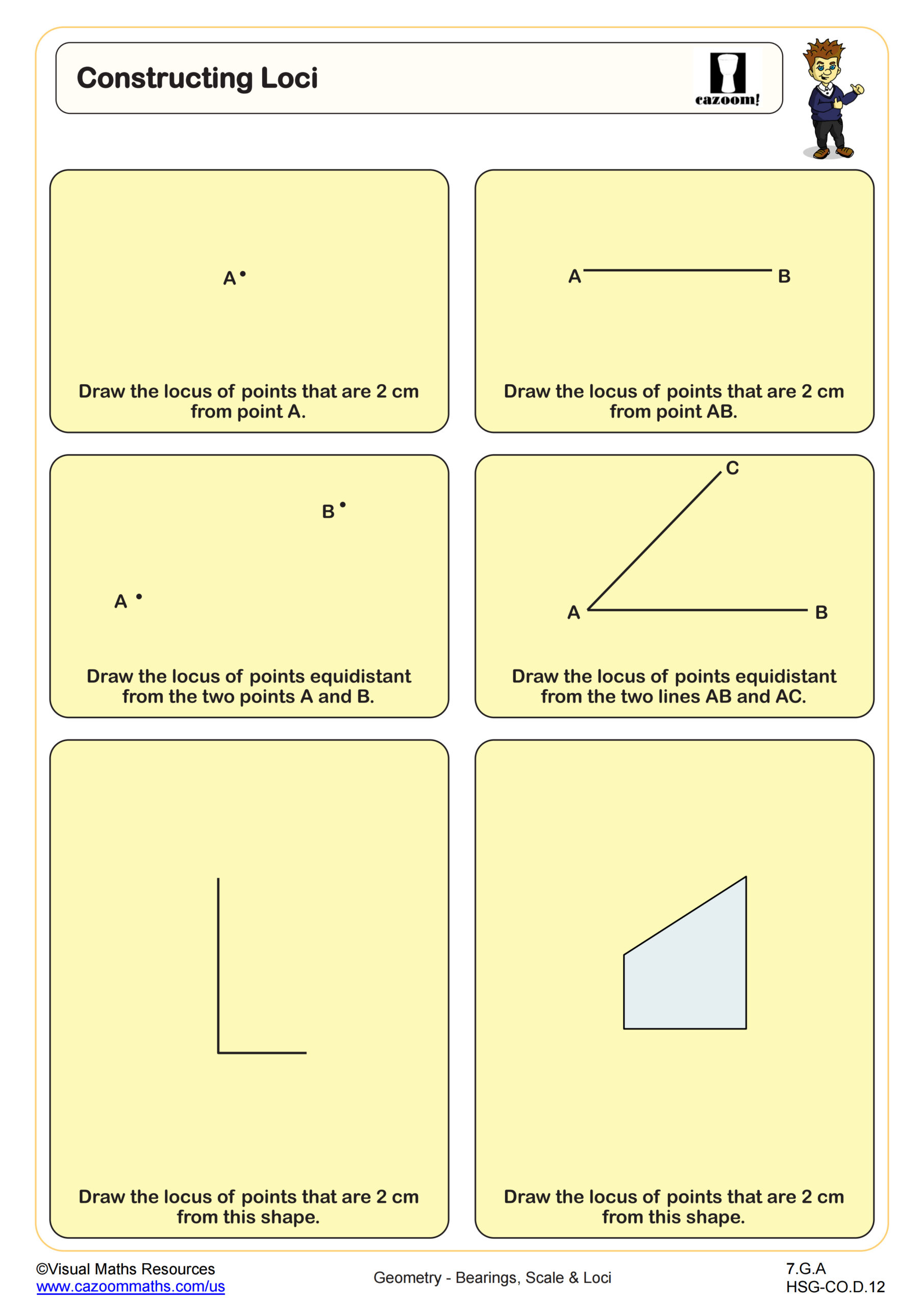
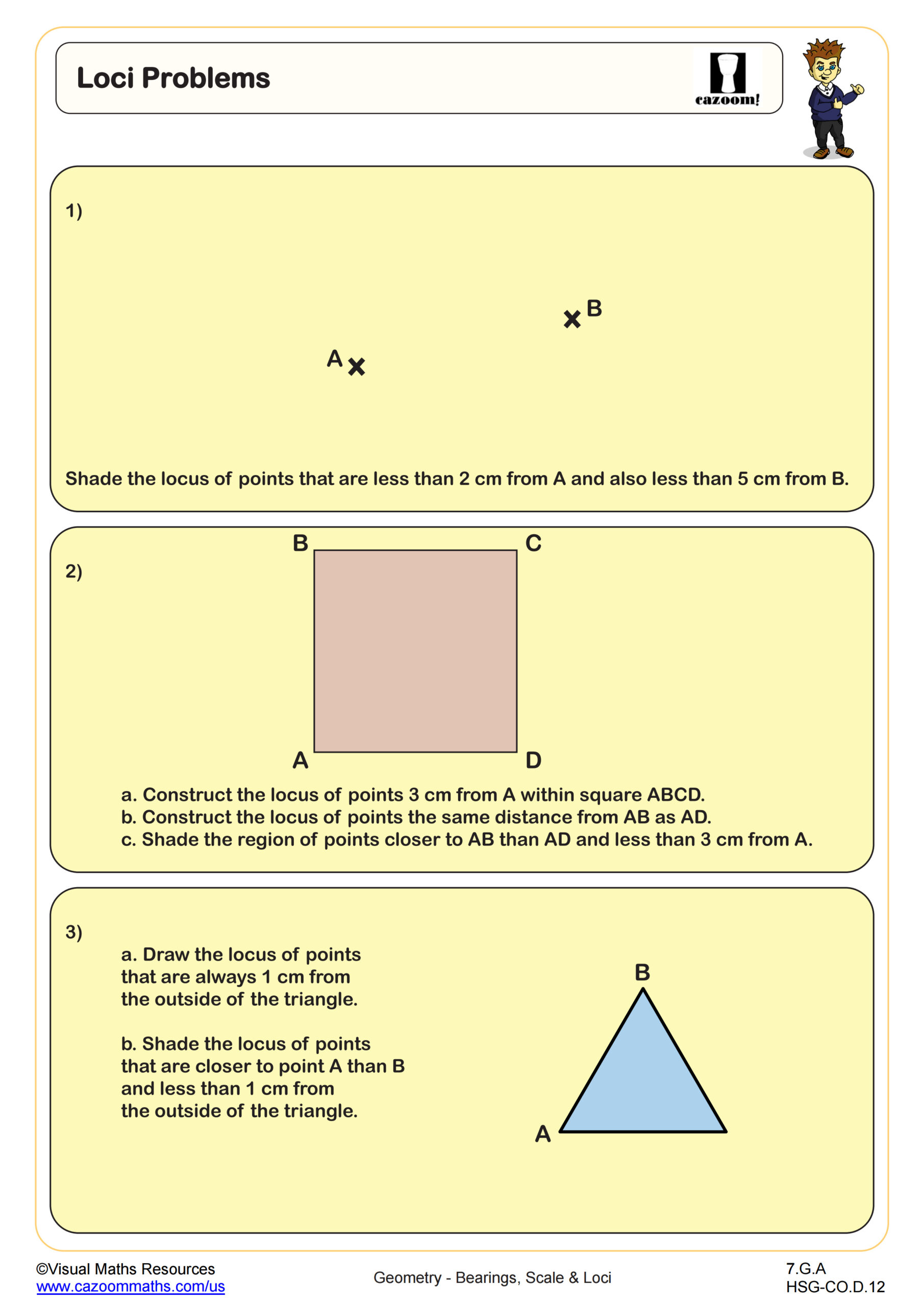
Loci (plural of locus) represent all points that satisfy a particular condition, such as being equidistant from two fixed points or maintaining a constant distance from a line. Students learn to construct these paths using compasses and straightedges, creating perpendicular bisectors, angle bisectors, and circles that represent possible locations. The worksheets guide students through identifying the condition, selecting the appropriate construction technique, and accurately drawing the resulting locus.
This skill connects directly to real-world applications in engineering, architecture, and GPS technology. When cell phone towers triangulate a phone's position, they're essentially using loci—circles representing possible distances from each tower—to identify the intersection point where the phone must be located. Similarly, architects use locus principles when determining optimal placement for features that must maintain specific distances from property lines or other structures. Students who understand loci develop stronger spatial reasoning skills that transfer to coordinate geometry and even calculus concepts involving curves defined by distance relationships.
How Can Teachers Use These Worksheets Most Effectively?
The worksheets provide scaffolded practice starting with basic bearing calculations before advancing to problems that combine bearings with scale factors and word problem contexts. The progression from Calculating Bearings (A) through word problems allows teachers to differentiate instruction, assigning foundational worksheets to students who need reinforcement while challenging advanced learners with multi-step applications. The clue-based variations require students to work backwards from partial information, strengthening problem-solving skills.
Many teachers use these worksheets during paired activities where one student describes a bearing or locus condition while their partner constructs it, then they compare results and discuss discrepancies. The complete answer keys make the worksheets particularly valuable for homework assignments or independent practice during intervention blocks, since students can self-check their work and identify specific error patterns. Teachers also find these useful as warm-up problems before map-reading activities or as targeted review before state assessments that include geometry and measurement questions involving direction and scale.