Middle School Functions Worksheets
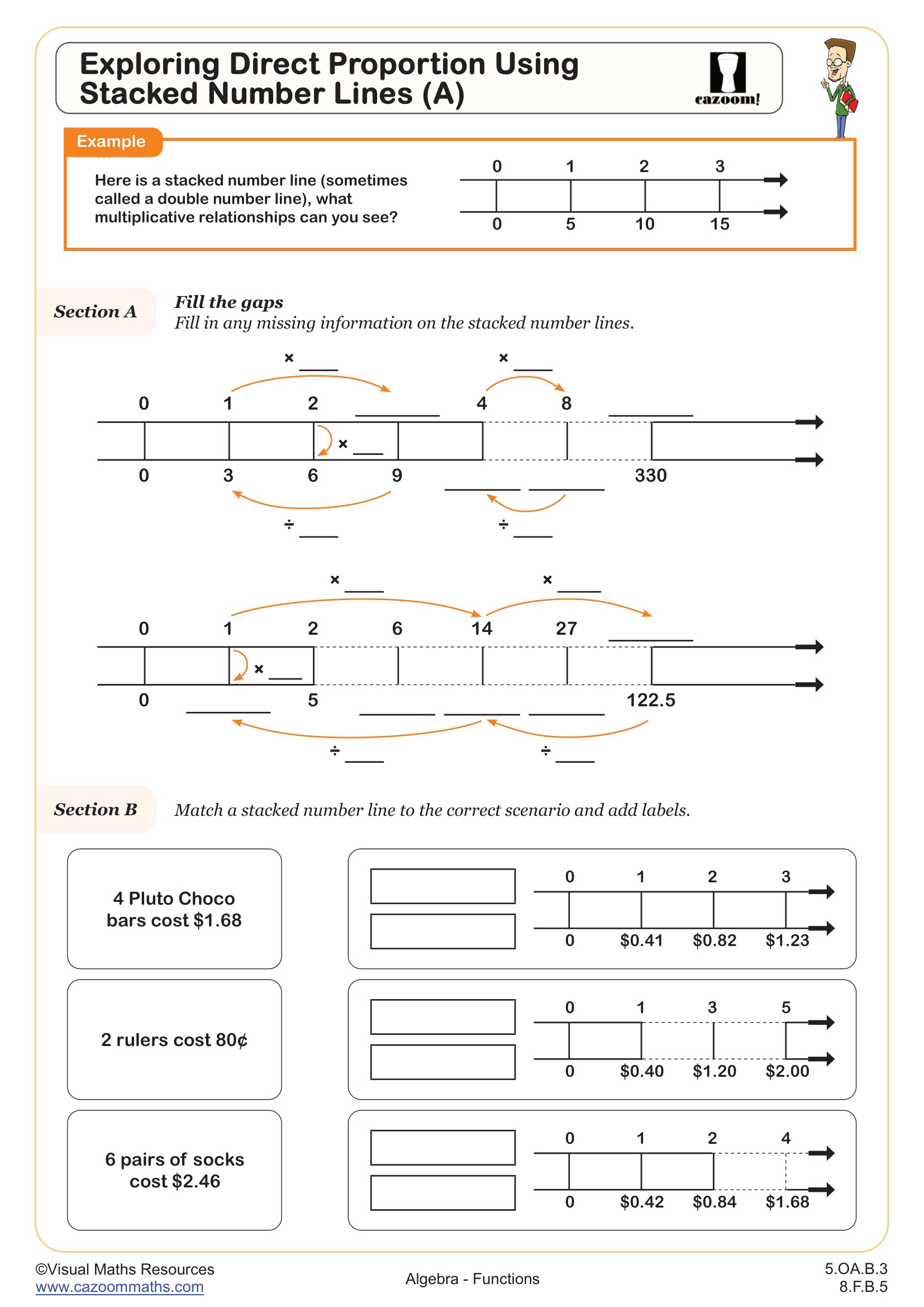
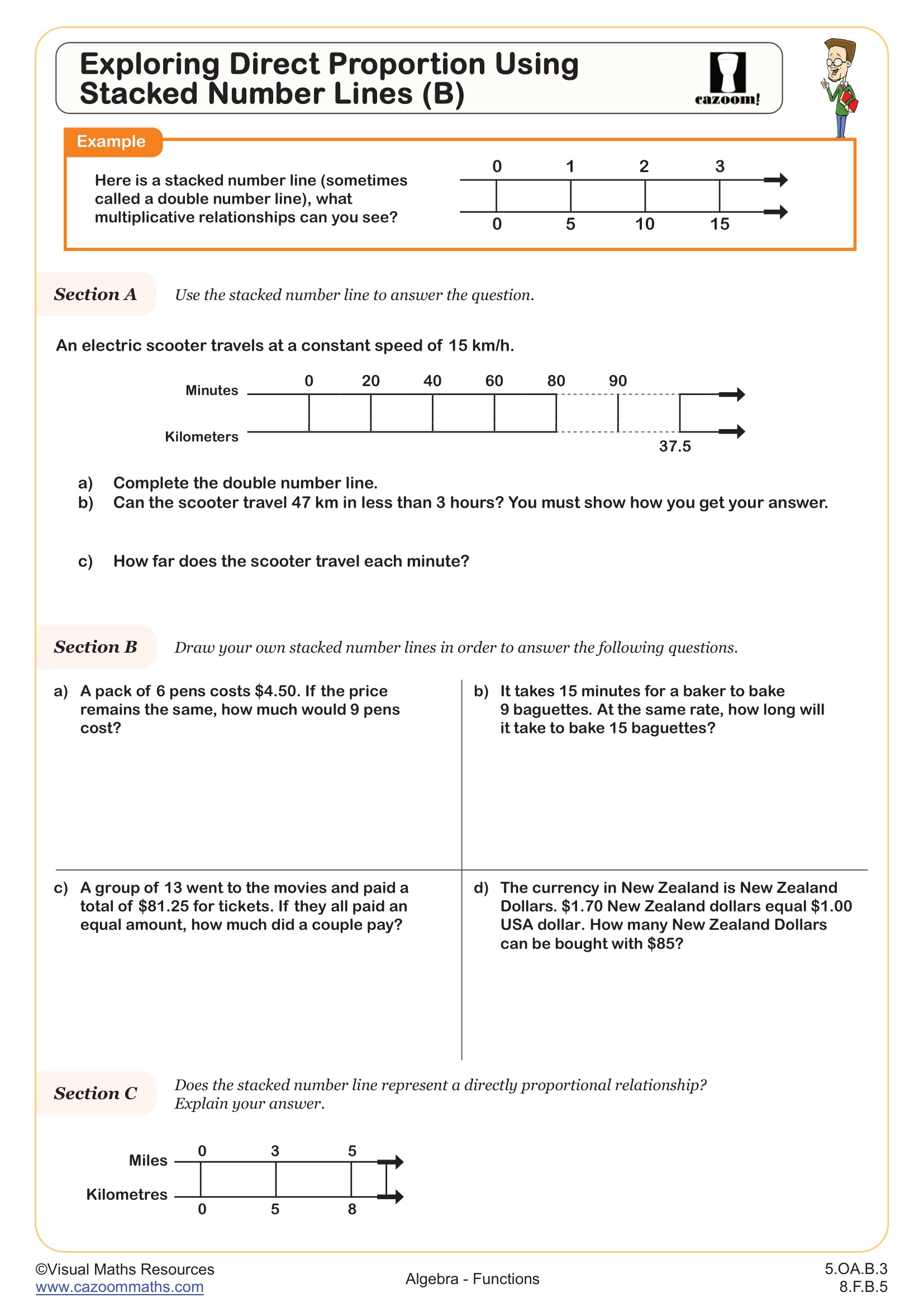
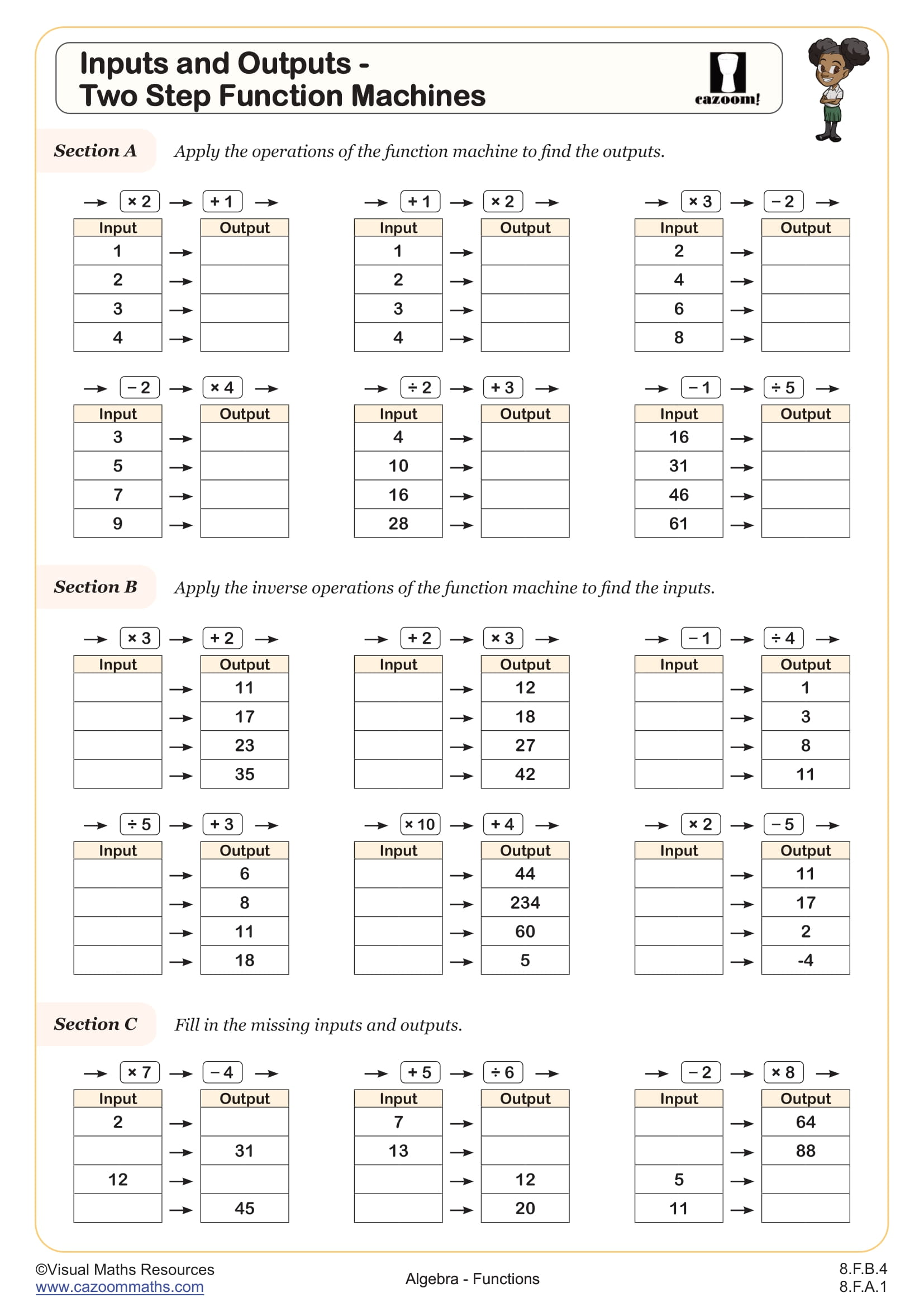
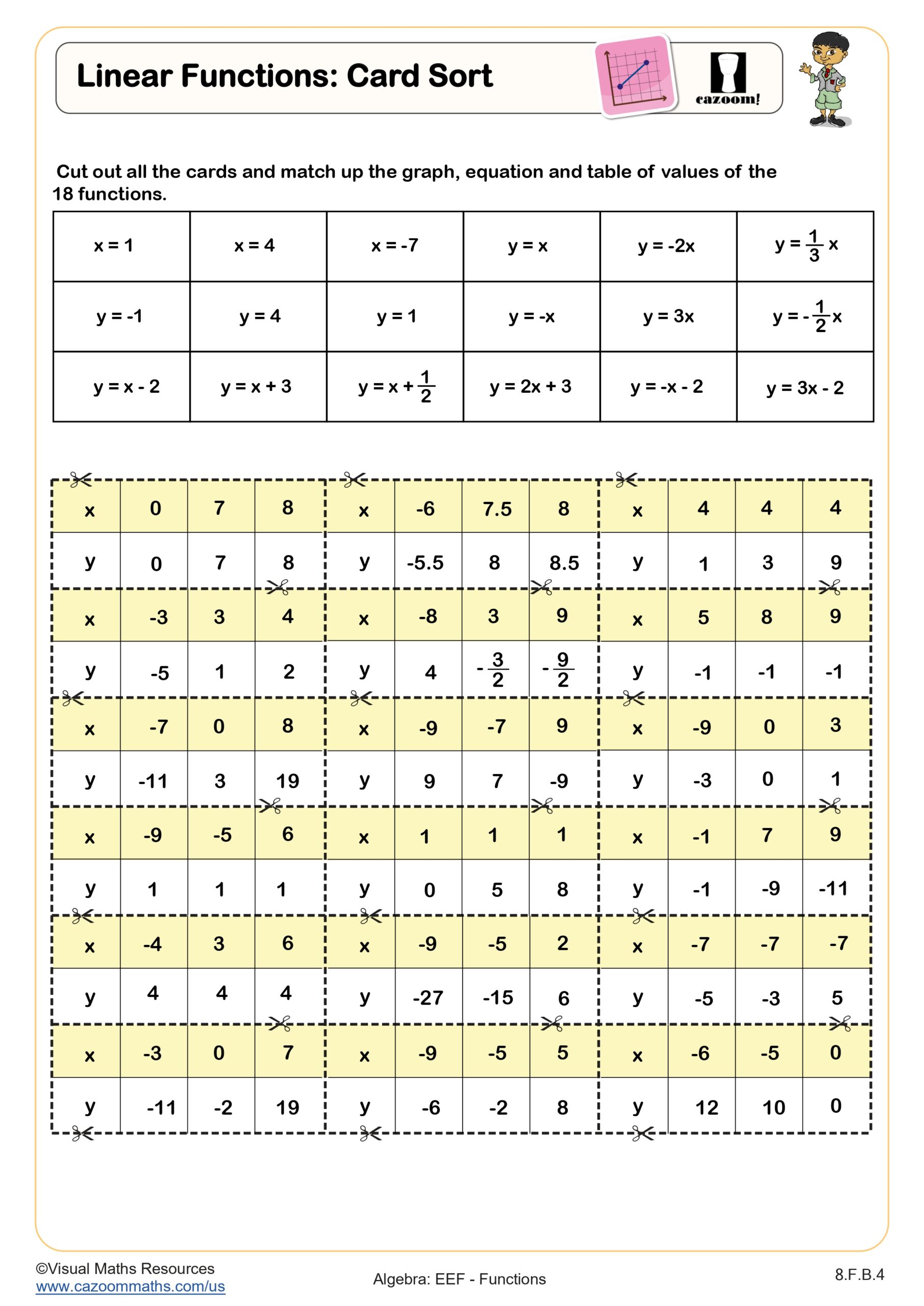
All worksheets are created by the team of experienced teachers at Cazoom Math.
What Are Functions and Why Do Students Learn Them in Middle School?
Functions represent the mathematical relationship between two quantities, where each input produces exactly one output. Middle school students learn functions because they form the backbone of algebra, calculus, and nearly every STEM field. The concept aligns with Common Core standards 6.EE.C.9, 7.RP.A.2, and 8.F.A.1, which progressively build from simple proportional relationships to formal function notation.
A common misconception students carry is thinking that any relationship between numbers qualifies as a function. Teachers often see students incorrectly label vertical line relationships or one-to-many mappings as functions. The vertical line test becomes a reliable tool once students understand that if any vertical line crosses a graph more than once, the relationship fails the function test because one input cannot produce multiple outputs.
Which Grade Levels Cover Functions Worksheets?
These functions worksheets span 6th grade, 7th grade, and 8th grade, covering the middle school years when students build algebraic thinking skills. Each grade level introduces progressively sophisticated function concepts, from basic proportional relationships to formal function notation and composition.
Sixth graders typically start by identifying patterns in tables and writing simple equations. Seventh grade expands to graphing linear relationships and understanding constant rates of change. By 8th grade, students work with function notation like f(x), evaluate functions using graphs, and tackle composite functions where one function's output becomes another's input. State assessments at the 8th grade level expect fluency with multiple representations of functions: tables, graphs, equations, and verbal descriptions.
What Are Composite Functions and Where Do Students Use Them?
Composite functions combine two or more functions, where the output of one function becomes the input for another. Written as f(g(x)) or (f ∘ g)(x), students evaluate from the inside out, first finding g(x), then substituting that result into f(x). This builds critical order-of-operations skills and prepares students for advanced algebra and calculus concepts.
Composite functions appear throughout STEM fields in surprisingly practical ways. Engineers use them when calculating fuel efficiency—one function converts speed to engine RPM, while another converts RPM to fuel consumption rate. Computer scientists rely on composite functions when programming, where one function processes user input and another formats the output for display. Students confidently tackle these problems once they recognize that composite functions mirror real-world sequences where one process feeds directly into another.
How Should Teachers Use These Functions Worksheets?
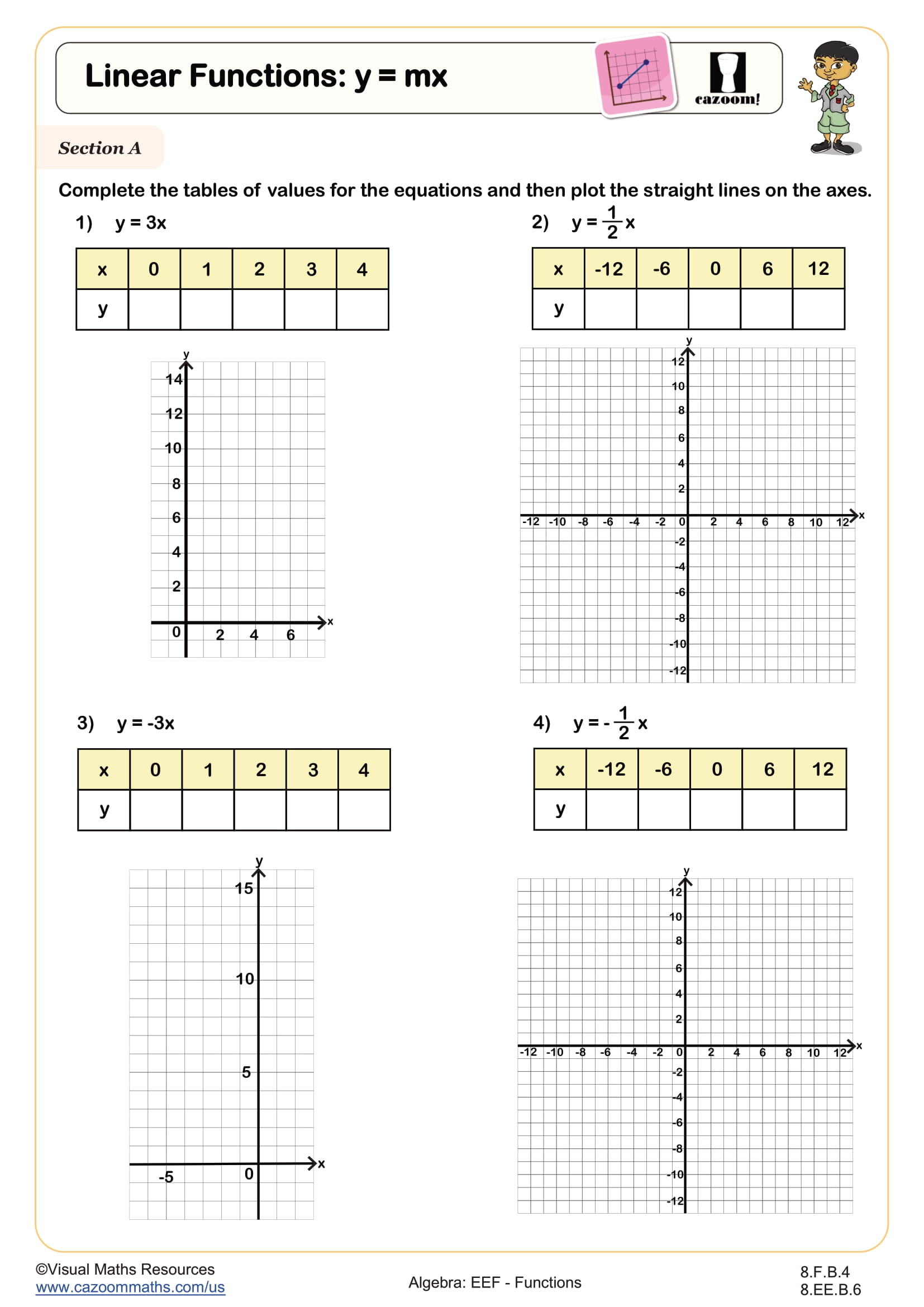
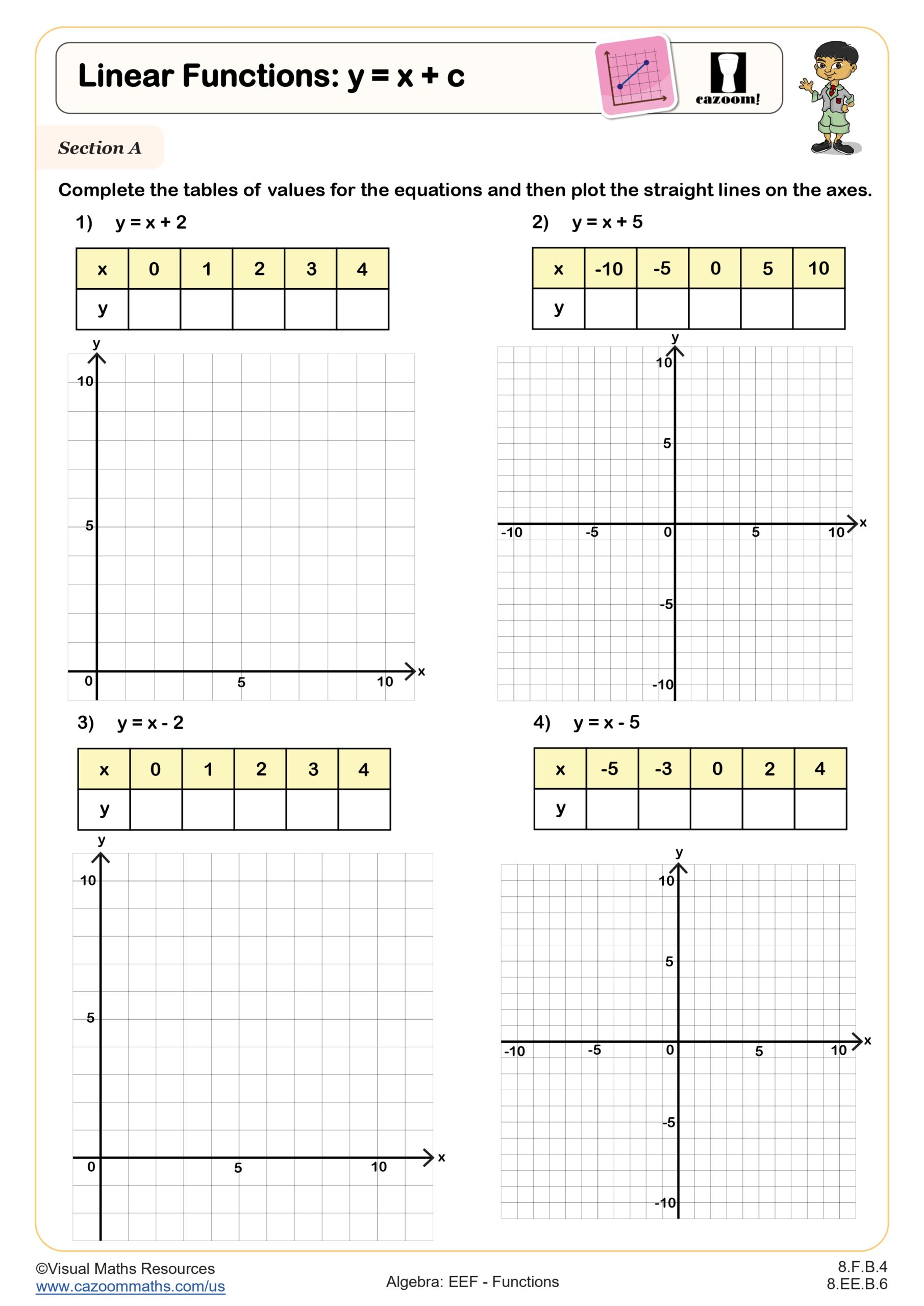
These worksheets build skills through carefully scaffolded problems that progress from basic function evaluation to more complex applications. Each worksheet focuses on a specific skill—whether graphing linear functions, working with slope and y-intercept separately, or combining functions—allowing teachers to target exactly where students need support. The included answer keys enable students to check their work independently or support peer review activities.
Teachers find these worksheets particularly effective for differentiated instruction. Struggling students benefit from starting with simpler y = x + c forms before tackling y = mx, while advanced learners can move quickly to composite functions. The worksheets work well as bellringers to activate prior knowledge, as guided practice during direct instruction, or as homework to reinforce classroom learning. Many teachers use them during intervention periods to address specific gaps revealed by formative assessments or practice tests.