Middle School PEMDAS Worksheets
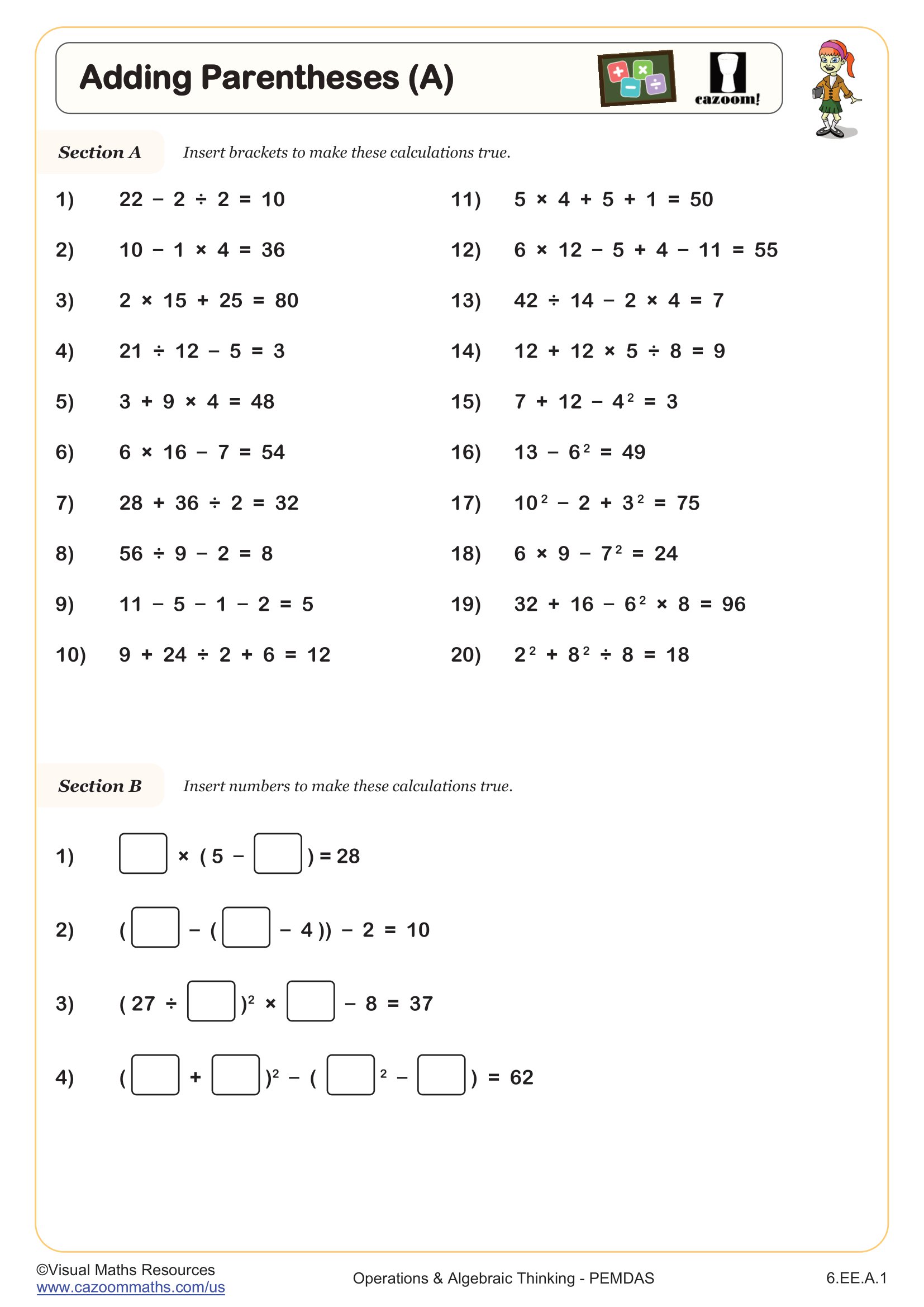
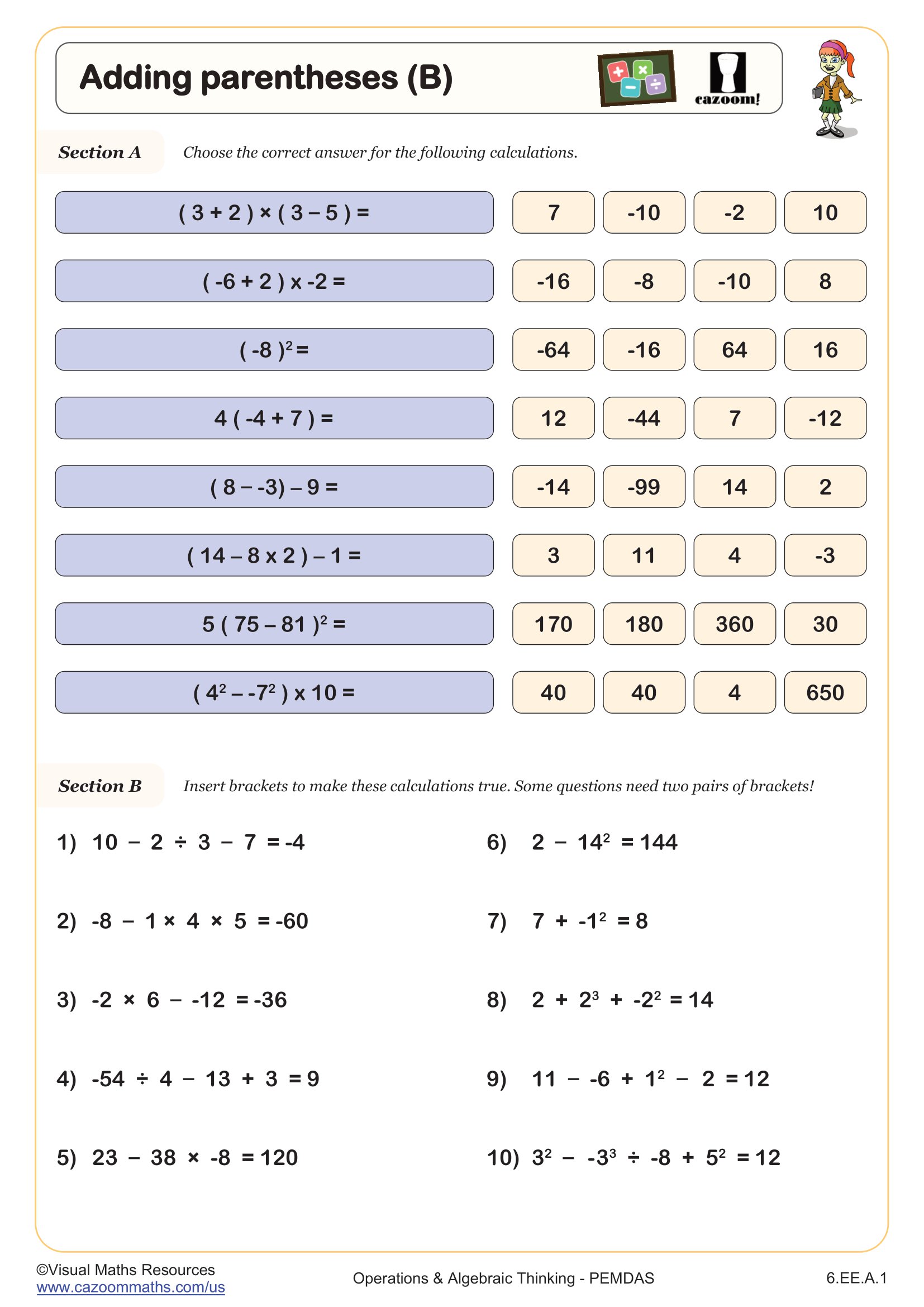
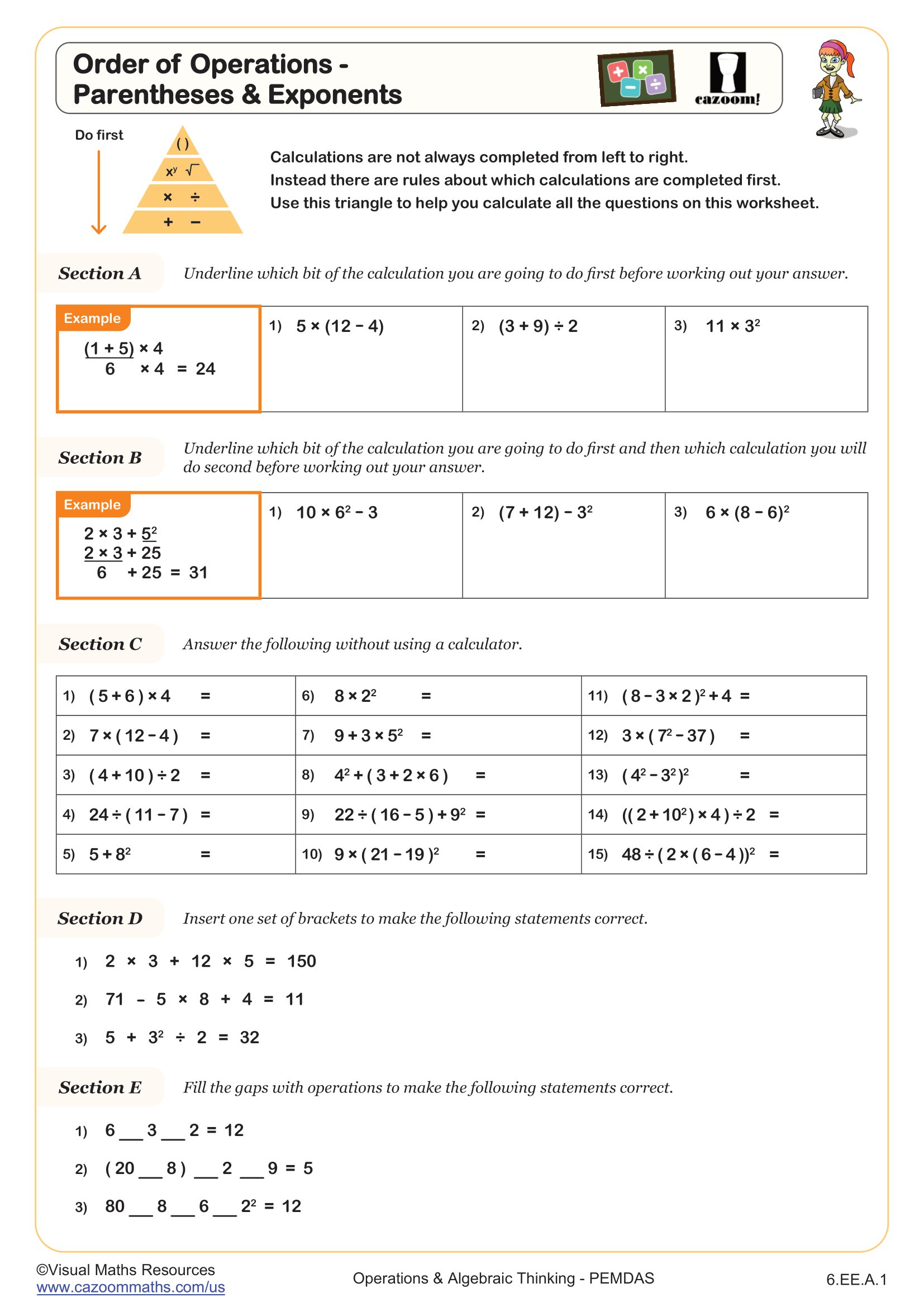
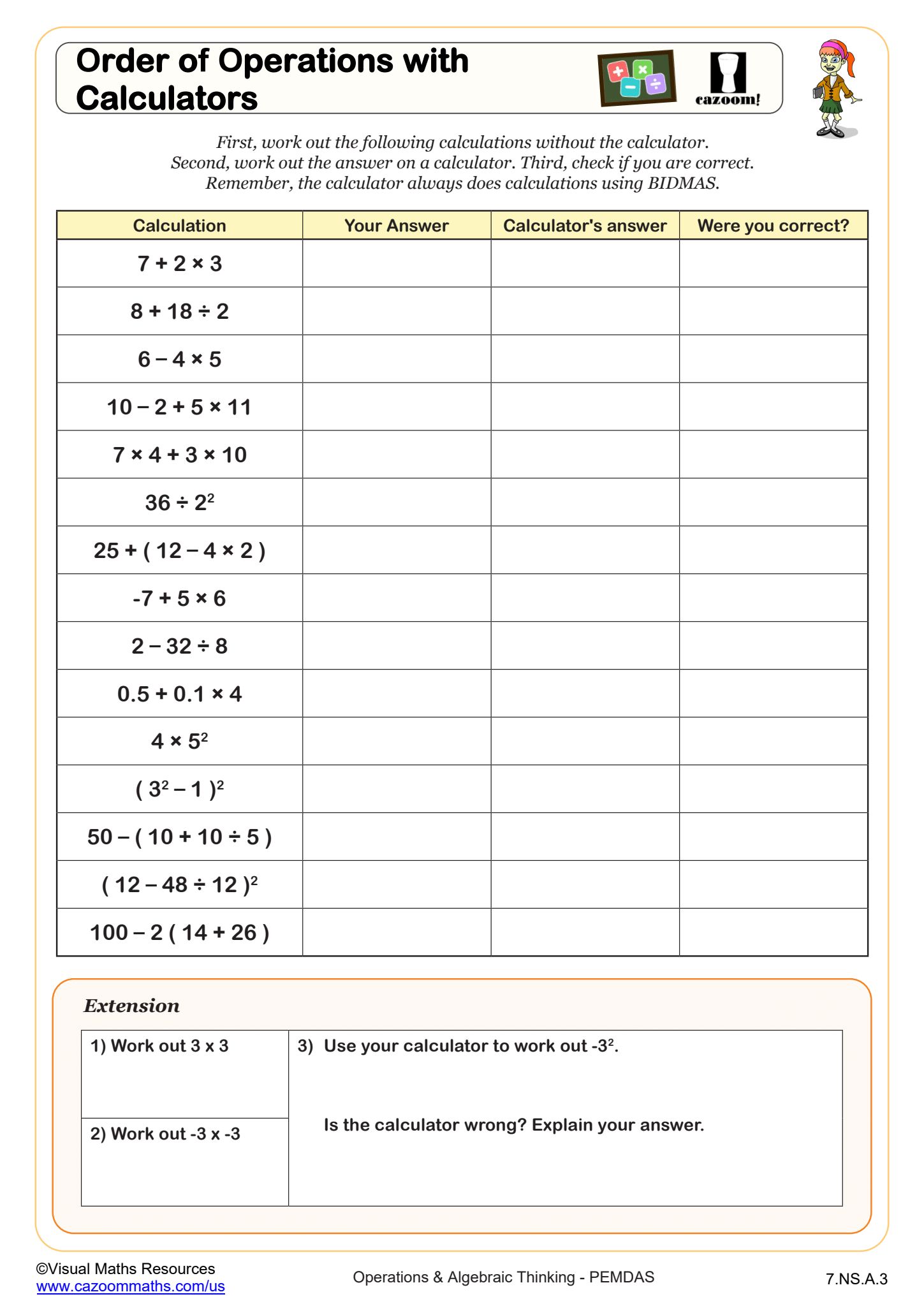
All worksheets are created by the team of experienced teachers at Cazoom Math.
What makes effective PEMDAS worksheets for middle school students?
Effective pemdas worksheets build complexity gradually, starting with simple two-operation problems before progressing to multi-step expressions with nested grouping symbols. The most useful order of operations worksheets include a mix of whole numbers, fractions, and decimals while maintaining focus on the procedural steps rather than computational complexity.
Teachers notice that students benefit most from worksheets that require them to show each step of their work, as this reveals whether errors stem from incorrect order of operations or basic arithmetic mistakes. Problems involving multiple sets of parentheses and brackets particularly help students understand how grouping symbols create a hierarchy that must be respected throughout the solution process.
How do PEMDAS skills develop across middle school grade levels?
Sixth graders typically begin with basic PEMDAS applications using whole numbers and simple grouping symbols, while seventh and eighth graders tackle more complex expressions involving negative numbers, fractions, and multiple levels of nested parentheses. The progression aligns with Common Core standards that introduce order of operations concepts in grade 6 and expand them through grade 8.
Math teachers observe that eighth graders often struggle when transitioning to algebraic expressions where variables are involved, making solid PEMDAS foundation work in earlier grades crucial. Students who master order of operations with numerical expressions find the leap to evaluating algebraic expressions much more manageable, as the procedural framework remains identical.
Why do students commonly make errors with exponents in PEMDAS problems?
Students frequently treat exponents as multiplication rather than repeated multiplication, leading to errors like calculating 2³ as 2 × 3 = 6 instead of 2 × 2 × 2 = 8. This misconception becomes particularly problematic when exponents appear within parentheses or when negative numbers are involved.
Classroom observations reveal that students also struggle with the placement of exponents in the order of operations, sometimes applying them after multiplication or division rather than immediately after resolving parentheses. Worksheets that specifically highlight exponent placement within complex expressions help students internalize that exponents take precedence over all operations except those within grouping symbols.
How can teachers use PEMDAS worksheets most effectively in the classroom?
Teachers find success using PEMDAS worksheets as both guided practice during initial instruction and independent practice for skill reinforcement. The most effective approach involves having students work through several problems together, verbalizing each step of the process before transitioning to individual work.
Many math teachers implement a peer-checking system where students compare their step-by-step solutions using the provided answer keys, allowing them to identify exactly where their reasoning diverged. This approach helps students recognize that order of operations errors often compound, making early detection crucial for developing accurate problem-solving habits that transfer to more advanced mathematical contexts.