Middle School PEMDAS Worksheets
All worksheets are created by the team of experienced teachers at Cazoom Math.
What makes effective PEMDAS worksheets 6th grade level?
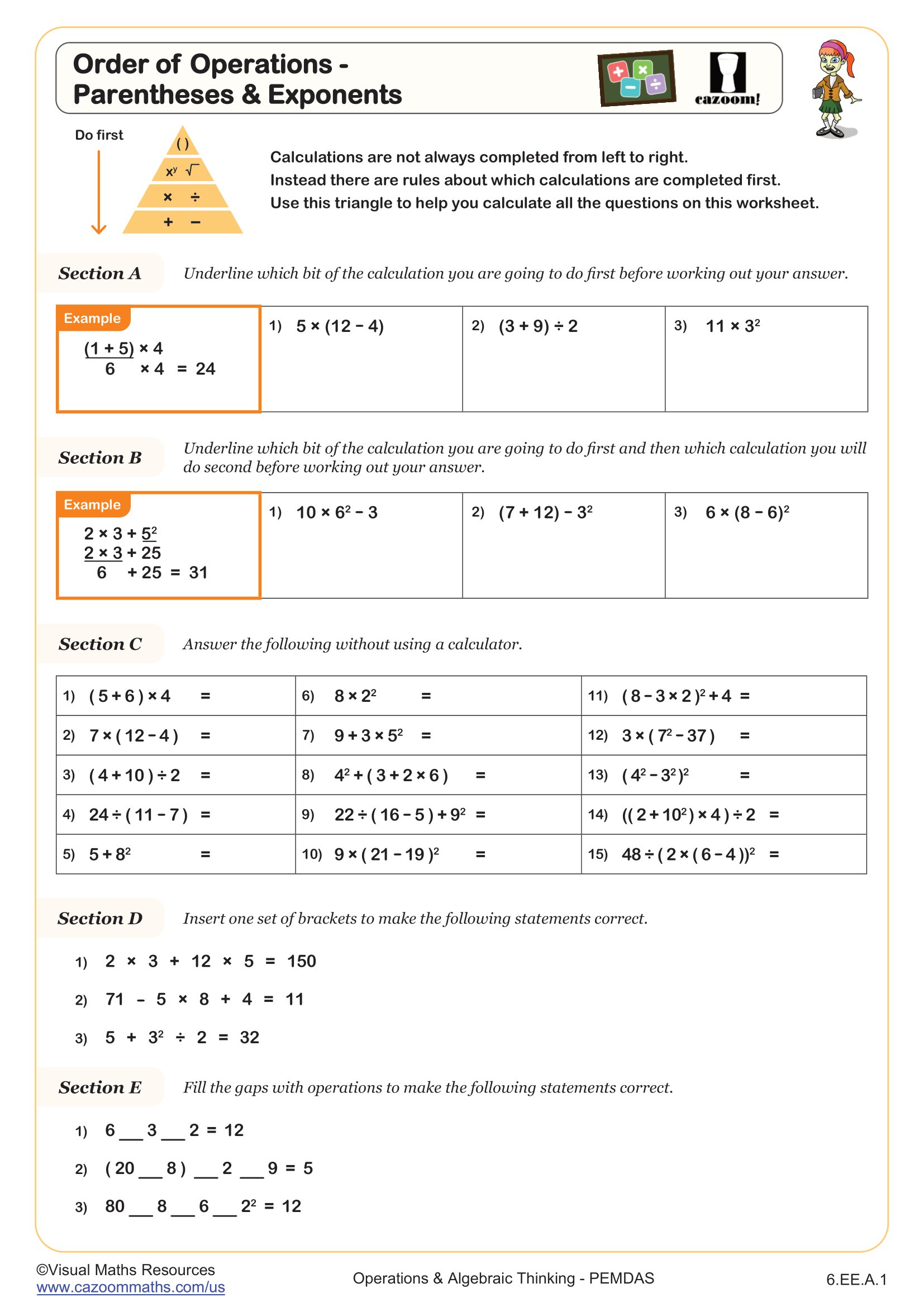
Effective 6th grade PEMDAS worksheet materials align with Common Core standard 6.EE.A.1, which requires students to evaluate numerical expressions with whole-number exponents. The problems should start with simple two-operation expressions and gradually build complexity to include all six operations with grouping symbols and exponents.
Teachers consistently observe that students at this level struggle most with distinguishing when multiplication and division have equal priority, often working strictly left to right instead of recognizing these operations as having the same precedence. Quality worksheets include multiple examples where division comes before multiplication in the expression to address this specific misconception.
How do PEMDAS skills progress from 6th to 8th grade?
PEMDAS 7th grade work expands beyond basic whole numbers to include integers, fractions, and decimals within order of operations problems. Students tackle more complex expressions with multiple levels of parentheses and begin seeing algebraic expressions mixed with numerical calculations. Eighth grade students apply PEMDAS when simplifying expressions with variables and working with scientific notation.
The progression requires students to maintain accuracy with the fundamental sequence while handling increasingly sophisticated number systems. Teachers notice that students who master basic PEMDAS questions 6th grade level with whole numbers adapt more successfully to fraction and decimal operations in later grades.
Why do students commonly make errors with exponents in PEMDAS?
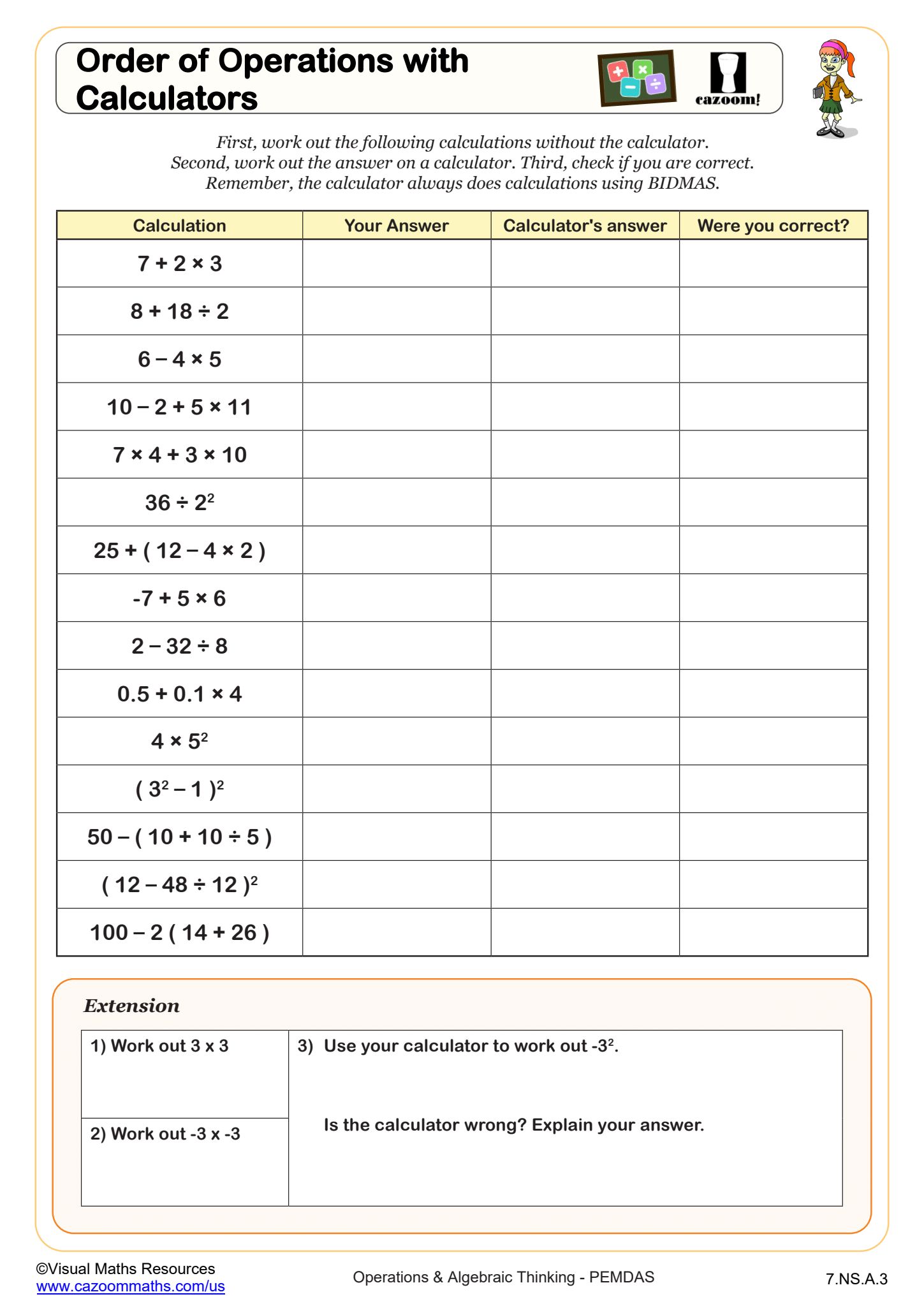
Students frequently misapply the order of operations when exponents are involved, particularly with expressions like -3² or 2 × 3². Many students incorrectly calculate -3² as positive 9 instead of negative 9, not recognizing that the exponent applies only to the 3, not the negative sign. Similarly, with 2 × 3², students often multiply first to get 6², rather than calculating 3² first to get 2 × 9.
These errors stem from not understanding that exponents have higher priority than both multiplication and negative signs when the negative isn't explicitly within parentheses. Teachers find that color-coding or highlighting the base and exponent separately helps students visualize what the exponent actually affects in the expression.
How should teachers use PEMDAS examples with answers grade 6 level?
Teachers get the most value from worked examples by having students trace through each step before attempting independent practice. The answer keys serve as step-by-step guides where students can check their reasoning at each stage of the process, not just verify the final answer. This approach helps identify whether errors occur in computation or in applying the correct sequence.
Many teachers implement a peer-checking system where students work problems independently, then compare their step-by-step work with a partner before consulting the answer key. This strategy builds mathematical communication skills while reinforcing proper PEMDAS application through discussion and explanation of different approaches to the same problem.