Middle School Pythagorean Theorem Worksheets
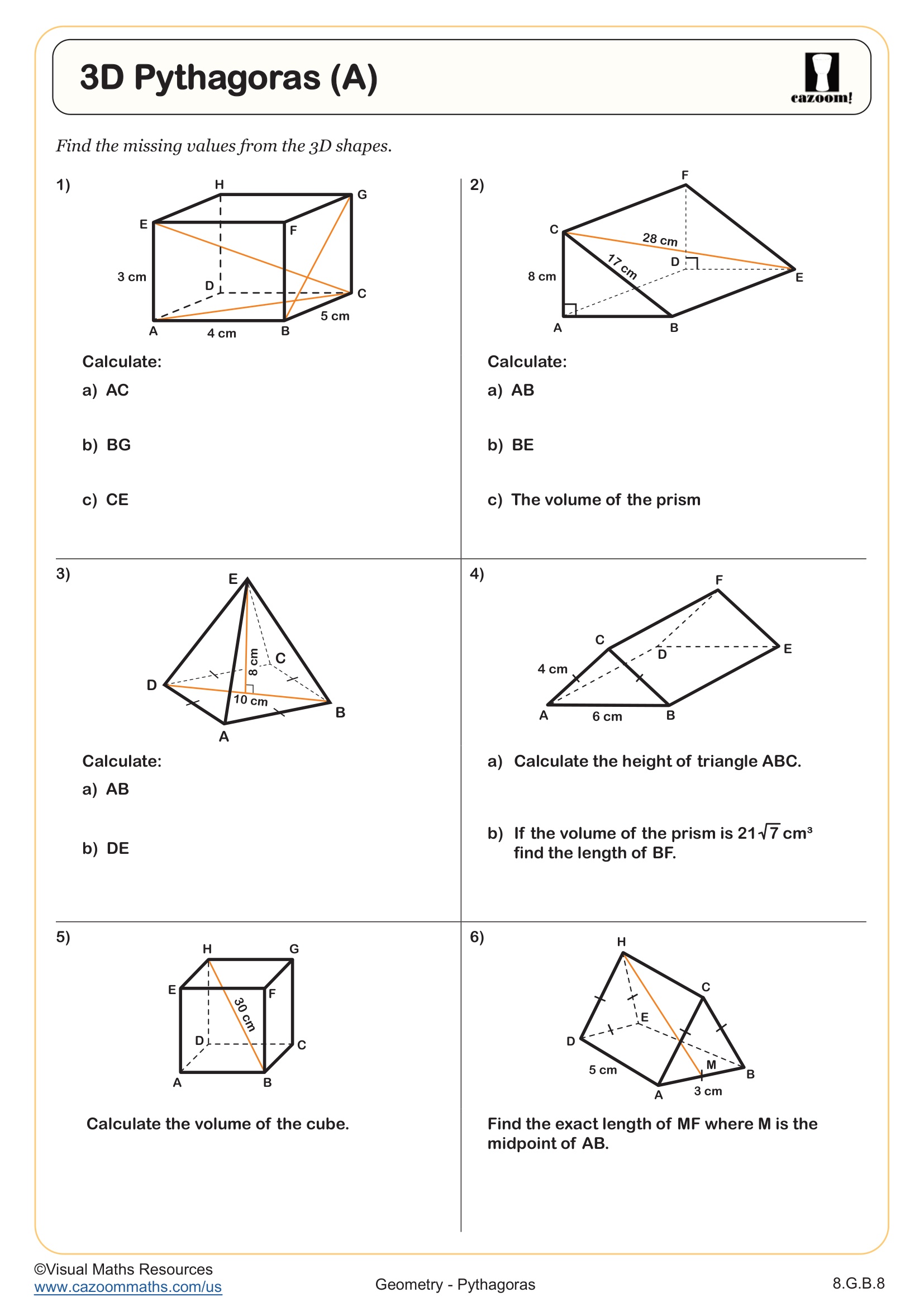
3D Pythagoras (A)
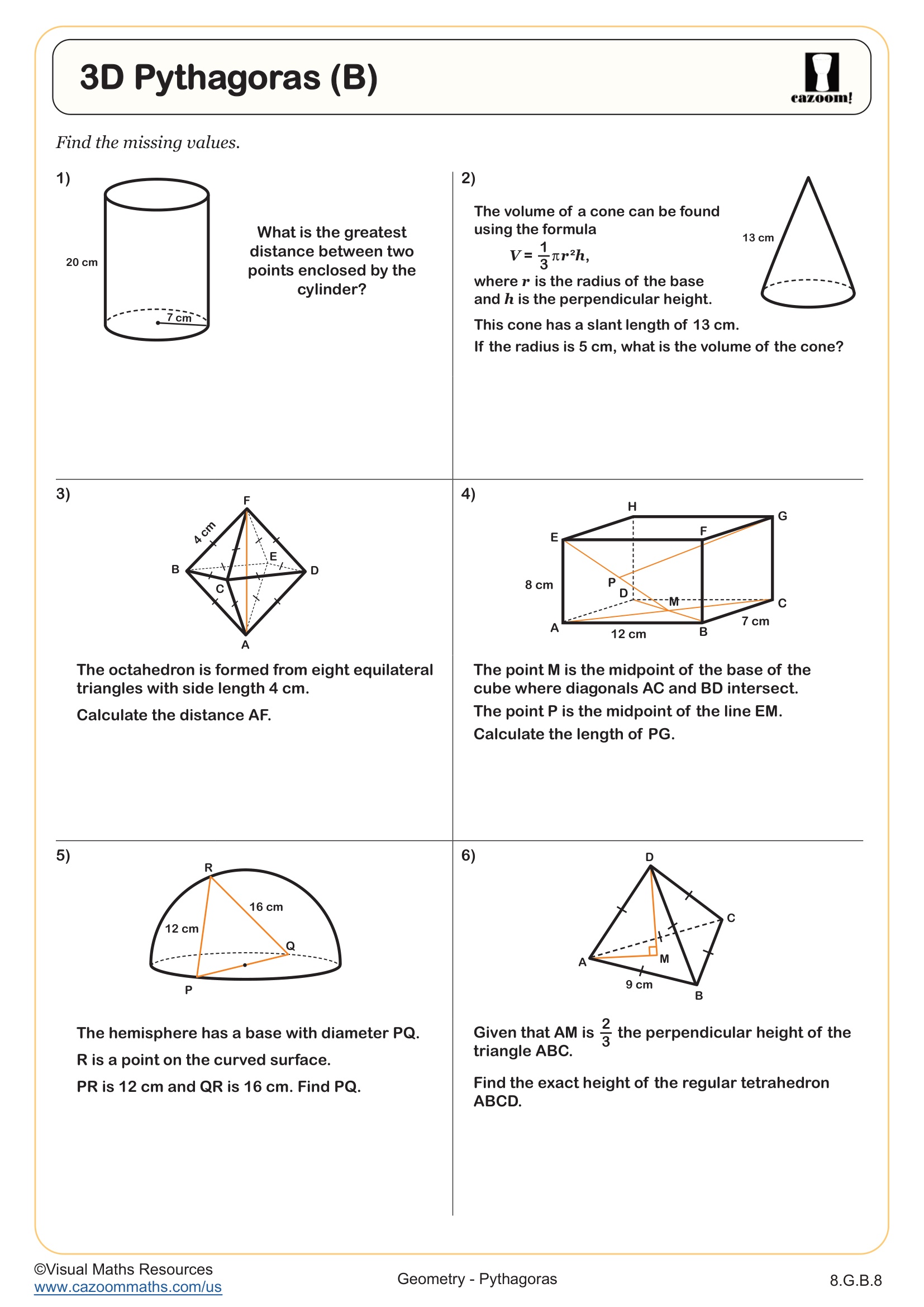
3D Pythagoras (B)
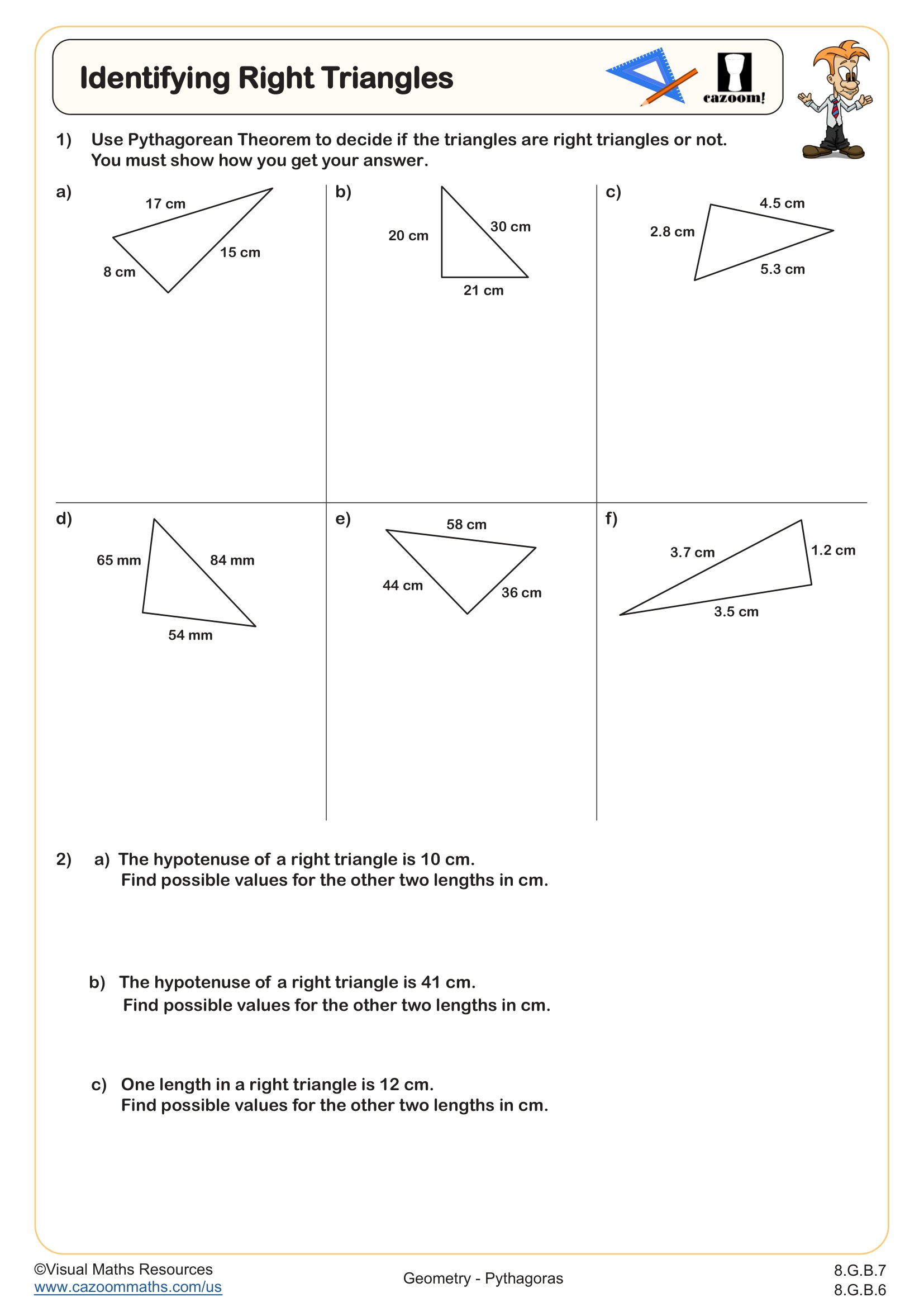
Identifying Right Triangles
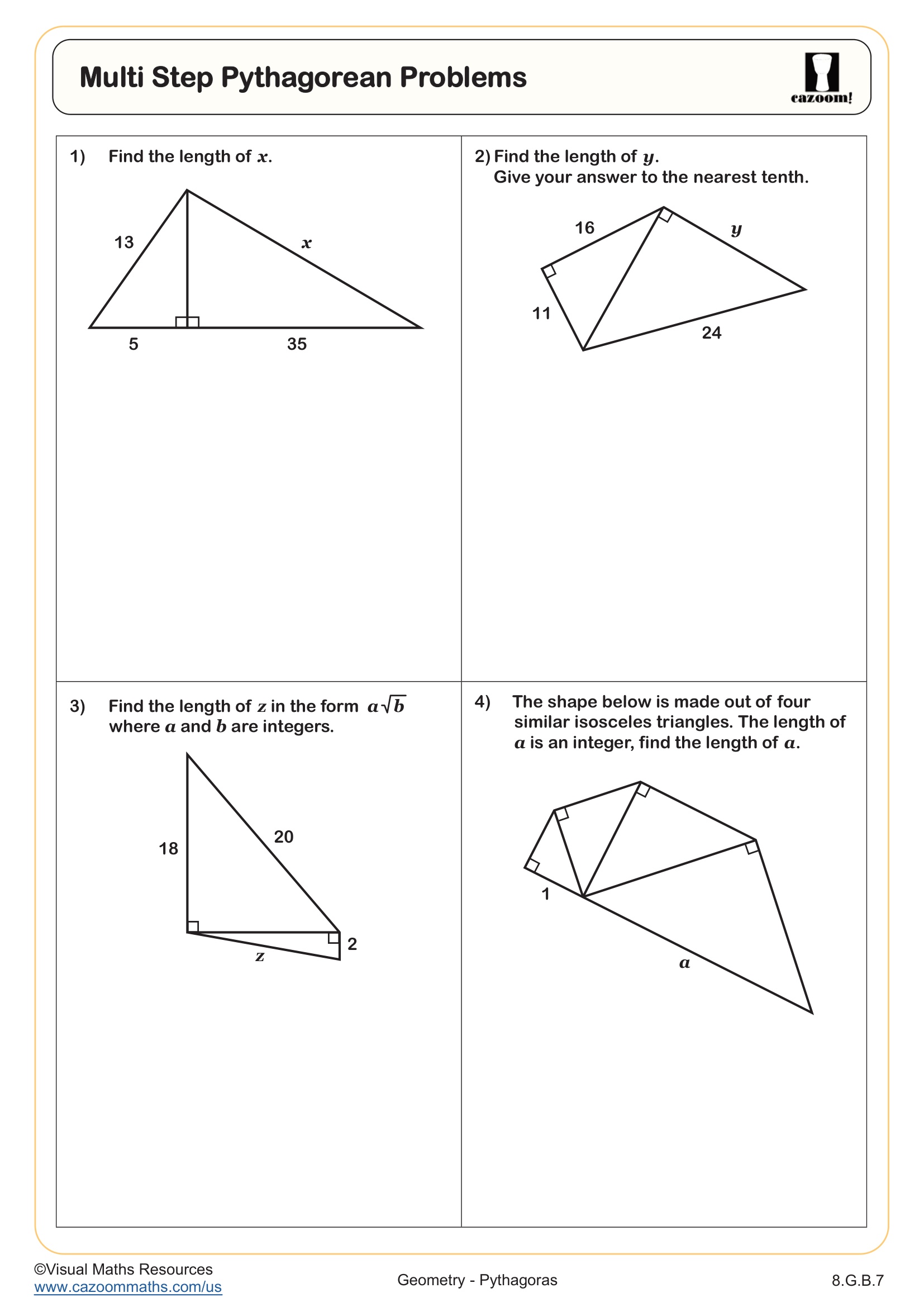
Multi Step Pythagorean Problems
Pythagorean Theorem and coordinates
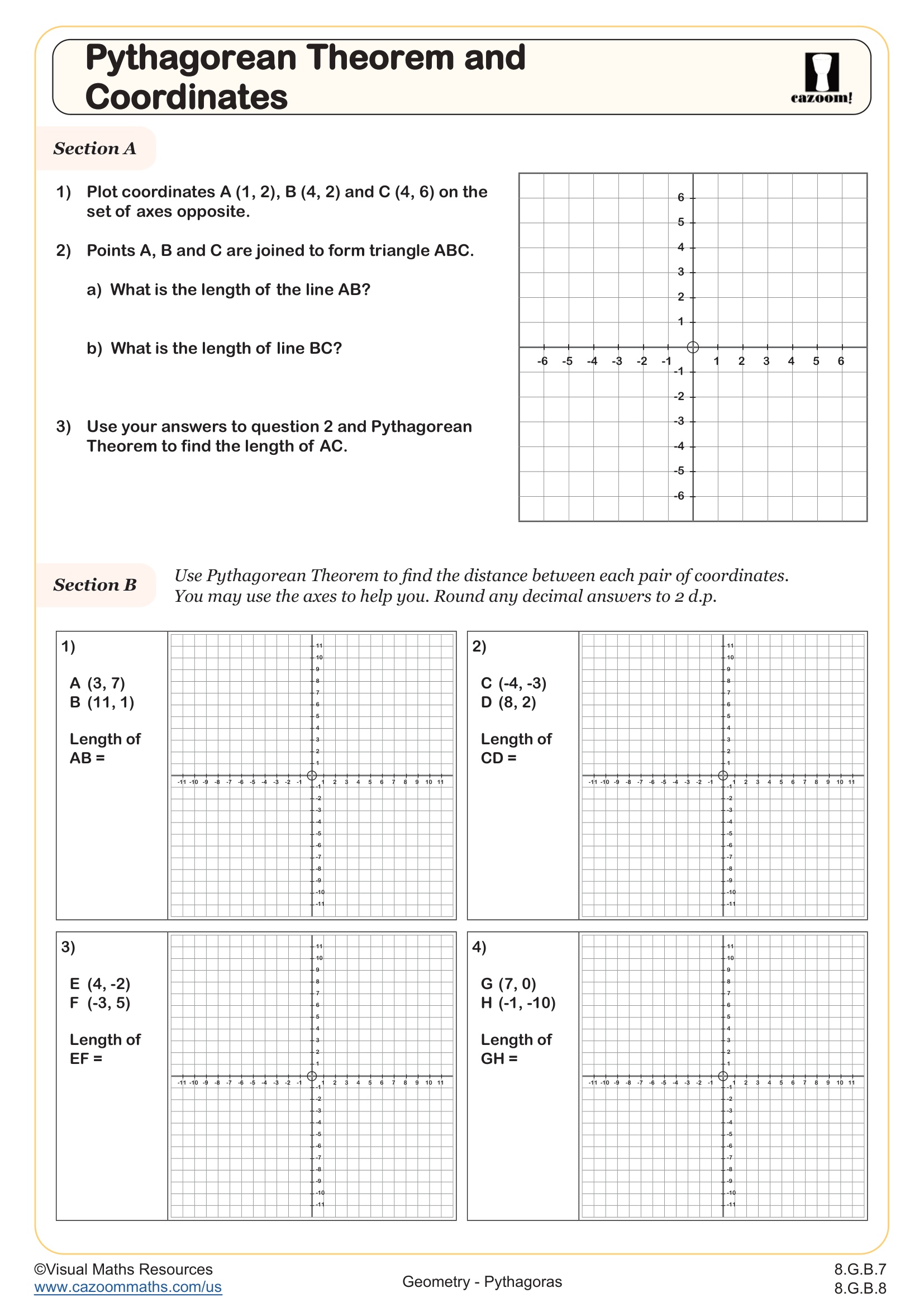
Pythagorean Theorem Word Problems
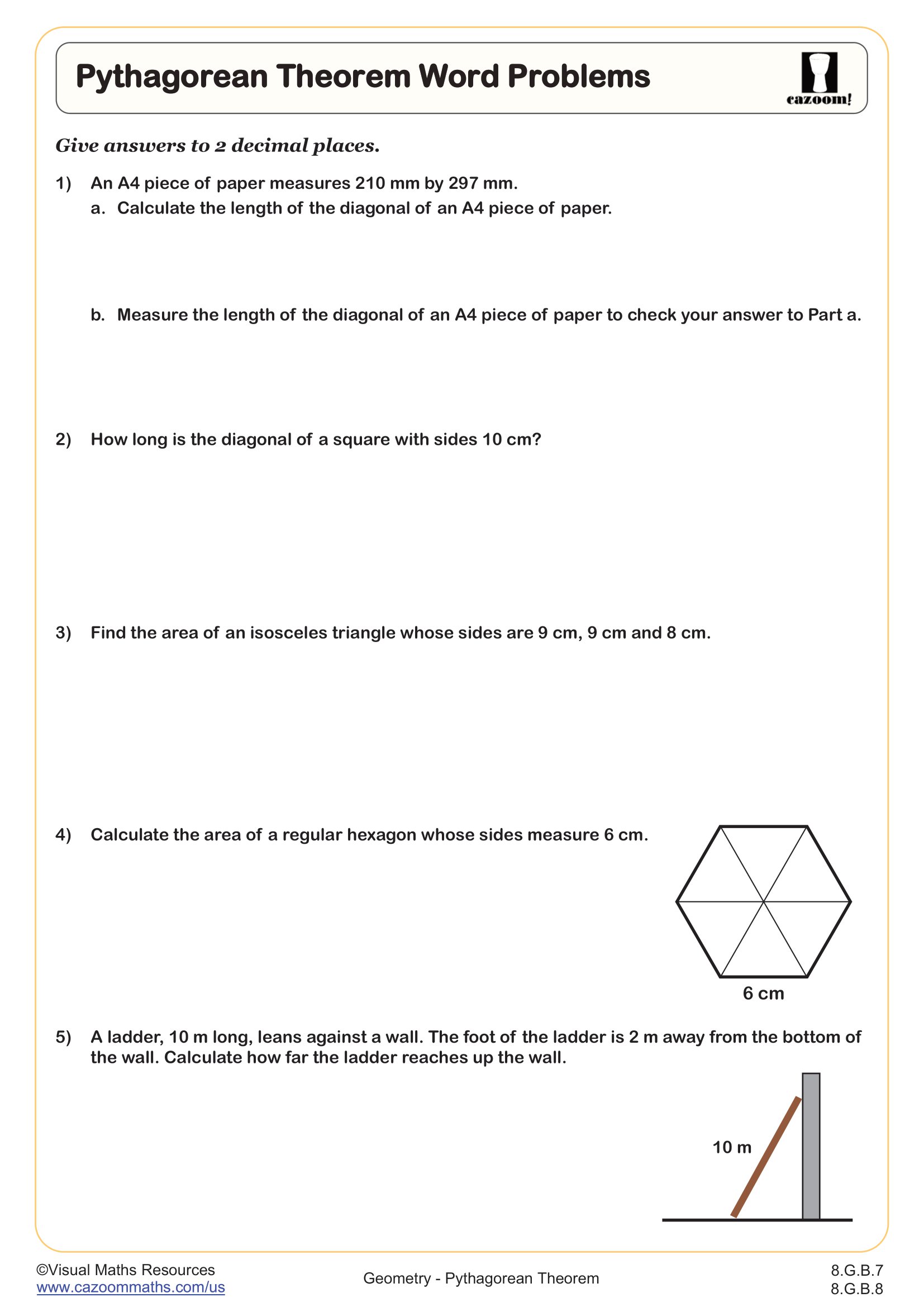
Pythagorean Theorem Word Problems (with clues)
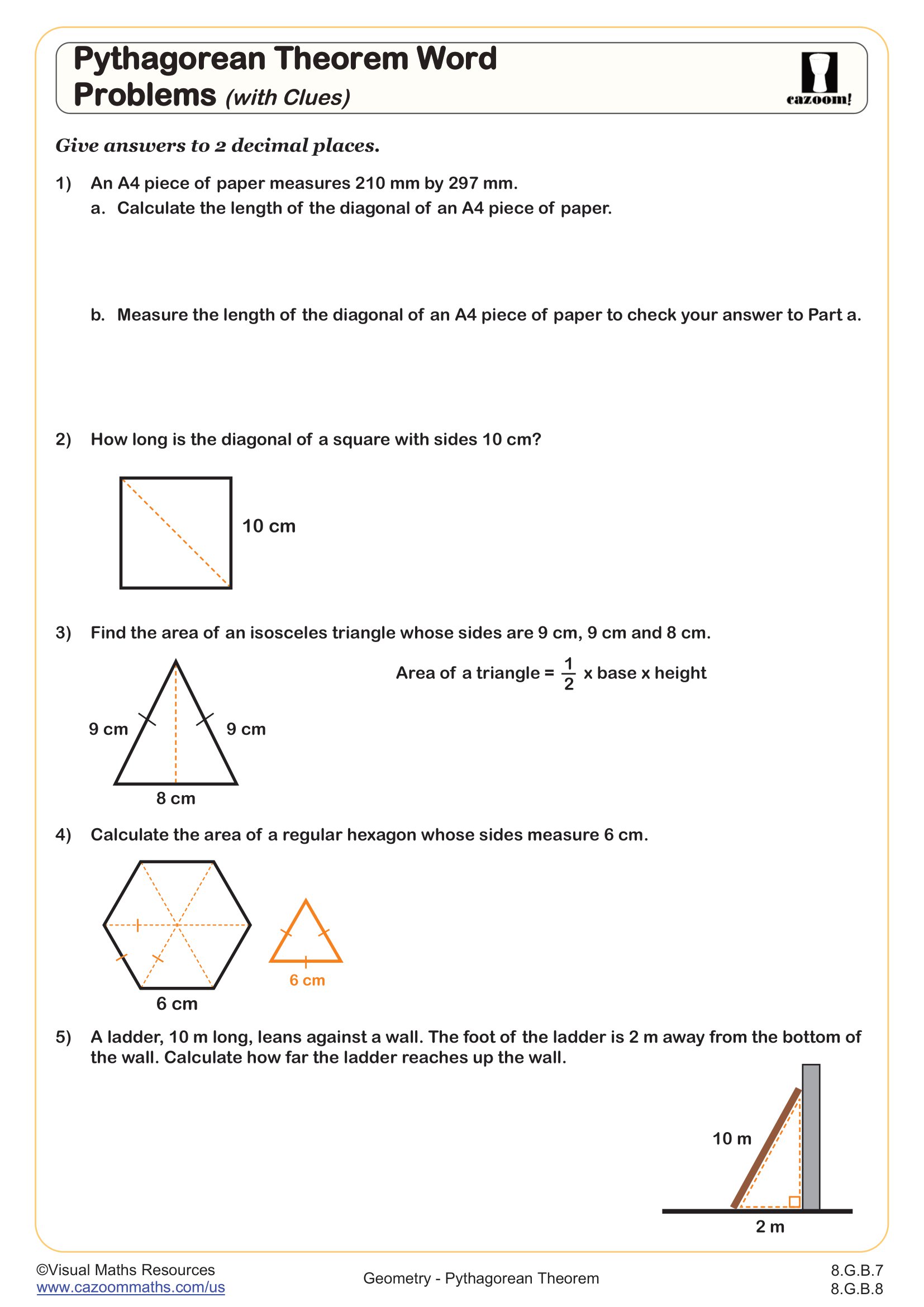
Pythagorean Theorem: Calculating Missing Side Lengths
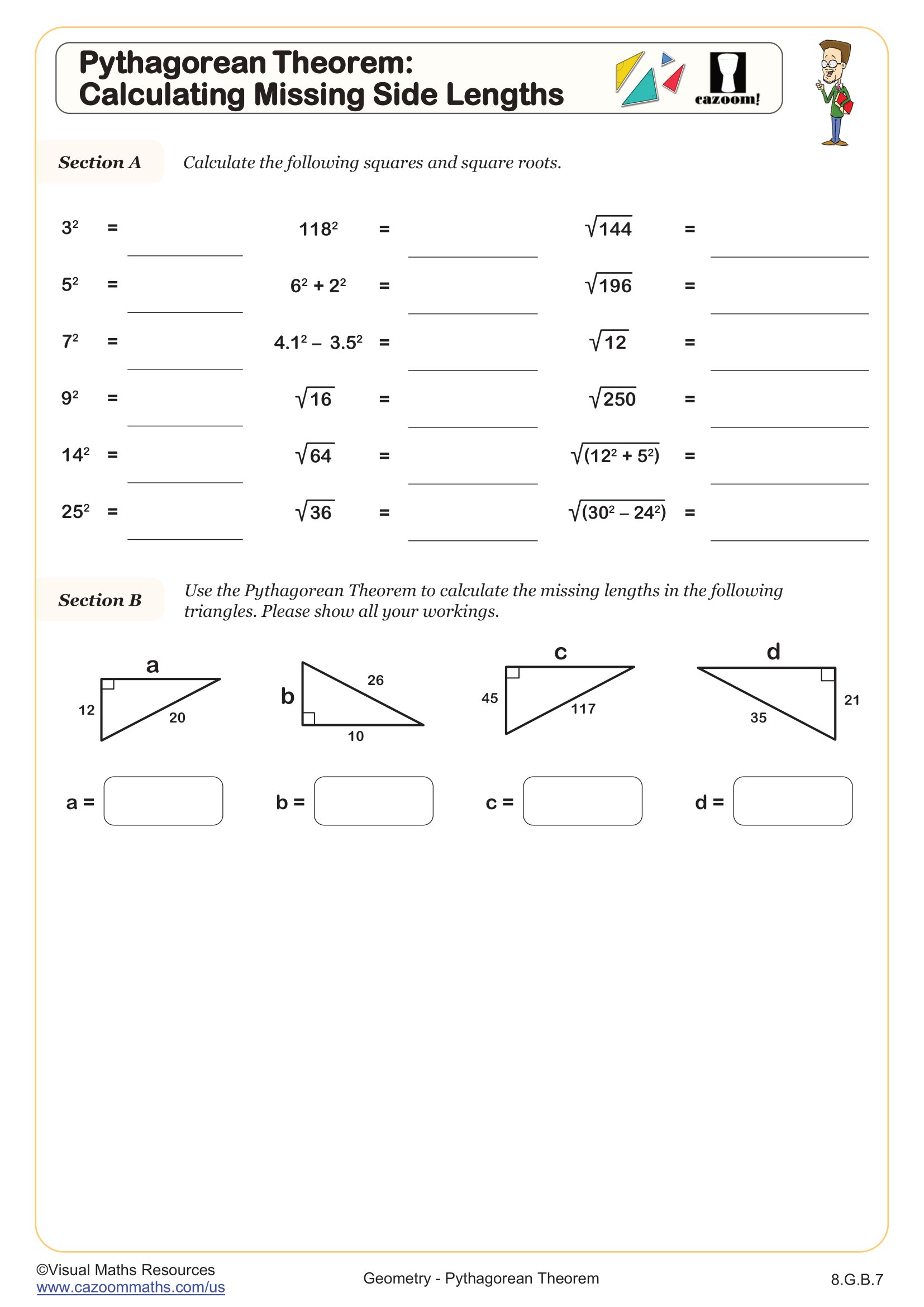
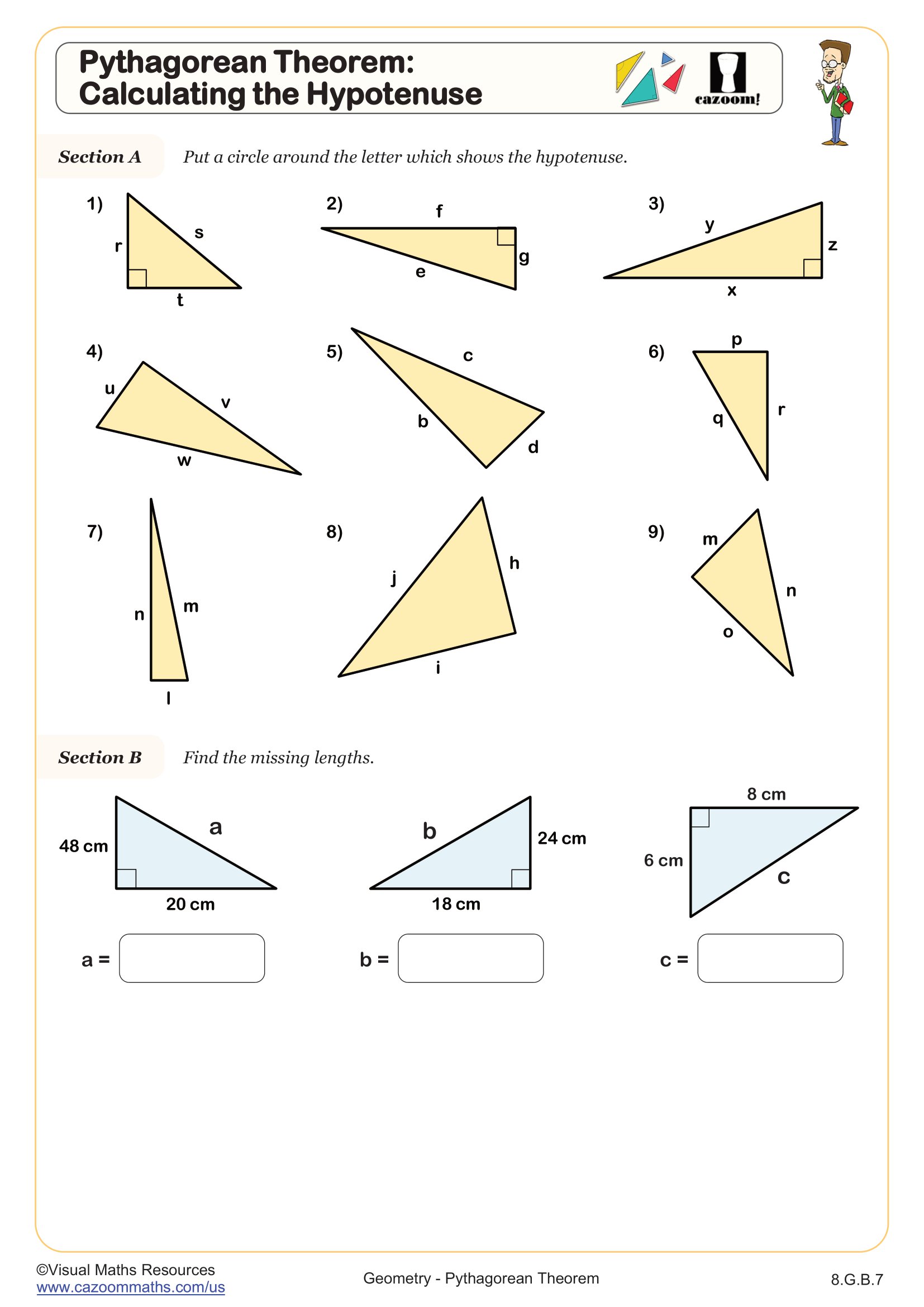
Pythagorean Theorem: Calculating the Hypotenuse
All worksheets are created by the team of experienced teachers at Cazoom Math.
What is the Pythagorean Theorem and why do students learn it in middle school?
The Pythagorean Theorem states that in a right triangle, the square of the hypotenuse equals the sum of the squares of the two legs (a² + b² = c²). This relationship appears in Common Core standards starting in 8th grade (8.G.B.6-8), though many districts introduce foundational concepts in 6th and 7th grade through geometry and spatial reasoning units. The theorem bridges algebra and geometry, requiring students to work with squared values, square roots, and geometric visualization simultaneously.
A common mistake occurs when students memorize the formula but fail to identify which side is the hypotenuse. Many students lose points on assessments by treating any side as c, not recognizing that c must always represent the longest side opposite the right angle. Teachers see breakthrough moments when students physically label triangles with "hyp" before setting up equations, transforming an abstract formula into a concrete problem-solving strategy.
What grade levels use Pythagorean Theorem worksheets?
These worksheets cover 6th grade, 7th grade, and 8th grade across the middle school stage. While the Pythagorean Theorem is formally introduced in 8th grade according to Common Core standards, earlier grades build prerequisite skills including working with right angles, understanding squared numbers, and recognizing special right triangles. The 8th grade focus includes proving the theorem and applying it to solve real-world distance and measurement problems.
The progression across middle school carefully scaffolds difficulty. Students in 6th and 7th grade typically explore basic right triangle identification and simple missing side problems with whole number solutions. By 8th grade, worksheets introduce decimal and radical answers, multi-step problems requiring multiple applications of the theorem, and coordinate plane problems where students find distances between points by constructing right triangles on a grid.
How does the Pythagorean Theorem apply to coordinate plane problems?
Coordinate plane applications extend the Pythagorean Theorem beyond drawn triangles to finding distances between any two points. Students plot two points, recognize that the horizontal and vertical distances form the legs of a right triangle, then apply a² + b² = c² to calculate the straight-line distance. This method leads directly to the distance formula, d = √[(x₂-x₁)² + (y₂-y₁)²], which students will use extensively in algebra and geometry courses.
This skill connects directly to GPS technology and navigation systems, where devices calculate the shortest distance between locations using coordinate-based positioning. Engineers use these calculations in construction planning, robotics programmers apply them to determine movement paths, and video game designers use distance formulas to program character movements and collision detection. Understanding the theorem's coordinate application helps students recognize that mathematical concepts power the technology they use daily.
How can teachers use these Pythagorean Theorem worksheets effectively?
The worksheets provide structured progression from identifying right triangles through multi-step applications, allowing teachers to assign practice that matches current instruction. Answer keys enable students to check their work during independent practice, particularly valuable when working with square roots where calculation errors are common. Teachers can use the example problems as guided instruction before students tackle similar problems independently, building confidence through worked models.
These materials work well for differentiated instruction, with simpler identification and whole-number problems supporting students who need foundational practice while coordinate plane applications challenge advanced learners. Many teachers assign specific worksheets for homework after introducing each subtopic, then use different worksheets for in-class review before assessments. The worksheets also serve intervention purposes, helping students in algebra or geometry who struggle with distance problems revisit the underlying Pythagorean concepts they may have missed in middle school.