Edexcel iGCSE Geometry and Trigonometry Revision Worksheets
Browse our iGCSE revision worksheets for the Geometry and Trigonometry section of Edexcel International GCSE Mathematics (4MA1). All worksheets include full answers and worked solutions.
4.1Foundation & Higher
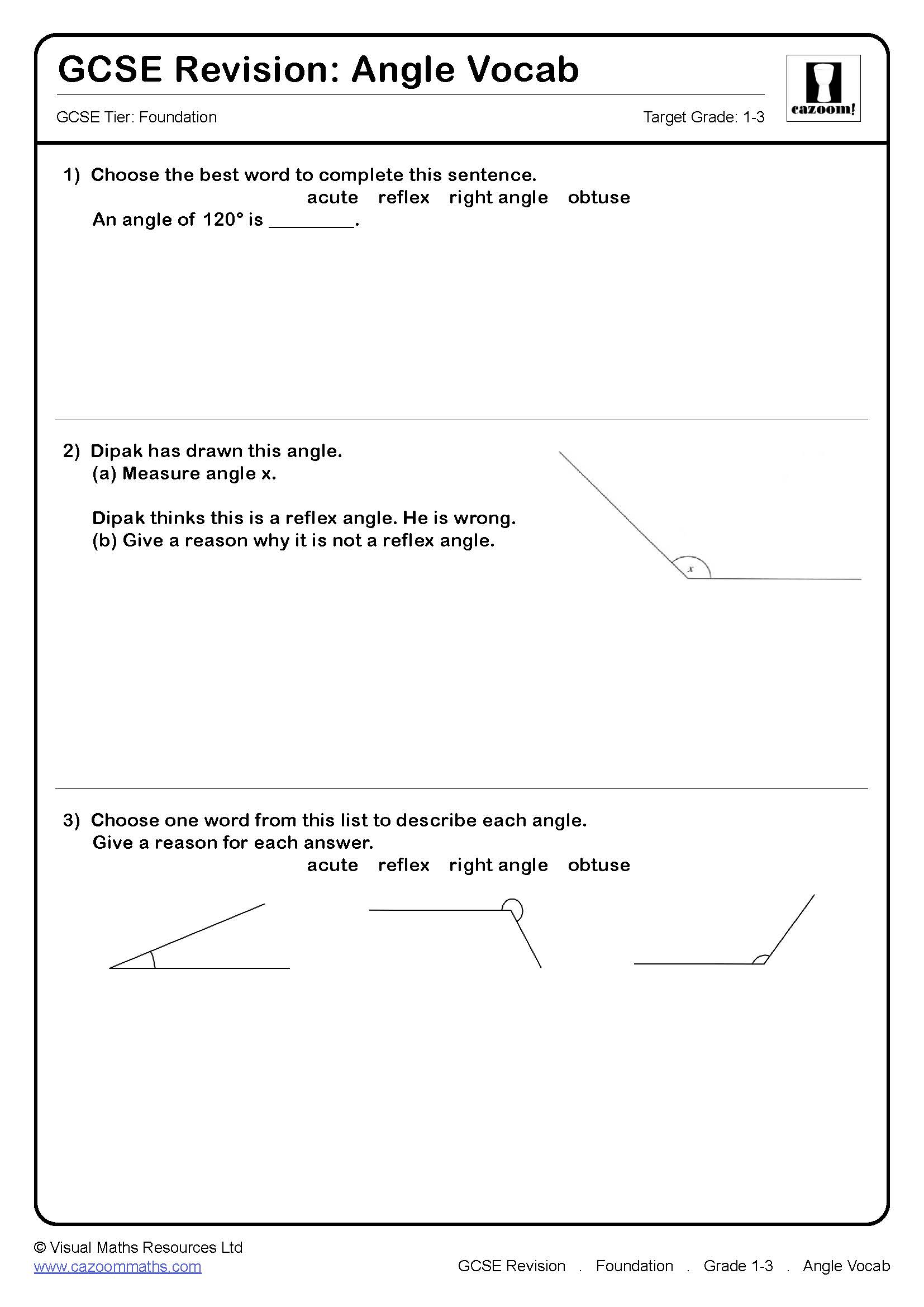
Distinguish between acute, obtuse, reflex and right angles. Use angle properties of intersecting lines, angles at a point, vertically opposite angles, alternate angles, corresponding angles and allied (co-interior) angles. Understand the exterior angle of a triangle property and the angle sum of a triangle. Use the properties of isosceles, equilateral and right-angled triangles.



4.2Foundation & Higher
Recognise and name parallelogram, rectangle, square, rhombus, trapezium, kite, pentagon, hexagon and octagon. Understand and use the angle sum of quadrilaterals and properties of parallelogram, rectangle, square, rhombus, trapezium and kite. Understand that a regular polygon has all sides and all angles equal. Calculate interior and exterior angles of regular polygons. Use the angle sum of a polygon formula: (2n − 4) right angles. Understand congruence and that congruent polygons have equal sides and equal angles.


4.3Foundation & Higher
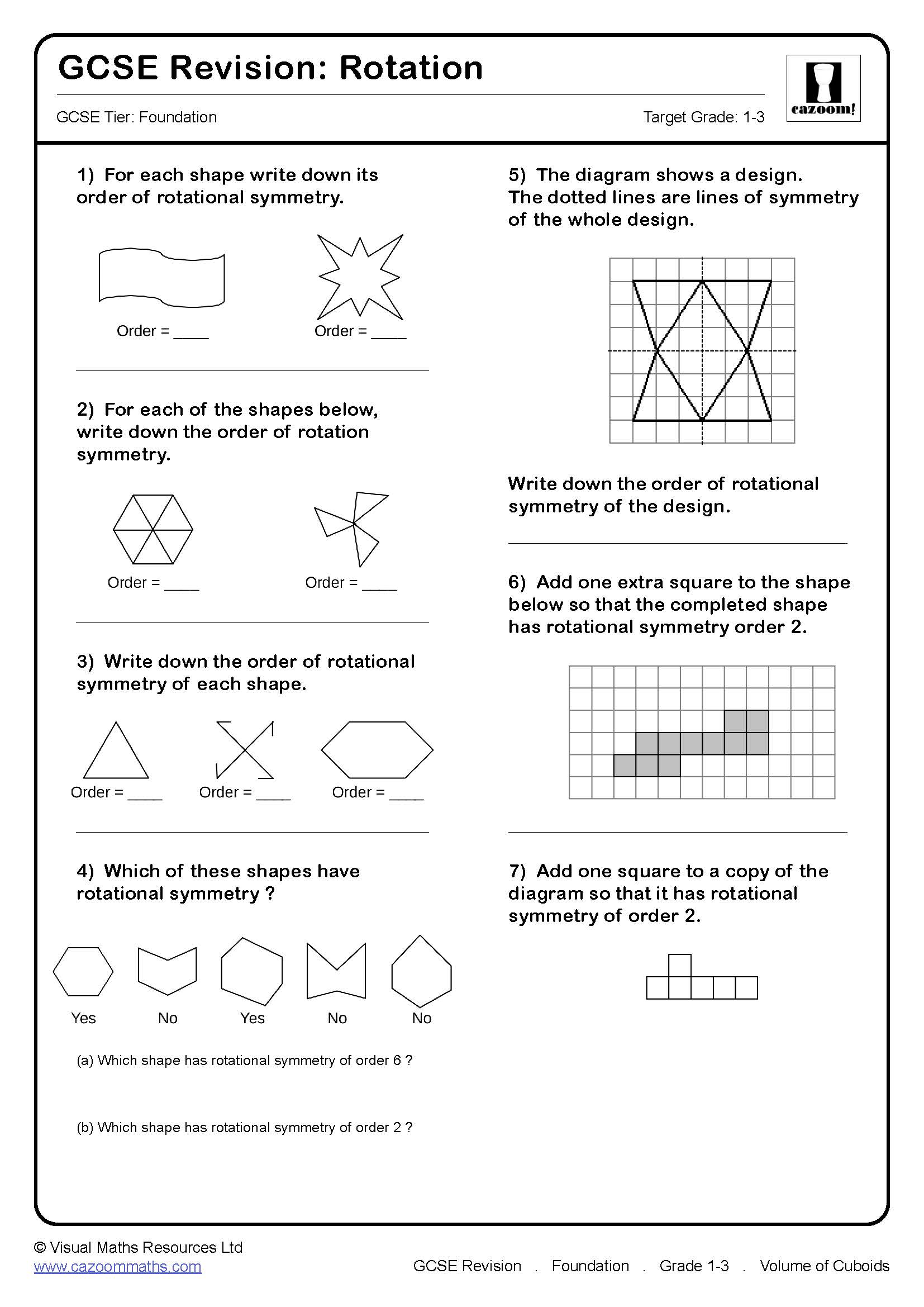
Identify line symmetry and rotational symmetry properties of triangles, quadrilaterals and polygons. Recognise and identify the order of rotational symmetry of a two-dimensional shape.

4.4Foundation & Higher
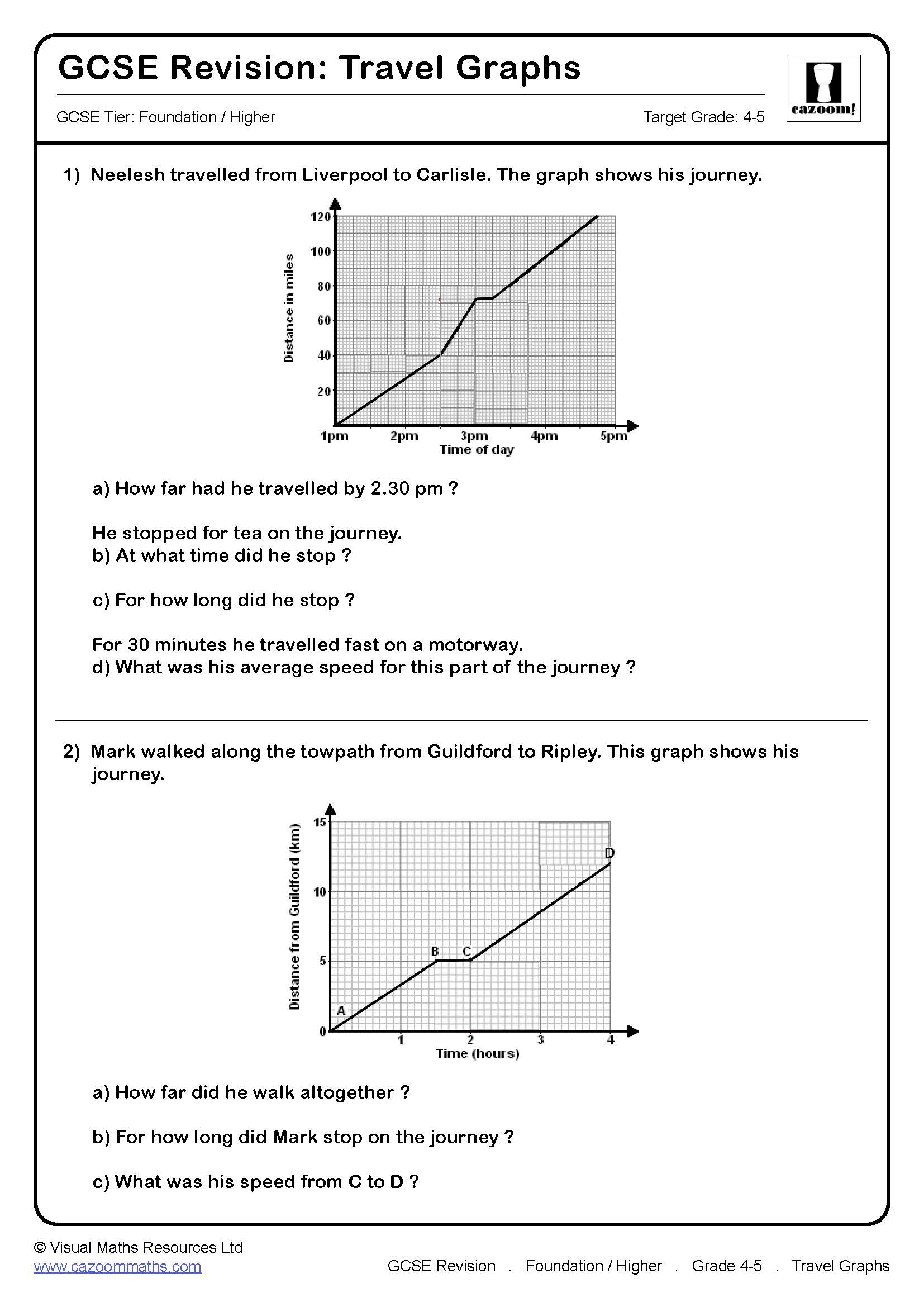
Interpret scales on a range of measuring instruments. Calculate times in terms of the 24-hour and 12-hour clock. Make sensible estimates of a range of measures. Understand and use bearings as three-figure angles measured clockwise from North. Measure and draw angles to the nearest degree. Understand the relationship between average speed, distance and time. Use compound measures such as speed, density and pressure (formula for pressure will be given).





4.5Foundation & Higher
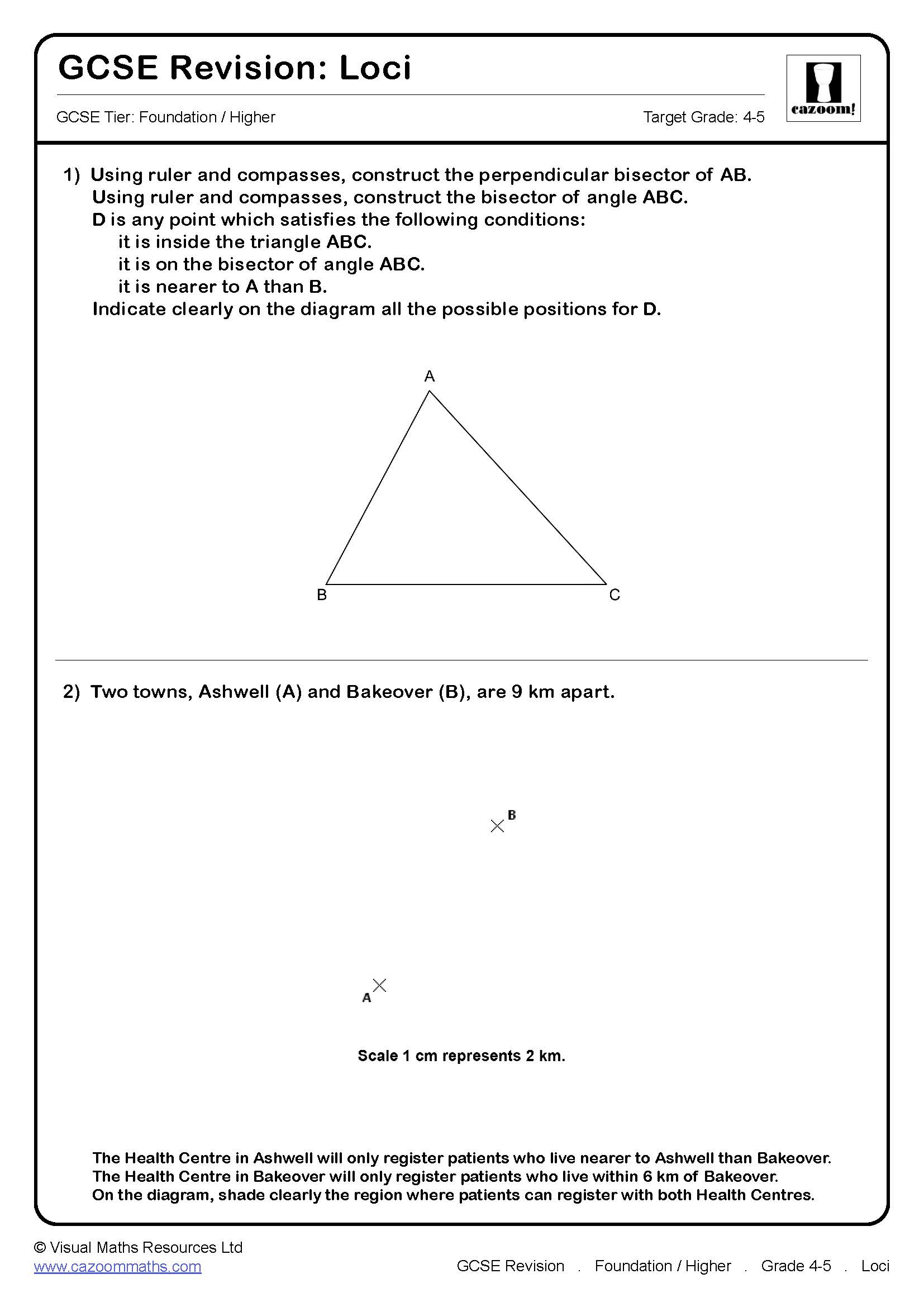
Measure and draw lines to the nearest millimetre. Construct triangles and other two-dimensional shapes using a ruler, protractor and compasses. Solve problems using scale drawings. Use straight edge and compasses to construct: the perpendicular bisector of a line segment, the bisector of an angle.


4.6Foundation & Higher
Recognise the terms centre, radius, chord, diameter, circumference, tangent, arc, sector and segment. Understand chord and tangent properties of circles: tangents from an external point are equal in length, the tangent to a circle is perpendicular to the radius at the point of contact, the perpendicular from the centre to a chord bisects the chord.


4.7Foundation & Higher
Give informal reasons, where required, when arriving at numerical solutions to geometrical problems involving lines, triangles, quadrilaterals, circles, polygons and simple solid figures.
4.8Foundation & Higher
Know, understand and use Pythagoras' theorem in two dimensions. Know, understand and use sine, cosine and tangent of acute angles to determine lengths and angles of a right-angled triangle. Apply trigonometrical methods to solve problems in two dimensions including bearings.


4.9Foundation & Higher
Convert measurements within the metric system to include linear, square, cubic and capacity measures. Find the perimeter of rectangles, triangles and compound shapes. Find the area of rectangles, triangles, parallelograms, trapezia and compound shapes. Find circumferences and areas of circles. Find perimeters and areas of semicircles.
Arcs and Sectors

Area & Circumference of Circles

Area & Volume Conversion

Area and Perimeter of Rectangles

Compound Shapes

Area by Counting

Area of Trapezium and Parallelogram
Area of Triangles

Forming and Solivng Equations with Shape

Perimeter

Surface Area & Volume of Prisms

Volume and Surface Area of Cones & Spheres

Volume and Surface Area of Cylinders

4.10Foundation & Higher
Recognise and name common solids: cube, cuboid, prism, pyramid, cylinder, sphere and cone. Understand the terms face, edge and vertex. Find the surface area of simple shapes using the area formulae for triangles and rectangles. Find the surface area of a cylinder. Find the volume of right prisms, including cuboids and cylinders (formula for cylinder given). Convert between metric units of volume.


4.11Foundation & Higher
Understand that similar figures have corresponding lengths in the same ratio but corresponding angles remain unchanged. Use and interpret maps and scale drawings.

