Back to:
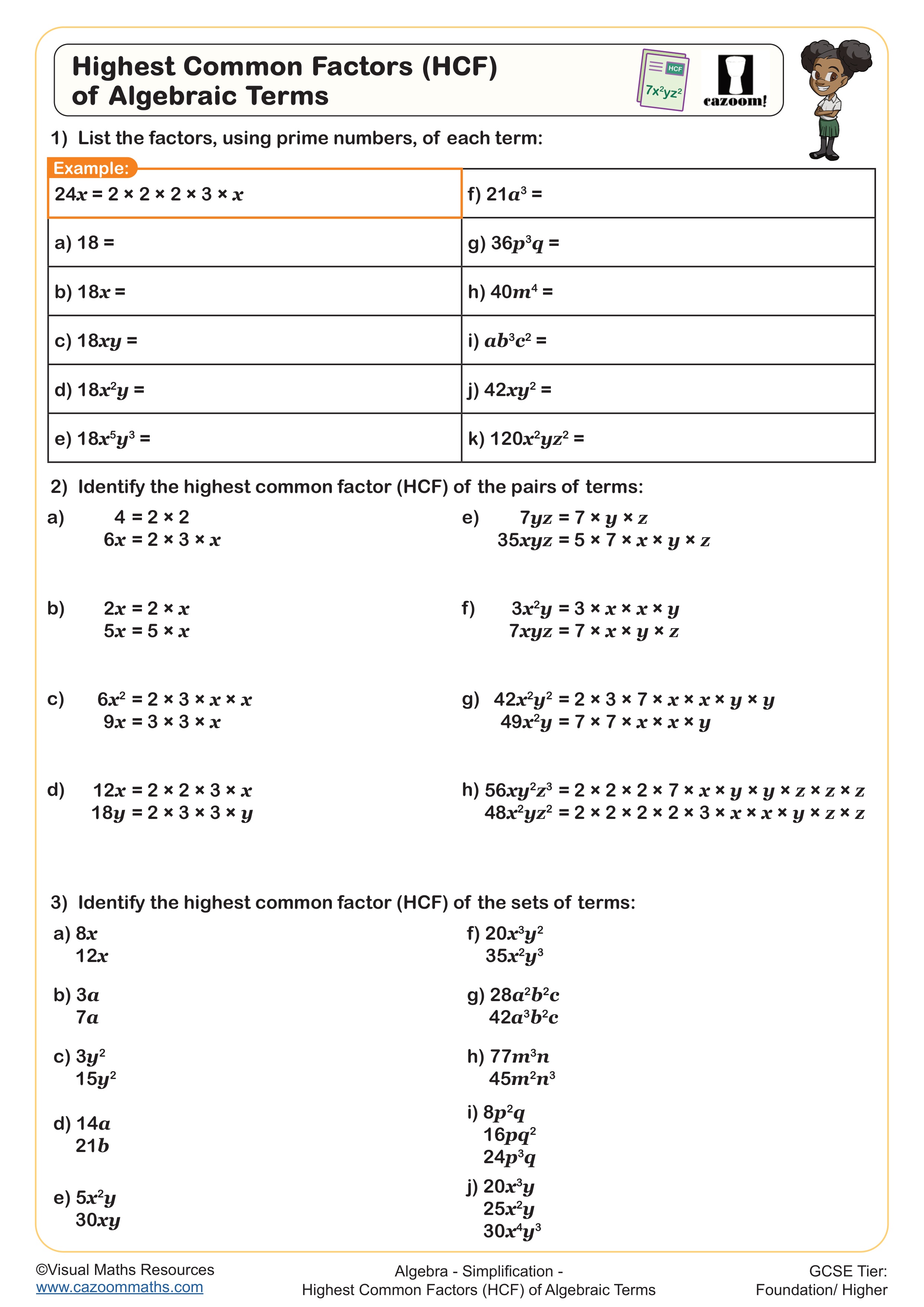
Highest Common Factors (HCF) of Algebraic Terms WORKSHEET
Suitable for Year groups: Year 8, Year 9
GCSE Tier: Foundation/Higher
Targeting grades: 4-5
Prerequisite knowledge: Prime factorisation of numbers. Identifying common factors. Multiplying and dividing powers with the same base.
Learning Objective: Use the concepts and vocabulary of prime numbers, factors (or divisors), common factors, highest common factor, prime factorisation, including using product notation and the unique factorisation property. Simplify and manipulate algebraic expressions to maintain equivalence by taking out common factors.
Highest Common Factors (HCF) of Algebraic Terms WORKSHEET DESCRIPTION
Guide students through understanding and finding the highest common factors (HCF) of algebraic terms step by step. Learners begin by breaking down terms into their prime factors and move on to identifying common factors, and determining the HCF for both pairs and sets of expressions.
As they progress, students apply reasoning skills to explain why the HCF takes the lowest powers of variables and test their understanding with open-ended and matching problems. Later questions introduce factorising using the HCF and reasoning challenges such as “always, sometimes, or never” statements to deepen conceptual understanding.
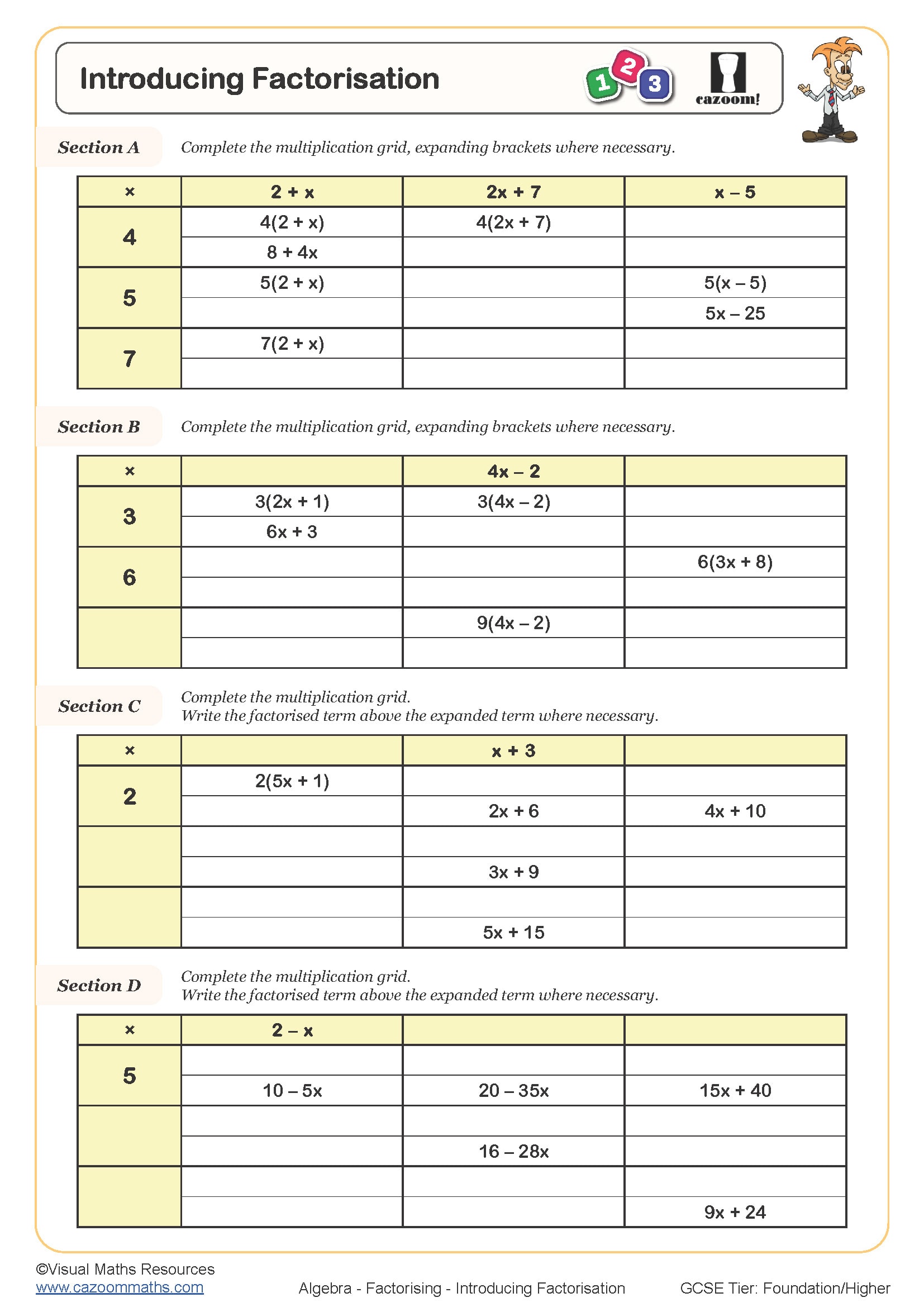
This worksheet provides an excellent starting point for learning factorisation, giving students the foundational skills they need before moving on to expanding and factorising more complex algebraic expressions.
By the end of this worksheet, students will confidently determine and apply the highest common factors in algebraic contexts, bridging number skills with algebraic manipulation.
As they progress, students apply reasoning skills to explain why the HCF takes the lowest powers of variables and test their understanding with open-ended and matching problems. Later questions introduce factorising using the HCF and reasoning challenges such as “always, sometimes, or never” statements to deepen conceptual understanding.
This worksheet provides an excellent starting point for learning factorisation, giving students the foundational skills they need before moving on to expanding and factorising more complex algebraic expressions.
By the end of this worksheet, students will confidently determine and apply the highest common factors in algebraic contexts, bridging number skills with algebraic manipulation.
All worksheets are created by the team of experienced teachers at Cazoom Maths.
RELATED TO Highest Common Factors (HCF) of Algebraic Terms WORKSHEET
Frequently Asked Questions
Students should be comfortable with prime factorisation of numbers and identifying common factors before tackling algebraic terms. They'll also need to understand how to multiply and divide powers with the same base, as this forms the foundation for working with algebraic expressions containing variables.