Solving Inequalities Worksheets
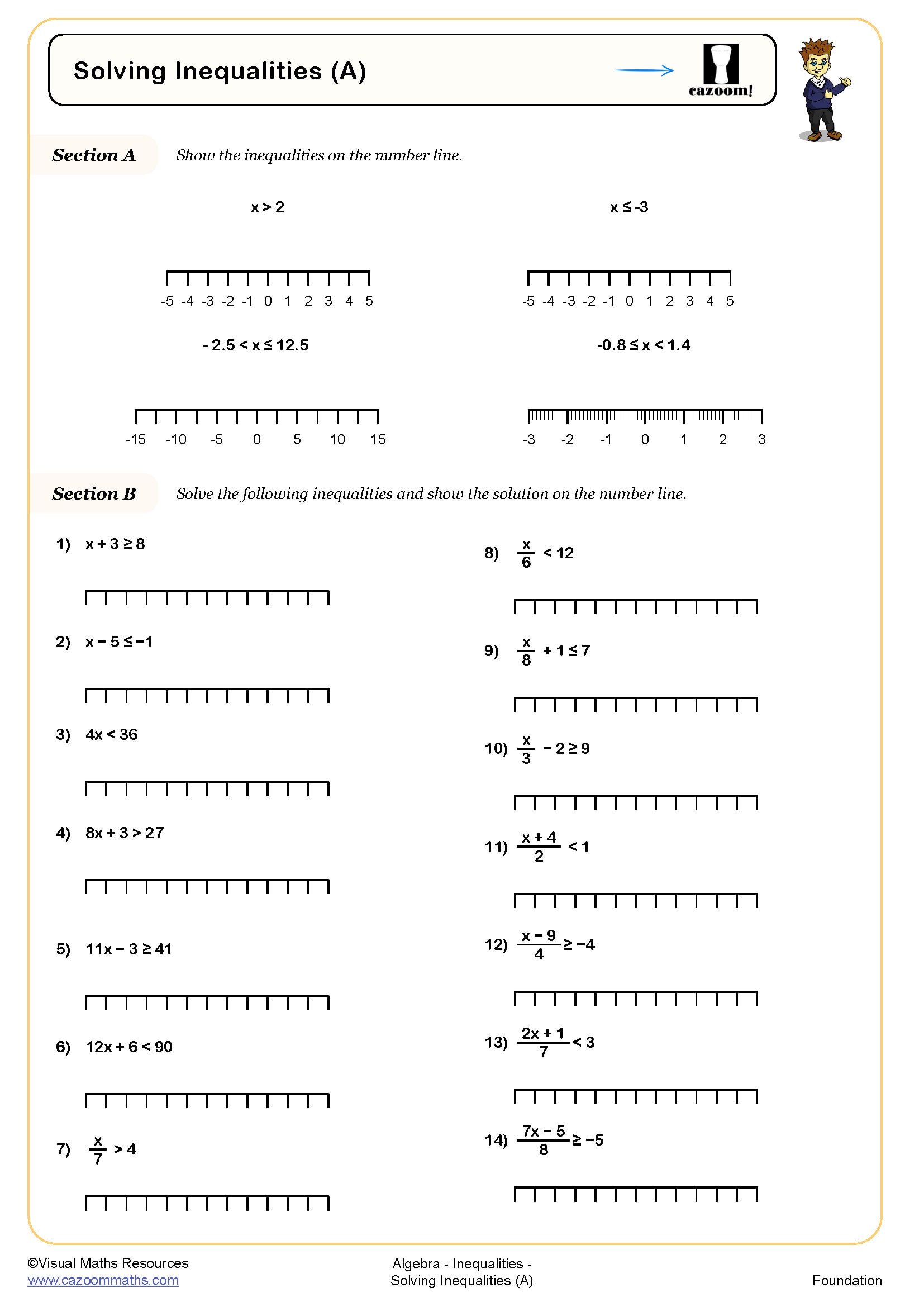
Solving Inequalities (A)
Year groups: 7, 8
Forming and Solving Linear Inequalities
Year groups: 8, 9

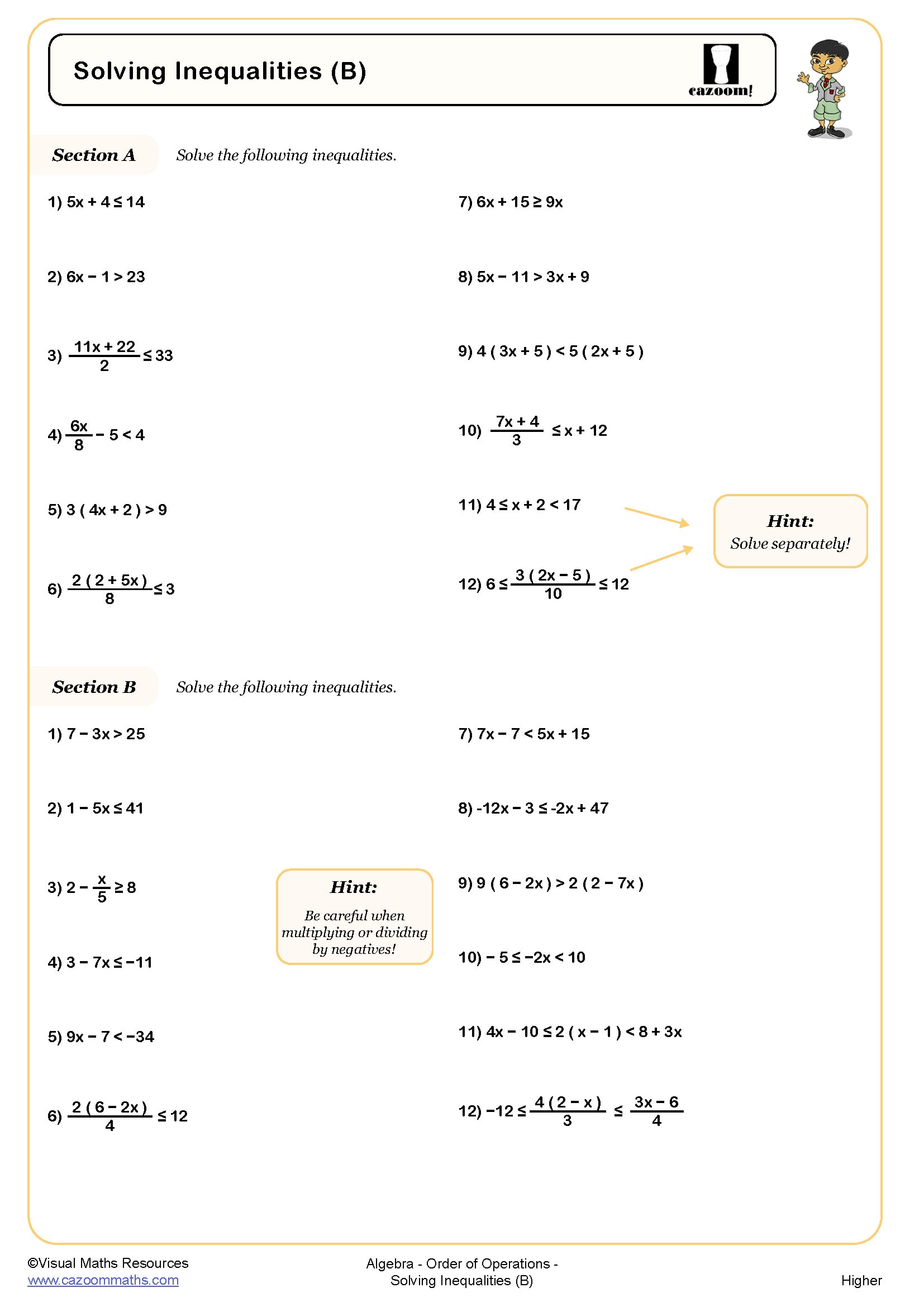
Solving Inequalities (B)
Year groups: 8, 9
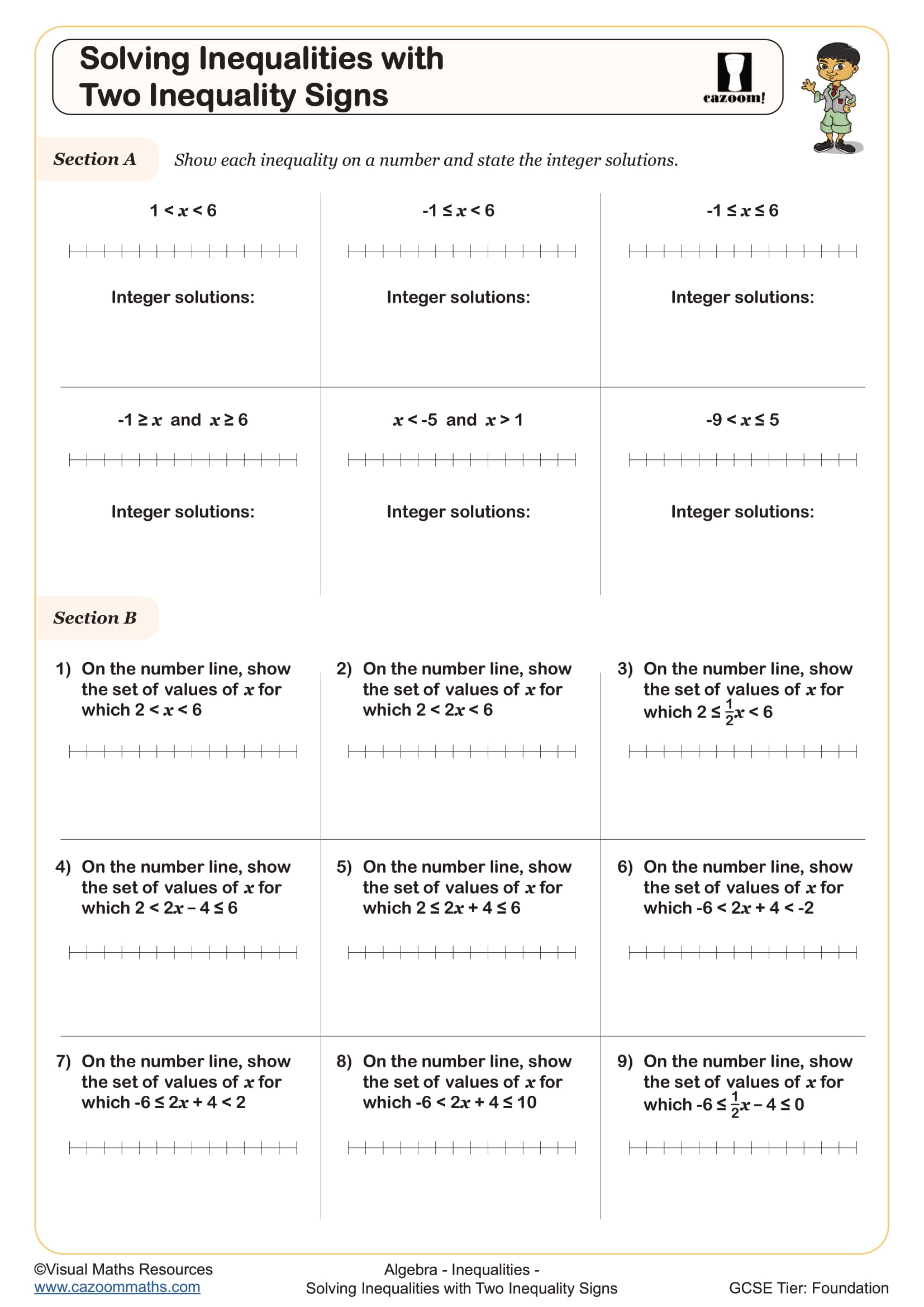
Solving Inequalities with Two Inequality Signs
Year groups: 8, 9
Solving Quadratic Inequalities (A) - without sketching
Year groups: 10, 11
-without-sketching-Questions.jpg?w=3840)
Solving Quadratic Inequalities (B)
Year groups: 10, 11
-Worksheet.jpg?w=3840)
Solving Quadratic Inequalities (C) - satisfying two inequalities
Year groups: 10, 11
-satisfying-two-inequalities-Worksheet.jpg?w=3840)
All worksheets are created by the team of experienced teachers at Cazoom Maths.
What are the rules for solving inequalities?
Solving inequalities follows the same rules as solving equations, with one critical exception that catches many students out. You can add, subtract, multiply, or divide both sides by any number to isolate the variable, but when you multiply or divide by a negative number, the inequality sign must flip direction. This reversal applies whether the original symbol is <, >, ≤, or ≥.
A common error occurs when students solve something like -2x > 6 and write x > -3 instead of correctly reversing to x < -3. Exam mark schemes consistently penalise this mistake, even when all other working is correct. Teachers find that asking students to substitute their answer back into the original inequality helps them spot when they've missed the flip, as the inequality won't hold true with an incorrect solution.
What year do you learn solving inequalities?
Students begin solving simple inequalities in Year 7, typically starting with one-step inequalities like x + 3 < 7 or 2x ≥ 10. The topic continues through Year 8, Year 9, Year 10, and Year 11, appearing in both Key Stage 3 and Key Stage 4. At GCSE, inequality questions regularly appear on Foundation and Higher papers, often combined with other algebraic skills or worded problem contexts.
Progression moves from basic one-step inequalities towards multi-step problems requiring brackets, collecting like terms, and handling negative coefficients. By Year 10 and Year 11, students tackle inequalities with unknowns on both sides and must represent solution sets using correct notation and number lines. Higher GCSE papers may combine inequalities with quadratics or include them within linear programming contexts, so the foundational skills developed from Year 7 onwards prove essential.
How do you solve two inequalities together?
When solving two inequalities that must both be satisfied, students work with each inequality separately before identifying the overlap in solutions. For example, if x > 2 and x ≤ 7, the solution set becomes 2 < x ≤ 7, representing all values greater than 2 but less than or equal to 7. Representing both on the same number line helps students visualise where the solutions overlap, which becomes the final answer.
This skill connects directly to quality control in manufacturing and engineering. Production specifications often state that a component must be 'greater than 4.8mm but no more than 5.2mm' to function properly. Engineers use inequality notation to express these tolerances, and any measurement falling outside this range results in a rejected part. Understanding how to work with combined inequalities helps students recognise how mathematics defines acceptable ranges in real-world STEM contexts, from chemical concentrations in pharmaceuticals to temperature ranges in aerospace applications.
How can these worksheets help students master inequalities?
The worksheets build confidence through carefully structured questions that progress from straightforward single-step problems to more complex multi-step inequalities. Each sheet includes worked examples or scaffolded questions that model the method before students attempt similar problems independently. The answer sheets show complete solutions, not just final answers, allowing students to identify exactly where their working differs if they make errors.
Teachers use these resources flexibly depending on classroom needs. They work well for homework when introducing the topic, as students can check their understanding without teacher support. During lessons, pairs can work through questions together, discussing why the inequality flips when dividing by negatives. For intervention groups, the worksheets provide focused practice on specific problem types where students previously lost marks, whilst the answers enable immediate feedback that helps correct misconceptions before they become embedded.