GCSE Foundation Bearings Scale and Loci Revision Worksheets
All worksheets are created by the team of experienced teachers at Cazoom Maths.
What Bearings Scale and Loci questions appear on the GCSE Foundation paper?
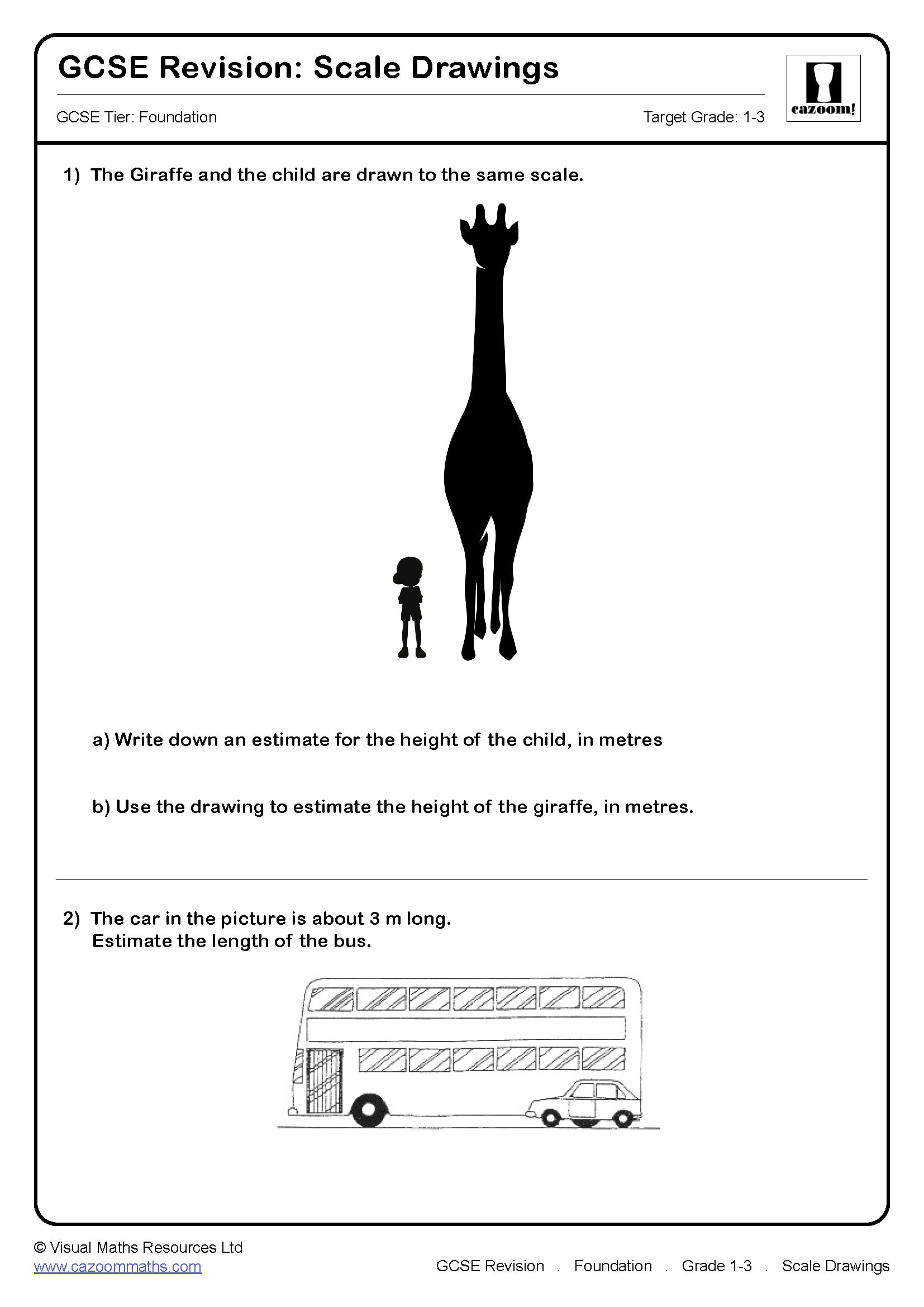
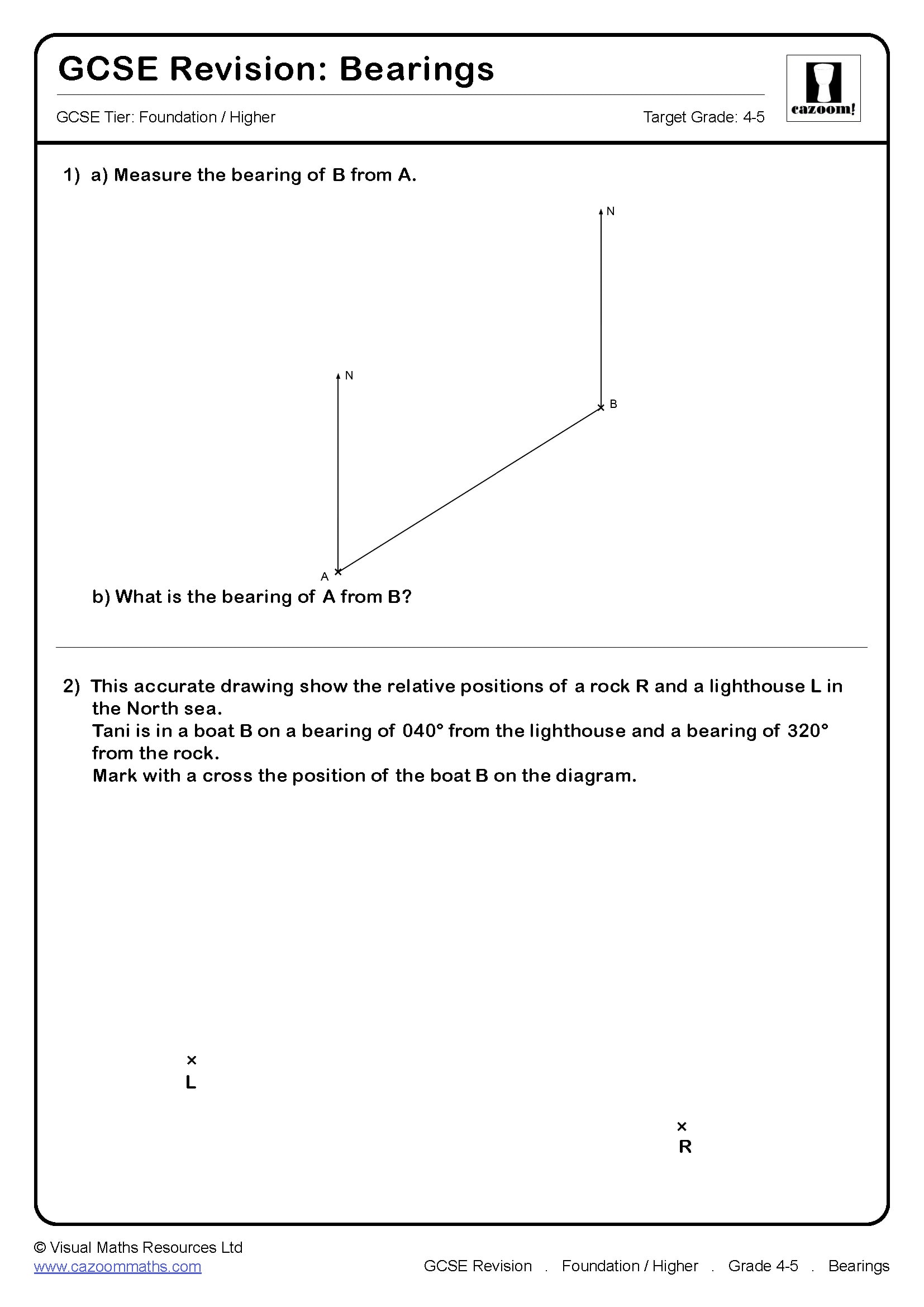
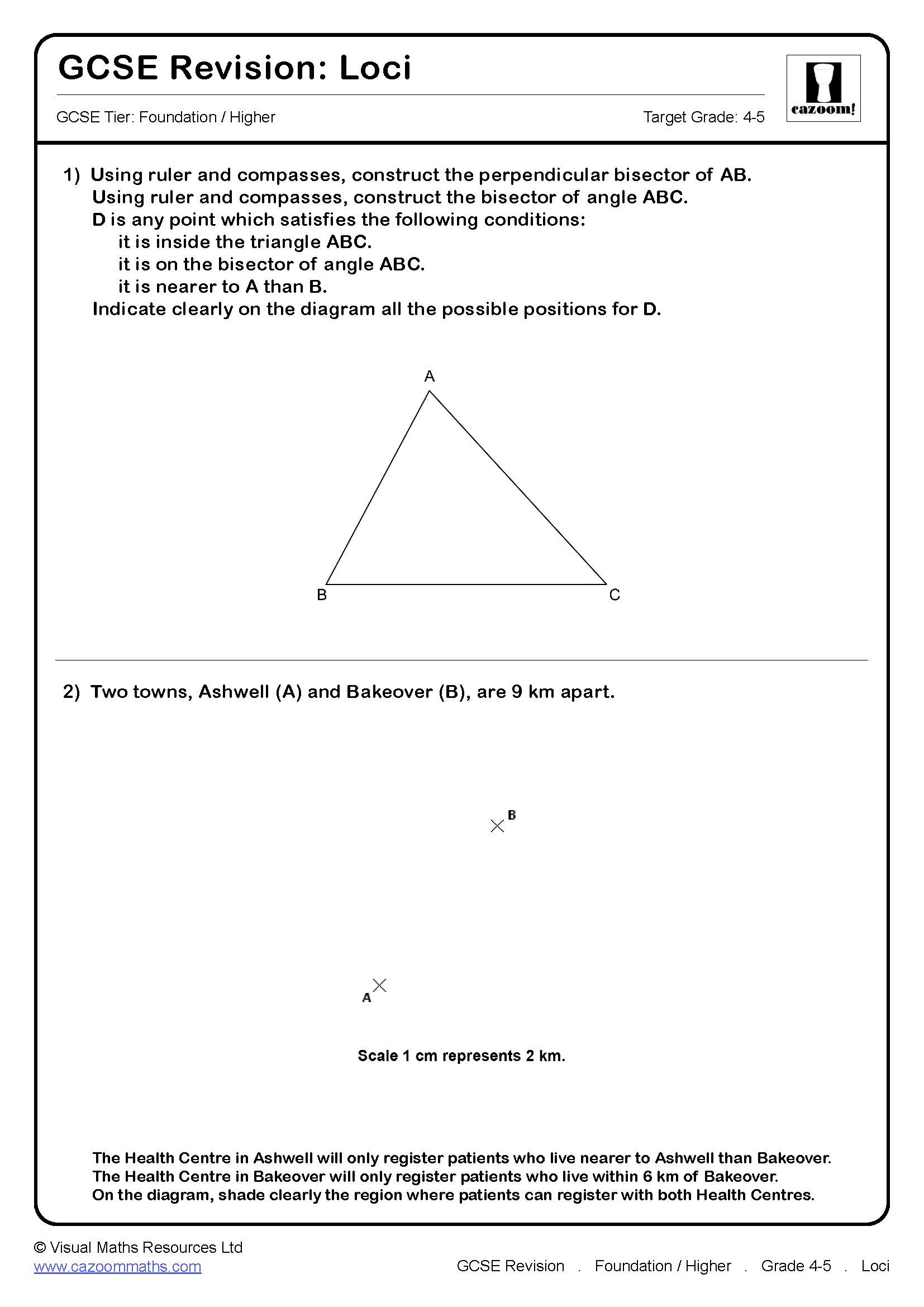
Foundation papers include questions worth around 8-12 marks across bearings, scale and loci. Students measure and draw bearings from a fixed point, typically using a protractor to work with three-figure notation. Scale drawing questions ask them to convert real distances into diagram measurements or vice versa, often involving maps or floor plans with scales like 1:50 or 1:1000. Loci questions require constructing paths equidistant from two points, a set distance from a single point (circle), or a fixed distance from a line (parallel lines). Most constructions use ruler and compasses.
Exam mark schemes penalise missing the third digit in bearings (writing 85° instead of 085°) and incorrect scale conversions where students multiply instead of divide. Teachers notice that students who write down their scale calculation as a separate working step lose fewer marks than those who attempt mental arithmetic.
What grade are Bearings Scale and Loci questions on Foundation GCSE maths?
Basic bearings questions, such as reading a three-figure bearing from a diagram or drawing a bearing from north, typically target grades 2-3. Scale questions asking for straightforward conversions (for example, finding real distance when 4cm represents 200m) sit around grades 3-4. The grade 4-5 questions combine skills: drawing a bearing and measuring a scaled distance, or shading a region that satisfies two loci conditions simultaneously. These higher-grade questions often appear towards the end of the paper.
Students aiming for grade 4 should prioritise accurate protractor work and scale conversions before attempting combined loci problems. Teachers often suggest mastering single-step bearings and scales first, then progressing to constructions. This builds confidence and secures easier marks before tackling the grade 5 questions that combine multiple elements in one diagram.
How is Bearings Scale and Loci tested differently on Foundation compared to Higher?
Foundation papers focus on straightforward constructions and single-step calculations. Students draw one bearing, apply one scale, or construct one simple locus like a perpendicular bisector. Questions provide clear instructions about what to measure or construct, and diagrams are typically larger with grid backgrounds to support accuracy. Higher tier questions demand multi-step reasoning: finding a bearing, then using trigonometry to calculate distance, or combining three loci to identify a single region. Algebraic methods and Pythagoras often appear within Higher loci problems.
The Foundation approach emphasises careful measurement and following geometric construction rules. Students who can accurately draw a bearing within 2°, convert scales without errors, and construct a locus using compasses will access the full grade range. Teachers notice that Foundation students benefit from repeated practice with actual measuring tools rather than purely numerical work.
How should students revise Bearings Scale and Loci for Foundation GCSE maths?
Students should work through worksheets with actual measuring equipment: protractor, ruler and compasses. Starting with bearings-only questions builds familiarity with three-figure notation and the north-clockwise direction. Moving to scale drawings next allows practice with conversions before attempting loci constructions, which require the most precision. Checking each answer immediately helps identify whether errors stem from measurement technique or misunderstanding the instruction. Timing later practice papers replicates exam pressure whilst maintaining accuracy.
Teachers can assign specific worksheets targeting gaps identified in assessments. For instance, students who struggle with reverse bearings benefit from focused practice on that skill alone before returning to mixed questions. Setting loci construction as homework works well when students have access to compasses, though teachers often find demonstration in class followed by independent worksheet practice produces better accuracy than homework alone.